Kinetic Energy is an important concept in Physics that describes the energy possessed by an object due to its motion. These notes cover the definition and units of energy, the kinetic energy formula, its derivation using equations of motion and calculus, important properties, relativistic kinetic energy, and the relationship between kinetic energy and linear momentum, along with solved numerical problems and important MCQs.
What is Energy in Physics ?
The energy of a body is defined as its capacity for doing work. Since energy of a body is the total quantity of work done,
(i) It is a scalar quantity (as work is a scalar quantity),
(ii) Its dimensional formula is [M L²T⁻²] i.e. same as that of work and
Units of Energy
The SI unit of energy is the same as that of work, i.e., joule (which is denoted by the letter J). Whenever work is done, an equal amount of energy is consumed. Thus, we can define 1 joule energy as follows :
An energy of 1 joule is needed to perform 1 J of work.
Joule is a small unit of energy, so sometimes a larger unit of energy called ‘kilojoule’ is also used. The symbol of kilojoule is kJ.
1 kilojoule (kJ) = 1000 joules = 10³ J
Practical Units of Energy
Some commonly used practical units of energy are:
1. Electron volt (eV): In atomic physics, energy is usually expressed in electron volt (eV). It is the energy gained by an electron, when it is accelerated through a potential difference of one volt.
1 eV = 1.6 x 10⁻¹⁹ J
The bigger units of energy are keV and MeV.
1 keV = 1.6 x 10⁻¹⁶ J
1 MeV = 1.6 x 10⁻¹³ J
2. Kilowatt-hour (kWh): It is a commercial unit of electrical energy used to measure electricity consumption.
1 kilowatt-hour (kWh) = 3.6 × 10⁶ J
3. Calorie (cal): It is a unit of energy commonly used to measure the energy supplied by food and the energy required to raise the temperature of a substance.
1 calorie (cal) = 4.186 J
Energy can exist in various forms such as mechanical energy, heat energy, light energy, sound energy, etc.
Mechanical Energy
Mechanical energy is the energy possessed by an object due to its motion or position. The concept of work can be used to calculate the mechanical energy of an object. We will be studying problems mainly concerned with mechanical energy, which is of two types, namely kinetic and potential energy. Kinetic Energy is discussed in next sections and potential energy in next article.
Define Kinetic Energy
The energy possessed by an object due to its motion is called kinetic energy.
The absolute unit of K.E. in the SI system is the joule (J), and in the CGS system, it is the erg.
Kinetic energy of an object moving with a certain velocity is equal to the work done on it to make it acquire that velocity. The kinetic energy of an object increases with its speed.
Examples of the Uses of Kinetic Energy:
1. The kinetic energy of moving air is used to operate windmills.
2. The kinetic energy of flowing water is used to run water mills.
3. The kinetic energy of a moving hammer helps drive a nail into a piece of wood.
4. A bullet fired from a gun can pierce a target because of its kinetic energy.
The kinetic energy of an object of mass m moving with a uniform velocity v is given by:
KE (or Eₖ) = ½ × m × v²
Every moving object possesses kinetic energy. In other words, an object has kinetic energy when it is in motion and has speed.
For example, a running person, a moving motorcycle, a moving car or bus, a falling stone, and an arrow flying through the air all possess kinetic energy.
When a moving object is brought to rest by an opposing force, its kinetic energy is used up in doing work against the resistance offered by that force.
We will now derive a formula to calculate the kinetic energy of a moving object.
Derivation for Kinetic Energy Formula Using Equations of Motion
The kinetic energy of a moving body can be calculated in either of the following two ways:
(i) By calculating the amount of work done in bringing the moving body to rest.
(ii) By calculating the amount of work done on the body to increase its velocity from the state of rest.
Let us use the second method to derive the formula for kinetic energy.
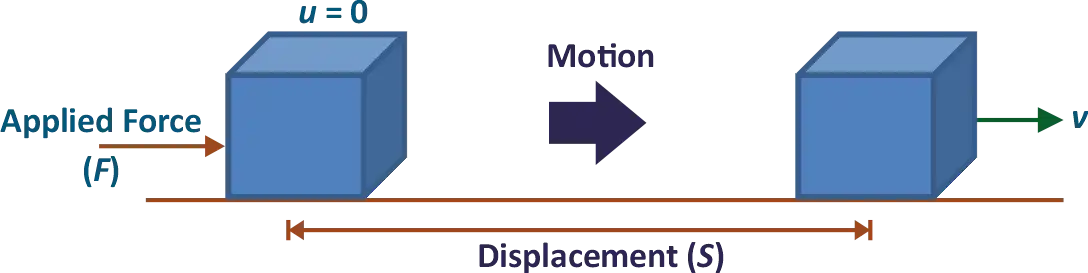
Suppose:
m = mass of a body initially at rest (i.e., u = 0)
F = force applied to the body
a = acceleration produced in the body in the direction of the applied force
v = velocity acquired by the body after moving through a distance S
We know that:
v² − u² = 2aS
Since u = 0,
v² − 0 = 2aS
Therefore,
a = v²/(2S) ….(I)
We also know that:
F = ma
Substituting the value of a from equation (i),
F = m × [v²/(2S)]
The work done on the body is given by:
Work done, W = Force × Distance
W = m × [v²/(2S)] × S
W = ½mv²
This work done on the body represents the kinetic energy acquired by it.
Therefore,
K.E. of the body = W = ½mv²
“Speed Thrills but Kills”
“Speed thrills but kills” is a very meaningful slogan. When the speed of a car is doubled, its kinetic energy becomes four times greater because kinetic energy is proportional to the square of velocity.
Therefore, four times as much work must be done to bring the car to rest during a crash. This can result in much greater damage and more serious injuries. Hence, driving at high speed can be extremely dangerous.
Derive an Expression for Kinetic Energy Formula Using Calculus Method
The formula for the kinetic energy of a body can also be derived using calculus.
Let:
m = mass of a body initially at rest (i.e., u = 0)
= force applied to the body
d = small displacement produced in the body in the direction of the applied force
The small amount of work done by the force is:
dW = · d
dW = F dS cos 0°
Therefore,
dW = F dS
If a is the acceleration produced by the applied force, then:
F = ma = m(dv/dt)
dW = [m(dv/dt)] dS
dW = m(dS/dt) dv
Since dS/dt = v,
dW = mv dv
Therefore, the total work done by the force in increasing the velocity of the body from zero to v is:
W = (1/2) mv²
This work done is equal to kinetic energy of the body of mass m, when moving
with velocity v.
∴ K.E. of the body = W = (1/2) mv²
Thus, the kinetic energy of a body is equal to half the product of its mass and the square of its velocity.
We observe that K.E. ∝ m and also K.E. ∝ v², i.e., a heavier body and a body moving faster possesses greater kinetic energy. The reverse is also true.
Learn more about Work with detailed explanations and solved examples.
Important Properties of Kinetic Energy
1. The expression for kinetic energy remains valid even when the applied force changes in magnitude, direction or both. Therefore, the formula (K.E. = ½mv²) is applicable regardless of how an object acquires its velocity v.
2. Since kinetic energy (= ½mv² =½m(·)) has magnitude only and no direction, it is a scalar quantity.
3. The kinetic energy of an object depends on its speed, not its velocity. This means that the direction of motion does not affect its kinetic energy.
4. Since mass (m) and the square of velocity (v²) are always positive, the kinetic energy of an object is always positive. It can never be negative.
5. The kinetic energy of an object undergoing non-uniform circular motion does not remain constant. For example, when an object moves in a vertical circle, its kinetic energy is maximum at the lowest point and minimum at the highest point.
Kinetic Energy Depends on Frame Of Reference
The kinetic energy of an object depends on the frame of reference. For example, consider a person of mass m sitting in a train moving with velocity v. The kinetic energy of the person is ½mv² with respect to the Earth, whereas it is zero with respect to the train.
Relativistic Kinetic Energy
The kinetic energy of a moving body is given by:
K.E. = ½mv²
This formula is valid when the speed of the body is much smaller than the speed of light (v ≪ c).
However, when the speed of a body becomes comparable to the speed of light, the classical formula is no longer applicable. According to Einstein’s theory of special relativity, relativistic expressions for mass and kinetic energy are used.
Relativistic Mass
The relativistic mass (m) of a moving body is given by:
m = m₀ / √(1 − v²/c²)
Relativistic Total Energy
The total energy (E) of a moving body is:
E = mc²
Substituting the value of relativistic mass:
E = m₀c² / √(1 − v²/c²)
Relativistic Kinetic Energy
The relativistic kinetic energy is equal to the difference between the total energy and the rest energy of the body.
Rest energy is given by:
E₀ = m₀c²
Therefore,
K.E. = E − E₀
Or,
K.E. = m₀c² [1/√(1 − v²/c²) − 1]
Where:
m₀ = Rest mass of the body.
m = Relativistic mass of the moving body.
v = Velocity of the body.
c = Speed of light in vacuum (3 × 10⁸ m/s).
E = Total relativistic energy.
E₀ = Rest energy.
K.E. = Relativistic kinetic energy.
Important: At speeds much smaller than the speed of light (v ≪ c), relativistic kinetic energy approaches the classical expression:
K.E. = ½mv²
Solved Numerical Problems on the Kinetic Energy Formula
Practice important intext numerical examples on kinetic energy to understand the application of its formula and strengthen your problem-solving skills for CBSE Class 11 Physics.
Intext Numerical Example [CBSE Class 11]
A body of mass 5 kg moves along a straight line with an initial velocity of 10 m/s and an acceleration of 20 m/s². Calculate its kinetic energy after 10 seconds.
Solution:
Mass, m = 5 kg
Initial velocity, u = 10 m/s
Acceleration, a = 20 m/s²
Time, t = 10 s
Using the equation of motion:
v = u + at
v = 10 + (20 × 10)
v = 210 m/s
Now, Kinetic Energy
KE = ½ × m × v²
KE = ½ × 5 × (210)²
KE = 110250 J
Intext Numerical Example [CBSE Class 11]
A body of mass 5 kg is initially at rest and is acted upon by a force of 20 N. Calculate the kinetic energy gained by the body after half a minute.
Solution:
Mass, m = 5 kg
Initial velocity, u = 0
Force, F = 20 N
Time, t = ½ min = 30 s
Acceleration acquired by body,
a = F/m = 20/5 = 4 m/s²
Using the equation of motion, final velocity of body after half a minute,
v = u + at
v = 0 + (4 × 30)
v = 120 m/s
The kinetic energy:
K.E. = ½ × m × v²
K.E. = ½ × 5 × (120)²
K.E. = 3.6 × 10⁴ J
Intext Numerical Example [CBSE Class 11]
A body of mass 5 kg is initially at rest and is acted upon by a force of 20 N. Calculate the kinetic energy gained by the body after half a minute.
Solution:
Given,
Mass, m = 5 kg
Initial velocity, u = 0
Force, F = 20 N
Time, t = ½ min = 30 s
a = F/m = 20/5 = 4 m/s²
Using the equation of motion,
v = u + at
v = 0 + (4 × 30)
v = 120 m/s
The kinetic energy:
K.E. = ½ × m × v²
K.E. = ½ × 5 × (120)²
K.E. = 3.6 × 10⁴ J
Relation between Kinetic Energy and Linear Momentum
Let m = mass of a body, v = velocity of the body.
Linear momentum of the body, p = m v
and
K.E. of the body = 1/2 m v² = 1/(2m) (m² v²)
K.E. = p² / (2m)
Therefore,
K.E. = ½mv² = ½pv = p²/2m
From the kinetic energy relation:
Momentum
p = 2K.E./v
Also,
p = √(2mK.E.)
Therefore,
p = 2K.E./v = √(2mK.E.)
This is an important relation. It shows that a body cannot have K.E. without having linear momentum. The reverse is also true.
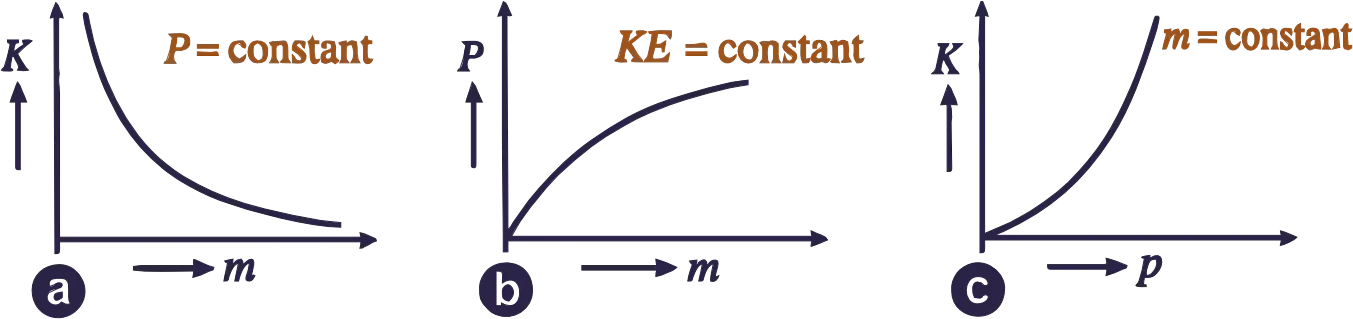
Further, if p = constant, K.E. ∝ 1 / m
If K.E. = constant, p² ∝ m or p ∝ √m
If m = constant, p² ∝ K.E. or p ∝ √(K.E.)
Solved Numericals on the Relation Between Kinetic Energy and Linear Momentum
Intext Numerical Example [CBSE Class 11]
A light body and a heavy body have equal momentum. Which body has greater kinetic energy and why?
Solution:
Let m₁ and m₂ be the masses of the lighter and heavier bodies, respectively, where m₁ < m₂. Let their velocities be v₁ and v₂.
Since both bodies have equal momentum,
m₁v₁ = m₂v₂ = p
The kinetic energy of a body is
K.E. = p²/2m
For the two bodies,
K.E₁ = p²/2m₁
K.E₂ = p²/2m₂
Therefore,
K.E₁/K.E₂ = m₂/m₁
Since m₂ > m₁,
K.E₁/K.E₂ > 1
K.E₁ > K.E₂.
Alternative Shorter Method
The kinetic energy of a body in terms of its momentum (p) and mass (m) is:
K.E. = p²/2m
Since both bodies have equal momentum, p is constant. Therefore,
K.E. ∝ 1/m
Thus, for the same momentum, kinetic energy is inversely proportional to mass. Since the lighter body has a smaller mass, it possesses greater kinetic energy.
Intext Numerical Example [CBSE Class 11]
A light body and a heavy body have equal kinetic energies. Which body has greater momentum and why?
Solution:
Let m₁ and m₂ be the masses of the lighter and heavier bodies, respectively, such that m₂ > m₁. Let v₁ and v₂ be their respective velocities.
Since both bodies have equal kinetic energies,
½m₁v₁² = ½m₂v₂² … (i)
Let p₁ and p₂ represent the linear momenta of the lighter and heavier bodies, respectively.
We know that momentum is given by:
p = mv
Therefore,
p₁ = m₁v₁
p₂ = m₂v₂
p₁/p₂ = m₁v₁/m₂v₂
(p₁/p₂)² = m₁²v₁²/m₂²v₂²
(p₁/p₂)² = (m₁/m₂) × (m₁v₁²/m₂v₂²)
From equation (i),
m₁v₁² = m₂v₂²
Therefore,
(p₁/p₂)² = m₁/m₂
p₁/p₂ = √(m₁/m₂)
Thus,
p ∝ √m (for constant kinetic energy).
Since m₂ > m₁, we have:
p₂ > p₁
Alternative Shorter Method
The relation between kinetic energy (K.E) and linear momentum (p) is:
K.E. = p²/2m
Therefore,
p = √(2m × K.E.)
Since the kinetic energy (K.E.) is the same for both bodies,
p ∝ √m
Thus, momentum is proportional to the square root of mass when kinetic energy remains constant. As the heavier body has a greater mass, it possesses greater linear momentum.
Therefore, the heavier body has greater momentum than the lighter body when both have equal kinetic energy.
Intext Numerical Example [CBSE Class 11]
The linear momentum of an object increases by 10%. Calculate the percentage increase in its kinetic energy.
Solution:
According to question,
p₂ = p₁ + 10% p₁ = p₁ + (10/100) p₁
p₂ = (110/100) × p₁
We know that,
K.E. = p²/2m
Therefore,
KE₂ = p₂²/2m
KE₂ = (110/100)² × p₁²/2m
KE₂ = (121/100) × KE₁
Clearly, KE₂ > KE₁.
Percentage increase in K.E.
= [(KE₂ − KE₁)/KE₁] × 100
= [(KE₂/KE₁) − 1] × 100
= (121/100 − 1) × 100
= (21/100) × 100
Percentage increase in K.E. = 21%
Previous Years’ and Important MCQs on Kinetic Energy
Practice important multiple-choice questions (MCQs) and previous years’ questions based on the kinetic energy formula to strengthen your understanding and prepare for competitive examinations.
Intext MCQ [JEE Concept]
Consider the following two statements:
Linear momentum of a system of particles is zero.
Kinetic energy of a system of particles is zero.
Then
(a) 1 implies 2 and 2 implies 1
(b) 1 does not imply 2 and 2 does not imply 1
(c) 1 implies 2 but 2 does not imply 1
(d) 1 does not imply 2 but 2 implies 1
[AIEEE 2003, Important for JEE]
Answer: (d) 1 does not imply 2 but 2 implies 1
Linear momentum is a vector quantity, whereas kinetic energy is a scalar quantity.
1. When kinetic energy is zero (Statement 2 ⇒ Statement 1)
The total kinetic energy of a system of n particles is given by:
K.E. = ½m₁v₁² + ½m₂v₂² + … + ½mₙvₙ²
Since the mass of each particle (mᵢ) is positive and the square of its speed (vᵢ²) is always non-negative, the total kinetic energy can be zero only when every particle is at rest.
Therefore,
v₁ = v₂ = … = vₙ = 0
The total linear momentum of the system is:
P⃗ = m₁v⃗₁ + m₂v⃗₂ + … + mₙv⃗ₙ
Since the velocity of every particle is zero:
P⃗ = 0
Thus, Statement 2 implies Statement 1.
2. When linear momentum is zero (Statement 1 ⇏ Statement 2)
The total linear momentum of a system is the vector sum of the momenta of its individual particles.
P⃗ = m₁v⃗₁ + m₂v⃗₂ + … + mₙv⃗ₙ
Since momentum is a vector quantity, the momenta of different particles can cancel each other when they move in opposite directions.
For example, consider two identical particles, each of mass m, moving in opposite directions with equal speeds v.
Their total momentum is:
P⃗ = mv⃗ + (−mv⃗) = 0
However, their total kinetic energy is:
K.E. = ½mv² + ½mv²
K.E. = mv² ≠ 0
Thus, the total momentum can be zero even when the total kinetic energy is non-zero.
Therefore, Statement 1 does not imply Statement 2.
Intext MCQ [NEET Concept]
A running man possesses half the kinetic energy of a boy whose mass is half the man’s mass. The man increases his speed by 1 m/s, after which his kinetic energy becomes equal to that of the boy. The man’s initial speed is
(a) √2 m/s
(b) (√2 − 1) m/s
(c) 1/(√2 − 1) m/s
(d) 1/√2 m/s
[Pb. PMT 2001, Important For NEET]
Answer: (c) 1/(√2 − 1) m/s
Given:
M = Mass of the man
m = Mass of the boy
V = Original speed of the man
v = Speed of the boy
According to the question:
m = M/2
The initial kinetic energy of the man is half the kinetic energy of the boy.
Therefore,
½MV² = ½ × (½mv²)
Substituting m = M/2:
½MV² = ½ × ½ × (M/2) × v²
V² = v²/4
V = v/2
Therefore,
v = 2V … (1)
When the man increases his speed by 1 m/s, his new speed becomes (V + 1) m/s.
At this speed, his kinetic energy becomes equal to that of the boy.
Therefore,
½M(V + 1)² = ½mv²
Substituting m = M/2:
½M(V + 1)² = ½ × (M/2) × v²
Simplifying:
(V + 1)² = v²/2
Taking square roots:
V + 1 = v/√2 … (2)
From equation (1):
v = 2V
Substituting this value into equation (2):
V + 1 = 2V/√2
V + 1 = √2V
√2V − V = 1
V(√2 − 1) = 1
Therefore,
V = 1/(√2 − 1) m/s
Hence, the original speed of the man is:
V = 1/(√2 − 1) m/s
Intext MCQ [IMU CET Concept]
A 10 kg body initially at rest is acted upon by two mutually perpendicular forces of 4 N and 3 N simultaneously. The kinetic energy acquired by the body after 10 seconds is
(a) 100 J
(b) 300 J
(c) 50 J
(d) 125 J
[Kerala (Engg.) 2001, Important For IMU CET]
Answer: (d) 125 J
Mass of the body (m) = 10 kg
Initial velocity (u) = 0 m/s (body is at rest)
First force (F₁) = 4 N
Second force (F₂) = 3 N
Angle between the forces (θ) = 90°
Time (t) = 10 s
Since the two forces act perpendicular to each other, the magnitude of the resultant force is:
F = √(F₁² + F₂²)
F = √(4² + 3²)
F = √(16 + 9)
F = 5 N
According to Newton’s second law of motion:
F = ma
Therefore,
a = F/m
a = 5/10
a = 0.5 m/s²
Using the first equation of motion:
v = u + at
Substituting the given values:
v = 0 + (0.5 × 10)
v = 5 m/s
The kinetic energy of the body is given by:
K.E. = ½mv²
K.E. = ½ × 10 × 5²
K.E. = 5 × 25
K.E. = 125 J
Intext MCQ [BITSAT Concept]
If the momentum of a body increases by 0.01%, its kinetic energy will increase by
(a) 0.01%
(b) 0.02%
(c) 0.04%
(d) 0.08%
[MP PET 2001, Important For BITSAT]
Answer: (b) 0.02%
The relation between kinetic energy (K.E) and linear momentum (p) is:
K.E = p²/2m
Since the mass (m) of the body remains constant:
K.E ∝ p²
Percentage change in kinetic energy = 2 × Percentage change in momentum
Given:
Percentage increase in momentum = 0.01%
Therefore,
Percentage increase in kinetic energy = 2 × 0.01%
Percentage increase in kinetic energy = 0.02%
Note: This calculation uses the small-change approximation, which is appropriate for very small percentage changes.
Intext MCQ [NEET Concept]
If the momentum of a body is increased by 100%, then the percentage increase in its kinetic energy is
(a) 150%
(b) 200%
(c) 225%
(d) 300%
[CBSE PMT 2001, Important for NEET]
Answer: (d) 300%
Let the initial momentum of the body be P₁ = P and its initial kinetic energy be KE₁.
When the momentum increases by 100%, the new momentum becomes:
P₂ = P + 100% of P
P₂ = P + P = 2P
The relation between kinetic energy and momentum is:
K.E. = P²/2m
For a body of constant mass (m), kinetic energy is proportional to the square of its momentum.
Therefore,
KE₂/KE₁ = (P₂/P₁)²
Substituting P₁ = P and P₂ = 2P,
KE₂/KE₁ = (2P/P)² = 4
Thus,
KE₂ = 4KE₁
The percentage increase in kinetic energy is:
Percentage increase = [(KE₂ − KE₁)/KE₁] × 100
= [(4KE₁ − KE₁)/KE₁] × 100
= 3 × 100 = 300%
Intext MCQ [IISER Concept]
A 5 kg body moving with a momentum of 10 kg m s⁻¹ is subjected to a constant force of 0.2 N along its direction of motion for 10 seconds. The increase in its kinetic energy is
(a) 2.8 J
(b) 3.2 J
(c) 3.8 J
(d) 4.4 J
[MP PET 1999, Important for IISER]
Answer: (d) 4.4 J
Mass of the body (m) = 5 kg
Initial momentum (P₁) = 10 kg·m/s
Applied force (F) = 0.2 N
Time (t) of impact = 10 s
According to the impulse-momentum theorem,
Change in momentum = Force × Time
P₂ − P₁ = F × t
P₂ = P₁ + F × t
P₂ = 10 + (0.2 × 10)
P₂ = 10 + 2 = 12 kg·m/s
The kinetic energy of a body in terms of its momentum is:
K.E. = P²/2m
Therefore, the increase in kinetic energy is:
ΔK.E. = K.E₂ − K.E₁
ΔK.E. = (P₂² − P₁²)/2m
ΔK.E. = (12² − 10²)/(2 × 5)
ΔK.E. = (144 − 100)/10
ΔK.E. = 44/10
ΔK.E. = 4.4 J
Intext MCQ [CUET & IMUCET Concept]
A body of mass 300 g has a velocity of (3î + 4ĵ) m/s at any instant of time. Its kinetic energy is
(a) 1.35 J
(b) 2.4 J
(c) 3.75 J
(d) 7.35 J
[Important for CUET & IMUCET]
Answer: (c) 3.75 J
Given:
Mass of the body (m) = 300 g = 300/1000 = 0.3 kg
Velocity vector (v⃗) = (3î + 4ĵ) m/s
The magnitude of the velocity vector is:
v = |v⃗| = √(3² + 4²) = √(9 + 16) = √25 = 5 m/s
The kinetic energy of a body is given by:
K.E. = ½mv²
K.E. = ½ × 0.3 × 5²
K.E. = 0.15 × 25
K.E. = 3.75 J
Intext MCQ [Sure Shot for NEET Exam]
A ball having kinetic energy E is projected at an angle of 45° to the horizontal. Its kinetic energy at the highest point of its flight is
(a) 1/2 E
(b) 1/4 E
(c) 1/8 E
(d) E
Answer: (a) 1/2 E
Given in the problem,
Angle of projection, θ = 45°
Initial kinetic energy = E
Let m be the mass of the ball and u be its initial velocity of projection.
The initial kinetic energy is:
E = ½mu²
At the highest point, the vertical component of velocity becomes zero. The ball moves only with its horizontal velocity.
Therefore,
v = u cos 45° = u/√2
The kinetic energy at the highest point is:
E′ = ½mv²
Substituting v = u/√2,
E′ = ½m(u/√2)²
E′ = ¼mu²
Since E = ½mu²,
E′ = E/2
Hence, the kinetic energy of the ball at the highest point is half of its initial kinetic energy.
Intext MCQ [Physics Punjab PGT Lecturer Cadre Exam]
A vehicle is moving on a rough horizontal road with velocity v. The stopping distance will be directly proportional to:
(a) √v
(b) v
(c) v²
(d) v³
Answer: (c) v²
According to the equation of motion,
v² = u² + 2aS
For a vehicle coming to rest, the final velocity v = 0 and the initial velocity is u. If a is the magnitude of retardation, then:
0 = u² − 2aS
Therefore,
S = u²/2a
Since the initial velocity is represented by v in the question, we can write:
S = v²/2a
For the same road conditions, the retardation remains constant.
Therefore,
S ∝ v²
Practice more questions with our Work Done by a Variable Force Using Graphical Method With Solved Numerical Problems.