Resolution of a vector is a fundamental concept in vector algebra and mechanics that involves splitting a vector into two or more component vectors acting in different directions while producing the same overall effect as the original vector. The most common form of vector resolution is into rectangular components along the x-axis and y-axis, which simplifies the analysis of forces, velocities, accelerations, and other vector quantities. Understanding the resolution of vectors and their rectangular components is essential for students preparing for Class 11 Physics, JEE Main, JEE Advanced, NDA, IMU CET, CUET, NEET, and other competitive examinations, as it forms the basis of many problems in mechanics, projectile motion, equilibrium, and engineering applications.
WHAT IS RESOLUTION OF A VECTOR ?
Resolution of a vector is the process of splitting a single vector into two or more vectors in different directions which together produce the same effect as is produced by the single vector alone. The vectors into which the given single vector is splitted are called component vectors.
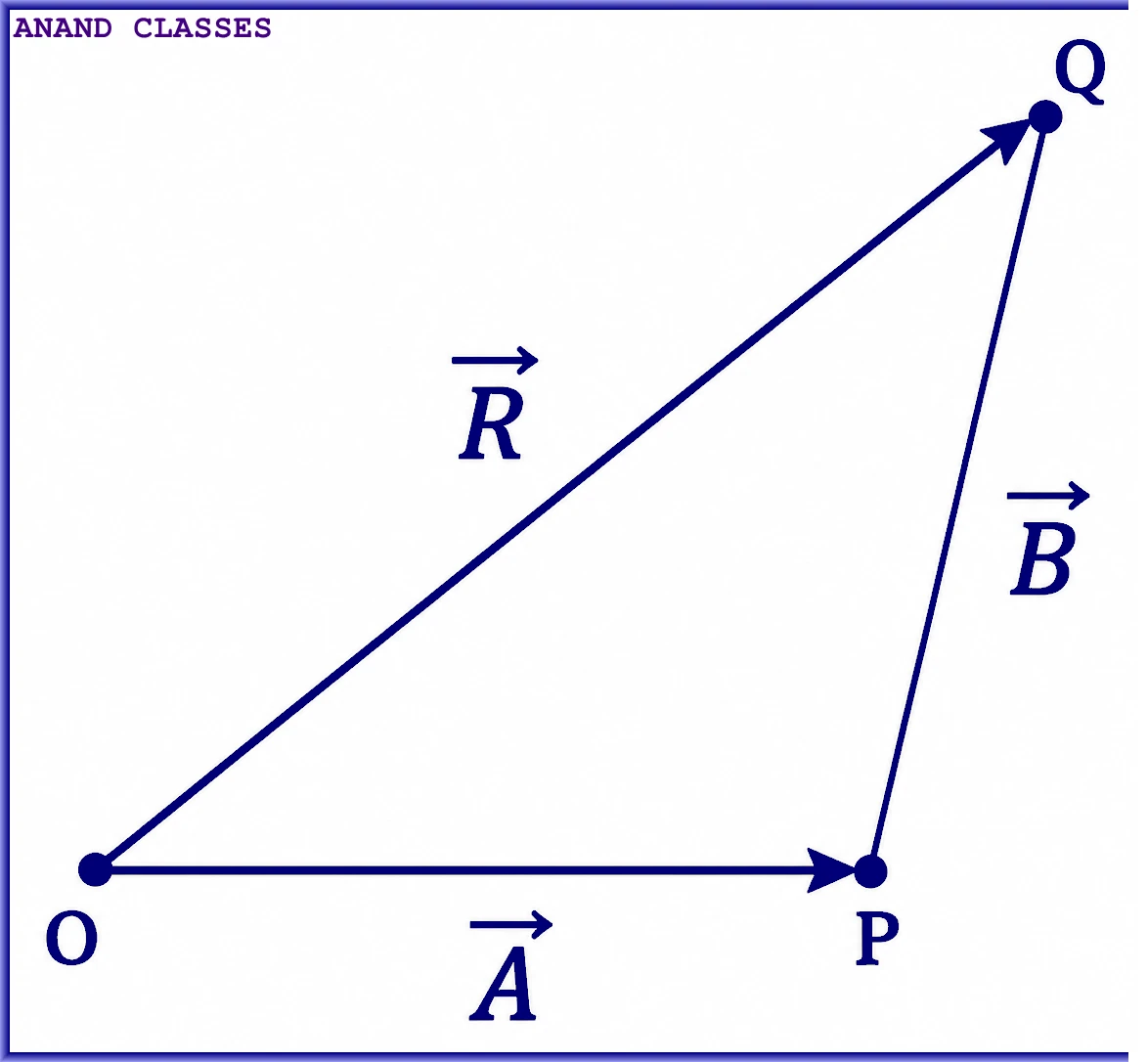
In fact, the resolution of a vector is just opposite to composition of vectors.
Let a vector be represented by . Let and be represented by and , so that :
Then and are the component vectors of .
Related topics include Define Zero Vector or Null Vector: Properties, Significance, Applications, Solved Examples
How do you resolve a vector into two component vectors along given directions ?
Suppose the given vector has to be resolved into two component vectors so that one component vector is along the direction of and other component vector is along the direction of , as shown in Figure(a).
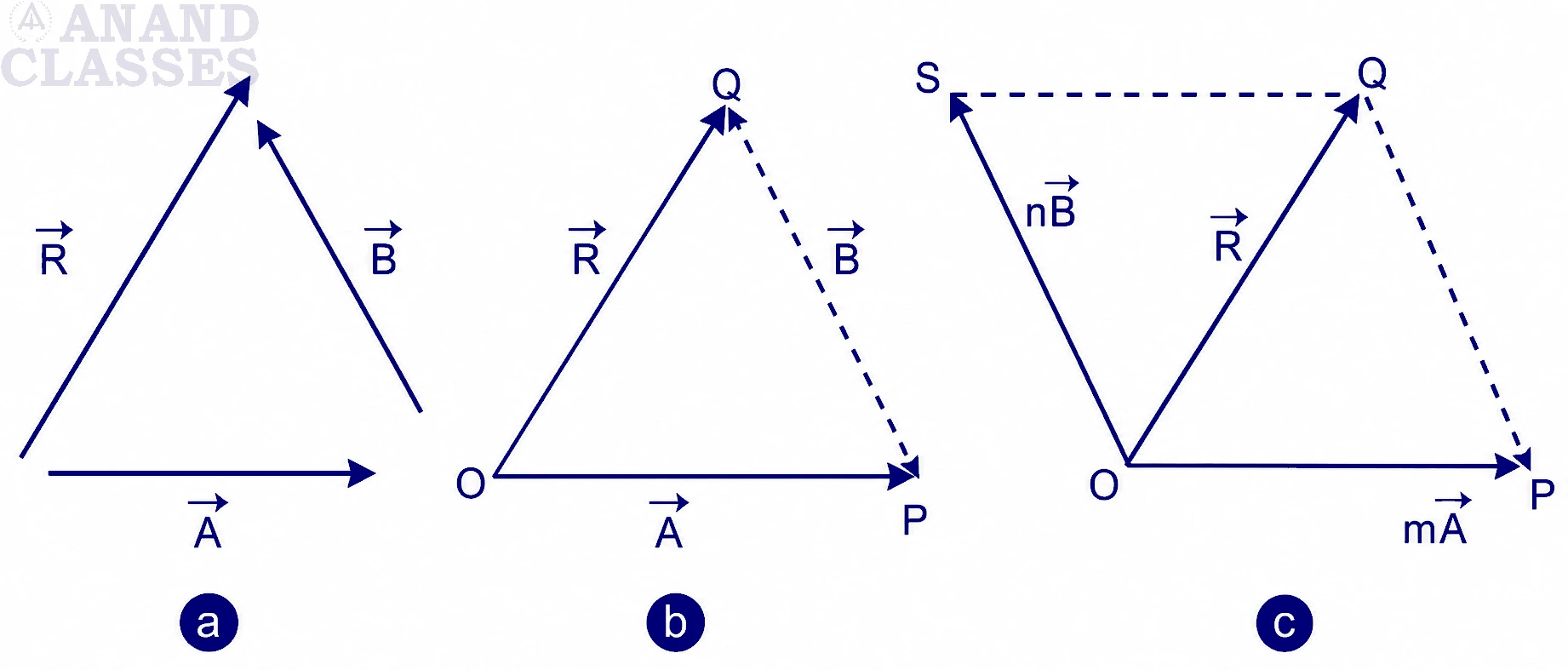
Draw to represent in magnitude and direction. From point O, draw a line parallel to the vector and from Q, draw a line parallel to the vector . Let these two lines intersect at point P, as shown in Figure(b). From triangle law of vectors addition,
Therefore, and are the two component vectors of in the direction of and .
Let and , where m and n are real numbers. Therefore, equation (1) can be written as :
Uniqueness of component vectors
It is to be noted that the resolution of vector into two component vectors along the direction of vectors and is unique. It means, there is only one pair of real numbers m and n which satisfy the equation (2).
To prove it, suppose m‘ and n‘ is another pair of real numbers such that :
From (2) and (3), we have :
Now and , therefore (m – m‘) = 0 and (n – n‘) = 0. It means m = m‘ and n = n‘. Hence there is one and only one way in which a vector can be resolved into two component vectors along the directions of two given vectors.
IMPORTANT NOTE
The resolution of vector given by equation (2) can also be obtained by following parallelogram law of vectors. From point O, draw two lines; one parallel to the vector and other parallel to the vector . Then from point Q, draw a line QS parallel to and line QP parallel to vector so that the parallelogram OPQS is formed, as Figure(c). Then by parallelogram law of vectors addition :where m and n are real numbers.
WHAT ARE RECTANGULAR COMPONENTS OF A VECTOR IN A PLANE ?
When a vector in a plane is splitted into two component vectors at right angles to each other, the component vectors are called rectangular components of that vector.
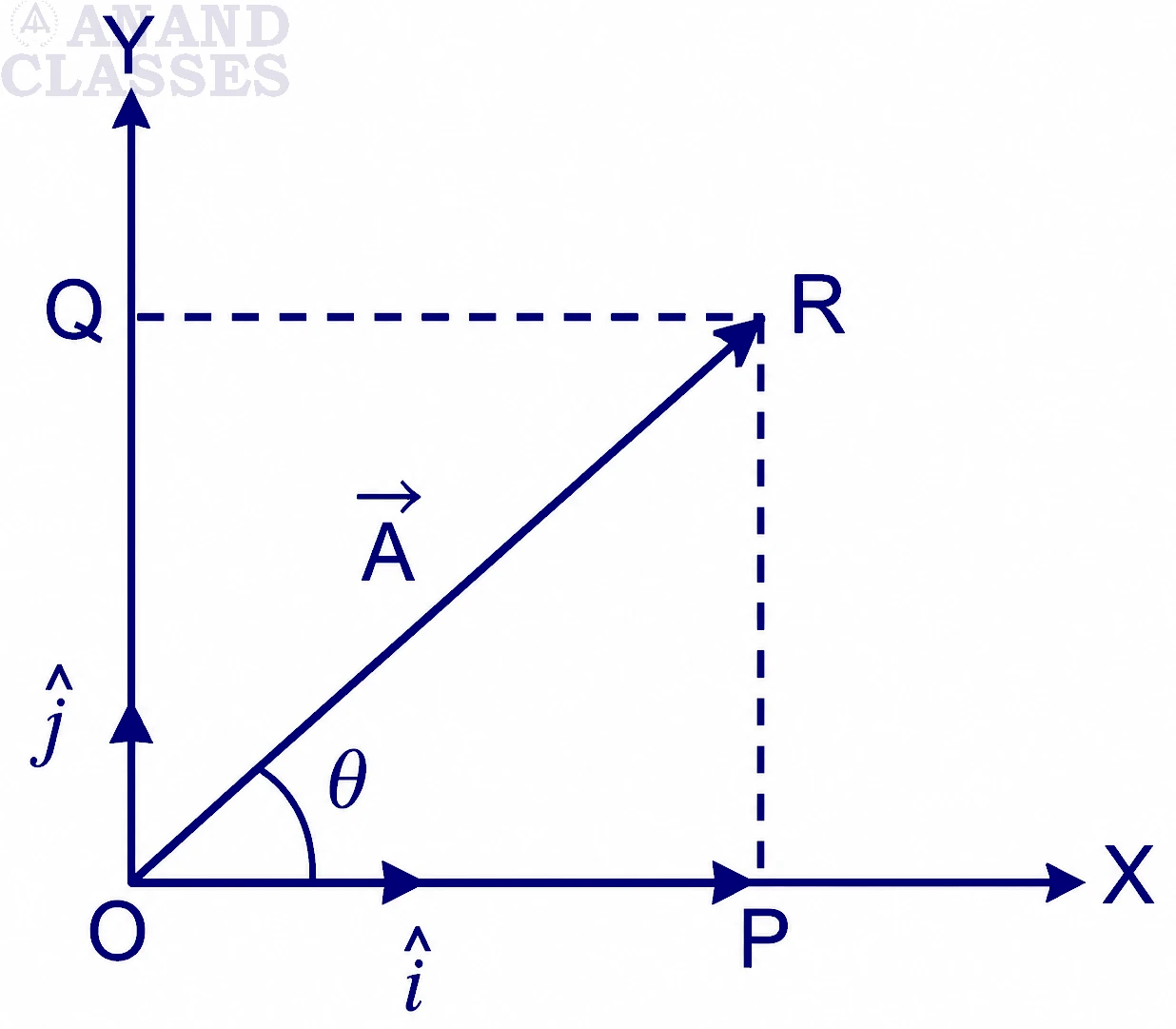
Suppose a vector represented by , has to be resolved into two rectangular component vectors along the directions of X-axis and Y-axis. From O, draw two axes OX and OY at right angles to each other, as shown in Figure. From point R, drop RP and RQ perpendiculars on OX and OY. Then, and are the rectangular components of . Here PR is equal and parallel to OQ, hence also represents in magnitude and direction.
From triangle law of vectors addition, we have :
Let and be the unit vectors along OX and OY directions respectively. Then :
From equation (4), we get :
Let ∠POR = θ. In Figure; and .
In right angled triangle ORP,
In right angled triangle ORP,
Also,
OR2 = OP2 + PR2
and
Thus is resolved into two rectangular components and along the directions of X-axis and Y-axis respectively.
For better understanding, also read Parallelogram Law of Vectors Addition and Subtraction of Vectors
Solved Examples Based on Rectangular Components of a Vector
Example 1:
Find the x and y components of a vector having a magnitude of 12 and making an angle of 45 degrees with the positive x-axis.
Solution:
The given vector is V= 12, and it makes an angle θ = 45º.
The x component of the vector = Vx = V Cos θ = 12.Cos 45º = 12.(1/√2) = 6√2.
The y component of the vector = Vy = V Sin θ = 12.Sin 45º = 12.(1/√2) = 6√2.
Therefore, the x component and the y components of the vector are both equal to 6√2.
Example 2:
A mass of 2 kg lies on a plane making an angle 30° to the horizontal. Resolve its weight along and perpendicular to the plane. Assume g = 10 ms-2.
Solution:
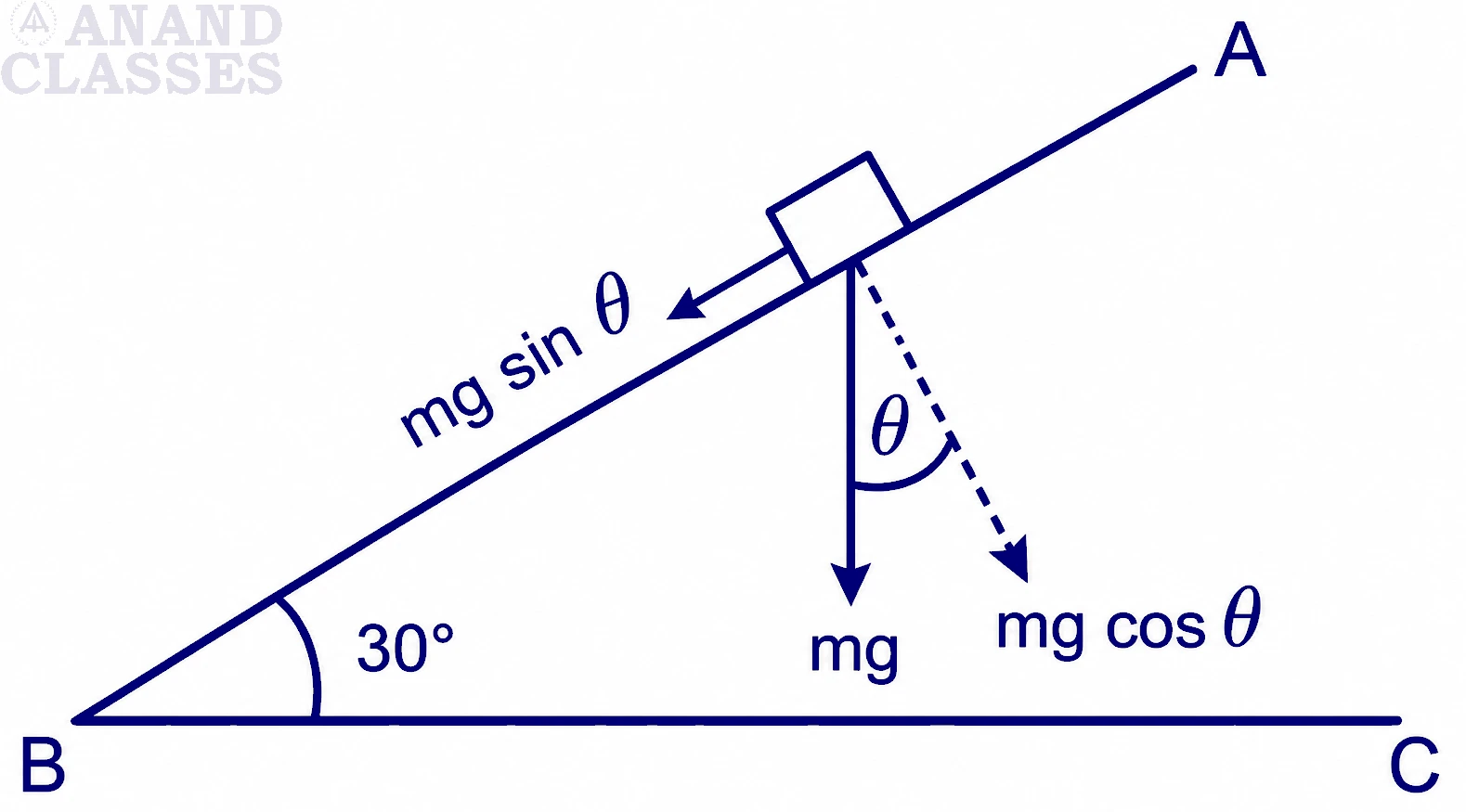
In Figure, the component of weight along the plane:
= mg sin θ = 2 X 10 X sin 30o = 10 N
The component of weight perpendicular to plane:
= mg cos θ = 2 X 10 X cos 30o = 2 X 10 X √3/2 = 17.3 N
Important related topics are Polygon Law and Triangle Law of Vectors Addition, Lami’s Theorem Analytical Method
CURIOSITY QUESTION
Q: How does the knowledge of resolution of vectors help the weight lifters in weight lifting?
Ans: A weight lifter can lift a heavy weight easily if the vertical force he applies to lift the load is more than the weight to be lifted. It can be attained, if the lifter keeps the grips of his hands near the middle on the bar having the weights at the ends. In such a situation, the force exerted while lifting is almost perpendicular to the bar, so that the vertical component of force applied has maximum value.
If the lifter keeps the grips of his hands on the bar near the weights to be lifted, the arms of the lifter will be inclined to his body at some angle. Then for the force applied by lifter, the vertical component of the force becomes less than maximum, which makes the lifting of load difficult.
Understand related topics like Multiplication of Vector by Real Number and Scalar
FAQs on Resolution of a Vector and Rectangular Components of a Vector
What is the resolution of a vector?
Resolution of a vector is the process of splitting a single vector into two or more component vectors acting in different directions such that their combined effect is equal to the original vector.
What are component vectors?
Component vectors are the vectors obtained when a given vector is resolved into different directions. Their vector sum is equal to the original vector.
How is the resolution of a vector related to the composition of vectors?
Resolution of a vector is the reverse process of vector composition. While composition combines vectors into a resultant vector, resolution splits a vector into component vectors.
Why do we resolve vectors into components?
Vectors are resolved into components to simplify calculations involving forces, velocities, accelerations, and other vector quantities acting in different directions.
Can a vector be resolved into more than two components?
Yes. A vector can be resolved into two, three, or more component vectors depending on the problem and the directions specified.
What is meant by resolving a vector along given directions?
It means expressing a vector as the sum of component vectors that act along specified directions.
Is the resolution of a vector unique?
Yes. For two fixed non-parallel directions, there is one and only one pair of component vectors whose resultant equals the given vector.
What are rectangular components of a vector?
Rectangular components are two mutually perpendicular component vectors, usually taken along the x-axis and y-axis, whose vector sum equals the original vector.
How do you resolve a vector into rectangular components?
A vector of magnitude (A) making an angle θ with the positive x-axis is resolved as : Ax = A cos θ, Ay = A sin θ
where Ax and Ay are the x and y components respectively.
What is the formula for a vector in terms of its rectangular components?
A vector can be written as:
where and are unit vectors along the x-axis and y-axis.
How can the magnitude of a vector be found from its components?
The magnitude of a vector is:
How is the direction of a vector determined from its components?
The angle (theta) made by the vector with the x-axis is:
What is the x-component of a vector?
The x-component is the projection of the vector along the x-axis and is given by Ax = A cos θ
What is the y-component of a vector?
The y-component is the projection of the vector along the y-axis and is given by Ay = A sin θ
What are the units of vector components?
The units of vector components are the same as the units of the original vector.
How are vector components used in physics?
Vector components are used to analyze forces, motion, projectile motion, equilibrium, work, and many other physical phenomena.
What is the significance of rectangular components?
Rectangular components allow vector calculations to be performed using simple algebra instead of geometric constructions.
Why are rectangular components perpendicular to each other?
They are taken along mutually perpendicular axes (x-axis and y-axis), making calculations easier and independent.
What are some applications of vector resolution in competitive exams?
Vector resolution is widely used in Class 11 Physics, JEE Main, JEE Advanced, NDA, IMU CET, CUET, NEET, and other engineering and defence entrance examinations for solving problems involving forces, motion, and equilibrium.
How does vector resolution help weightlifters?
A weightlifter can maximize the upward (vertical) component of force by applying force nearly perpendicular to the bar. This increases lifting efficiency and makes lifting heavy weights easier.
What is the difference between a resultant vector and component vectors?
A resultant vector is obtained by combining two or more vectors, whereas component vectors are obtained by splitting a single vector into parts.
Can vector resolution be represented geometrically?
Yes. Vector resolution can be represented using the triangle law of vectors or the parallelogram law of vectors.
What is the most common method of resolving vectors in a plane?
The most common method is resolving vectors into rectangular components along the horizontal (x-axis) and vertical (y-axis) directions.
Why is vector resolution important for JEE and NDA exams?
Vector resolution forms the foundation of mechanics, including forces, equilibrium, motion, projectile motion, and work-energy problems, making it a frequently tested concept in competitive examinations.
Important Units and Measurements Links
In this chapter on Units and Measurements: Conceptual Questions and Answers, Practice Exercise, you will develop a solid foundation in measurement principles, SI units, and error analysis. The section includes important conceptual questions with clear explanations, followed by practice exercises to reinforce learning. It is designed to help students improve precision in calculations and build confidence for board and JEE exams and problem-solving.