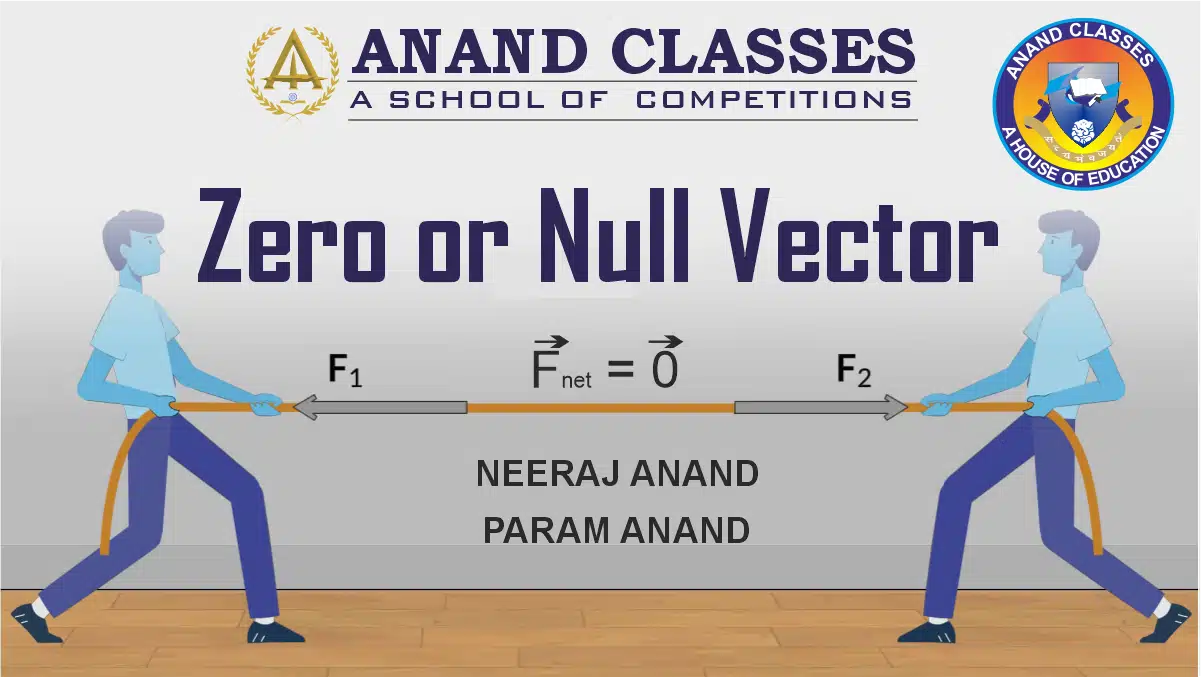
Zero vector or null vector is an important topic in vector algebra that helps students understand the basic concepts of vectors and their applications in physics. It is widely used in problems related to motion, force, displacement, velocity, and equilibrium conditions. Learning the properties and applications of zero vectors with simple examples improves conceptual understanding and helps students prepare for Class 11 Physics, CBSE board exams, JEE Main, NEET, and other competitive examinations.
What is Zero Vector or Nul Vector ?
A vector which has zero magnitude and an arbitrary direction is called zero vector or nul vector. A zero vector is represented by (arrow over the number zero). It is also called null vector.
A zero vector being of zero magnitude must be represented by an arrow of zero length. The direction of the arrow head of a zero vector represented by zero length cannot be specified, hence the zero vector has an arbitrary direction.
Zero vector symbol is given by = (0, 0, 0) in three dimensional space and in a two-dimensional space, it written as = (0, 0). The components of a null vector are all equal to 0 as it has zero length and it does not point in any direction. It is also called the additive identity of the set of vectors as whenever we add a zero vector to any other non-zero vector, the resultant is equal to the given non-zero vector.
Learn more about Why is displacement a vector quantity?
Illustrations of Zero Vector
(i) When a vector is multiplied by zero, the result is a zero vector. That is,
(ii) The result of addition of a vector to its own negative vector is a zero vector. That is,
What are the Examples of Zero Vector ?
(i) The velocity vector of a stationary particle is a zero vector.
(ii) The acceleration vector of an object moving with a uniform velocity is a zero vector.
(iii) The displacement vector of a stationary object over any arbitrary interval of time is a zero vector.
(iv) The position vector of the origin of coordinate axes is a zero vector.
You may also like to study Position Vector Representation
What are the Properties of Zero Vector or Null Vector ?
Now that we have understood the meaning of the null vector, let us go through some of its properties to understand more about it. Given below are some of the important properties of a zero vector (null vector) :
(i) When a zero vector is added to a non-zero vector, the resultant vector is equal to the given non-zero vector. Thus,
Hence a null vector is an additive identity in vector algebra.
(ii) When a zero vector is subtracted to a non-zero vector, the resultant vector is equal to the given non-zero vector. Thus,
(iii) When a non-zero vector is subtracted from a null vector, the resultant vector is equal to the negative of the given non-zero vector, i.e.,
(iv) The multiplication of a non-zero real number n with a zero vector is again a zero vector. Thus,
n
(v) The dot product of a zero vector with any vector is 0. i.e.,
(vi) The cross product of a null vector with any vector is always equal to the null vector. i.e.,
(vii) If n1 and n2 are two different non-zero real numbers, where n1 ≠ n2, then the relation :
can hold only if both and are zero vectors, and are not parallel or antiparallel vectors.
A zero vector has a lot of physical significance. It is useful in describing the physical situation involving vector quantities.
For better understanding, also read How does the position vector change with movement?
What is the Significance or Importance of Null or Zero Vector ?
We have understood the concept of a zero vector. Let us now see its significance in the field of vector algebra and real-life through an example. Consider a man running in the east direction for 5 km. After running for 5 km in the east direction, he runs back towards the west direction for another 5 km. East and west are in opposite directions, so after running towards the west for 5 km, the man is at the point where he started. So, technically he has covered 10 km of distance by running but in vector algebra, his displacement is considered to be 0 km as his final and initial points are the same.
Displacement is a vector quantity whereas distance is a scalar quantity. So, the significance of the zero vector is that even though the displacement is a null vector but it tells the arbitrary direction (west) in which the man is facing.
Zero Vectors hold significance in various mathematical and scientific contexts. Their properties find applications in linear algebra, physics, computer science, and engineering. Understanding and leveraging these vectors enhance problem-solving capabilities and mathematical reasoning.
Understand related topics like Multiplication of a Vector by a Real Number (n)
Zero Vector or Null Vector Solved Examples
Example 1 :
Two men apply equal forces on a wooden box but in opposite directions. Will the box move in any direction?
Solution:
When two vector quantities with equal magnitudes act in opposite directions, then the net vector quantity is always a zero vector or a null vector. Since equal forces are being applied on the box but in opposite directions, therefore, the net force acting on the box will be a zero vector. Hence, the box will not move in any direction.
Example 2 :
Consider a ship moving eastward with a velocity vector V1 = [10, 0] and m/s, and a strong westward wind with velocity vector V2 = [−10, 0] m/s. The net velocity (Vnet) of the ship can be calculated as:
Solution:
Vnet = V1 + V2
⇒ Vnet = [10, 0] + [−10, 0] = [0, 0].
Here, the net velocity vector is a zero vector, indicating that the ship, despite the forces acting on it, remains stationary. This example illustrates the cancellation effect of opposing vectors resulting in a zero vector.
Example 3:
Suppose a particle is subjected to two forces F1 = [5, 3] N and F2 = [−5, −3] N. The resultant force (Fresultant) acting on the particle can be determined as:
Solution:
Fresultant = F1 + F2
⇒ Fresultant = [5, 3] + [−5, −3] = [0, 0]
In this case, the net force is a zero vector, signifying that the forces are in equilibrium, and the particle remains at rest.
Explore detailed notes on What is Parallelogram Law of Vectors Addition ?
FAQs on Zero Vector or Null Vector
What is a zero vector?
A zero vector is a vector that has zero magnitude and an arbitrary direction. It is represented by a zero with an arrow over it.
Why is a zero vector called a null vector?
A zero vector is also called a null vector because its magnitude is zero.
Does a zero vector have direction?
A zero vector has an arbitrary direction because its magnitude is zero and it cannot be represented by a definite length.
How is a zero vector represented?
A zero vector is represented by a symbol consisting of zero with an arrow over it.
What happens when a vector is multiplied by zero?
When any vector is multiplied by zero, the result is a zero vector.
What is obtained when a vector is added to its negative vector?
The addition of a vector and its negative vector gives a zero vector.
What is an example of a zero vector in physics?
The velocity of a stationary particle is an example of a zero vector.
Why is the acceleration of an object moving with uniform velocity a zero vector?
If an object moves with uniform velocity, its velocity does not change with time, so its acceleration becomes zero.
What is the displacement vector of a stationary object?
The displacement vector of a stationary object over any interval of time is a zero vector.
Is the position vector of the origin a zero vector?
Yes, the position vector of the origin of coordinate axes is a zero vector.
What happens when a zero vector is added to another vector?
Adding a zero vector to any vector does not change the original vector.
What happens when a zero vector is subtracted from another vector?
Subtracting a zero vector from a vector leaves the vector unchanged.
What is the result of multiplying a zero vector by a non-zero real number?
Multiplying a zero vector by any non-zero real number still gives a zero vector.
Why is the zero vector important in physics?
The zero vector helps describe physical situations where vector quantities such as displacement, velocity, or acceleration become zero.
Can two different scalar multiples of vectors be equal?
Yes, but this condition is generally possible only when both vectors involved are zero vectors.