Strengthen your understanding of Motion in a Plane (Vectors) with a comprehensive collection of Conceptual Questions and Answers and Numerical Problems with Step-by-Step Solutions for Class 11 Physics. This resource is designed according to the latest CBSE syllabus and is equally useful for State Board, JEE Main, NEET, and other competitive exams. Covering topics such as scalar and vector quantities, vector addition and subtraction, resolution of vectors, unit vectors, position vectors, relative motion, and projectile motion, these solved questions help students build strong concepts, improve problem-solving skills, and prepare confidently for school and entrance examinations.
Topicwise Very Short Answer Questions and Numerical Problems with Solutions (Carrying 1 Mark) for CBSE and State Level School Board Exams
Topic – I : Vectors and Vectors addition for CBSE and State Level School Board Exams
Give an example of a physical quantity:
(i) which has neither unit nor direction
(ii) has a direction but not a vector
(iii) can be either a vector or a scalar.
Ans.
(i) Specific gravity has neither unit nor direction
(ii) Pressure or current has a direction but not a vector
(iii) Angular displacement can be either a vector or a scalar
Students should also study Assertion and Reason MCQs on Motion in a Plane (Vectors) for Class 11 Physics, JEE, NEET
Is finite rotation a vector?
Ans. The finite rotation about an axis is not a vector because its addition to another finite rotation about a different axis does not obey the commutative law of addition.
Consider a vector . What is a unit vector perpendicular to ?
Ans. . It will be a unit vector along the Z-axis as lies in the X-Y plane.
State the most basic condition for the addition of vectors.
Ans. The most basic condition for the addition of vectors is that they must represent physical quantities of the same nature.
Vectors cannot be added algebraically. Why?
Ans. It is so because vectors possess direction as well as magnitude.
Does it make sense to call a physical quantity a vector when its magnitude is zero?
Ans. Yes, a null vector has a definite physical significance.
Are the magnitude and direction of same as that of ?
Ans. The vectors and have the same magnitude but opposite directions.
Is the magnitude of the same as that of ?
Ans. Magnitude is the same when the angle between and is 90°, and is different if the angle is other than 90°.
Give two necessary conditions for a given quantity to be a vector.
Ans. The quantity can be taken as a vector if it obeys the following conditions:
- The quantity has both magnitude and direction.
- The quantity obeys the laws of vector addition.
What is the property of two vectors if ?
Ans. Given, , i.e., is a null vector.
Are the commutative law and associative law applicable to vector subtraction?
Ans. Commutative law is not applicable to vector subtraction because:
Associative law is also not applicable to vector subtraction because:
If the magnitude of vectors , , and are 3, 4, and 5 units respectively, and if , find the angle between and .
Ans. Since , the angle between and is 90°. Let be the angle between and , then:
Find the vector sum of coplanar forces, each of magnitude , when each force is making an angle of with the preceding one.
Ans. Zero. Since the total angle between coplanar forces , it means the forces can be represented by the various sides of a closed polygon taken in order, hence their resultant force is zero.
Is a unit vector? Explain.
Ans. is not a unit vector. If , then:
The angle which makes with the X-axis is given by:
Under what condition, three vectors (i) cannot give zero resultant (ii) can give zero resultant?
Ans.
(i) When three vectors are not lying in the same plane, they cannot produce a zero resultant.
(ii) When three vectors are lying in a single plane and are represented in magnitude and direction by the three sides of a triangle taken in the same order, they can produce a zero resultant.
Can the magnitude of the resultant vector of two given vectors be less than the magnitude of any of the given vectors?
Ans. Yes, if the angle between the two vectors is more than 90° but less than 270°, because in that case is negative.
Under what conditions will the directions of the sum and difference of two vectors be the same?
Ans. The direction of the sum and difference of two vectors will be the same when the two vectors are unequal in magnitude and acting in the same direction.
What is the minimum number of unequal forces whose vector sum is zero?
Ans. Three forces, provided they can be represented by the three sides of a triangle taken in the same order.
What is the minimum number of forces (all numerically equal) whose vector sum can be zero?
Ans. Two only, provided they are acting in opposite directions.
To strengthen your concepts, learn about Motion in a Plane (Vectors) MCQs for Class 11 Physics With Answers and Solutions
Topic – II : Components of Vectors and Relative Velocity for CBSE and State Level School Board Exams
A unit vector is represented by . If the values of and are and respectively, find the value of .
Ans. Given,
Here,
A vector is expressed as where and are its components along the x-axis and y-axis respectively. If vector makes an angle with the x-axis, then is given by which expression?
Ans. Here, and
What are the maximum number of (i) rectangular component vectors (ii) component vectors, into which a vector can be resolved in a plane?
Ans.
(i) Two only in a plane.
(ii) Any number of component vectors in a plane.
Can a vector be multiplied with both dimensional and non-dimensional scalars?
Ans. Yes. When a vector is multiplied by a dimensional scalar, the resultant vector will have different dimensions. For example, if an acceleration vector is multiplied by mass (a dimensional scalar), the resultant vector has the dimensions of force.
When a vector is multiplied by a non-dimensional scalar, it will be a vector having the same dimensions as that of the given vector.
If a vector is added or subtracted from another vector, the resultant is a vector. Is this also true in the case of multiplication of two vectors?
Ans. May or may not be true. If the multiplication of two vectors is a scalar product (dot product), then the new physical quantity is a scalar. If the multiplication is a vector product (cross product), then the new physical quantity is a vector.
A boat is moving with a velocity with respect to ground. The water in the river is moving with a velocity with respect to ground. What is the relative velocity of the boat with respect to water?
Ans. Velocity of boat w.r.t. ground, .
Velocity of water w.r.t. ground, .
Relative velocity of boat w.r.t. water is:
Tipic – III. Scalar product and vector product of vectors for CBSE and State Level School Board Exams
If , and are non-zero vectors and and , then find out the value of .
Ans. As ().
Similarly, ().
Therefore, and are parallel to each other.
Can the scalar product of two vectors be negative?
Ans. Yes, it will be negative if the angle between the two vectors is between 90° and 270°.
If , and are mutually perpendicular vectors, then find the value of .
Ans.
Find the value of .
Ans.
Show that .
Ans. As .
If , find the value of the angle between and .
Ans. As , therefore:
A vector points vertically upward and points towards east. What is the direction of ?
Ans. The direction of is along North according to the Right-handed screw rule.
What is the angle between and , if and denote the adjacent sides of a parallelogram drawn from a point and the area of the parallelogram is ?
Ans. Area of parallelogram .
Given,
Practice more questions from NCERT Exemplar Solutions for Vectors Class 11 Physics Motion in a Plane
Topicwise Short Answer Questions and Numerical Problems with Solutions (Carrying 2 Mark) for CBSE and State Level School Board Exams
Topic – I : Vectors and Vectors addition for CBSE and State Level School Board Exams
Vectors , and satisfy the equation , and their magnitudes are related by the equation . How is the vector oriented with respect to vector ? Explain your reasoning.
Ans. If is the angle between and , then:
Therefore, vector is oriented in the same direction as vector .
Do and lie in the same plane. Explain.
Ans. Yes, and lie in the same plane because is represented by the diagonal of a parallelogram where two adjacent sides are represented by vectors and . The diagonal passes through the common tail of and .
is represented by the other diagonal of the same parallelogram. It does not pass through the common tail of and . From above, we note that both and lie in the plane of the same parallelogram.
Can we add a vector representing a force of 10 N to a vector of force 200 dyne.
Ans. Force is a vector quantity. The two forces can be added by the laws of vectors (parallelogram law of vectors or triangle law of vectors), which is possible if we know the angle between the two forces. As the angle between the two given forces is not known, hence, they cannot be added.
Given , can the magnitude of be equal to the magnitude of ? Explain.
Ans. Yes. Given:
Hence, the magnitude of must be equal to the magnitude of .
Two vectors and are of equal length and mutually perpendicular. Show by vector diagram that their vector sum and vector difference will be of the same length and mutually perpendicular.
Ans. Draw and from the arrow head of , draw of the same length (i.e., ) and perpendicular to . Now will represent .
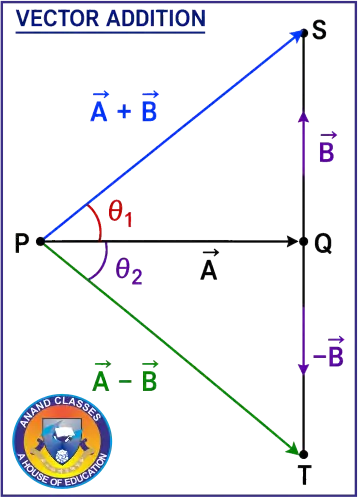
Here:
Now draw , where . Now will represent . Here:
On measuring, the lengths of and come out to be the same, and the angle between them is:
Two vectors and are added. Prove that the magnitude of the resultant vector cannot be greater than and smaller than or .
Ans. The magnitude of resultant vector of two vectors and is given by:
Case (i): will be maximum if .
Case (ii): will be minimum if .
Suppose you have two forces and . How would you combine them in order to have a resultant force of magnitudes (a) zero, (b) , and (c) ?
Ans. The magnitude of resultant of the addition of two vectors and is given by:
where is the angle between and .
(a) If , and :
i.e., the two vectors are acting in opposite directions.
(b) If , and :
i.e., the two vectors are acting in the same direction.
(c) If , and :
What is the difference between the following data?
(i)
(ii)
Ans.
(i) It is the product of a pure number and a velocity vector, hence the unit of the product is the same as that of the velocity vector. The product is a velocity of magnitude towards west.
(ii) It is the product of a scalar (time) and a velocity vector. The unit of this product will be . Thus, the product is a displacement of magnitude 15 km towards west.
What is the property of two vectors and , if ?
Ans. We know that:
As per the question:
Squaring both sides, we get:
It means the vectors and are perpendicular to each other.
Given that and , find the angle between and .
Ans.
Topic – II. Components of Vectors and Relative Velocity for CBSE and State Level School Board Exams
Find a vector and its magnitude as well as direction with the x-axis having initial point and terminal point .
Ans.
It means lies in the x-z plane.
If is the angle which makes with the x-axis, then:
The velocity of a body is , 30° west of south. Find the north and east components of the vector.
Ans. The angle which the given velocity makes with the north direction is .
The angle which the given velocity makes with the east direction is .
What are the angles made by vector with the x-axis and y-axis?
Ans. Comparing the given vector with the standard form , we have and .
Let and be the angles which makes with the x-axis and y-axis respectively. Then:
The resultant of two vectors and is perpendicular to the vector and its magnitude is equal to half of the magnitude of the vector . Find out the angle between and .
Ans. Let , , and the resultant such that . Let the angle between and be .
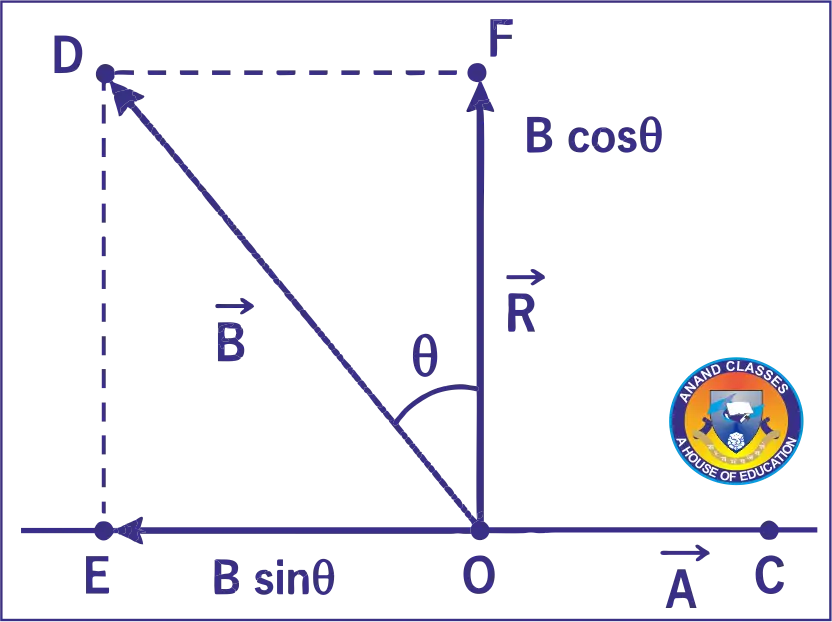
Resolving into two rectangular components, we have along (OF) and along OE (opposite to ). Since the net resultant is entirely along OF:
As per the question, :
Hence, the total angle between and is:
A man moving in rain holds his umbrella inclined to the vertical even though the rain drops are falling vertically downwards. Why?
Ans. A man walking in the rain can protect himself if he holds his umbrella in the direction of the relative velocity of the rain w.r.t. himself.
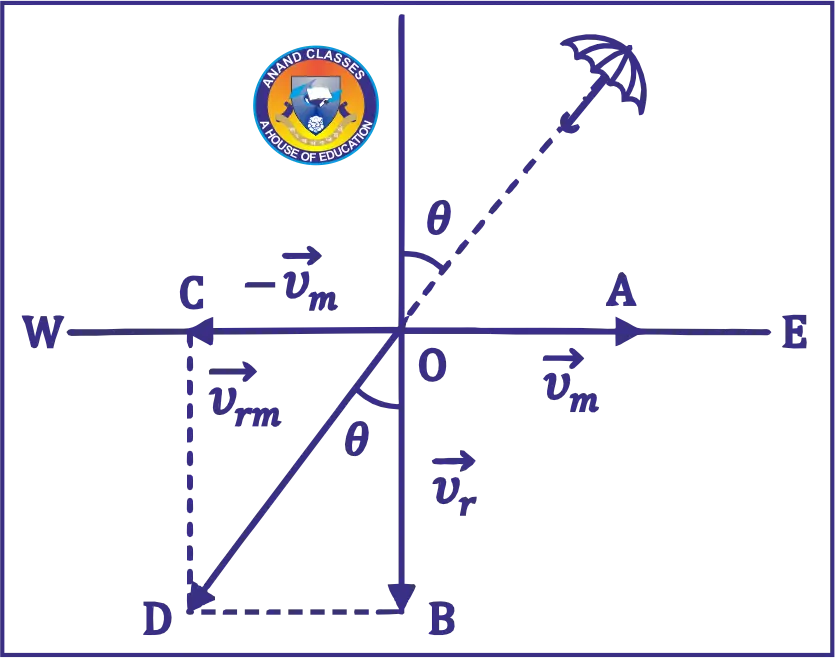
Consider a man moving due east with velocity . Suppose the rain is falling vertically downwards with velocity . The relative velocity of the rain w.r.t. the man is:
Let make an angle with the vertical, then:
Thus, the man must hold his umbrella at an angle of with the vertical, slanted forward in the direction of his motion.
Strengthen your fundamentals with NCERT Solutions for Vectors Class 11 Physics Chapter Motion in a Plane
Topic – III. Scalar Product and Vector Product of Vectors for CBSE and State Level School Board Exams
If , show that , where is the smaller angle between and .
Ans. Given
.
Taking the dot product of with itself:
If , then determine the angle between and .
Ans. Given, . Taking the dot product of with itself:
The sum and difference of two vectors are perpendicular to each other. Prove that the vectors are equal in magnitude.
Ans. Let the two vectors be and . As the vectors and are perpendicular to each other, their dot product must be zero:
Since :
Topic-wise Conceptual Questions with Answers and Numerical Problems with Solutions (3 Marks) for CBSE and State School Board Exams
Topic – I : Vectors and Vectors addition for CBSE and State Level School Board Exams
Can three vectors not in one plane give a zero resultant? Can four vectors do?
Sol. Three vectors which are not in one plane cannot give a zero resultant. This is because the resultant of two vectors (in a plane) lies in their plane. It cannot balance the third vector which is in a different plane.
The resultant of four coplanar vectors can be zero if they are represented in magnitude and direction by four sides of a polygon taken in the same order. The resultant of four non-coplanar vectors may be zero.
What is the magnitude and direction of ?
Sol. Magnitude of
Let make an angle with the direction , then:
We can order events in time and there is a sense of time, distinguishing past, present and future. Is therefore, time a vector?
Sol. Time always flows on and on i.e., from past to present and then to future. Therefore, a direction can be assigned to time. Since the direction of time is unique, it does not need to be specified or stated. It is due to this reason that time cannot be a vector though it has a direction.
Is greater than or less than ? Explain.
Sol.
It is a negative quantity for all values of and is zero if . Hence:
Is greater than or less than ? Explain.
Sol.
It is a negative quantity for all values of and has a zero value for . Hence:
The resultant of two vectors and is perpendicular to and its magnitude is half that of . What is the angle between and ?
Sol. Here, , , and .
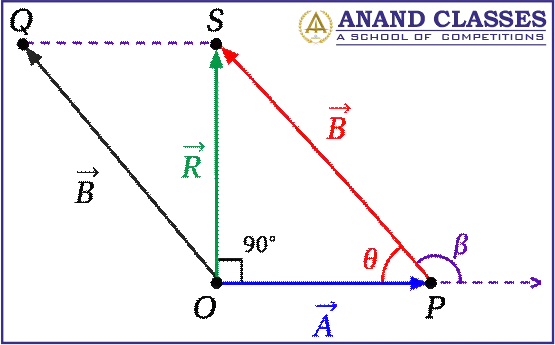
In :
Let , then:
Therefore, the angle between and is:
The three vectors , and are represented in magnitude and direction by , and . If , show that S is the mid point of PQ.
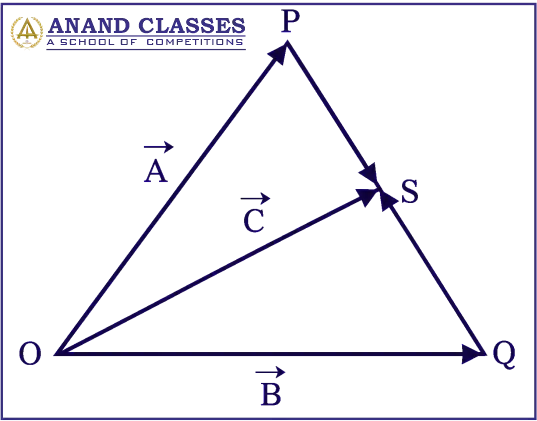
Sol. In , by vector addition:
… (i)
Similarly, in , we have:
….(ii)
Adding equations (i) and (ii), we get:
Since , the left side becomes zero:
Hence, S is the mid point of PQ.
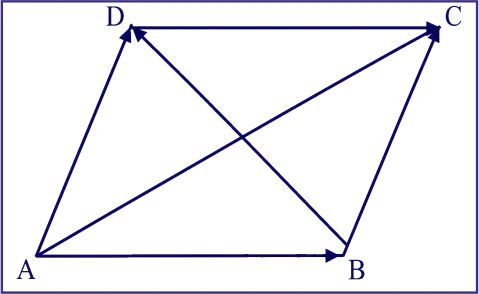
ABCD is a parallelogram. AC and BD are its diagonals. Show that:
(a)
(b)
Sol.
(a) Refer to Figure., using the triangle law of vectors, we have :
(b)
The greatest resultant of two vectors and is times their least resultant. Given > . When is the angle between the two vectors, their resultant is half the sum of the two vectors. Show that .
Sol. The greatest resultant of two vectors
The least resultant of two vectors
According to the question:
The standard resultant formula is:
Given that , substituting :
Putting these values back into equation (i):
On solving for , we get:
ABCDEF is a regular hexagon. What is the value of ?
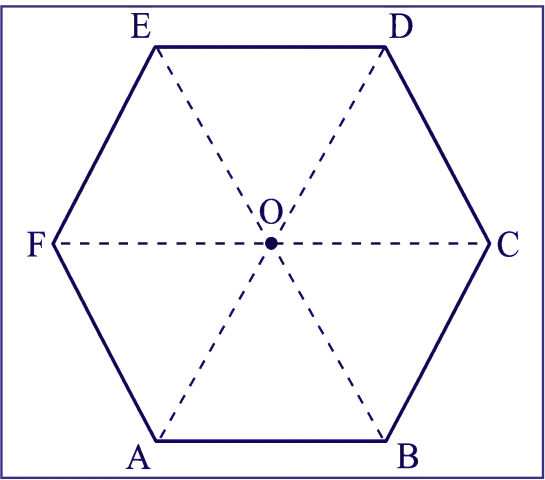
Sol.
Since and in a regular hexagon, those terms cancel out:
Topic – II. Components of Vectors and Relative Velocity for CBSE and State Level School Board Exams
Can the flight of a bird be an example of the composition of vectors?
Sol. Yes, the flight of a bird is an example of the composition of vectors. As the bird flies, it strikes the air downwards with forces W’, W with its wings along WO. According to Newton’s Third Law of motion, the air strikes the wings in the opposite direction with the same reaction force. These reactions combine vectorially to push the bird forward and upward.
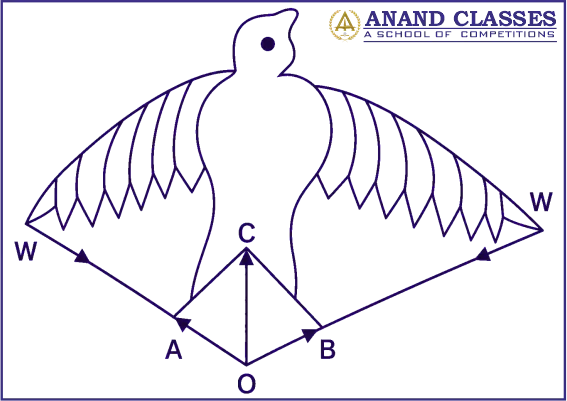
According to parallelogram law of vectors, the resultant of and is . It is this resultant upward force which is responsible for the flight of the bird.
A room has dimensions 3 m × 4 m × 5 m. A fly starting at one corner ends up at the diametrically opposite corner. (a) What is the magnitude of its displacement? (b) If the fly were to walk, what is the length of the shortest path it can take?
Sol.
(a) If the starting point of fly which is one corner of room is taken as origin of coordinates, then the coordinates of diametrically opposite corner of room are (3, 4, 5). So displacement is
and
m
(b) When the fly were to walk, then shortest distance travelled is
m
A man rows directly across a flowing river in time and rows an equal distance down the stream in time . If is the speed of the man in still water and that of stream, then find the ratio of and in terms of and .
Sol. A man will row directly across a flowing river if his resultant velocity of river flow and the man is along OC, which is perpendicular to the river velocity .
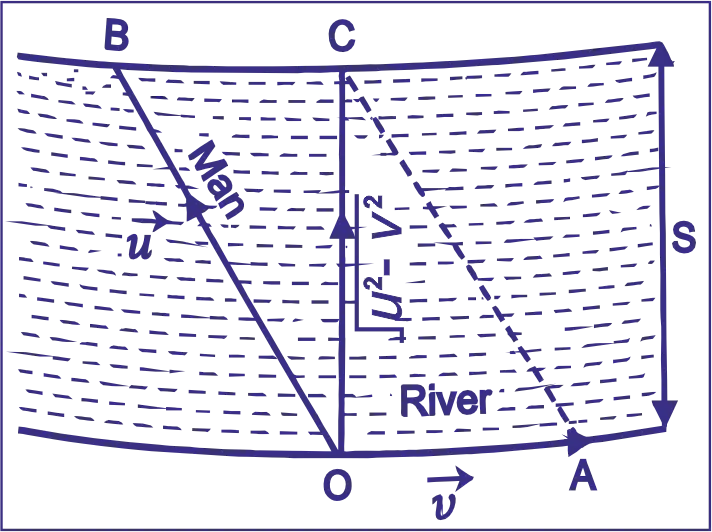
Resultant velocity of man across the river along OC
Resultant velocity of man down the stream
If is the distance covered in each case, then
and
An aeroplane takes off at an angle of 30° to the horizontal. If the component of its velocity along the horizontal is 240 km h⁻¹, what is the actual velocity? Also find the vertical component of its velocity?
Sol. Let be the actual velocity of aeroplane while taking off. As per question
or
km h⁻¹
Vertical component velocity of aeroplane
km h⁻¹
A plane is travelling eastward at a speed of 400 km h⁻¹. Wind is blowing southward at a speed of 80 km h⁻¹. What is the direction of the plane relative to the ground?
Sol. Here, velocity of plane, where km h⁻¹.
Velocity of wind, where km h⁻¹.
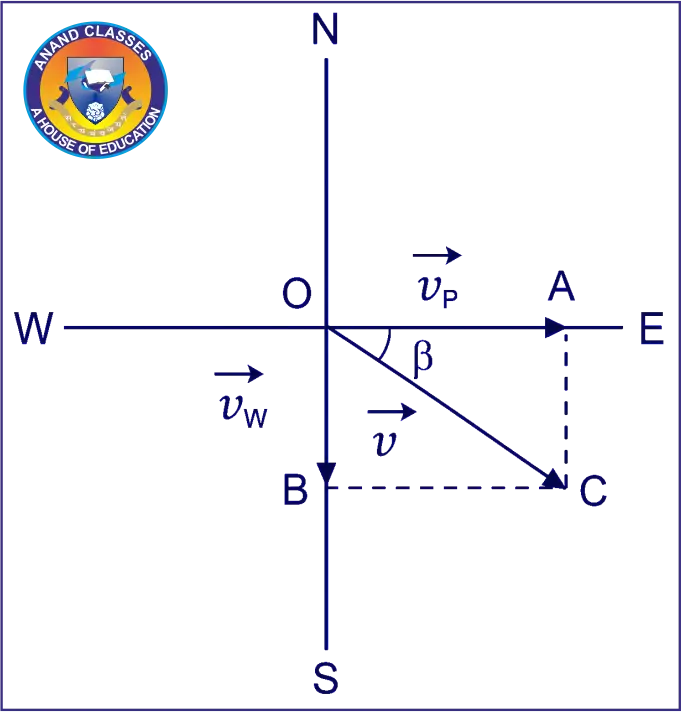
The plane will have a resultant velocity along OC. Let be the angle between and , then
south of east
A weight mg is suspended from the middle of a rope whose ends are at the same level. The rope is no longer horizontal. Find the minimum tension required to completely straighten the rope.
Sol.
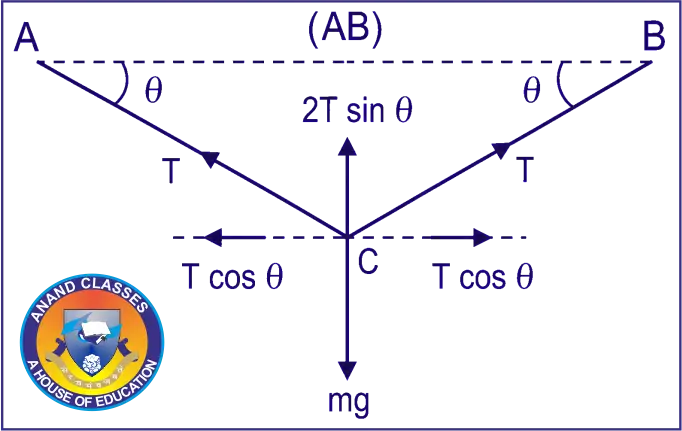
or
When the rope is straight, ;
Then,
Topic – III. Scalar product and vector product of vectors for CBSE and State Level School Board Exams
If is it correct to conclude that ?
Sol. Given
i.e.,
… (i)
where is smaller angle between and ; and is the smaller angle between and .
From (i),
… (ii)
If then from (ii), or
If then from (ii), or
Three vectors , and satisfy the relation and . To which vector, the vector is parallel?
Sol.
As ; so is perpendicular to
As ; so is perpendicular to
is perpendicular to both and
so is parallel to
If , is it correct to conclude that ?
Sol. Let be the smaller angle between and ; and be the smaller angle between and .
Given,
… (i)
where and are unit vectors in the direction of vectors and respectively.
From (i),
… (ii)
If and , then and
If and , then and
If and , then and
If and , then and
If , show that need not be equal to .
Sol.
… (i)
To satisfy (i), the three possibilities can be there
(i) or
(ii)
(iii) and parallel to each other
i.e. , where is a non zero real number.
or
Thus, if , need not be equal to . The given statement is true if is a zero vector or is equal to .
If three vectors , and are such that , and then prove that .
Sol.
Given,
or
… (i)
But so either
or or is perpendicular to
Also
… (ii)
But therefore either or or is parallel to
But at a time cannot be perpendicular to and parallel to . So equations (i) and (ii) will be true at a time if
In any , prove that .
Sol. Here Vectors , , are represented by the three sides of a triangle taken in one order. Their resultant is zero.
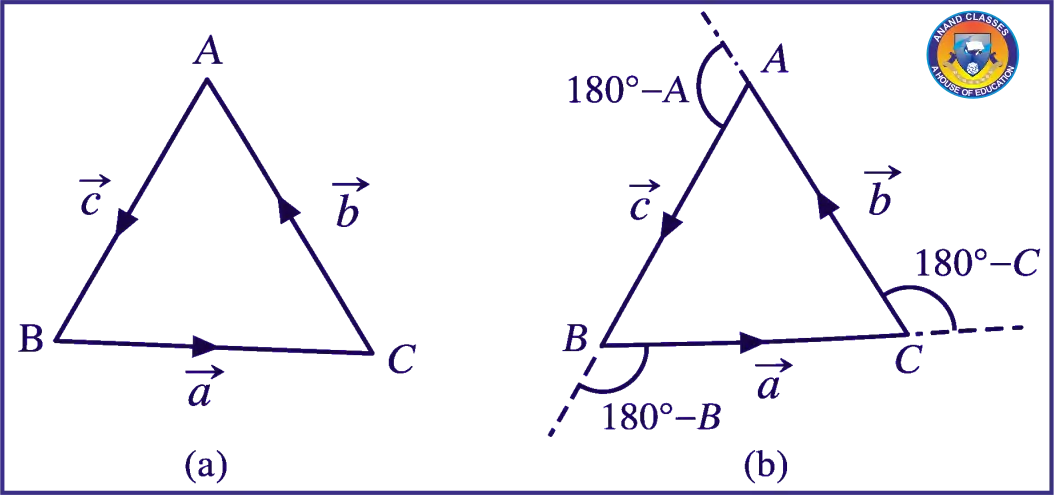
So
… (i)
Similarly we can get
… (ii)
From (i) and (ii),
Dividing it by , we get