Equations of motion under gravity are used to study the motion of bodies falling freely towards the Earth or moving vertically upward against gravity. In such cases, the acceleration acting on the body is due to gravity and is represented by g. These equations help in calculating important physical quantities such as final velocity, distance travelled, maximum height reached, and time of flight. Understanding motion under gravity is essential for solving numerical problems related to free fall, upward projection, and vertical motion in physics.
Motion of Body Under Gravity (Free Fall)
The force of attraction that the earth exerts on all the bodies is called force of gravity and the acceleration induced by gravity is called acceleration due to gravity, represented by g. All bodies irrespective of their size, weight or composition fall with the same acceleration near the surface of earth in the absence of air. Motion of a body falling towards the earth from a small altitude (h<<R) is known as free fall (R : Radius of Earth).
“Related topics include Derive Equations of Motion Using Calculus Method, Solved Numerical Examples“
Equaions of Motion When a Body Dropped From a Height
Consider an object of mass m falling from a height h. Assume there is no air resistance. For convenience, let us choose the downward direction as positive y-axis as shown in the Figure.
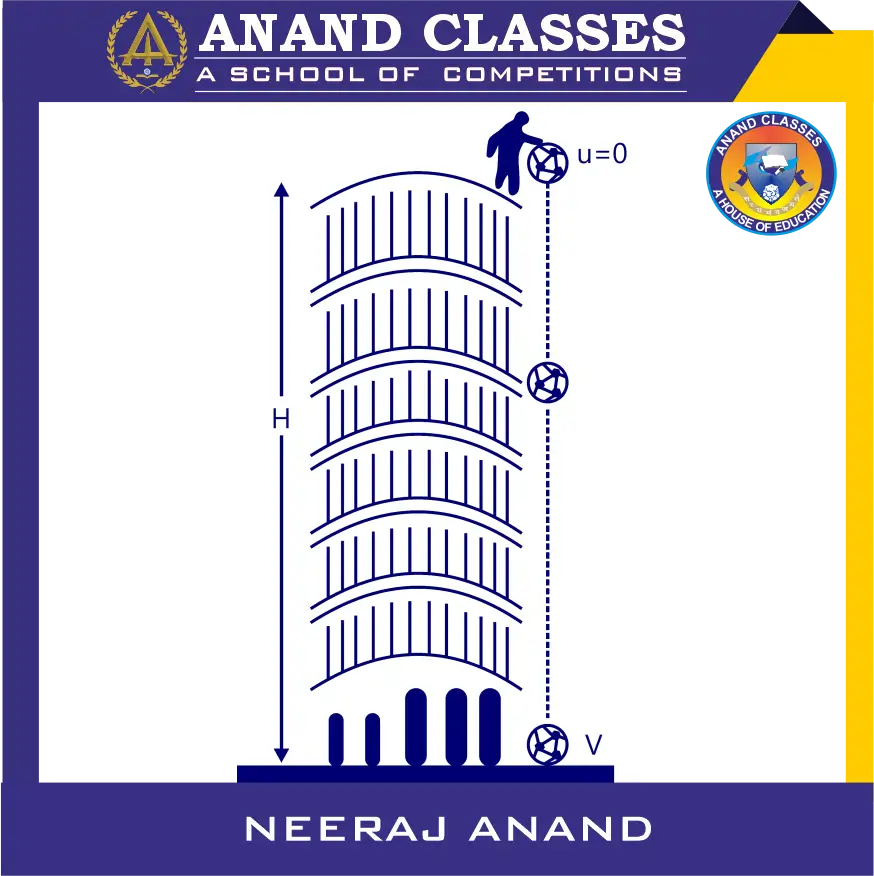
The object experiences acceleration ‘g’ due to gravity which is constant near the surface of the Earth. We can use kinematic equations to explain its motion. We have
The acceleration $\vec{a} = g\hat{j}$
By comparing the components, we get
ax = az = 0, $a_y = g$
Let us take for simplicity, $ a_y = a = g $
If the particle is thrown with initial velocity ‘$u$’ downward which is in negative y– axis, then velocity ($v$) and position ($y$) at of the particle any time t is given by
$v = u + gt$, $y = ut + \frac{1}{2} gt^2$, $v^2 = u^2 + 2gy$
When an object is dropped from a rest position, it undergoes free fall. We define the starting position as the origin ($y=0$) and choose the downward direction as positive.
Initial velocity ($u$) : $0\text{ m/s}$ (since it starts from rest)
Acceleration ($a$) : $+g$ (where $g \approx 9.8\text{ m/s}^2$ or $10\text{ m/s}^2$, acting downward in the direction of motion)
(a) Modified Equations of Motion for Free Fall
Substituting, $s = h$, $u = 0$ and $a = g$ into the three standard equations of kinematics : $v = u + at$, $s = ut + \frac{1}{2} at^2$, $v^2 = u^2 + 2as$, we have :
Velocity-Time Relation : $$v = gt$$
Displacement-Time Relation : $$h = \frac{1}{2}gt^2$$
Velocity-Displacement Relation : $$v^2 = 2gh$$
(b) Velocity of Body Just Before Hitting the Ground
If a body is dropped from a total height $H$, its final velocity $v$ right before it impacts the ground can be calculated using the third equation of motion (substituting $h = H$) :
$$v^2 = 2gH$$
$$v = \sqrt{2gH}$$
The above equation implies that the body falling from greater height(H) will have higher velocity when it reaches the ground.
(c) Total Time of Flight of Body ($T$)
The total time $T$ required for the object to travel the entire vertical distance $H$ is found by rewriting the second equation of motion :
$$H = \frac{1}{2}gT^2$$
Multiplying both sides by 2 and dividing by $g$:
$$T^2 = \frac{2H}{g}$$
$$T = \sqrt{\frac{2H}{g}}$$
The above equation implies that greater the height(H), particle takes more time(T) to reach the ground. For lesser height(H), it takes lesser time to reach the ground.
(d) Distance Covered in the nth Second of its Motion while Free all (Galileo’s Law of Odd Numbers)
The standard equation for displacement in a specific $n^{\text{th}}$ second is $S_n = u + \dfrac{a}{2}(2n – 1)$. Substituting $u = 0$ and $a = g$ :
$$h_n = \frac{1}{2}g(2n – 1)$$
If we calculate the distance covered during successive, equal 1-second intervals ($n = 1, 2, 3, \dots$) :
For $n = 1$ : $h_1 = \frac{1}{2}g(2(1) – 1) = \frac{1}{2}g(1)$
For $n = 2$ : $h_2 = \frac{1}{2}g(2(2) – 1) = \frac{1}{2}g(3)$
For $n = 3$ : $h_3 = \frac{1}{2}g(2(3) – 1) = \frac{1}{2}g(5)$
The ratio of distances covered in the $1^{\text{st}}, 2^{\text{nd}}, 3^{\text{rd}}, \dots$ seconds is a sequence of odd integers :
$$\text{Ratio} = 1 : 3 : 5 : 7 : \dots$$
This directly validates Galileo’s Theorem: For a uniformly accelerating body starting from rest, the distances traveled in equal successive time intervals are in the ratio of odd integers.
(e) Total Cumulative Distance vs. Total Time
From the formula $h = \frac{1}{2}gt^2$, because $g$ is constant, cumulative height is directly proportional to the square of total elapsed time :
$$h \propto t^2$$
If we look at the total distance covered after total cumulative times of $t, 2t, 3t, \dots$:
Distance at time $1t \propto (1)^2 = 1$
Distance at time $2t \propto (2)^2 = 4$
Distance at time $3t \propto (3)^2 = 9$
The total cumulative distance covered over intervals of $t, 2t, 3t$ scales as the square of integers :
$$\text{Ratio} = 1^2 : 2^2 : 3^2 : \dots = 1 : 4 : 9 : \dots$$
“This topic is closely connected with Derive Equations of Uniformly Accelerated Motion“
CBSE Question
An iron ball and a feather are both falling from a height of 10 m.
(a) What is the time taken by the iron ball and the feather to reach the ground?
(b) What are the velocities of the iron ball and the feather when they reach the ground? (Ignore air resistance and take g = 10m/s2
Solution :
Initial velocity ($u$) = 0 m/s (both are dropped from rest)
Height ($h$) = 10 m
Acceleration due to gravity g = 10 m/s2
(a) Time taken to reach the ground (T)
The displacement-time equation for an object falling freely from rest is :
$$h = \frac{1}{2}gT^2$$
$$T = \sqrt{\frac{2h}{g}}$$
Substituting the given values :
$$T = \sqrt{\frac{2 \times 10}{10}}$$
$$T = \sqrt{2} \approx 1.414\text{ s}$$
| Important Conceptual Note |
|---|
| Because the equations of motion under gravity do not include a mass variable (m), the acceleration depends only on gravity, not on the mass of the falling object. In the absence of air resistance, both the iron ball and the feather take the exact same time 1.414 s to reach the ground. |
Galileo concluded that in vaccum all objects fall with the same acceleration g and reach the ground at the same time.
(b) Velocity when reaching the ground ($v$)
The velocity-displacement equation for an object falling freely from rest is :
$$v^2 = 2gh$$
$$v = \sqrt{2gh}$$
Substituting the given values :
$$v = \sqrt{2 \times 10 \times 10}$$
$$v = \sqrt{200}$$
$$v = 10\sqrt{2} \approx 14.14\text{ m/s}$$
| Important Conceptual Note |
|---|
| Because the equations of motion under gravity do not include a mass variable (m), the acceleration depends only on gravity, not on the mass of the falling object. In the absence of air resistance, both the iron ball and the feather hit the ground with a velocity of 14.14 m/s. |
For complete preparation, also study NCERT Exemplar Solutions Motion In a Straight Line Class 11 Physics Chapter 2
Equations of Motions for Body Projected Vertically Upwards
Consider an object of mass m thrown vertically upwards with an initial velocity $u$. Let us neglect the air friction. In this case we choose the vertical direction as positive y-axis as shown in the Figure, then the acceleration $a = -g$ (neglect air friction) and $g$ points towards the negative y-axis.
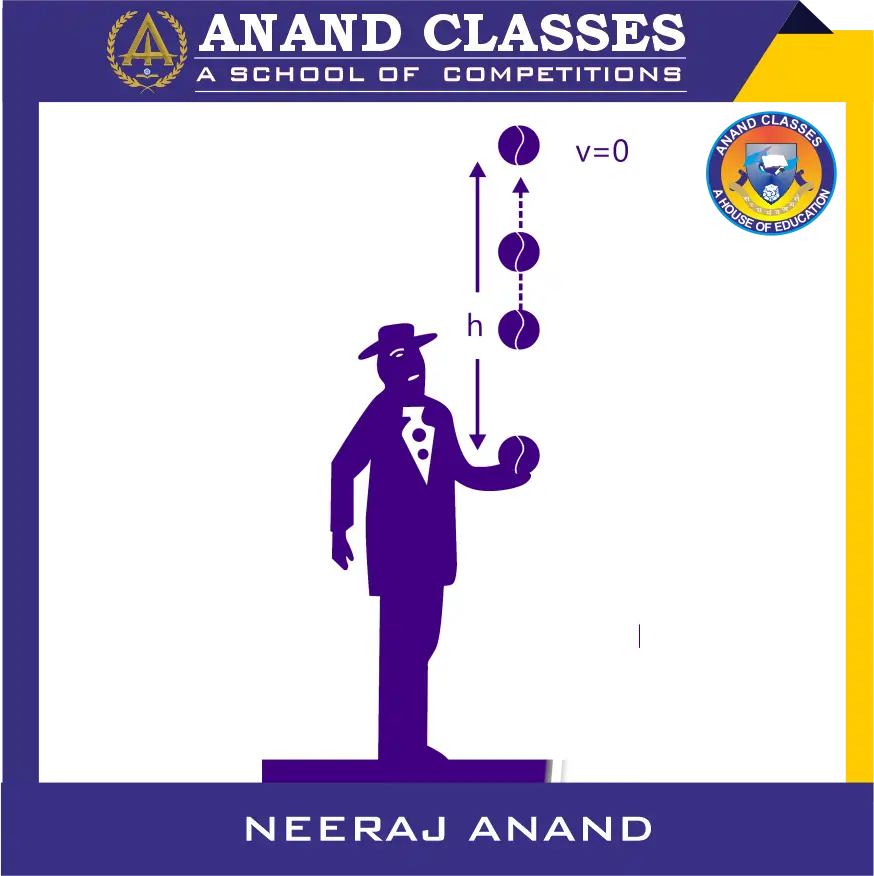
Considering the point of projection as origin and upward direction as positive :
Initial velocity = $+u$
Acceleration, $a = -g$ (since gravity acts downwards)
If a body is projected vertically upward with velocity $u$ and after time $t$ it reaches a height $y$, then the velocity ($v$) and position ($y$) of the object at any time t are
$$v = u – gt$$
$$y = ut – \frac{1}{2} gt^2$$
The velocity of the object at any position ($y$) (from the point where the object is thrown) is
$$v^2 = u^2 – 2gy$$
When the body reaches at Maximum height (H)
When the body reaches the maximum height (H), then final velocity $v = 0$ at Maximum Height (H).
At maximum height ($y = H$), final velocity $v = 0$.
Using equation $v^2 = u^2 – 2gy$
$$ 0 = u^2 – 2gH $$
$$2gH = u^2 $$
$$ H = \frac{u^2}{2g} $$
Time taken to reach maximum height
Let (t) be the time taken by body to reach maximum height (H) :
At maximum height, $v = 0$.
Using equation : $v = u – gt$
$$ 0 = u – gt $$
$$ gt = u $$
$$ t = \frac{u}{g} $$
Time of Flight (T)
Time of flight is the total time taken by the body to go up and come back to the ground (i.e., when displacement $h = 0$).
Using equation :
$$h = ut – \frac{1}{2} gt^2$$
$$
0 = uT – \frac{1}{2}gT^2
$$
$$
\Rightarrow \quad T\left(u – \frac{1}{2}gT\right) = 0
$$
$$
\Rightarrow \quad T = 0 \quad \text{or} \quad T = \frac{2u}{g}
$$
Thus, Time of Flight, $T = \dfrac{2u}{g}$
| Important Observations |
|---|
| Time of ascent = Time of descent Time taken to go up ($t_1$) = Time taken to come down ($t_2$) $$ t_1 = t_2 = \frac{u}{g} $$ |
| The speed with which the body is projected upwards is equal to the speed with which it returns to the ground. |
| The magnitude of velocity at any point is the same whether the body is moving upwards or downwards (only direction is opposite). |
JEE Main Problem :
Consider a ball being thrown upwards with an initial speed of $u$. Find out $u$ if the ball is at a height of 80 m and the interval between two times it passes this height is 6 s. (Take g = 10 m/s2)
Solution
When a body is thrown vertically upwards, it rises to a maximum height and then falls back down. Consequently, for any position below its peak height, the body will pass that point twice: once while moving upward (ascending) and once while moving downward (descending).
Initial velocity = $+u$ (upwards)
Acceleration due to gravity (a) = –g = -10m/s2 (downwards)
Displacement (s) = +80 m
Time interval between the two occurrences ($\Delta t$) = 6 s
Using the second equation of motion :
$$s = ut + \frac{1}{2}at^2$$
Substituting our values into the formula :
$$80 = ut + \frac{1}{2}(-10)t^2$$
$$80 = ut – 5t^2$$
Rearranging this into standard quadratic form ($at^2 + bt + c = 0$) :
$$5t^2 – ut + 80 = 0 \text{..(Equation 1)}$$
Let $t_1$ and $t_2$ be the two distinct times when the ball reaches a height of 80 m (where $t_2 > t_1$). These two times are the roots of Equation 1.
Using the standard quadratic formula $t = \dfrac{-b \pm \sqrt{b^2 – 4ac}}{2a}$ :
Lower time (ascending) : $t_1 = \dfrac{u – \sqrt{u^2 – 4(5)(80)}}{2(5)} = \dfrac{u – \sqrt{u^2 – 1600}}{10}$
Higher time (descending) : $t_2 = \dfrac{u + \sqrt{u^2 – 4(5)(80)}}{2(5)} = \dfrac{u + \sqrt{u^2 – 1600}}{10}$
According to problem, the time difference between these two points is 6 seconds ($\Delta t = t_2 – t_1 = 6\text{ s}$) :
$$\left(\frac{u + \sqrt{u^2 – 1600}}{10}\right) – \left(\frac{u – \sqrt{u^2 – 1600}}{10}\right) = 6$$
Combine the fractions:
$$\frac{\left(u + \sqrt{u^2 – 1600}\right) – \left(u – \sqrt{u^2 – 1600}\right)}{10} = 6$$
$$\frac{2\sqrt{u^2 – 1600}}{10} = 6$$
$$\frac{\sqrt{u^2 – 1600}}{5} = 6$$
$$\sqrt{u^2 – 1600} = 30$$
$$u^2 – 1600 = 900$$
$$u^2 = 900 + 1600$$
$$u^2 = 2500$$
$$u = \sqrt{2500} = 50\text{ m/s}$$
The initial upward speed of the ball is $50\text{ m/s}$.
(We disregard the negative square root since speed is a scalar magnitude).
“Read more about Acceleration & Retardation Definition, Units : Average, Instantaneous Acceleration“
CBSE Question :
A balloon is ascending at the rate of 14 m/s at a height of 98 m above the ground when a packet is dropped from the balloon. After how much time and with what velocity does the packet reach the ground? (Take g = 9.8 m/s2)
Solution :
When an object is dropped from a moving vehicle (like an ascending balloon), it inherits the instantaneous velocity of that vehicle due to inertia. Therefore, even though the packet is “dropped”, it initially moves upward with a speed of 14 m/s before gravity slows it down and pulls it back toward Earth.
To solve this efficiently, we can establish a consistent sign convention for our vectors : For Downward direction = Positive ($+$) and for Upward direction = Negative ($-$ ). Given Data based on Sign Convention :
Initial velocity of the packet ($u$) = -14 m/s (upward direction)
Vertical displacement (S) = +98 m (net displacement is downward, from the release point to the ground)
Acceleration due to gravity (a) = +g = +9.8 m/s2 (acts downward)
$$S = ut + \frac{1}{2}at^2$$
Substituting the given values into the formula :
$$98 = -14t + \frac{1}{2}(9.8)t^2$$
$$98 = -14t + 4.9t^2$$
Rearranging into standard quadratic form ($at^2 + bt + c = 0$) :
$$4.9t^2 – 14t – 98 = 0$$
$$7t^2 – 20t – 140 = 0$$
Now, apply the quadratic formula $t = \dfrac{-b \pm \sqrt{b^2 – 4ac}}{2a}$ :
$$t = \frac{-(-20) \pm \sqrt{(-20)^2 – 4(7)(-140)}}{2(7)}$$
$$t = \frac{20 \pm \sqrt{400 + 3920}}{14}$$
$$t = \frac{20 \pm \sqrt{4320}}{14}$$
Since $\sqrt{4320} \approx 65.73$ :
$$t = \frac{20 \pm 65.73}{14}$$
Time cannot be negative, so we choose the positive root :
$$t = \frac{20 + 65.73}{14} = \frac{85.73}{14} \approx 6.12\text{ s}$$
To Calculate the Final Velocity ($v$) Just Before Hitting the Ground,
Using the first equation of motion :
$$v = u + at$$
Substituting the known values ($u$ = -14 m/s, $a$ = 9.8 m/s2, and t = 6.12 s :
$$v = -14 + (9.8 \times 6.12)$$
$$v = -14 + 59.98$$
$$v = 45.98\text{ m/s}$$
(The positive sign shows that the final velocity points downward towards the ground).
“Understand related topics like Systems of Units | Seven Fundamental and Two Supplementary Units of SI, MKS, CGS, FPS“
CBSE Question
A parachutist bails out from an aeroplane and, after dropping through a distance of 40 m, opens his parachute and decelerates at 2 m/s2. If he reaches the ground with a speed of 2 m/s, how long is he in the air? At what height did he bail out from the plane? (Take g = 9.8 m/s2)
Solution :
We can divide the parachutist’s motion into two distinct stages :
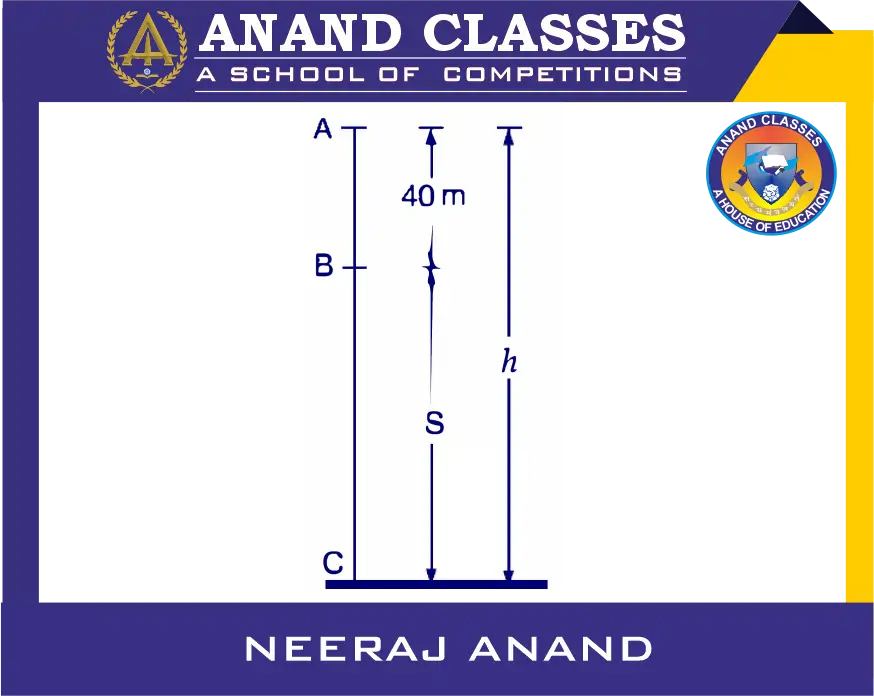
Stages 1 : Motion from Point A to Point B (Free Fall)
During this phase, the parachutist falls freely under gravity from rest.
Initial velocity ($u_1$) = 0 m/s (bails out from rest relative to vertical fall)
Distance fallen ($S_1$) = 40 m
Acceleration ($a_1$) = g = 9.8 m/s2
Step 1 : Find the time taken ($t_1$) in Stage 1
$$S_1 = u_1t_1 + \frac{1}{2}a_1t_1^2$$
$$40 = 0(t_1) + \frac{1}{2}(9.8)t_1^2$$
$$40 = 4.9t_1^2$$
$$t_1^2 = \frac{40}{4.9} = \frac{400}{49}$$
$$t_1 = \sqrt{\frac{400}{49}} = \frac{20}{7} \approx 2.86\text{ s}$$
Step 2 : Find the final velocity ($v_1$) at the end of Stage 1
$$v_1 = u_1 + a_1t_1$$
$$v_1 = 0 + 9.8 \times \frac{20}{7}$$
$$v_1 = 1.4 \times 20 = 28\text{ m/s}$$
Stage 2 : Motion from Point B to Point C (Deceleration Phase)
At point $B$, the parachute opens. The final velocity of Stage 1 ($v_1 = 28\text{ m/s}$) becomes the initial velocity ($u_2$) for this stage.
Initial velocity ($u_2$) = $28\text{ m/s}$
Final velocity ($v_2$) = $2\text{ m/s}$ (speed upon hitting the ground)
Acceleration ($a_2$) = $-2\text{ m/s}^2$ (negative because it is a deceleration)
Step 3 : Find the distance covered ($S_2$) in Stage 2
$$v_2^2 – u_2^2 = 2a_2S_2$$
$$(2)^2 – (28)^2 = 2(-2)S_2$$
$$4 – 784 = -4S_2$$
$$-780 = -4S_2$$
$$S_2 = \frac{-780}{-4} = 195\text{ m}$$
Step 4 : Find the time taken ($t_2$) in Stage 2
$$v_2 = u_2 + a_2t_2$$
$$2 = 28 + (-2)t_2$$
$$2t_2 = 28 – 2$$
$$2t_2 = 26$$
$$t_2 = 13\text{ s}$$
1. Total Time in the Air ($t$)
The total time the parachutist remains in the air is the sum of the times from both stages :
$$t = t_1 + t_2$$
$$t = \frac{20}{7}\text{ s} + 13\text{ s} \approx 2.86\text{ s} + 13\text{ s} = 15.86\text{ s}$$
2. Initial Bailing Height ($h$)
The total height from which the parachutist bailed out is the sum of the distances from both stages :
$$h = S_1 + S_2$$
h = 40 m + 195 m = 235 m
To strengthen your concepts, learn about Relative Velocity Formula Explained With Solved Examples
CBSE Question
A ball is allowed to fall from the top of a tower 200 m high. At the same instant, another ball is thrown vertically upwards from the bottom of the tower with a velocity of 40 m/s. When and where will the two balls meet? (Take g = 9.8 m/s2)
Solution :
Suppose the two balls meet at a point P after an elapsed time t from the start. Let this meeting point P be at a height h above the ground.
As a result :
The ball thrown from the bottom travels an upward distance equal to $h$.
The ball dropped from the top travels a downward distance equal to $(200 – h)$.
Motion of the ball dropped from the top
For this ball, we consider the downward direction as positive.
Initial velocity ($u_1$) = 0 m/s (dropped from rest)
Displacement ($S_1$) = 200 – h
Acceleration ($a_1$) = +g = 9.8 m/s2
Using the second equation of motion ($S = ut + \frac{1}{2}at^2$) :
$$200 – h = 0(t) + \frac{1}{2}(9.8)t^2$$
$$200 – h = 4.9t^2 \text{.. (Equation 1)}$$
Motion of the ball thrown vertically upwards
For this ball, we consider the upward direction as positive.
Initial velocity ($u_2$) = 40 m/s
Displacement ($S_2$) = h
Acceleration ($a_2$) = –g = -9.8 m/s2 (acting downward against the motion)
Using the second equation of motion :
$$h = 40t + \frac{1}{2}(-9.8)t^2$$
$$h = 40t – 4.9t^2 \text{.. (Equation 2)}$$
Solve for the time ($t$) when they meet
To eliminate the height variable h, add Equation 1 and Equation 2 together :
$$(200 – h) + h = (4.9t^2) + (40t – 4.9t^2)$$
$$200 = 40t$$
$$t = \frac{200}{40} = 5\text{ s}$$
The two balls will meet exactly 5 seconds after they are released.
Solve for the position (h) where they meet
Substitute the value of t = 5 s back into Equation 2 to find the height above the ground :
h = 40(5) – 4.9(5)2
h = 200 – 4.9(25)
h = 200 – 122.5
h = 77.5 m
Alternative Shortcut Method: Relative Motion
Since both objects experience the exact same acceleration due to gravity ($g$) downward, their relative acceleration ($a_{\text{rel}}$) is zero:
$$a_{\text{rel}} = a_1 – a_2 = (-g) + (g) = 0$$
The relative initial velocity ($v_{\text{rel}}$) between them approaching each other is :
$$v_{\text{rel}} = 40\text{ m/s} + 0\text{ m/s} = 40\text{ m/s}$$
The total relative distance separating them is the full height of the tower ($200\text{ m}$) :
$$t = \frac{\text{Relative Distance}}{\text{Relative Velocity}} = \frac{200\text{ m}}{40\text{ m/s}} = 5\text{ s}$$
CBSE Question
A stone let fall from the top of a tower traverses a distance of 24.5 m in the last second of its fall. Find the height of the tower. (Take g = 9.8 m/s2)
Solution :
Initial velocity ($u$) = 0 m/s (dropped from rest)
Distance traveled in the last second of its motion ($S_{n^{\text{th}}}$) =24.5 m
Acceleration due to gravity (g) = 9.8 m/s2
Let us assume that the stone takes a total time of n seconds to reach the ground. This means the “last second” of its motion corresponds precisely to the $n^{\text{th}}$ second.
The formula for the distance traveled by a uniformly accelerating body during its specific $n^{\text{th}}$ second of motion is :
$$S_{n^{\text{th}}} = u + \frac{g}{2}(2n – 1)$$
$$24.5 = 0 + \frac{9.8}{2}(2n – 1)$$
$$24.5 = 4.9(2n – 1)$$
$$2n – 1 = \frac{24.5}{4.9}$$
$$2n – 1 = 5$$
$$2n = 6$$
$$n = 3\text{ s}$$
The stone takes a total of 3 seconds to fall from the top of the tower to the ground.
Now that we know the total travel time (t = n = 3 s), we can calculate the total vertical distance (height h) using the second equation of motion :
$$h = ut + \frac{1}{2}gt^2$$
Substituting $u = 0$, $g = 9.8\text{ m/s}^2$, and $t = 3\text{ s}$ :
$$h = 0(3) + \frac{1}{2}(9.8)(3)^2$$
$$h = 4.9 \times 9$$
$$h = 44.1\text{ m}$$
The total height of the tower is $44.1\text{ meters}$.
Body Thrown Vertically Upward from a Height : Equations of Motion
When an object is thrown in upward direction, velocity is upwards whereas acceleration acts downwards, i.e. they are in opposite directions. Hence initially the object undergoes retardation and rises through a certain height and then it undergoes free fall from that height.
Let’s say a body is thrown vertically upward from a height h with initial velocity $u$. It will :
(i) Rise to a maximum height where its velocity becomes zero.
(ii) Then fall back down past the initial height and eventually hit the ground.
Upward Motion (until max height)
At max height :
Final velocity $v = 0$
Acceleration $a = -g$
Using the equation of motion :
$$v = u – gt$$
$$0 = u – gt_1$$
$$ t_1 = \frac{u}{g}$$
Time to reach maximum height :
$$t_1 = \frac{u}{g}$$
Maximum height above projection point :
Using the equation of motion $$v^2 = u^2 – 2g h_1$$
$$0 = u^2 – 2g h_1$$
$$h_1 = \frac{u^2}{2g}$$
Downward Motion (from top to ground)
Now the body starts falling from a height :
$$H = h + h_1 = h + \frac{u^2}{2g}$$
It starts from rest at height H and falls under gravity.
Time to fall from maximum height to ground (t2) :
Using Equations of Motion :
$$s = \frac{1}{2}gt^2$$
$$H = \frac{1}{2}gt_2^2 $$
$$ t_2 = \sqrt{\frac{2H}{g}} $$
$$ t_2 = \sqrt{\frac{2(h + \dfrac{u^2}{2g})}{g}}$$
Total Time of Flight
$$T = t_1 + t_2 = \frac{u}{g} + \sqrt{\frac{2(h + \dfrac{u^2}{2g})}{g}}$$
Velocity Just Before Hitting Ground
Use $v^2 = u^2 + 2gH$, where $u = 0$ (because it’s falling from rest at maximum height) : $$v = \sqrt{2g(h + \frac{u^2}{2g})}$$
JEE Main Question
A ball is thrown upwards from a $40\text{ m}$ high tower with a velocity of $10\text{ m/s}$. Calculate the time when it strikes the ground. (Take $g = 10\text{ m/s}^2$)
Solution :
Height of the tower ($h$) = $40\text{ m}$
Initial upward velocity ($u$) = $10\text{ m/s}$
Acceleration due to gravity ($g$) = $10\text{ m/s}^2$
Stage 1: Upward Motion (From the top of the tower to maximum height)
In this phase, the ball rises until its velocity momentarily drops to zero at its highest point.
Time taken to reach maximum height ($t_1$) :$$t_1 = \frac{u}{g}$$$$t_1 = \frac{10}{10} = 1\text{ s}$$
Maximum height reached above the tower ($h_1$) :$$h_1 = \frac{u^2}{2g}$$$$h_1 = \frac{10^2}{2 \times 10} = \frac{100}{20} = 5\text{ m}$$
Stage 2 : Downward Motion (From maximum height to the ground)
Now, the ball treats the highest point as its new starting position. It falls from rest under the influence of gravity to the ground.
Total height above the ground ($H$) :$$H = h + h_1$$$$H = 40\text{ m} + 5\text{ m} = 45\text{ m}$$
Time taken to fall from maximum height to the ground ($t_2$) :$$t_2 = \sqrt{\frac{2H}{g}}$$$$t_2 = \sqrt{\frac{2 \times 45}{10}}$$$$t_2 = \sqrt{\frac{90}{10}} = \sqrt{9} = 3\text{ s}$$
Stage 3 : Total Time of Flight ($T$)
The total time elapsed from the moment the ball is thrown until it strikes the ground is the sum of the upward and downward travel times:
$$T = t_1 + t_2$$
$$T = 1\text{ s} + 3\text{ s} = 4\text{ s}$$
The ball strikes the ground $4\text{ seconds}$ after it is thrown.
“Read Full Chapter Notes Motion in a Straight Line“
FAQs Very Short Question and Answers based on on Equations of Motion Under Gravity
What are equations of motion under gravity?
Equations of motion under gravity are mathematical relations used to describe the motion of objects moving vertically under the influence of Earth’s gravitational force. These equations are applied when a body falls freely downward or is projected upward. They help in calculating velocity, height, distance travelled, and time taken during motion.
What is meant by free fall?
Free fall is the motion of a body when gravity is the only force acting on it. In this type of motion, air resistance is neglected and the body accelerates continuously towards the Earth. Examples include a stone dropped from a height or a fruit falling from a tree.
What happens when a body is thrown vertically upward?
When a body is thrown vertically upward, gravity acts downward and gradually reduces its speed. After reaching the maximum height, the body momentarily comes to rest before starting to fall back towards the Earth. This motion is an important application of equations of motion under gravity.
Why is acceleration due to gravity important in vertical motion?
Acceleration due to gravity determines how quickly the velocity of a body changes during vertical motion. It acts downward in both free fall and upward motion. The value of gravitational acceleration is nearly constant near the Earth’s surface, which makes calculations easier.
What is the difference between upward motion and downward motion under gravity?
In downward motion, gravity increases the speed of the falling body with time. In upward motion, gravity acts opposite to the direction of motion and decreases the speed of the body until it stops momentarily at the highest point. Both motions are analysed using the same principles of kinematics.
What is meant by maximum height in upward motion?
Maximum height is the highest point reached by a body thrown vertically upward. At this point, the velocity of the body becomes zero for a brief moment before it starts descending. The maximum height depends on the initial speed with which the body is projected upward.
What is the time of flight in vertical motion?
Time of flight is the total time taken by a body to complete its upward and downward journey. It includes the time taken to rise upward and the time taken to return to the original position. This concept is widely used in projectile and vertical motion problems.
Can equations of motion under gravity be applied in daily life?
Yes, these equations are useful in understanding many real-life situations such as falling objects, jumping, throwing balls upward, parachuting, and the motion of rockets. They are also important in engineering, sports science, and space research.
Why is air resistance usually neglected in free fall problems?
Air resistance is neglected to simplify calculations and focus only on the effect of gravity. In ideal free fall motion, gravity is considered the only force acting on the body. This assumption helps students understand the basic concepts of motion more clearly.
Why are equations of motion under gravity important for students?
These equations form an important part of kinematics and are frequently asked in school examinations, competitive exams, and engineering entrance tests. They help students develop problem-solving skills and build a strong conceptual understanding of mechanics and motion.
Important Units and Measurement Chapter Links
To strengthen your understanding, you should also study Dimensional Analysis and Dimensional Formulae of Physical Quantities and the Principle of Dimensional Homogeneity, which are closely related to unit conversion. It is also helpful to revise Units and Measurements for basic concepts and practice JEE Main Previous Year Questions (PYQs) and IMU CET PYQs to improve problem-solving skills. Exploring these related topics on this website will help you master numerical applications effectively.