Distance and displacement are fundamental concepts in kinematics that describe how an object moves from one position to another. While distance represents the total path traveled, displacement gives the shortest straight-line distance along with direction. Understanding these concepts is essential for solving numerical problems and answering conceptual questions accurately. This section includes solved numericals and conceptual questions with answers to strengthen problem-solving skills and clarify key differences between distance and displacement.
Understand Distance Travelled and Displacement
In everyday language, the words distance and displacement are used in the same sense but in physics these two words have different meanings. Let us understand this difference by taking with an example as follows.
Imagine a man who lives at Point A and needs to reach Point C. However, before reaching C, he must meet his friend at Point B. He starts from A, travels 5 km to B, and then continues for 3 km to C. The total path he follows, ABC, represents the actual distance traveled, which is 8 km.
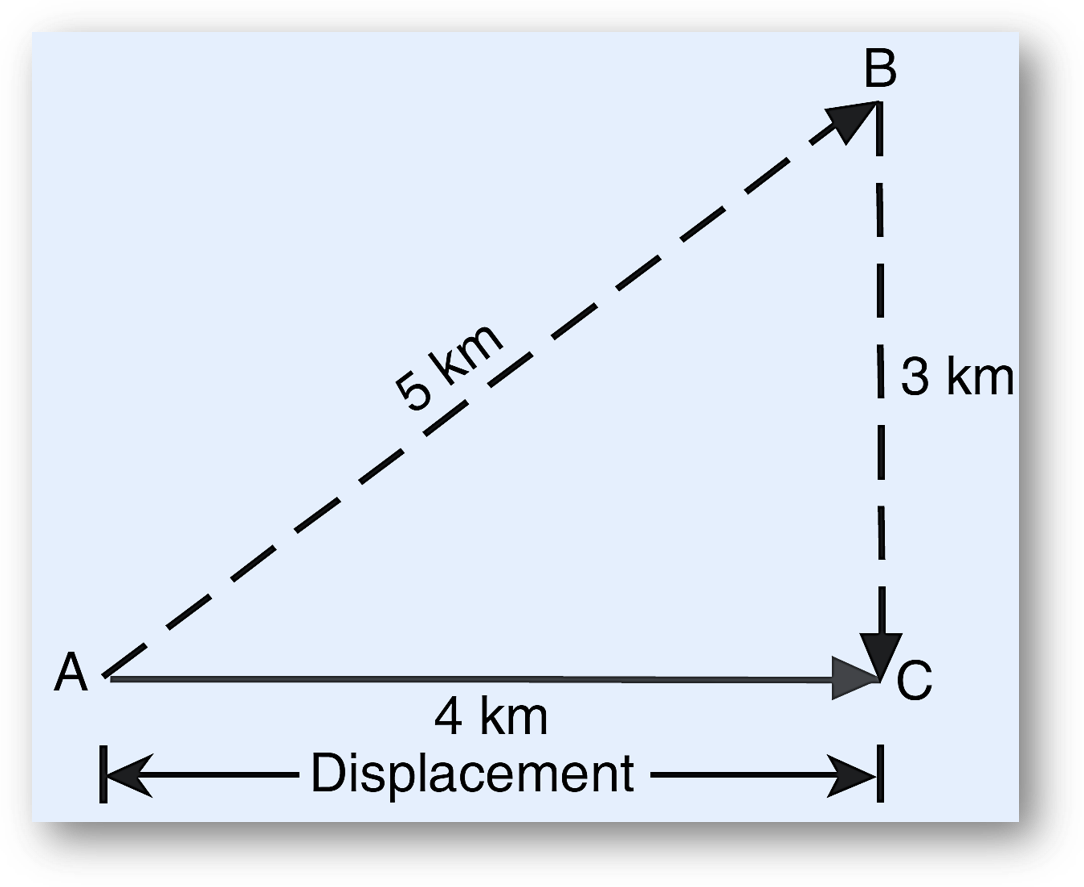
Displacement = 4 km towards East.
Understanding Distance
The distance traveled by a moving body is the actual length of the path covered, regardless of direction. In this case :
Total Distance = 5 km + 3 km = 8 km
Understanding Displacement
Now, let’s analyze the shortest route. Instead of following the indirect path ABC, we draw a straight line from A to C, measuring 4 km. This straight-line distance (AC) is called displacement. It tells us how far the man is from his starting point, along with direction.
AB2 = AC2 + BC2
AC2 = AB2 – BC2
AC2 = 52 – 32
AC = 4 km
Displacement = 4 km (East direction)
Hence,
Distance is the total path covered (8 km).
Displacement is the shortest straight-line distance between the start and end points (4 km, East).
Distance Explanation
Definition : Distance is the actual path length covered by a moving particle in a given interval of time.
Key Features :
Distance is always positive and never decreases.
Distance is a Scalar Quantity (Has only magnitude, no direction).
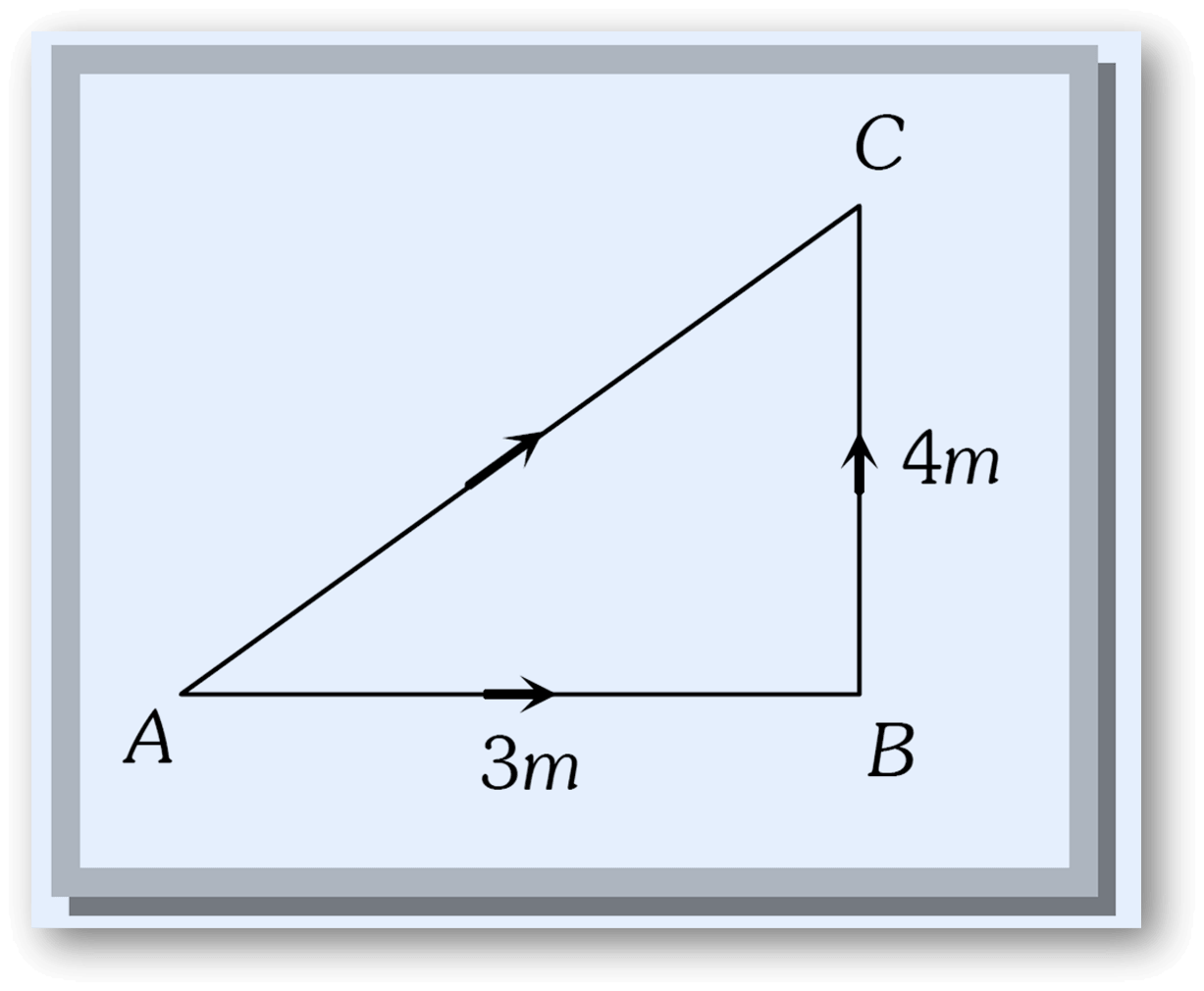
Formula : If a particle starts from A and reaches C through B, then Distance traveled = AB + BC = 7 m
Dimension of Distance : [M⁰L1T⁰]
SI Unit of Distance: metre (m)
Displacement Explanation
Definition : Displacement is the shortest distance between the initial and final position of a particle in a given time.
Key Features :
Displacement is a vector Quantity (Has both magnitude and direction).
Formula : Displacement of the particle from A to C in the above diagram is given by :
|AC| = √[(AB)² + (BC)² + 2(AB)(BC)cos90°] = 5m
Dimension : [M⁰L1T⁰]
SI Unit : metre (m)
Vector Addition Rule : If a body undergoes multiple displacements S₁, S₂, S₃, …, Sₙ, then the net displacement is vector sum : S = S₁ + S₂ + S₃ + … + Sₙ
“To understand this topic better, learn about Velocity Definition, Units, Dimensions: Uniform and Non Uniform, Instantaneous, Average Velocity“
Can Distance Be Zero ? Can Displacement Be Zero ?
Distance can never be zero as long as the body moves.
Displacement can be zero if the body returns to its starting point.
Following two examples where a body travels a certain distance but the final displacement of the body is zero.
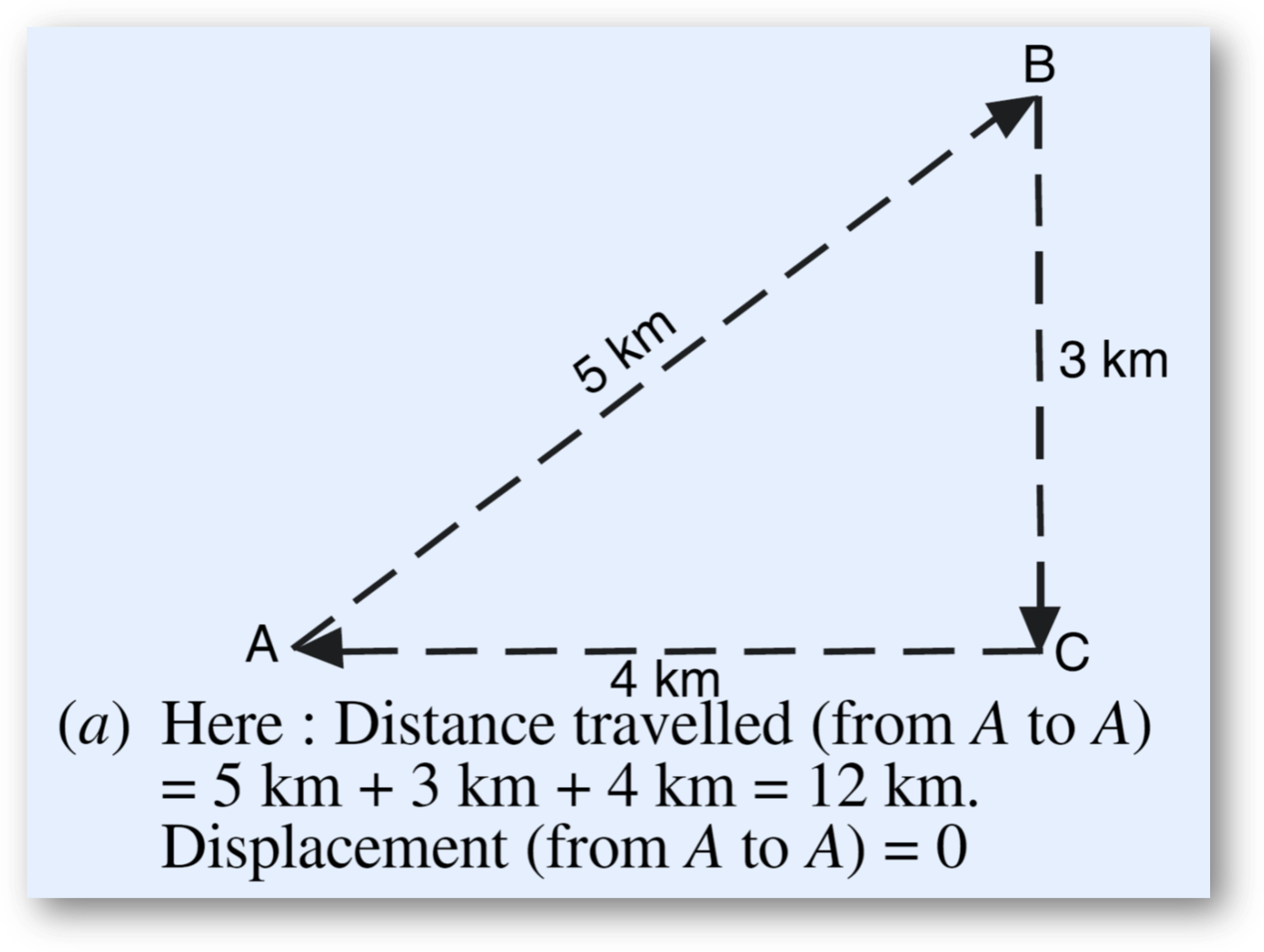
Example.1
A man travels: 5 km from A to B, 3 km from B to C and 4 km from C back to A
Total Distance tarvelled = 5 km + 3 km + 4 km = 12 km
Total Displacement = 0 km (since he is back at A)
Example.2
Example: Completing one full lap on a circular track → Distance = Circumference = 2πr, Displacement = 0.
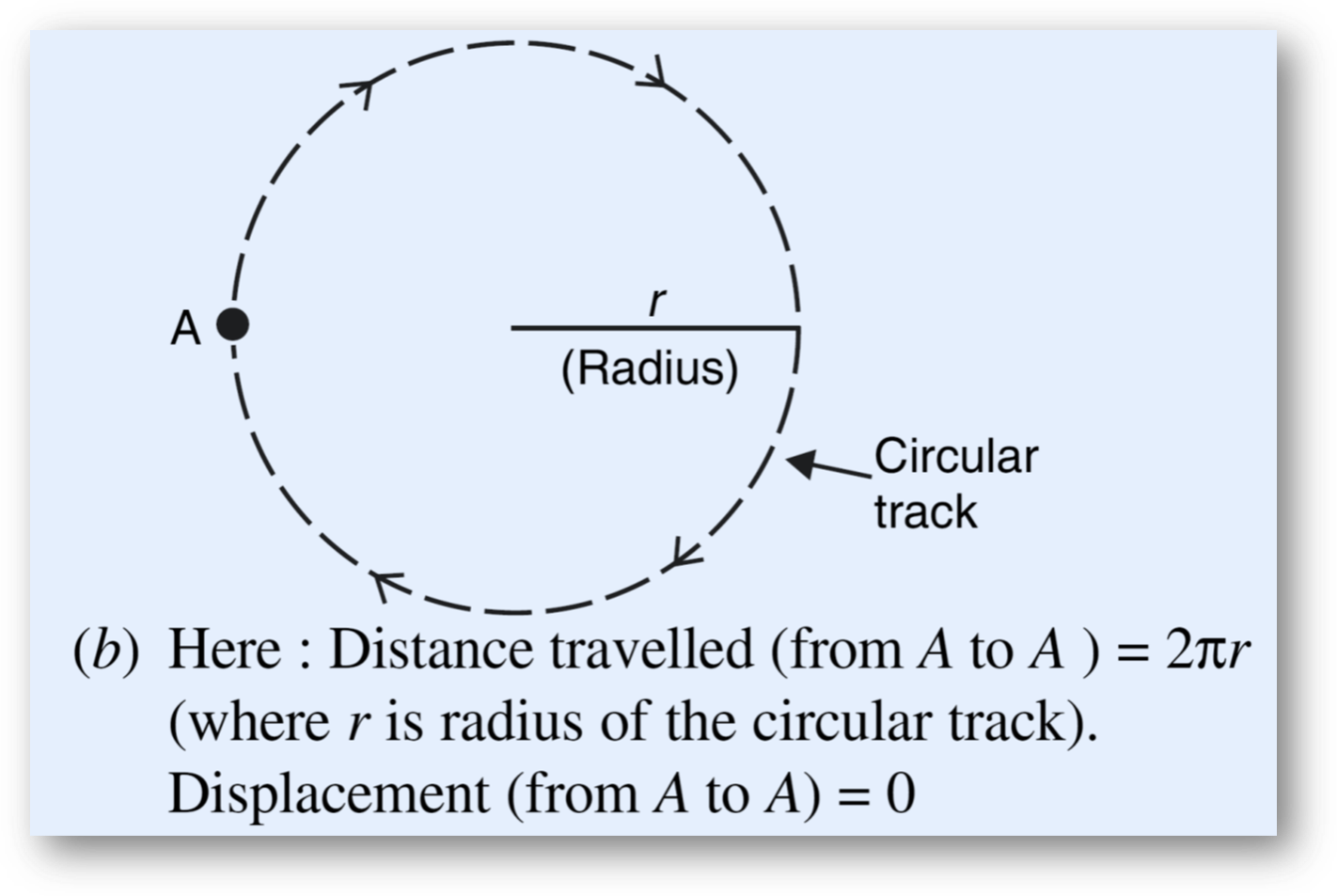
From the above discussion, the following conclusions may be drawn about the displacement :
- The displacement has units of length.
- The displacement of an object in a given time interval can be positive, zero or negative.
- The actual distance travelled by an object in a given time interval is either equal to or greater than the magnitude of the displacement.
Thus, the displacement of an object between two points tells the shortest distance between these two points. - The displacement of an object between two points does not tell exactly how the object actually moved between those two points.
| Key Point |
|---|
| The actual distance travelled by an object in a given time interval can be equal to or greater than the magnitude of displacement. It can never be less than the magnitude of displacement. |
| The displacement of an object in a given time interval can be positive, zero or negative. However, distance covered by the object in a given time interval is always positive. |
Difference Between Distance and Displacement
Here is a clear tabular comparison between distance and displacement:
| Property | Distance | Displacement |
|---|---|---|
| Definition | Total length of the actual path traveled by an object. | Shortest straight-line path between the initial and final positions. |
| Nature | Scalar quantity (has only magnitude). | Vector quantity (has both magnitude and direction). |
| Magnitude | Always positive and greater than or equal to displacement. | Can be positive, zero, or negative. |
| Value | Can have multiple values depending on the path taken. | Single-valued for a given motion. |
| Change with Time | Always increases or remains constant. | Can increase, decrease, or become zero. |
| Equality Condition | Equal to displacement only when motion is in a straight line without changing direction. | Always equal to the shortest path between two points. |
| Mathematical Relation | Distance > 0 | Displacement > = or < 0 |
| Representation | Represented by a curved or straight path. | Represented by a straight line from initial to final position. |
Note : The magnitude of displacement is equal to minimum possible distance between two positions. So
Distance ≥ |Displacement|.
Graphical illustration of Distance and Displacement
Here is a graphical illustration of distance and displacement. The curved path APB represents the actual distance traveled, while the straight arrow from A to B represents the displacement vector rAB
Imagine a particle moving from point A to point B along a curved path APB.
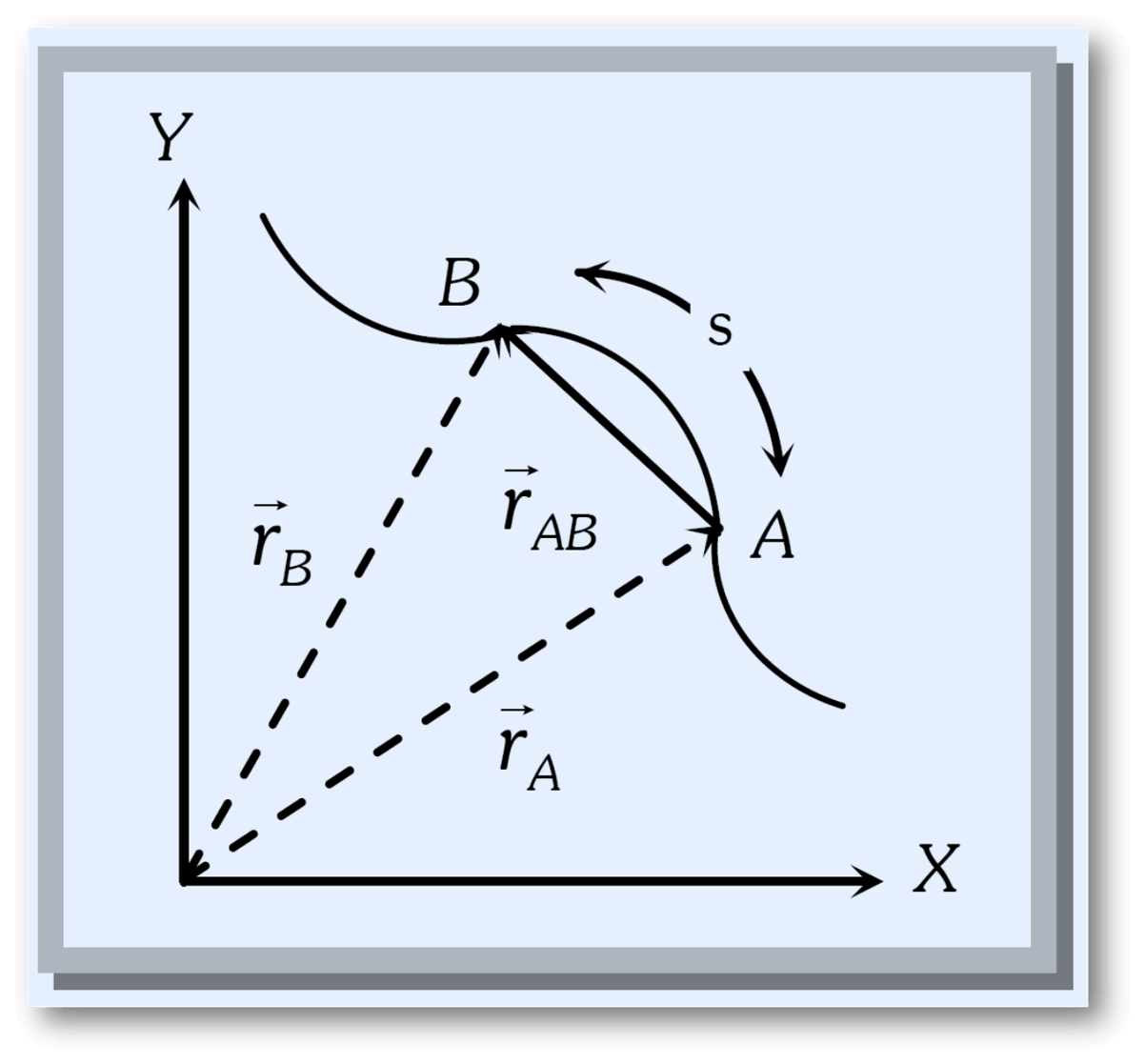
- Distance (s) : The total length of the path APB traveled by the particle.
- Displacement rAB : The straight-line vector from A to B.
- rAB = rB – rA
Solved Numerical Problems Based on Distance and Displacement
A car moves 600 m east and then 400 m west. Find (i) The total distance traveled (ii) The displacement
Solution :
Total distance traveled : \begin{array}{l} S = 600 + 400 = 1000 \text{ m} \end{array}
Displacement : \begin{array}{l} D = 600 – 400 = 200 \text{ m} \quad (\text{towards east}) \end{array}
A person walks 6 m east and then 8 m north. Find (i) The total distance traveled (ii) The displacement
Solution:
Total distance traveled : $$ S = 6 + 8 = 14 \text{ m} $$
Displacement using the Pythagorean theorem : \begin{array}{l} D = \sqrt{6^2 + 8^2} = \sqrt{36 + 64} = \sqrt{100} = 10 \text{ m} \end{array}
A runner moves along a circular track of radius 14 m and completes half a revolution. Find (i) The distance traveled (ii) The displacement
Solution:
Distance traveled : \begin{array}{l} S = \pi r = \pi (14) = 44 \text{ m} \quad (\text{using} \, \pi \approx 3.14) \end{array}
Displacement (diameter of the circle) : \begin{array}{l} D = 2r = 2(14) = 28 \text{ m} \end{array}
A man travels in the following sequence : 1.5 m East, 2.0 m South and 4.5 m East (i) What is the total distance traveled? (ii) What is the resultant displacement? [CBSE]
Solution :
Total distance = 1.5 + 2.0 + 4.5 = 8.0 m
To determine the resultant displacement, we trace his path on a diagram.
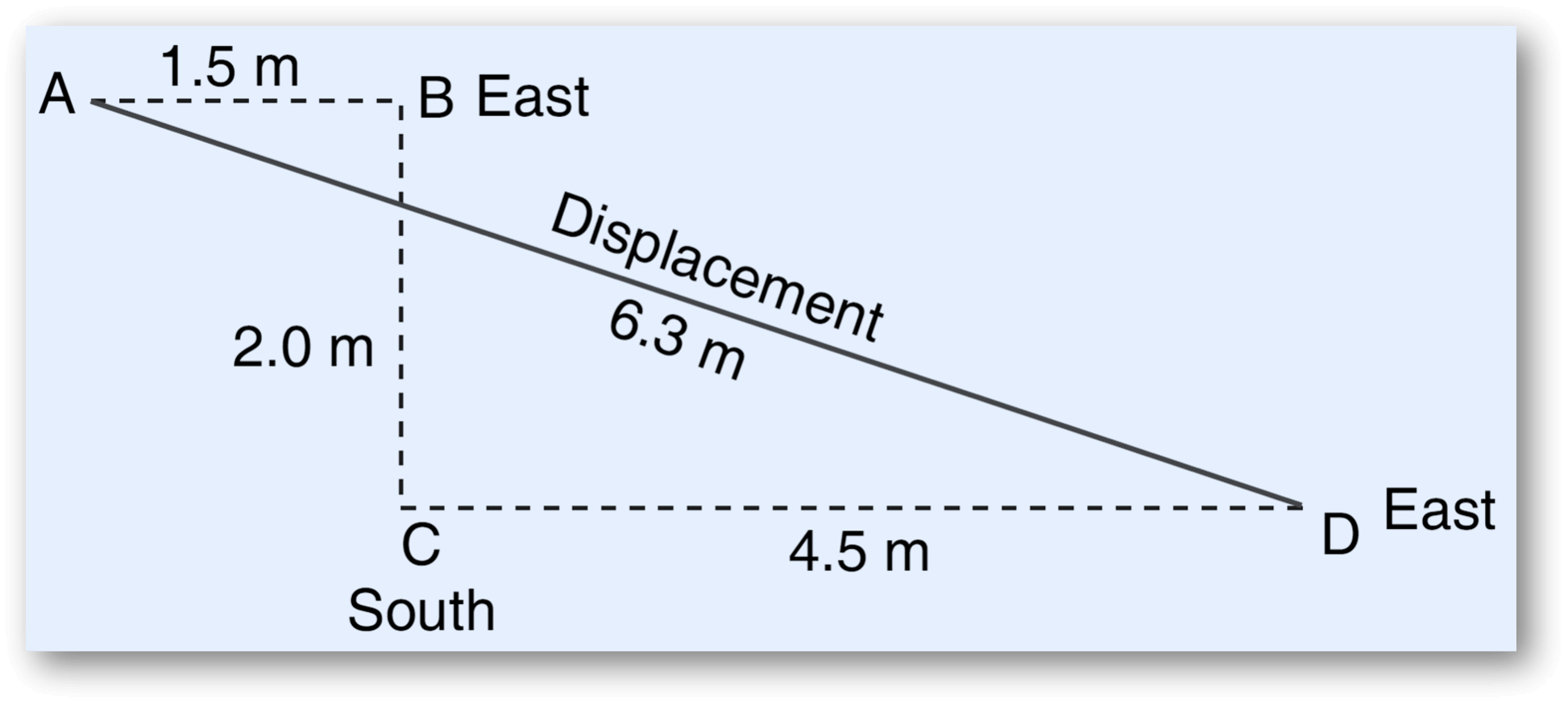
Draw 1.5 m East (AB)
Draw 2.0 m South (BC)
Draw 4.5 m East (CD)
Now, the resultant displacement is represented by a straight line from the starting point A to the final point D. Measuring the length of AD, we get 6.3 m.
AD2 = (AB + CD)2 + BC2
AD2 = (1.5 + 4.5)2 + 22
AD = 6.3 m.
Final displacement = 6.3 m
A man walks 10 meters towards the north and then 20 meters towards the east. What is his displacement? [AIPMT]
Solution :
Given, a man moves 10m North and then 20m East.
Taking East as x-axis and North as y-axis, the displacement vector d is:
\begin{array}{l} \mathbf{d} = 20 \hat{i} + 10 \hat{j} \end{array}
Magnitude of displacement: \begin{aligned}
\text{|d|} &=\begin{array}{l} \sqrt{20^2 + 10^2} = \sqrt{400 + 100} = \sqrt{500} = 10\sqrt{5} \approx 22.5 \text{m} \end{array}\end{aligned}
A man walks 3 m north, 4 m east, and then 3 m south. What is the net distance and displacement?
Solution :
Net distance is \begin{array}{l} S = 3 + 4 + 3 = 10 \text{ m} \end{array}
Displacement is
\begin{array}{l} D = 4 \text{ m (east, as north-south cancels out)} \end{array}
A body moves over one-fourth of a circular arc in a circle of radius r. What are the distance traveled and displacement? [Olympiads]
Solution:
Let particle start from A, its position vector rA and after one quarter position vector rB
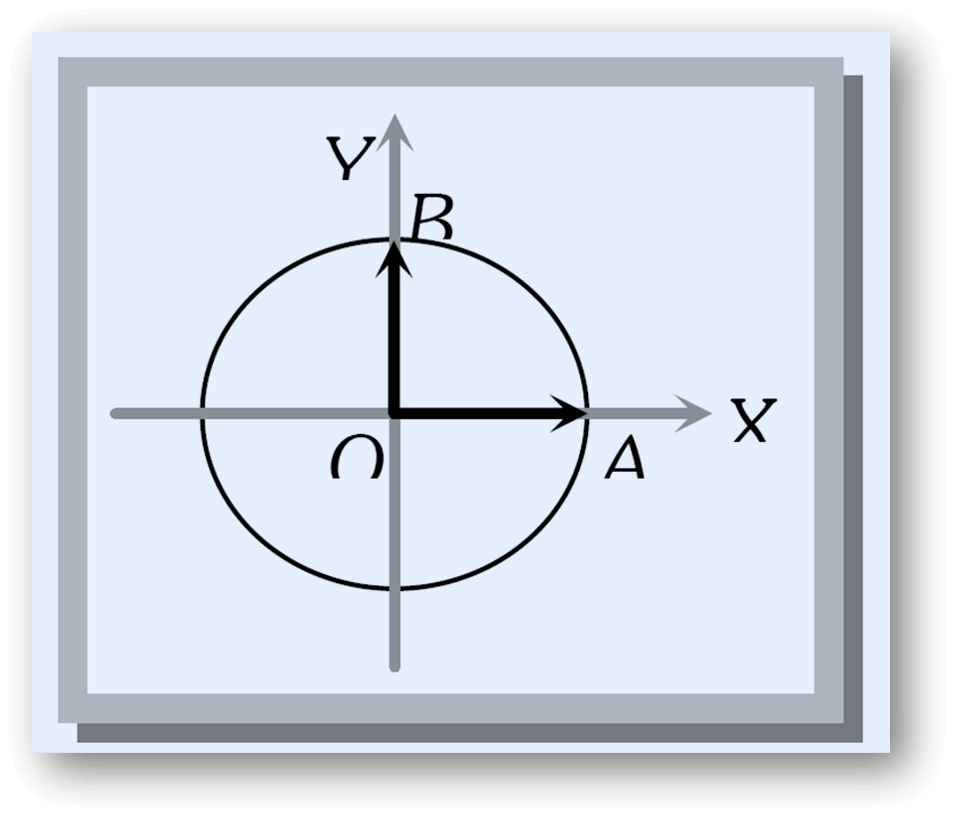
Position vectors :
Initial position at A :
\begin{array}{l} \mathbf{r}_A = r \hat{i} \end{array}
Final position at B (after 90° movement) :
\begin{array}{l} \mathbf{r}_B = r \hat{j} \end{array}
Displacement : \begin{array}{l} \mathbf{d} = \mathbf{r}_B – \mathbf{r}_A = r\hat{j} – r\hat{i} \end{array}
Magnitude of displacement: \begin{array}{l} |\mathbf{d}| = \sqrt{r^2 + r^2} = r\sqrt{2} \end{array}
Distance traveled (arc length): \begin{array}{l} \text{Distance} = \frac{1}{4} \times 2\pi r = \frac{\pi r}{2} \end{array}
When a wheel rolls forward by half a revolution, what is the displacement of the initial contact point with the ground? The radius of the wheel is R. [AIEEE]
Solution:
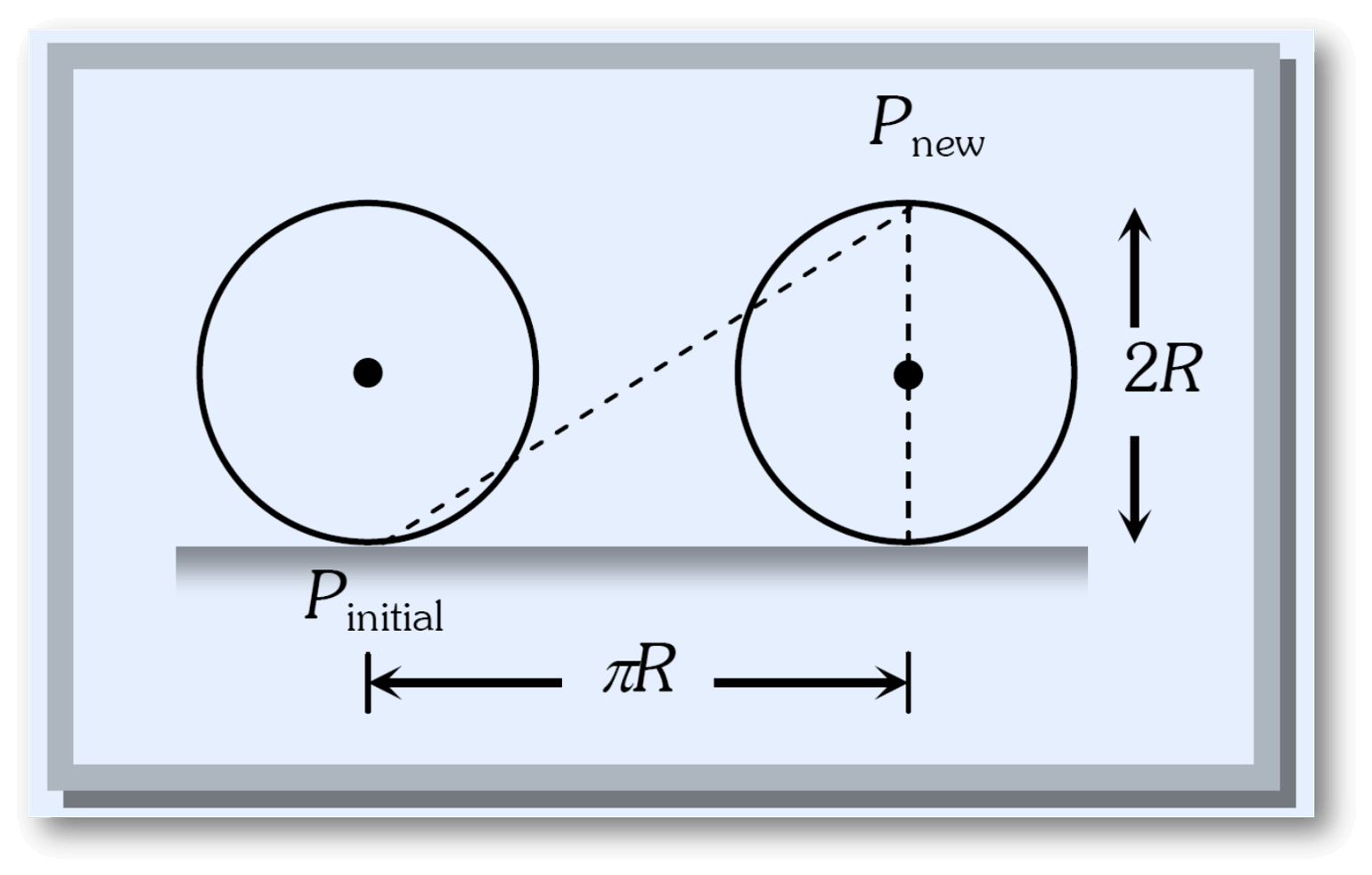
Horizontal distance covered by the wheel in half a revolution : \begin{array}{l} \text{Distance} = \pi R \end{array}
Vertical displacement of the point (moves from bottom to top of the wheel) : \begin{array}{l} \text{Vertical shift} = 2R \end{array}
Total displacement (using Pythagoras theorem) : \begin{array}{l} d = \sqrt{(\pi R)^2 + (2R)^2} \end{array} \begin{array}{l} d = R \sqrt{\\π^2 + 4} \end{array}
Exam Oriented Conceptual Frequently Asked Questions and Answers (FAQs)
What is the difference between distance and displacement?
Distance is the total length of the path traveled, while displacement is the shortest distance from the start to end point, considering direction.
Can displacement be greater than distance?
No, displacement is always equal to or smaller than distance.
Why is displacement a vector quantity?
Because it has both magnitude and direction.
Give an example where displacement is zero but distance is not.
If a person walks around a circular track and returns to the starting point, displacement is zero but distance is the entire circumference traveled.
If a body returns to its starting point, what is the displacement?
Zero, because the initial and final positions coincide.
State the unit and dimension of distance and displacement.
SI Unit : Metre (m)
Dimension : [M⁰L¹T⁰]
Can a body have zero displacement but nonzero distance?
Yes, when it returns to its starting point.
Why is displacement always a straight line?
Because it is the shortest path between two points.
Can displacement be negative?
No, but it can have a direction opposite to reference.
Important Chapter Interlinks
Explore the fundamentals of mechanics, including statics and dynamics, to understand how forces and motion govern physical systems. Learn the differences between kinematics and kinetics, where kinematics describes motion without considering forces, while kinetics explains motion with forces. This section also covers motion in one, two, and three dimensions, helping you build a strong conceptual base for solving problems in physics and preparing for exams like JEE and IMUCET.
The previous chapter on Units and Measurements in Class 11 Physics builds a strong foundation for all topics in mechanics by covering physical quantities, systems of units, SI base and derived units, prefixes, dimensional analysis, and significant figures. It also explains errors in measurement, accuracy, precision, and methods of error propagation, which are essential for solving numerical problems correctly. These concepts are frequently tested in JEE PYQs and IMUCET PYQs, making them crucial for exam preparation. A clear understanding of units and dimensions helps in verifying equations, converting units, and simplifying complex problems in kinematics, laws of motion, work, energy, and other mechanics topics. This complete chapter notes section connects theoretical concepts with practical problem-solving, ensuring a smooth transition to advanced mechanics topics.