What is Mechanics, Statics, Dynamics, Kinematics, and Kinetics is a fundamental topic in physics that introduces the study of motion and forces. Mechanics is the branch of physics that deals with the behavior of objects under the influence of forces. It is divided into statics, which studies bodies at rest, and dynamics, which studies bodies in motion. Dynamics is further divided into kinematics, which describes motion without considering forces, and kinetics, which explains motion by considering the forces causing it. This topic forms the foundation for Class 11 Physics and is essential for exams like JEE, NDA, IMUCET, and Merchant Navy entrance tests.
What is Mechanics?
Mechanics is the branch of physics that studies motion, forces, and the behavior of physical bodies in response to various external influences. It provides a framework for understanding how objects move, interact, and change over time.
What are the Types of Mechanics ?
Mechanics can be broadly classified into three main types :
1. Classical Mechanics
Classical Mechanics deals with the motion of macroscopic objects at speeds much slower than the speed of light. Also known as Newtonian mechanics. Classical Mechanics based on the principles formulated by Sir Isaac Newton in the 17th century, particularly his three laws of motion. Examples :
- Motion of a car on the road.
- Free-fall of an object under gravity.
2. Quantum Mechanics
Quantum Mechanics deals with the behavior of particles at the atomic and subatomic level. This theory developed in the early 20th century to explain phenomena that classical mechanics cannot, such as : wave-particle duality of matter and light. Quantum Mechanics used in modern technology, such as semiconductors and lasers.
3. Statistical Mechanics
Statistical Mechanics explains the macroscopic properties of matter based on the behavior of its microscopic constituents (atoms and molecules). This theory provides a statistical framework for understanding the thermal and mechanical properties of systems composed of a large number of particles. Statistical Mechanics used in thermodynamics and material science.
Discuss the Classification of Mechanics
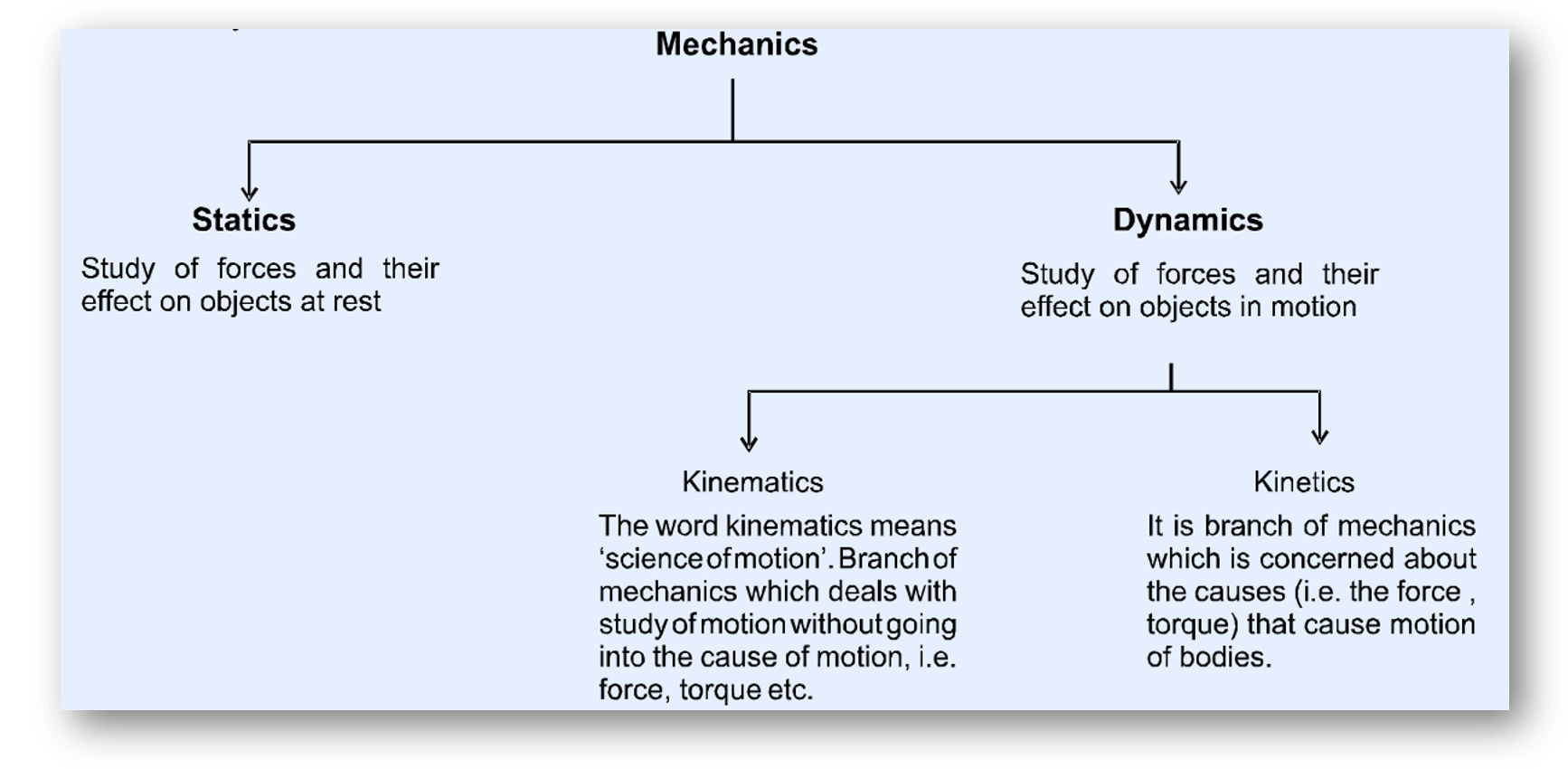
Statics and dynamics are the two main branches of mechanics. Whereas statics is the study of the objects at rest, dynamics is the study of objects in motion. An object can have uniform motion, even when a number of forces are acting on it. Such forces are said to be in equilibrium. Thus, statics is the study of the motion of an object under the effect of forces in equilibrium.
1. Statics
Statics deals with objects that are at rest or in equilibrium. It studies forces acting on stationary bodies. Examples of statics include bridges, buildings, and objects under equilibrium conditions.
2. Dynamics
The study of the motion of the objects by taking into account the cause (or causes) of their change of state (rest or of uniform motion) is called dynamics.
Example of Dynamics : A football being kicked involves dynamics since the applied force determines its motion, speed, and direction.
The word dynamics comes from the Greek word “dynamis” meaning power.
Dynamics is further divided into Kinematics and Kinetics :
a) Kinematics :
The study of the motion of the objects without taking into account the cause of their motion is called kinematics. Kinematics deals with displacement, velocity, acceleration, and different types of motion. Kinematics describes motion using mathematical equations. The mass of the object is not considered during study of kinematics.
Example of Kinematics : A train moving at a constant speed of 60 km/h along a straight track is an example of kinematics. We can calculate its displacement after a certain time using kinematic equations.
The word kinematics comes from the Greek word “kinema” meaning motion
b) Kinetics :
Kinetics studies the motion of objects by considering the forces that cause motion. It studies the causes of motion, such as force, mass, and energy. The mass of the object is taken into consideration. Newton’s Laws of Motion play a significant role in kinetics.
Discuss the Difference Between Statics and Dynamics
Based on the principles of physics and the applications found in the physics syllabus, here is an elaboration of the differences between Statics and Dynamics :
| Feature | Statics | Dynamics |
| State of Object | The object is at rest or moving at a constant velocity (static equilibrium). | The object is in motion and its state changes over time. |
| Acceleration | Zero acceleration ($a = 0$). The velocity does not change. | Non-zero acceleration ($a \neq 0$). The velocity changes over time. |
| Net Force | Balanced forces. The vector sum of all forces and moments is zero ($\sum F = 0$). | Unbalanced forces. A resultant net force exists, typically expressed as $F = ma$. |
| Time Factor | Time is usually not a primary variable as the state is constant. | Time is a critical variable as position and velocity are functions of time. |
| Mathematical Tools | Primarily uses Algebraic equations and Trigonometric identities. | Heavily utilizes Calculus (Limits and Derivatives) to find rates of change. |
| Core Branches | Deals with fixed structures and rigid bodies. | Divided into Kinematics (motion only) and Kinetics (forces causing motion). |
| Engineering Focus | Designing stable structures like bridges, buildings, and dams. | Designing moving systems like engines, vehicles, and robotics. |
Discuss the Difference between Kinetics and Kinematics
Dynamics is broadly divided into two branches : Kinematics and Kinetics. While both deal with the motion of objects, they differ significantly in whether they account for the forces and masses that produce that motion.
| Feature | Kinematics | Kinetics |
| Primary Focus | Studies the geometry of motion—describing how an object moves (position, velocity, acceleration). | Studies the cause of motion—analyzing why an object moves the way it does. |
| Mass Involvement | The mass of the object is ignored. All objects are treated as points in motion regardless of their weight. | The mass of the object is critical, as it determines how much force is needed to achieve acceleration ($F=ma$). |
| Role of Force | Forces are not considered. It focuses purely on the displacement and time aspects of motion. | Forces and torques are the central focus. It investigates how applied forces result in motion. |
| Mathematical Nature | Extremely mathematical. It relies heavily on coordinate geometry and calculus to relate displacement, time, and rate of change. | Extremely mathematical. It uses equations of motion, work-energy theorems, and impulse-momentum principles. |
Clarification on Mathematical Expressions
It is a common misconception that Kinetics does not involve mathematical expressions. In fact, both branches are deeply mathematical:
- Kinematics uses equations like $v = u + at$ or $s = ut + \frac{1}{2}at^2$.
- Kinetics uses Newton’s Second Law ($F = ma$) and energy equations ($Work = \Delta KE$).
What are the Important Applications of Mechanics ?
Mechanics serves as the foundational framework for understanding how forces interact with matter to create motion or maintain stability.
1. Engineering : Structural Integrity and Machinery
Engineering relies on both statics and dynamics to ensure safety and performance.
- Bridges and Buildings : Engineers use statics to calculate load distribution, ensuring that the sum of all forces and moments equals zero so the structure remains at rest.
- Vehicles and Machinery : Dynamics is applied to design engines and transmission systems. Calculus is used here to find the derivative of distance functions to determine velocity and acceleration.
- Fluid Mechanics : Crucial for designing irrigation systems and drainage, applying principles of pressure and flow.
2. Space Science : Celestial and Orbital Mechanics
Mechanics allows us to predict the behavior of objects beyond Earth’s atmosphere.
- Planetary Motion : Scientists use kinetics to study the gravitational forces that cause planets to orbit the sun.
- Satellite Deployment : Kinematics is used to calculate the exact position and speed required for a satellite to stay in a stable orbit without falling back to Earth or drifting away.
- Spacecraft Trajectories : Precise calculations involving Trigonometric Functions and Vectors are required to navigate spacecraft through three-dimensional coordinate planes.
3. Medical Science : Biomechanics and Prosthetics
The human body is often modeled as a complex mechanical system.
- Human Motion Analysis: Biomechanics studies the “Kinetics” of muscles and bones to treat movement disorders or optimize physical therapy.
- Prosthetic Design: Engineers create artificial limbs that mimic the mechanical properties of human joints, using “Calculus” to ensure the rate of change in motion feels natural to the user.
- Cardiovascular Mechanics: Modeling the flow of blood through arteries as a fluid dynamics problem helps in designing heart valves and stents.
4. Sports Science : Optimizing Athletic Performance
Athletes use mechanics to gain a competitive edge by mastering the physics of their sport.
- Athletics (Projectiles): In sports like javelin or shot put, “Kinematics” is used to find the optimal launch angle (often analyzed through Trigonometric identities) to maximize distance.
- Equipment Design: The aerodynamics of a golf ball or the tension in a tennis racket string are analyzed using “Kinetics” to understand how force impacts the ball’s speed.
- Injury Prevention: Analysis of movement helps athletes adjust their form to avoid high-impact forces that lead to joint or ligament damage.
FAQs (Very Short Conceptual Questions and Answers)
What is the difference between Classical Mechanics and Quantum Mechanics?
Classical mechanics applies to macroscopic objects at everyday speeds, while quantum mechanics deals with atomic and subatomic particles with wave-particle duality.
What is the importance of mechanics in daily life?
Mechanics explains movements, forces, and energy transformations in vehicles, structures, machines, and even the human body.
How is mechanics important in real life?
Mechanics is applied in engineering, construction, vehicle design, robotics, biomechanics, and sports science.
What is the difference between statics and dynamics?
Statics deals with objects at rest with balanced forces, while dynamics studies moving objects with unbalanced forces.
Give two real-life examples of statics.
A stationary bridge holding traffic, and a book placed on a table.
Why is statics important in engineering?
Statics helps engineers design stable and strong structures like bridges and buildings by ensuring forces are balanced.
What forces are involved in statics?
Forces like tension, normal force, gravitational force, and applied forces are considered in statics.
How does Newton’s Laws relate to dynamics?
Newton’s Second Law (F = ma) explains how forces cause acceleration, which is the fundamental concept of dynamics.
What is the primary difference between kinematics and dynamics?
Kinematics describes motion without considering forces, while dynamics studies the causes of motion and forces acting on objects.
Give a real-life example where both kinematics and dynamics are used.
When a car accelerates from rest to a certain speed, kinematics helps describe the motion (velocity, acceleration), while dynamics explains how the force applied by the engine affects the motion.
What is the difference between kinematics and kinetics?
Kinematics describes motion without considering forces, while kinetics studies motion along with the forces causing it.
Why is force not considered in kinematics?
Kinematics only deals with motion, such as velocity and acceleration, without analyzing the forces responsible for it.
How does kinetics help in designing automobiles?
Kinetics helps engineers understand forces acting on vehicles, such as friction, acceleration, and braking mechanisms.
Is Newton’s Second Law of Motion related to kinetics or kinematics?
Newton’s Second Law of Motion (F = ma) is related to kinetics because it involves force and mass.
Which branch of mechanics is useful in analyzing planetary motion?
Kinematics, as it studies the motion of celestial bodies without considering the forces acting on them.
Important Chapter Links
While studying Motion in a Straight Line in CBSE Class 11 Physics, it is important to have a clear understanding of the previous chapter Units and Measurements, as all physical quantities like displacement, velocity, and acceleration are expressed using fundamental units and derived units and significant figures as it forms the backbone of all numerical and conceptual understanding in kinematics. This section not only builds on those fundamental concepts but also includes practice through JEE Previous Year Questions (PYQs) and IMU CET PYQs, helping students connect basic measurement concepts with real problem-solving in motion. Topics such as physical quantities, systems of units, fundamental and derived units, significant figures, error analysis, dimensional analysis, and conversion of units are directly applied while solving motion problems. This section also connects with detailed practice resources including conceptual questions, numerical problems, and exam-oriented content like JEE Main PYQs (Set 1–4) and IMU CET (DNS & GME) PYQs and MCQs. By linking these topics, students can improve calculation accuracy, understand the correctness of physical equations using dimensional homogeneity, and strengthen their overall preparation for CBSE exams as well as competitive exams like JEE, NDA, IMUCET, and Merchant Navy entrance tests.