Motion in one, two, and three dimensions forms the foundation of kinematics of CBSE Class 11 Physics, helping us understand how objects move in space. From simple straight-line motion to complex three-dimensional trajectories, the study of rest and motion explains how position changes with time. By analyzing different types of motion and treating objects as point masses, we simplify real-world problems using position vectors, enabling precise mathematical descriptions of motion in physics. These concepts are frequently tested in JEE PYQs, NEET PYQs and IMUCET PYQs, making them crucial for exam preparation.
Definition of Rest and Motion
Understanding rest and motion is fundamental in physics. Every object is either at rest or in motion relative to some reference frame. The concept of rest and motion is relative and depends on the observer’s point of view.
Rest : If a body does not change its position as time passes with respect to a frame of reference, it is said to be at rest.
Motion : If a body changes its position as time passes with respect to a frame of reference, it is said to be in motion.
What is Frame of Reference ?
It is a system to which a set of coordinates are attached and with reference to which an observer describes any event.
Example :
A passenger standing on a platform observes a tree as stationary (at rest).
The same passenger, when moving in a train, observes the tree as moving.
In both conditions, the observer is correct because the reference frame is different.
Hence, Rest and motion are relative terms, depending upon the chosen frame of reference.
A tree is fixed at a place, so we say that it is stationary. Similarly, a house, a school, a factory, electric poles and telephone poles are all stationary objects which remain fixed at a place. On the other hand, a man, animals, birds, cars, buses, trains, ships and aeroplanes, etc., do not remain stationary all the time. They can move from one place to another. The movement of a body (or object) is called motion.
A common characteristic of all the moving bodies is that they change their position with time. We can now define motion as follows :
Define Motion
A body is said to be in motion (or moving) when its position changes continuously with respect to a stationary object taken as reference point.
For example, when the position of a car changes continuously with respect to stationary objects like houses and trees, etc., we say that the car is moving or that the car is in motion.
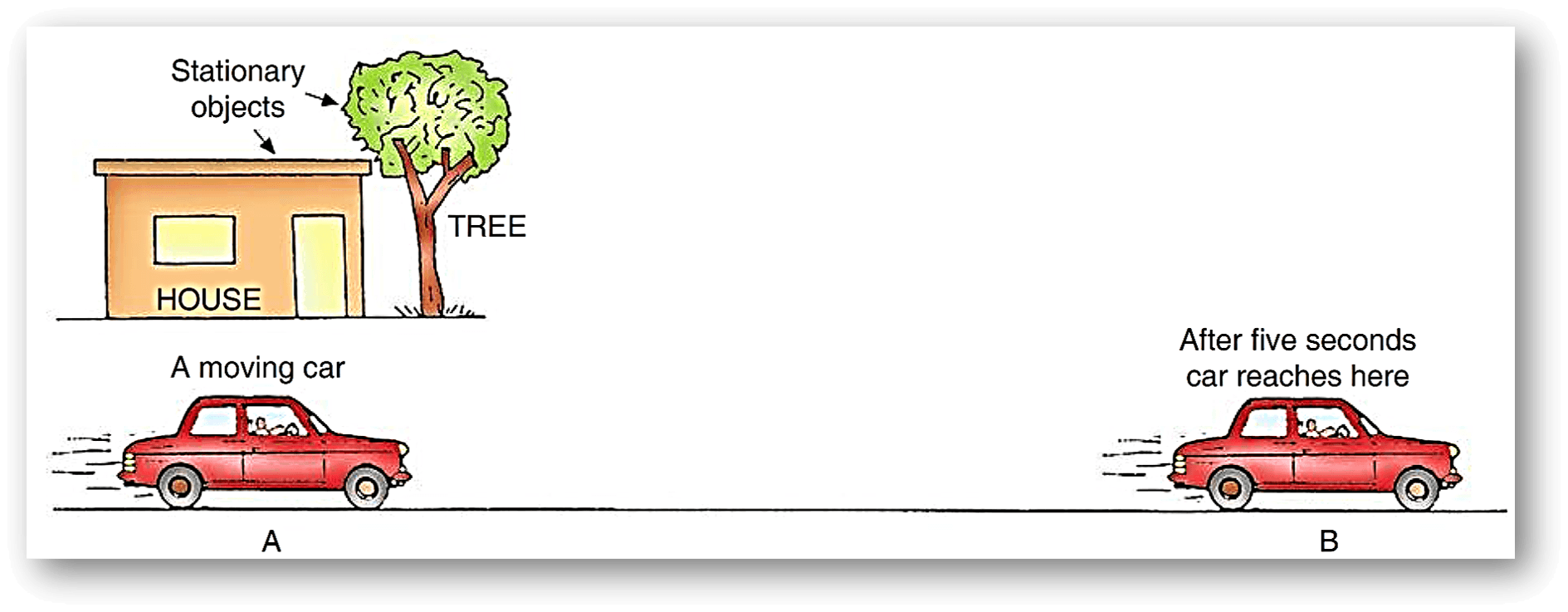
Let us take an example to understand the meaning of motion more clearly. In Figure we see a car at position A in front of a house and a tree at a particular time (In this case, the house and tree are the stationary objects which are taken as a reference point). Now, after 5 seconds, we see the same car at position B which is quite far away from the house and the tree (see Figure). This means that the position of this car is changing continuously with respect to a stationary object, house or tree. So, we say that this car is moving or that this car is in motion.
Categories of Motion
Motion is broadly classified into 3 categories.
- Rectilinear and translatory motion.
- Circular and rotatory motion.
- Oscillatory and vibratory motion.
1. Rectilinear and Translatory Motion
Rectilinear motion is the movement of an object in a straight line.
Translatory motion occurs when all points of a body move uniformly in the same direction.
Examples of Rectilinear and Translatory Motion :
- A car moving on a straight road.
- A falling stone.
- A train moving along a straight track.
Characteristics of Rectilinear and Translatory Motion :
- The object moves along a straight path.
- The direction of motion remains constant.
- It can be uniform (constant velocity) or non-uniform (changing velocity).
2. Circular and Rotatory Motion
Circular motion is when an object moves along a circular path.
Rotatory motion occurs when an object spins about a fixed axis.
Examples of Circular and Rotatory Motion :
- The motion of a satellite around the Earth (circular motion).
- A spinning top (rotatory motion).
- A Ferris wheel in an amusement park.
Characteristics of Circular and Rotatory Motion:
- The object follows a circular path.
- It can be uniform (constant speed) or non-uniform (changing speed).
- The motion is due to centripetal force directed towards the center.
3. Oscillatory and Vibratory Motion
Oscillatory motion occurs when an object moves back and forth about a fixed point.
Vibratory motion is a rapid form of oscillatory motion with high frequency.
Examples of Oscillatory and Vibratory Motion :
- A pendulum swinging to and fro (oscillatory motion).
- Vibrations of a guitar string (vibratory motion).
- The motion of a tuning fork.
Characteristics of Oscillatory and Vibratory Motion :
- The object repeats its motion after a fixed time interval.
- Restoring force directs the motion towards equilibrium.
- Examples include simple harmonic motion (SHM) like a mass-spring system.
Understanding Position with Multiple Observers
Any object occupies a definite point in space, but its position is perceived differently depending on the observer’s location. Consider an object placed at point O. Three different observers located at different positions will provide different descriptions of the position of point O. Each observer describes the position of point O in relation to themselves, and all observations are correct from their respective perspectives.
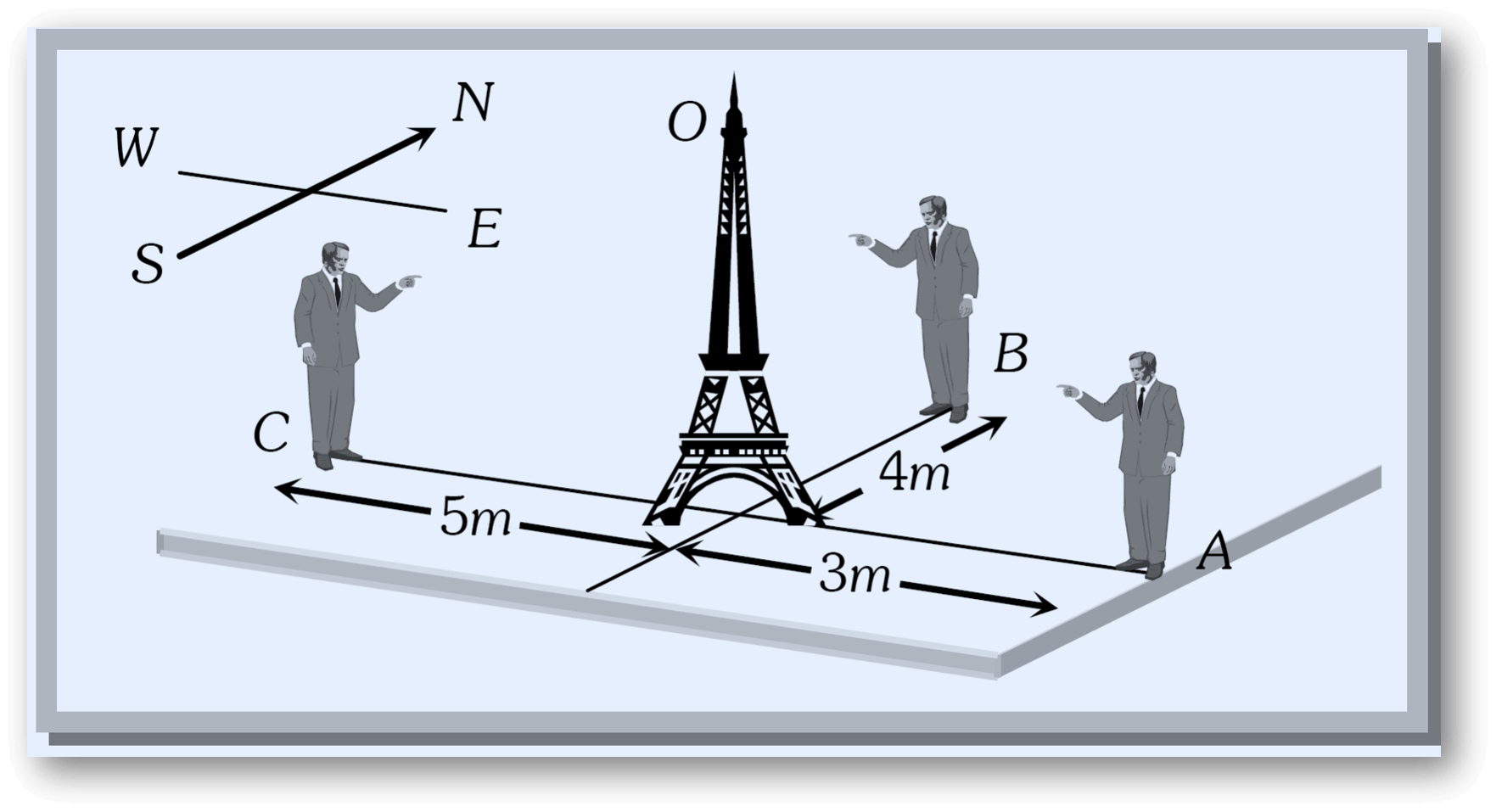
- Observer A : States that point O is 3 meters away in the west direction.
- Observer B : States that point O is 4 meters away in the south direction.
- Observer C : States that point O is 5 meters away in the east direction.
Thus, the position of any point is determined by two factors:
- Distance from the observer.
- Direction with respect to the observer.
To mathematically express the position of a point, we use a vector quantity called the position vector.
Position Vector Representation
If a point P is located in a two-dimensional plane with coordinates (x, y), then its position vector is given by: \begin{array}{l} \mathbf{r} = x \hat{i} + y \hat{j} \end{array}
If the point P is in three-dimensional space with coordinates (x, y, z), then the position vector is expressed as: \begin{array}{l} \mathbf{r} = x \hat{i} + y \hat{j} + z \hat{k} \end{array}
Here \begin{array}{l} \mathbf{} \hat{i} , \hat{j} , \hat{k} \end{array}
are unit vectors along the x, y, and z axes respectively.
Note : This topic will discuss in more detail in chapter Vectors.
Q : A point has coordinates (3, 4). What is its position vector?
Ans. : The position vector of a point (x, y) is given by xi+yj, so substituting x = 3 and y = 4, we get 3i + 4j.
Concept of Point Object
While studying the motion of an object ; sometimes, its dimensions are of no importance. For example, if one travels from one place to another distant place by a bus, the length of the bus may be ignored as compared to the distance travelled.
In other words, although the bus has a finite size, yet for the study of the motion of the bus along the road ; its motion may be considered as the motion of a point or a particle.
In mechanics, a particle is a geometrical mass point or a material body of negligible dimensions.
It is only a mathematical idealisation. In practice, the nearest approach to a particle is a body, whose size is much smaller than the distance or the length measurements involved.
Concept of Particle
Physically, a particle is considered as analogues to a point. A body with a definite size is considered as a particle when all of its parts have same displacement, velocity and acceleration. The motion of any such body can be studied by the motion of any point on that body.
Motion in One, Two and Three Dimensions
To study the motion of an object, one has to study the change in the position of the object w.r.t. its surroundings with the passage of time. In mechanics, the position of an object in space (in general) is specified with the help of a set of three mutually perpendicular lines, called the co-ordinate frame.
In Figure. shown, the point P represents the initial position of an object, while the point Q represents its final position.
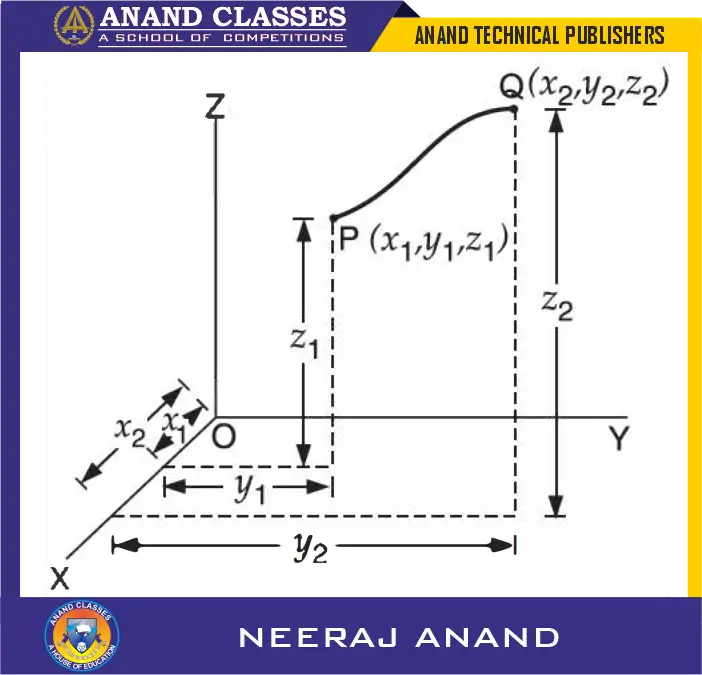
Each of the two positions of the object is fixed in the space with the help of a set of three distances $x$, $y$ and $z$ along X-axis, Y-axis and Z-axis respectively, which are called the co-ordinates of the point. The change in the position of the object with the passage of time means the change in the values of $x$, $y$ and $z$ with the time. The position of the object changes due to a change in one or two or in all of its three co-ordinates.
Motion is the change in position of a body with respect to time. Motion can be classified into different types based on the number of dimensions in which the body moves.
(i) One Dimensional Motion
The motion of an object is called one dimensional, if only one of the three co-ordinates required to specify the position of the object in space changes w.r.t. time.
In such a motion, the object moves along a straight line. For example, motion of a train along a straight railway track, a man walking on a level and narrow road, an object falling freely under gravity, etc.
(ii) Two Dimensional Motion
The motion of an object is called two dimensional, if two of the three coordinates required to specify the position of the object in space change w.r.t. time.
In such a motion, the object moves in a plane. For example, a billiard ball moving over the billiard table, an insect crawling over the floor of a room, earth revolving around the sun, etc.
(iii) Three Dimensional Motion
The motion of an object is called three dimensional, if all the three coordinates required to specify the position of the object in space change w.r.t. time.
Such a motion is not restricted to a straight line or a plane but takes place in space. It is the most general form of the motion. A few examples of three dimensional motion are a flying kite, a flying bird, a flying aeroplane, the random motion of gas molecules, etc.
Difference Between One-Dimensional, Two-Dimensional, and Three-Dimensional Motion
| Feature | One-Dimensional Motion (1D) | Two-Dimensional Motion (2D) | Three-Dimensional Motion (3D) |
|---|---|---|---|
| Definition | Motion along a single axis (straight line). | Motion in a plane (two perpendicular axes). | Motion in space (three perpendicular axes). |
| Axes Involved | Only one axis (X or Y or Z). | Two axes (X-Y or Y-Z or X-Z). | Three axes (X, Y, and Z). |
| Examples | – A car moving on a straight road. – A freely falling object under gravity. – A train moving along a straight track. | – Projectile motion (like a ball thrown at an angle). – Circular motion in a plane (like a satellite orbiting Earth). – A car taking a turn on a curved road. | – The motion of an airplane in air. – The movement of a fish in water. – The flight of a bird. |
| Equations of Motion | Kinematic equations apply in one dimension. | Vector form of kinematic equations used in two directions. | Kinematic equations extended to three directions. |
| Graphical Representation | Represented as a straight-line graph in displacement-time graph. | Motion is represented as a curve in a plane. | Motion is represented as a trajectory in space. |
Difference Between Rectilinear Motion and Translatory Motion
| Feature | Rectilinear Motion | Translatory Motion |
|---|---|---|
| Definition | Motion along a straight line. | Motion where all points of a body move in the same direction and cover equal distances in the same time. |
| Path | Always a straight line. | Can be straight or curved. |
| Example | A car moving on a straight road, a falling stone. | A train moving on a track, a book sliding on a table. |
| Type of Motion | A special type of translatory motion. | General term that includes both rectilinear and curvilinear motion. |
| Nature | Always linear. | Can be linear or curvilinear. |
Difference Between Circular Motion and Rotatory Motion
| Feature | Circular Motion | Rotatory Motion |
|---|---|---|
| Definition | Motion of an object along a circular path. | Motion of an object about its own axis. |
| Path | A fixed circular path. | Rotation around an internal axis. |
| Example | A car moving on a circular track, the revolution of Earth around the Sun. | A spinning top, the rotation of Earth on its own axis. |
| Nature | The entire object moves along a circle. | Different points of the object follow different circular paths around the axis. |
| Fixed Axis? | May or may not have a fixed axis. | Always has a fixed axis within the object. |
| Force Required | Centripetal force keeps the object in circular motion. | Internal forces maintain rotational motion. |
Difference Between Oscillatory Motion and Vibratory Motion
| Feature | Oscillatory Motion | Vibratory Motion |
|---|---|---|
| Definition | Repeated to-and-fro motion of an object about a fixed point or equilibrium position. | Rapid back-and-forth motion of an object in a fixed position. |
| Direction | Motion can be linear or angular. | Motion is usually very small and rapid. |
| Path | Object moves between two extreme points around a mean position. | Object undergoes small displacements around its mean position. |
| Example | A pendulum, a swing, a mass attached to a spring. | The vibration of a guitar string, the motion of a tuning fork. |
| Speed | Can be slow or fast. | Always very fast. |
| Energy Transfer | Energy is transferred between potential and kinetic forms. | Energy is transferred as mechanical waves or sound. |
| Type of Motion | Oscillations can be slow and periodic. | Vibrations are usually rapid and may or may not be periodic. |
Exam Oriented Conceptual Frequently Asked Questions and Answers (FAQs)
What is the definition of rest and motion?
Rest is when a body does not change its position with respect to a chosen frame of reference, whereas motion is when it does.
What is meant by the frame of reference?
A frame of reference is a coordinate system or set of points with respect to which an observer measures the position of an object.
Can an object be at rest and in motion at the same time?
Yes, rest and motion are relative. A book on a table is at rest with respect to the table but in motion with respect to the Earth’s rotation.
Give an example where motion is relative.
A person sitting in a moving bus is at rest with respect to the bus but in motion with respect to an observer on the road.
Can we say that an object is always in motion?
No, motion depends on the frame of reference. If observed from a moving train, a tree outside appears to be moving, but from the ground, it is at rest.
How does the concept of relative motion help in physics?
It helps understand different observations by different observers and is crucial in areas like mechanics and Einstein’s theory of relativity.
What is a position vector?
A position vector is a vector that represents the position of a point relative to a reference origin.
Why do different observers report different positions for the same object?
Different observers describe an object’s position relative to their own location, which leads to different observations. However, all observations are correct within their respective frames of reference.
Can position be negative?
The magnitude of a position vector (distance) is always positive, but its components along the coordinate axes can be negative depending on the direction.
How does the position vector change with movement?
If an object moves, its coordinates change, which in turn modifies its position vector.
Can two observers see an object at the same location?
Yes, but only if they are positioned symmetrically with respect to the object or share the same frame of reference.
How does the coordinate system affect the position vector?
The position vector depends on the chosen coordinate system. A change in the origin or axis orientation alters the vector representation.
What is motion?
Motion is the change in position of a body with respect to time.
What is one-dimensional motion?
Motion that occurs along a straight line where only one coordinate changes with time.
Give two examples of two-dimensional motion.
Motion of a car on a circular turn, motion of a billiards ball.
What is the difference between 2D and 3D motion?
In two-dimensional motion, only two coordinates change, while in three-dimensional motion, all three coordinates change.
Can a body have two-dimensional motion with only one coordinate changing?
No, for two-dimensional motion, two coordinates must change with time.
A projectile is fired from the ground at an angle. What type of motion does it exhibit?
It exhibits two-dimensional motion because it moves in both horizontal and vertical directions.
Define rectilinear motion and give two examples.
Rectilinear motion is the motion of an object along a straight line. Examples : A car moving on a straight road, A falling apple from a tree.
Explain oscillatory motion with an example.
Oscillatory motion is a periodic motion where an object moves back and forth about a fixed point. Example: A simple pendulum swinging.
What is simple harmonic motion (SHM)?
SHM is a special type of oscillatory motion where the restoring force is directly proportional to displacement and acts towards the equilibrium position.
Can an object have both translatory and rotatory motion? Explain.
Yes, a rolling ball exhibits both translatory and rotatory motion.
Why does a pendulum eventually stop swinging?
Due to air resistance and friction at the pivot, energy is lost, stopping the motion.
What is translatory motion? Give an example.
Translatory motion is a type of motion in which all points of a body move in the same direction, covering equal distances in the same time. An example is a train moving on a track.
Differentiate between rectilinear and curvilinear motion.
Rectilinear Motion : Motion along a straight path (e.g., a cyclist riding on a straight road).
Curvilinear Motion : Motion along a curved path (e.g., a satellite orbiting Earth).
Is rectilinear motion always a type of translatory motion? Explain.
Yes, rectilinear motion is a type of translatory motion because all points of the object move in the same direction with the same velocity.
Can an object have translatory motion without rectilinear motion?
Yes, an object can have translatory motion without rectilinear motion if it follows a curved path, known as curvilinear motion.
Define circular motion with an example.
Circular motion is the motion of an object along a circular path. Example : A satellite orbiting Earth.
What is rotatory motion? Give an example.
Rotatory motion occurs when a body spins around a fixed axis. Example : A spinning top.
Differentiate between circular and rotatory motion.
Circular Motion : The whole object moves in a circular path (e.g., a car moving on a circular track).
Rotatory Motion : The object rotates about its own axis (e.g., a fan blade spinning).
Does a rotating Earth exhibit circular or rotatory motion? Explain.
The Earth exhibits both :
Rotatory Motion: It spins around its own axis.
Circular Motion: It revolves around the Sun in an orbit.
Can an object have both circular and rotatory motion simultaneously? Give an example.
Yes, a rolling wheel has both circular (center moves in a circular path) and rotatory (spins around its own axis) motion.
Define oscillatory motion with an example.
Oscillatory motion is the repetitive to-and-fro movement of an object about a fixed equilibrium position. Example: A pendulum moving back and forth.
What is vibratory motion? Give an example.
Vibratory motion is a type of rapid oscillatory motion in which an object moves back and forth about a fixed position. Example: The vibration of a tuning fork.
How is vibratory motion different from oscillatory motion?
Oscillatory Motion : Can be slow or fast, and the object moves between two extreme points (e.g., a pendulum).
Vibratory Motion : A rapid and small back-and-forth movement (e.g., guitar string vibration).
Can oscillatory motion be periodic? Explain.
Yes, oscillatory motion is periodic if the motion repeats at regular time intervals, such as in a simple pendulum.
How does energy transfer occur in vibratory motion?
In vibratory motion, energy is transferred as mechanical waves or sound, such as when a guitar string vibrates and produces sound waves.
Important Chapter Interlinks
The chapter on Units and Measurements in Class 11 Physics builds a strong foundation for all topics in mechanics by covering physical quantities, systems of units, SI base and derived units, prefixes, dimensional analysis, and significant figures. It also explains errors in measurement, accuracy, precision, and methods of error propagation, which are essential for solving numerical problems correctly. These concepts are frequently tested in JEE PYQs and IMUCET PYQs, making them crucial for exam preparation. A clear understanding of units and dimensions helps in verifying equations, converting units, and simplifying complex problems in kinematics, laws of motion, work, energy, and other mechanics topics. This complete chapter notes section connects theoretical concepts with practical problem-solving, ensuring a smooth transition to advanced mechanics topics.