
Velocity is one of the most important concepts in physics that describes the rate of motion of an object in a particular direction. Unlike speed, velocity includes both magnitude and direction, making it a vector quantity. It helps explain how quickly and in which direction an object changes its position with time. Concepts such as average velocity, instantaneous velocity, uniform velocity, and non-uniform velocity are fundamental for understanding motion in mechanics. A strong understanding of velocity is essential for solving numerical problems in CBSE, JEE, NEET, NDA, and other competitive examinations.
What do you understand by velocity, and how do you define velocity?
Velocity is a fundamental concept in physics that describes the motion of an object in a specific direction. Unlike speed, which only tells us how fast an object is moving, velocity also includes information about the direction of movement.
The speed of a car (or any other body) gives us an idea of how fast the car is moving but it does not tell us the direction in which the car is moving. Thus, to know the exact position of a moving car we should also know the direction in which the car is moving. In other words, we should know the speed of the car as well as the direction of speed. This gives us another term known as velocity which can be defined as follows :
Velocity of a body is the distance travelled by it per unit time in a given direction. That is
$$\text{Velocity} (v) = \frac{\text{Distance travelled in a given direction}}{\text{Time taken}}$$
If a body travels a distance ‘s’ in time ‘t’ in a given direction, then its velocity ‘$v$’ is given by :
$$v = \dfrac{s}{t}$$
where:
$v$ = velocity of the body
$s$ = distance travelled (in the given direction)
$t$ = time taken (to travel that distance)
We know that the ‘Distance travelled in a given direction’ is known as ‘Displacement’. So, we can also write the definition of velocity in terms of ‘Displacement’. We can now say that : Velocity of a body is the displacement produced per unit time. We can obtain the velocity of a body by dividing the ‘Displacement’ by ‘Time taken’ for the displacement. Thus, we can write another formula for velocity as follows :
$$\text{Velocity} (v) = \frac{\text{Displacement}}{\text{Time taken}}$$
$$v = \dfrac{s}{t}$$
where:
$v$ = velocity of the body
$s$ = displacement of the body
$t$ = time taken (for displacement)
The SI unit of velocity is the same as that of speed, namely, metres per second (m/s or m s–1). We can use the bigger unit of kilometres per hour to express the bigger values of velocities and centimetres per second to express the small values of velocities.
It should be noted that both, speed as well as velocity, are represented by the same symbol v. The difference between speed and velocity is that speed has only magnitude (or size), it has no specific direction, but velocity has magnitude as well as direction. In fact, velocity of a body is its speed in a specified direction (in a single straight line).
Speed is a scalar quantity (because it has magnitude only). Velocity is a vector quantity (because it has magnitude as well as direction). For example, the expression ‘25 km per hour’ is the speed (because it has magnitude only), but the expression ‘25 km per hour towards North’ (or any other direction) is velocity (because it has both magnitude as well as a specified direction).
To be strictly accurate, whenever velocity is expressed, it should be given as speed in a ‘certain direction’. Usually, however, velocities are expressed without mentioning direction for the sake of convenience. The direction is assumed without being stated. The direction of velocity is the same as the direction of displacement of the body.
The ‘Distance travelled’ by a body in a given direction divided by ‘Time’ gives us average velocity. For example, if a car travels a distance of 100 km in 4 hours in the North direction, then its average velocity is $\frac{100}{4}$ = 25 km per hour, due North. We have just seen that,
$$v = \dfrac{s}{t}$$
So,
s = $v$ × t
Thus,
Displacement travelled = Average velocity × Time
This formula should be memorized because it will be used in solving numerical problems.
“Students should also study Speed, Average Speed, Instantaneous Speed, Units and Examples“
What are the units of Velocity ?
The SI unit of displacement is metre (m) and that of time is second (s), therefore, the SI unit of velocity is metres per second which is written as m/s or m s–1. The small values of velocity are expressed in the units of centimetres per second which is written as cm/s or cm s–1. To express high velocity values, we use the unit of kilometres per hour, written as km.p.h. or km/h or km h–1. Please note that if we have to compare the velocity of a number of bodies, then we must express the velocities of all of them in the same units.
Hence the important units used in mechanics are as follows :
| System | Unit of Velocity | Symbol |
|---|---|---|
| SI System | Metres per second | $m/s$ or $m s^{-1}$ |
| CGS System | Centimetres per second | $cm/s$ or $cm s^{-1}$ |
| Practical | Kilometres per hour | $km/h$ or $km h^{-1}$ |
What is the dimensional formula of Velocity ?
Since speed is defined as: $$\text{Velocity} (v) = \frac{\text{Displacement}}{\text{Time taken}}$$
Dimension of Displacement = [$M^0L^1T^0$]
Dimension of Time = [$M^0L^0T^1$]
Thus, $$ \text{Dimension of Velocity} = [M^0L^1T^{-1}] $$
“Related topics include Equations of Uniformly Accelerated Motion“
What is Uniform Velocity (or Constant Velocity) ?
If an object travels in a specified direction in a straight line and moves the same distance every second, we say that its velocity is uniform.
Thus, A body has a uniform velocity if it travels in a specified direction in a straight line and moves over equal distances in equal intervals of time, no matter how small these time intervals may be.
Conditions for Uniform Velocity
- The body must move in a straight line.
- It must cover equal distances in equal time intervals.
- Its direction must remain unchanged.
Example : A car moving at 40 km/hr due North without changing speed or direction.
Similar topics for practice include Motion in One, Two and Three Dimensions“
What is Non-Uniform Velocity (or Variable Velocity) ?
The velocity of a body can be changed in two ways :
(i) by changing the speed of the body, and
(ii) by keeping the speed constant but by changing the direction.
When a body does not cover equal distances in equal intervals of time, the velocity is said to be variable or non-uniform velocity. In this case the speed of the body is not constant.
Even if the speed of a body is constant but the direction is changing, the velocity will not be uniform.
Suppose a car is moving on a circular road with constant speed. Now, though the speed of the car is constant, its velocity is not constant because the direction of car is changing continuously (due to circular road), its velocity is also changing (though the speed is constant). The motion of car in this case is said to be accelerated.
What is Instantaneous Velocity ?
The velocity of an object at a specific instant of time is called Instantaneous Velocity. It is mathematically given by the derivative of displacement with respect to time : $$v = \lim_{\Delta t \to 0} \frac{\Delta x}{\Delta t}$$
or
$$v = \frac{dx}{dt}$$
Example : The speedometer reading of a car at a particular instant shows the instantaneous velocity.
Graphically : The slope of the displacement-time graph gives the instantaneous velocity.
“Important concepts connected to this topic are What is Mechanics, Statics, Dynamics, Kinematics, Kinetics“
What is the Difference Between Speed and Velocity ?
Speed and velocity are often confused because they are similar, but they have key differences :
| Feature | Speed | Velocity |
| Basic Definition | The rate of change of distance with respect to time. | The rate of change of displacement with respect to time. |
| Mathematical Nature | Scalar Quantity. It has magnitude only. | Vector Quantity. It possesses both magnitude and a specific direction. |
| Calculus Notation (Instantaneous) | $$v = \frac{ds}{dt}$$ (where $s$ is the total path length) | $$\vec{v} = \frac{d\vec{r}}{dt}$$ (where $\vec{r}$ is the position vector) |
| Sign Convention | Always positive or zero. It can never be negative. | Can be positive, negative, or zero depending on the choice of the origin and axis. |
| Path Dependency | Depends on the actual path taken by the object. | Independent of the path; depends only on the initial and final positions. |
| In a Closed Path (Round Trip) | The average speed is never zero for a moving object ($v_{avg} > 0$). | The average velocity is strictly zero ($\vec{v}_{avg} = 0$) because net displacement is zero. |
| Effect of Direction Change | A change in direction does not change speed. | A change in direction changes velocity, even if the numerical speed remains constant. |
| Dimensional Formula | $[M^0 L^1 T^{-1}]$ | $[M^0 L^1 T^{-1}]$ |
| SI / CGS Units | $\text{m/s}$ (SI) , $\text{cm/s}$ (CGS) | $\text{m/s}$ (SI) , $\text{cm/s}$ (CGS) |
The Magnitude Relationship :
The magnitude of velocity is less than or equal to speed. It can never exceed speed.
$$\text{Average Speed} \ge |\text{Average Velocity}|$$
When are they equal? Only when an object moves in a straight line without reversing its direction (unidirectional rectilinear motion).
When is speed greater? Whenever the object curves, turns, or backtracks.
Instantaneous Value :
While Average Speed and Average Velocity can be vastly different, their Instantaneous values are equal.
$$\text{Instantaneous Speed} = |\text{Instantaneous Velocity}|$$
Because the time interval ($dt$) is so infinitely small, the particle does not have time to change its direction. The straight-line displacement ($d\vec{r}$) matches the path length ($ds$).
The Acceleration (Uniform Circular Motion)
If a particle moves in a circle at a constant speed of $v \text{ m/s}$ :
- Its speed is uniform.
- Its velocity is non-uniform (variable) because the direction of the velocity vector (which is always tangential to the circular path) changes at every single point.
- Because velocity is changing, the object is accelerating (Centripetal Acceleration, $\vec{a} = \dfrac{v^2}{r}$), proving you can accelerate even at a constant speed.
Thus, velocity provides more information than speed because it tells us both how fast something is moving and in which direction.
What is Average Velocity ?
Velocity is a vector quantity that defines the rate at which an object changes its position. Unlike speed, velocity includes direction. If an object covers different displacements with varying speeds or takes different time intervals, we calculate the average velocity over the entire journey.
Average velocity helps in understanding the overall motion of an object when the velocity is not constant.
Definition :
The average velocity of a body for a given interval of time is defined as the ratio of the total displacement traveled to the total time taken.
Mathematically,
$$v_{av} = \frac{\text{Total Displacement Travelled}}{\text{Total Time Taken}}$$
Understanding Average Velocity with an Example
Imagine a car travels 180 km in 3 hours along North and then another 120 km in 2 hours along South. The total displacement traveled is: 180 – 120 = 60 km
The total time taken is: 3 + 2 = 5 hours
Thus, the average velocity is: $$v_{av} = \frac{60}{5} = 12 \text{ km/h}$$
This means the car covered an average of 12 km per hour along North direction over the entire journey.
What is Time-Averaged Velocity ?
When a particle moves at different uniform velocities $v_1, v_2, v_3, \dots$ for different time intervals $t_1, t_2, t_3, \dots$, then:
$$v_{av} = \frac{\text{Total Displacement Travelled}}{\text{Total Time Taken}}$$
$$v_{av} = \frac{d_1 + d_2 + d_3 + \dots}{t_1 + t_2 + t_3 + \dots}$$
$$v_{av} = \frac{v_1t_1 + v_2t_2 + v_3t_3 + \dots}{t_1 + t_2 + t_3 + \dots}$$
Note : Time average velocity is the arithmetic mean of different velocities over a given time period.
It is used when an object moves with different velocities for equal time intervals.
Example: A bus moves at 80 km/h for 2 hours in east direction, then at 40 km/h for 3 hours in west direction. What is the average velocity of bus ?
Solution :
The total displacement traveled: (80×2)-(40×3)=160-120=40 km
Total time taken: 2+3=5 hours
So, the average velocity: $$v_{av} = \frac{40}{5} = 8 \text{ km/h}$$
This means the bus covered an average of 8 km per hour along East direction over the entire journey.
Special Case:
If a particle moves with velocity $v_1$ for half the total time and $v_2$ for the remaining half, then: $$v_{av} = \frac{v_1 + v_2}{2}$$
What is Displacement-Averaged Velocity ?
If a particle covers different displacements $d_1, d_2, d_3, \dots$ with velocities $v_1, v_2, v_3, \dots$, then:
$$v_{av} = \frac{\text{Total Displacement Travelled}}{\text{Total Time Taken}}$$
$$v_{av} = \frac{d_1 + d_2 + d_3 + \dots}{t_1 + t_2 + t_3 + \dots}$$
$$v_{av} = \dfrac{d_1 + d_2 + d_3 + \dots}{\dfrac{d_1}{v_1} + \dfrac{d_2}{v_2} + \dfrac{d_3}{v_3} + \dots}$$
Note : Displacement average velocity (also known as harmonic mean velocity) is calculated when different displacements are covered with different velocities.
It is useful in cases where an object covers equal displacements at different velocities.
Special Cases:
1. If a particle moves half the total displacement at $v_1$ and the other half at $v_2$, then:
$$v_{av} = \frac{2 v_1 v_2}{v_1 + v_2} $$
2. If a particle moves one-third of the displacement at $v_1$, the next one-third at $v_2$, and the last one-third at $v_3$, then :
$$v_{av} = \frac{3 v_1 v_2 v_3}{v_1 v_2 + v_2 v_3 + v_3 v_1} $$
“Read more about Distance and Displacement, Solved Numericals, Conceptual Questions Answers”
What is the Difference Between Average Speed and Average Velocity ?
| Feature | Average Speed | Average Velocity |
|---|---|---|
| Definition | Total distance traveled divided by total time taken. | Total displacement divided by total time taken. |
| Formula | $v_{\text{avg}} = \frac{\text{Total Distance}}{\text{Total Time}}$ | $v_{\text{avg}} = \frac{\text{Total Displacement}}{\text{Total Time}}$ |
| Type of Quantity | Scalar (only magnitude, no direction). | Vector (has both magnitude and direction). |
| Depends On | Total path length covered. | Straight-line distance between initial and final position. |
| Can be Zero? | Never zero if there is motion. | Can be zero if initial and final positions are the same. |
| Always Positive? | Yes, it is always positive. | Can be positive, negative, or zero, depending on displacement. |
| Example | A car moves 60 km forward and 40 km back in 2 hours. Total distance = 100 km, Total time = 2 hr. Average speed = $\frac{100}{2}$ = 50 km/h. | The same car’s displacement = 20 km (net position change). Average velocity = $\frac{20}{2}$ = 10 km/h in the forward direction. |
Solved Numerical Problems Based on Average Velocity
Question.1 : A man walks on a straight road from his home to a market $2.5\text{ km}$ away with a speed of $5\text{ km/h}$. Finding the market closed, he instantly turns and walks home with a speed of $7.5\text{ km/h}$. What is the magnitude of the average velocity and average speed of the man over the interval of time
(i) $0\text{ to } 30\text{ min}$,
(ii) $0\text{ to } 50\text{ min}$, and
(iii) $0\text{ to } 40\text{ min}$ ?
Solution :
Here, the distance between the home and the market is $s = 2.5\text{ km}$.
The speed of the man while going to the market is $v_1 = 5\text{ km/h}$. Therefore, the time taken to reach the market is calculated as :
$$t_1 = \frac{\text{Distance}}{\text{Speed}} = \frac{2.5\text{ km}}{5\text{ km/h}} = 0.5\text{ h} = 30\text{ min}$$
The speed of the man while returning from the market is $v_2 = 7.5\text{ km/h}$. Therefore, the time taken to return home is :
$$t_2 = \frac{\text{Distance}}{\text{Speed}} = \frac{2.5\text{ km}}{7.5\text{ km/h}} = \frac{1}{3}\text{ h} = 20\text{ min}$$
The total time for the entire round trip is $t_1 + t_2 = 30\text{ min} + 20\text{ min} = 50\text{ min}$.
(i) Over the interval of time 0 to 30 min :
During this time interval, the man travels directly from his home to the market.
Total path length (distance) covered = $2.5\text{ km}$
Magnitude of total displacement = $2.5\text{ km}$
Time interval $t = 30\text{ min} = 0.5\text{ h}$
$$\text{Average Speed} = \frac{\text{Total path length}}{\text{Total time}} = \frac{2.5\text{ km}}{0.5\text{ h}} = 5\text{ km/h}$$
$\text{Magnitude of Average Velocity} = $
$\dfrac{\text{Magnitude of displacement}}{\text{Total time}} = \dfrac{2.5\text{ km}}{0.5\text{ h}} = 5\text{ km/h}$
(ii) Over the interval of time 0 to 50 min :
During this time interval, the man goes from his home to the market and then completely returns back to his home.
Total path length (distance) covered = $2.5\text{ km} + 2.5\text{ km} = 5\text{ km}$
Magnitude of total displacement = $0\text{ km}$ (since the initial and final positions are identical)
Time interval $t = 50\text{ min} = \dfrac{50}{60}\text{ h} = \dfrac{5}{6}\text{ h}$
$\text{Average Speed} = \dfrac{\text{Total path length}}{\text{Total time}} = $
$=\dfrac{5\text{ km}}{\frac{5}{6}\text{ h}} = 5 \times \dfrac{6}{5} = 6\text{ km/h}$
$\text{Magnitude of Average Velocity} = $
$=\dfrac{\text{Magnitude of displacement}}{\text{Total time}} = \dfrac{0\text{ km}}{\frac{5}{6}\text{ h}} = 0\text{ km/h}$
(iii) Over the interval of time 0 to 40 min :
The total time interval is $t = 40\text{ min} = \frac{40}{60}\text{ h} = \frac{2}{3}\text{ h}$.
During the first $30\text{ min}$, the man covers a distance of $2.5\text{ km}$ to reach the market. During the remaining $10\text{ min}$ (which equals $\frac{10}{60}\text{ h} = \frac{1}{6}\text{ h}$), he walks back toward his home at a speed of $7.5\text{ km/h}$.
Distance covered during the return journey in these $10\text{ min}$ is:
$$\text{Distance} = \text{Speed} \times \text{Time} = 7.5\text{ km/h} \times \frac{1}{6}\text{ h} = 1.25\text{ km}$$
Therefore, for the $40\text{-minute}$ interval :
Total path length (distance) covered = $2.5\text{ km} + 1.25\text{ km} = 3.75\text{ km}$
Magnitude of total displacement = $2.5\text{ km} – 1.25\text{ km} = 1.25\text{ km}$
$\text{Average Speed} = \dfrac{\text{Total path length}}{\text{Total time}} =$
$ =\dfrac{3.75\text{ km}}{\frac{2}{3}\text{ h}} = 3.75 \times \dfrac{3}{2} = 5.625\text{ km/h}$
$\text{Magnitude of Average Velocity} = $
$=\dfrac{\text{Magnitude of displacement}}{\text{Total time}} = $
$=\dfrac{1.25\text{ km}}{\frac{2}{3}\text{ h}} = 1.25 \times \dfrac{3}{2} = 1.875\text{ km/h}$
Question.2 : The position-time graph for a dancer demonstrating dance steps along a straight line is as shown in the figure.
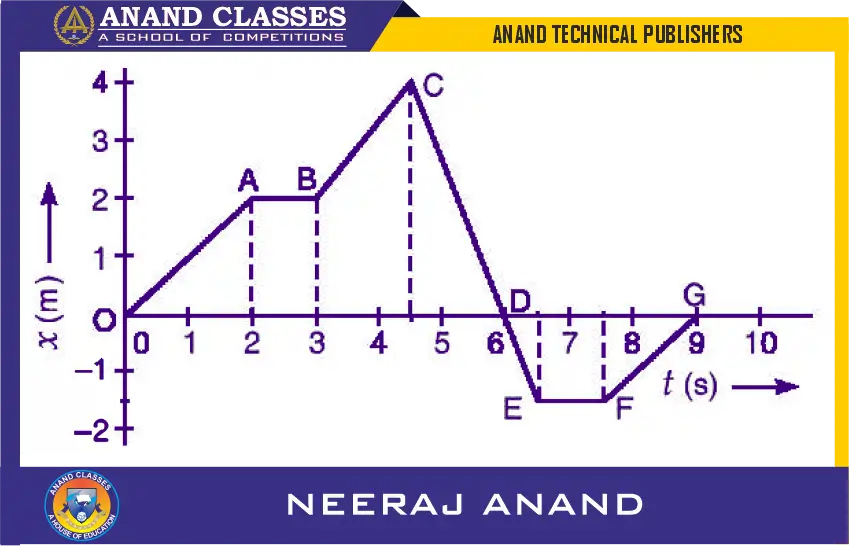
(a) What are the average speed and average velocity for each dance step?
(b) What is the average velocity of the dancer during the time interval between $t = 4.5\text{ s}$ to $t = 9\text{ s}$?
Solution : Use the following formulas in the solutions
$$\text{Average Speed} = \frac{\text{Total Path Length (Distance)}}{\text{Total Time Taken}}$$
$$\text{Average Velocity} = \frac{\text{Net Displacement}}{\text{Total Time Taken}} = \frac{x_{\text{final}} – x_{\text{initial}}}{t_{\text{final}} – t_{\text{initial}}}$$
(a) Calculations for each dance step
1. For the dance step shown by region $OA$
Initial position at $t = 0\text{ s}$ : $x = 0\text{ m}$
Final position at $t = 2\text{ s}$ : $x = 2\text{ m}$
Time taken ($t$) = $2 – 0 = 2\text{ s}$
Path length = $2\text{ m}$, Displacement = $2 – 0 = 2\text{ m}$
$$\text{Average speed} = \frac{2\text{ m}}{2\text{ s}} = 1\text{ m/s}$$
$$\text{Average velocity} = \frac{2\text{ m}}{2\text{ s}} = 1\text{ m/s}$$
2. For the dance step shown by region $AB$
Initial position at $t = 2\text{ s}$: $x = 2\text{ m}$
Final position at $t = 3\text{ s}$: $x = 2\text{ m}$
Time taken ($t$) = $3 – 2 = 1\text{ s}$
Path length = $0\text{ m}$ (dancer is stationary), Displacement = $2 – 2 = 0\text{ m}$
$$\text{Average speed} = \frac{0\text{ m}}{1\text{ s}} = 0\text{ m/s}$$
$$\text{Average velocity} = \frac{0\text{ m}}{1\text{ s}} = 0\text{ m/s}$$
3. For the dance step shown by region $BC$
Initial position at $t = 3\text{ s}$: $x = 2\text{ m}$
Final position at $t = 4.5\text{ s}$: $x = 4\text{ m}$
Time taken ($t$) = $4.5 – 3 = 1.5\text{ s}$
Path length = $4 – 2 = 2\text{ m}$, Displacement = $4 – 2 = 2\text{ m}$
$$\text{Average speed} = \frac{2\text{ m}}{1.5\text{ s}} = 1.33\text{ m/s}$$
$$\text{Average velocity} = \frac{2\text{ m}}{1.5\text{ s}} = 1.33\text{ m/s}$$
4. For the dance step shown by region $CE$
Initial position at $t = 4.5\text{ s}$: $x = 4\text{ m}$
Final position at $t = 6.5\text{ s}$: $x = -1.5\text{ m}$
Time taken ($t$) = $6.5 – 4.5 = 2\text{ s}$
Path length = Magnitude of distance traveled from $4\text{ m}$ down to $-1.5\text{ m}$ = $5.5\text{ m}$
Displacement = Final position $-$ Initial position = $-1.5 – 4 = -5.5\text{ m}$
$$\text{Average speed} = \frac{5.5\text{ m}}{2\text{ s}} = 2.75\text{ m/s}$$
$$\text{Average velocity} = \frac{-5.5\text{ m}}{2\text{ s}} = -2.75\text{ m/s}$$
5. For the dance step shown by region $EF$
Initial position at $t = 6.5\text{ s}$: $x = -1.5\text{ m}$
Final position at $t = 7.5\text{ s}$: $x = -1.5\text{ m}$
Time taken ($t$) = $7.5 – 6.5 = 1\text{ s}$
Path length = $0\text{ m}$, Displacement = $-1.5 – (-1.5) = 0\text{ m}$
$$\text{Average speed} = \frac{0\text{ m}}{1\text{ s}} = 0\text{ m/s}$$
$$\text{Average velocity} = \frac{0\text{ m}}{1\text{ s}} = 0\text{ m/s}$$
6. For the dance step shown by region $FG$
Initial position at $t = 7.5\text{ s}$: $x = -1.5\text{ m}$
Final position at $t = 9\text{ s}$: $x = 0\text{ m}$
Time taken ($t$) = $9 – 7.5 = 1.5\text{ s}$
Path length = $1.5\text{ m}$, Displacement = $0 – (-1.5) = 1.5\text{ m}$
$$\text{Average speed} = \frac{1.5\text{ m}}{1.5\text{ s}} = 1\text{ m/s}$$
$$\text{Average velocity} = \frac{1.5\text{ m}}{1.5\text{ s}} = 1\text{ m/s}$$
(b) Average velocity between $t = 4.5\text{ s}$ and $t = 9\text{ s}$
Position at initial time ($t_1 = 4.5\text{ s}$): $x_1 = 4\text{ m}$
Position at final time ($t_2 = 9\text{ s}$): $x_2 = 0\text{ m}$
Net displacement = $x_2 – x_1 = 0 – 4 = -4\text{ m}$
Total time interval = $t_2 – t_1 = 9 – 4.5 = 4.5\text{ s}$
$$\text{Average velocity} = \frac{\text{Net displacement}}{\text{Total time taken}} = \frac{-4\text{ m}}{4.5\text{ s}} = -0.89\text{ m/s}$$
FAQs – Examination Asked Questions and Answers Based on Velocity
What do you understand by velocity?
Velocity is a physical quantity that describes both the speed and direction of motion of an object. Unlike speed, velocity tells us not only how fast an object is moving but also the direction in which it is moving.
How do you define velocity?
Velocity is defined as the displacement covered by a body per unit time in a specified direction. Mathematically, velocity is given by:
$$v = \dfrac{s}{t}$$
where (s) is displacement and (t) is time taken.
What is the difference between speed and velocity?
Speed is a scalar quantity because it has only magnitude, whereas velocity is a vector quantity because it has both magnitude and direction. A body may have constant speed but changing velocity if its direction changes continuously.
What is the SI unit of velocity?
The SI unit of velocity is metre per second, written as (m/s) or (m,s^{-1}). Other commonly used units are centimetre per second ((cm/s)) and kilometre per hour ((km/h)).
What is the dimensional formula of velocity?
The dimensional formula of velocity is:
$$[M^0L^1T^{-1}]$$
because velocity is obtained by dividing displacement by time.
What is uniform velocity?
A body is said to have uniform velocity when it moves in a straight line in a fixed direction and covers equal displacements in equal intervals of time. In this case, both speed and direction remain constant.
What is non-uniform velocity?
Non-uniform velocity occurs when either the speed or direction of a moving body changes with time. Even if speed remains constant, a change in direction causes velocity to change.
What is instantaneous velocity?
Instantaneous velocity is the velocity of an object at a particular instant of time. It is represented mathematically as:
$$v = \frac{dx}{dt}$$
and can be observed using the speedometer reading of a moving vehicle at any instant.
What is average velocity?
Average velocity is defined as the total displacement divided by the total time taken. It gives the overall rate of displacement of a body during its motion and includes direction.
Can velocity be negative?
Yes, velocity can be positive, negative, or zero depending on the direction of motion chosen as reference. Negative velocity generally indicates motion in the opposite direction.
Why is velocity considered a vector quantity?
Velocity is considered a vector quantity because it has both magnitude and direction. The direction of velocity is always the same as the direction of displacement of the object.
What happens to velocity in circular motion?
In circular motion, even if the speed remains constant, the velocity changes continuously because the direction of motion changes at every point. Hence, the object is said to be accelerating.
What is the relation between displacement and velocity?
Velocity is obtained by dividing displacement by time:
$$v = \dfrac{\text{Displacement}}{\text{Time}}$$
Thus, displacement and velocity are directly related quantities.
Can average velocity become zero?
Yes, average velocity can become zero if the initial and final positions of the object are the same. This happens because displacement becomes zero even though the object may have traveled some distance.
What is the importance of studying velocity in physics?
Velocity is one of the most important concepts in mechanics because it helps describe motion accurately. It is widely used in kinematics, dynamics, circular motion, and many advanced topics in physics and engineering.
Who provides these physics notes and explanations?
These physics notes, study materials, and conceptual explanations are provided by Physics Anand Classes. The content is designed to help students prepare for CBSE board exams, JEE, NEET, NDA, IMUCET, and other competitive examinations.
Who has written these physics explanations?
The physics explanations and educational content are written by Er. Neeraj Anand. The notes are prepared in a simple, detailed, and student-friendly manner to improve conceptual understanding and problem-solving skills in physics.
Important Chapter Links
Learn more about important topics of Physics Class 11 CBSE related to Units and Measurements such as physical quantities, SI units, dimensional analysis, significant figures, errors in measurements, accuracy and precision, scientific notation, and unit conversion. Similar concepts include vectors and scalars, motion in a straight line, mathematical tools in physics, and experimental methods in measurements. Students should also study dimensional formulae, propagation of errors, and applications of measurements in numerical problems to build a strong foundation for CBSE, JEE, NEET, NDA, and other competitive