
Motion is one of the most important concepts in physics and mechanics. In everyday life, we observe objects moving with different speeds and in different ways. Some objects move with constant speed and cover equal distances in equal intervals of time, while others change their speed continuously during motion. The study of uniform motion, non-uniform motion, speed, average speed, and instantaneous speed helps us understand how objects move from one place to another. These concepts form the foundation of kinematics and are widely used in school physics, engineering, transportation, and competitive examinations.
What is Uniform Motion and Non-Uniform Motion
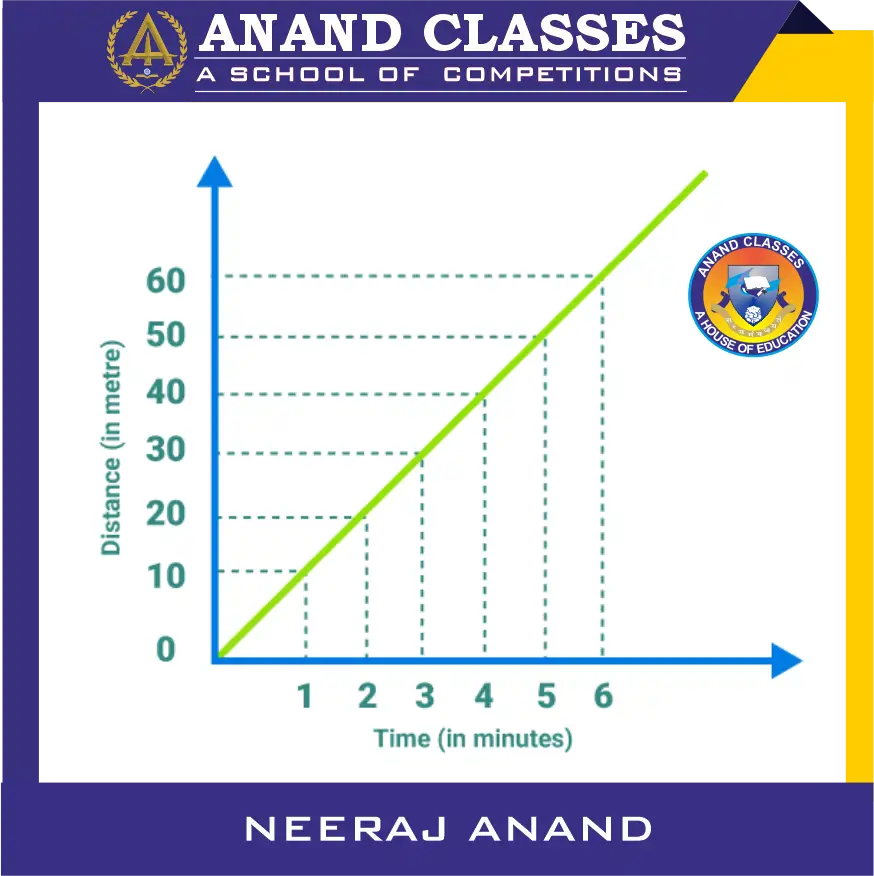
A body has a uniform motion if it travels equal distances in equal intervals of time, no matter how small these time intervals may be. As the body is moving in rectilinear motion with a constant velocity (v = constant), the acceleration of the body is zero (a = 0). For example, a man running at a constant speed of say, 10 metres per minute, will cover equal distances of 10 metres, every minute, so its motion will be uniform. Please note that the distance-time graph for uniform motion is a straight line (as shown in Figure below).
A body has a non-uniform motion if it travels unequal distances in equal intervals of time. For example, if we drop a ball from the roof of a tall building, we will find that it covers unequal distances in equal intervals of time. It covers :

4.9 metres in the 1st second,
14.7 metres in the 2nd second,
24.5 metres in the 3rd second, and so on.
Thus, a freely falling ball covers smaller distances in the initial ‘1 second’ intervals and larger distances in the later ‘1 second’ intervals (see Figure).
From this discussion we conclude that the motion of a freely falling body is an example of non-uniform motion. The motion of a train starting from the Railway Station is also an example of non-uniform motion. This is because when the train starts from a Station, it moves a very small distance in the ‘first’ second. The train moves a little more distance in the ‘2nd’ second, and so on. And when the train approaches the next Station, the distance travelled by it per second decreases.
Please note that the distance-time graph for a body having non-uniform motion is a curved line (as shown in Figure below).
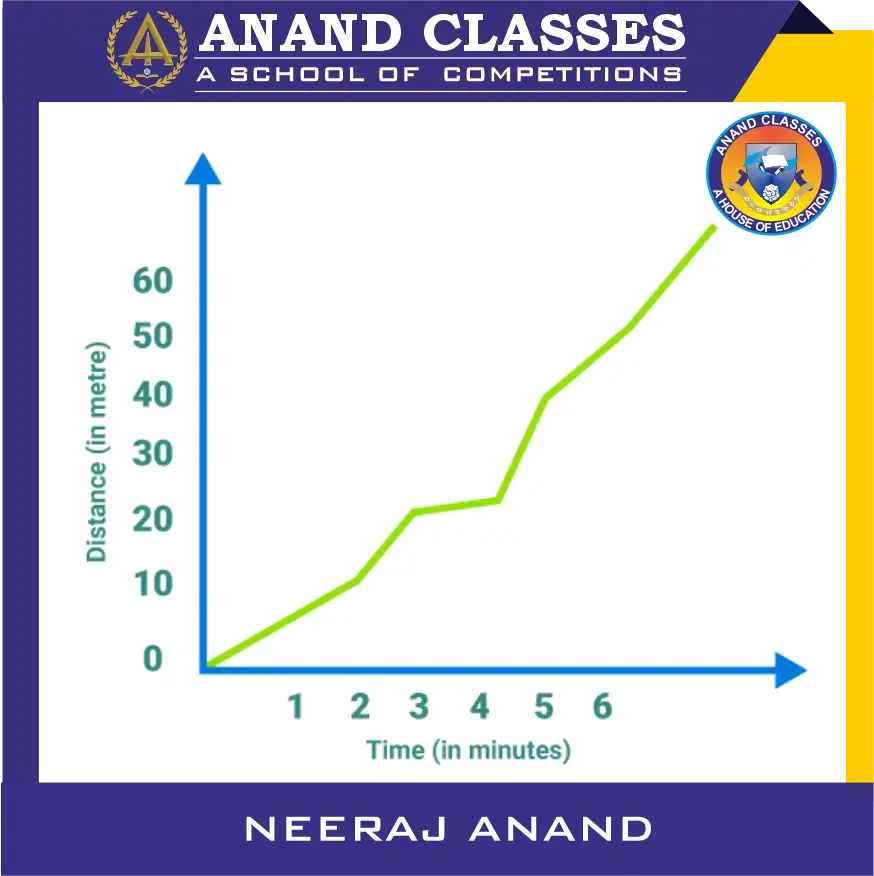
Thus, in order to find out whether a body has uniform motion or non-uniform motion, we should draw the distance-time graph for it. If the distance-time graph is a straight line, the motion will be uniform and if the distance-time graph is a curved line, the motion will be non-uniform. It should be noted that non-uniform motion is also called accelerated motion.
“”Learn More About Motion in One, Two and Three Dimensions“
What is Speed ?
If a car is running slow, we say that its speed is low. And if a car is running fast, then we say that its speed is high. Thus, the speed of a body gives us an idea of how slow or fast that body is moving. We can now define the speed of a moving body as follows :
Speed is the rate at which an object moves and is defined as the distance covered per unit time.
What is the formula of Speed ?
Speed of a body is the distance travelled by it per unit time. The speed of a body can be calculated by dividing the ‘Distance travelled’ by the ‘Time taken’ to travel this distance. So, the formula for speed can be written as :
$$\text{Speed}(v) = \dfrac{\text{Distance Travelled}}{\text{Time Taken}} $$
If a body travels a distance $s$ in time $t$, then its speed $v$ is given by :
$$v = \dfrac{s}{t} $$
where $v$ = speed
$s$ = distance travelled
and $t$ = time taken (to travel that distance)
Suppose a car travels a distance of 100 kilometres in 4 hours, then the speed of this car is given by :
$$\text{Speed}(v) = \dfrac{\text{100 kilometers}}{\text{4 hours}} $$
Speed ($v$) = 25 kilometres per hour (or 25 km/h)
Thus, the speed of this car will be 25 kilometres per hour. This means that the car travels a distance of 25 kilometres ‘every one hour’.
The above given formula for calculating speed has three quantities in it : Speed, Distance travelled and Time taken. If we are given the values of any two quantities, then the value of third quantity can be calculated by using this formula.
“Learn More About Distance and Displacement“
What are the units of Speed ?
The SI unit of distance is metre (m) and that of time is second (s), therefore, the SI unit of speed is metres per second which is written as m/s or m s–1. The small values of speed are expressed in the units of centimetres per second which is written as cm/s or cm s–1. To express high speed values, we use the unit of kilometres per hour, written as km.p.h. or km/h or km h–1. Please note that if we have to compare the speeds of a number of bodies, then we must express the speeds of all of them in the same units. Speed has magnitude only, it has no specified direction, therefore, speed is a scalar quantity.
Hence the important units used in mechanics are as follows :
| System | Unit of Speed | Symbol |
|---|---|---|
| SI System | Metres per second | $m/s$ or $m s^{-1}$ |
| CGS System | Centimetres per second | $cm/s$ or $cm s^{-1}$ |
| Practical | Kilometres per hour | $km/h$ or $km h^{-1}$ |
Sample Problem. A scooterist covers a distance of 3 kilometres in 5 minutes. Calculate his speed in :
(a) centimetres per second (cm/s)
(b) metres per second (m/s)
(c) kilometres per hour (km/h)
Solution.
(a)
In order to calculate the speed in centimetres per second we should convert the given distance of 3 kilometres into centimetres and the given time of 5 minutes into seconds. Please note that 1 kilometre has 1000 metres and 1 metre has 100 centimetres. Now,
Distance travelled = 3 km
Distance travelled $= 3 \times 1000$ m
Distance travelled $= 3 \times 1000 \times 100$ cm
Distance travelled $= 300,000$ cm
Time taken = 5 minutes
Time taken $= 5 \times 60$ seconds
Time taken $= 300$ s
We know that,
$$
\text{Speed} = \frac{\text{Distance travelled}}{\text{Time taken}}
$$
$$
\text{Speed} = \frac{300,000 \text{ cm}}{300 \text{ s}} = 1000 \text{ cm/s}
$$
Thus, the speed of scooterist is 1000 centimetres per second.
(b)
In order to express the speed in metres per second we should convert the given distance of 3 kilometres into metres and the given time of 5 minutes into seconds. Thus, in this case :
Distance travelled = 3 km
Distance travelled $= 3 \times 1000$ m
Distance travelled $= 3000$ m
Time taken = 5 minutes
Time taken $= 5 \times 60$ seconds
Time taken $= 300$ s
Now,
$$
\text{Speed} = \frac{\text{Distance travelled}}{\text{Time taken}} = \frac{3000 \text{ m}}{300 \text{ s}} = 10 \text{ m/s}
$$
So, the speed of scooterist is 10 metres per second.
(c)
And finally, in order to calculate the speed in kilometres per hour, we should express the given distance in kilometres (which is already so), and the given time in hours. So, in this case :
Distance travelled = 3 km
Time taken = 5 minutes
Time taken $= \dfrac{5}{60}$ hours
Time taken $= 0.083$ h
We know that,
$$
\text{Speed} = \frac{\text{Distance travelled}}{\text{Time taken}} = \frac{3 \text{ km}}{0.083 \text{ h}} = 36 \text{ km/h}
$$
Thus, the speed of scooterist is 36 kilometres per hour.
Unit Conversions :
$1 km/h = \dfrac{1000}{3600} \text{m/s} =\dfrac{5}{18} \text{m/s}$
$1 m/s = 3.6 \text{km/h}$
Example : Convert 72 km/h into m/s : $$ 72 \times \frac{5}{18} = 20 \text{ m/s} $$
What is the dimensional formula of Speed ?
Since speed is defined as: $$ \text{Speed} = \frac{\text{Distance}}{\text{Time}} $$
Dimension of Distance = [$M^0L^1T^0$]
Dimension of Time = [$M^0L^0T^1$]
Thus, $$ \text{Dimension of Speed} = [M^0L^1T^{-1}] $$
What is Uniform Speed (or Constant Speed) and give example ?
A body has a uniform speed if it travels equal distances in equal intervals of time, no matter how small these time intervals may be.
For example, a car is said to have uniform speed of say, 60 km per hour, if it travels 30 km every half hour, 15 km every quarter of an hour, 1 km every minute, and $\frac{1}{60}$ km every second.
As we have already discussed above, in actual practice the speed of a body rarely remains uniform (or constant) for a long time. If, however, the speed of a body is known to be constant, we can find out exactly how much distance it will travel in a given time or if we know the distance travelled by the body, we can calculate the time taken to travel that distance.
Uniform speed is defined as the ratio of the path length to the time taken by the object to cover that path. Mathematically,
$\text{speed of the uniform motion}=\dfrac{\text{path length}}{\text{time
interval}}$
We will now solve some numerical problems based on speed.
Sample Problem. The train ‘A’ travelled a distance of 120 km in 3 hours whereas another train ‘B’ travelled a distance of 180 km in 4 hours. Which train travelled faster ?
Solution. In order to solve this problem, we have to calculate the speeds of both the trains separately. The train having higher speed will have travelled faster.
(i) We know that :
$$
\text{Speed} = \frac{\text{Distance travelled}}{\text{Time taken}}
$$
Now, Distance travelled by train A = 120 km
And, Time taken by train A = 3 h
So,
$$
\text{Speed of train A} = \frac{120 \text{ km}}{3 \text{ h}} = 40 \text{ km/h}
$$
Thus, the speed of train A is 40 kilometres per hour.
(ii) Again,
$$
\text{Speed} = \frac{\text{Distance travelled}}{\text{Time taken}}
$$
Now, Distance travelled by train B = 180 km
And, Time taken by train B = 4 h
So,
$$
\text{Speed of train B} = \frac{180 \text{ km}}{4 \text{ h}} = 45 \text{ km/h}
$$
Thus, the speed of train B is 45 kilometres per hour.
From the above calculations we find that the train A travels a distance of 40 kilometres in one hour whereas the train B travels a distance of 45 kilometres in one hour. Since the speed of train B is higher, therefore, train B has travelled faster.
“Also study Velocity Definition, Units, Dimensions: Uniform and Non Uniform, Instantaneous, Average Velocity“
What is Non-Uniform (Variable) Speed and give example ?
In actual practice the speed of a body rarely remains uniform (or constant) for a long time. When a body covers unequal distances in equal time intervals, it is said to be moving with non-uniform or variable speed.
Definition
A body has a uniform speed if it travels equal distances in unequal intervals of time, no matter how small these time intervals may be.
The speed of a vehicle on a road is never uniform. Its speed increases and decreases at random. Since the speed of the vehicle on the road keeps on changing, it is said to have accelerated motion.
What is an Average Speed and how to measure it ?
While travelling in a car (or a bus) we have noticed that it is very difficult to keep the speed of the car at a constant or uniform value because at many places the brakes are to be applied to slow down or stop the car due to various reasons. Since maintaining a constant speed is difficult in real-world situations, we use average speed to determine the overall speed of an object. Average speed is not the simple average of speeds in different time intervals. It depends on total distance and total time.
Definition :
The average speed of a body for a given interval of time is defined as the ratio of the total distance travelled to the total time taken.
Formula for Average Speed :
$$v_{\text{avg}} = \frac{\text{Total Distance Travelled}}{\text{Total Time Taken}}$$
Imagine a car travels 120 km in 3 hours and then another 180 km in 2 hours. The total distance traveled is: 120+180=300 km
The total time taken is: 3+2=5 hours
Thus, the average speed is: $$v_{av} = \frac{300}{5} = 60 \text{ km/h}$$
This means the car covered an average of 60 km per hour over the entire journey.
What are the types of Average Speeds ?
There are two types of average speeds and are discuss as follows :
1. Time-Averaged Speed
When a particle moves at different uniform speeds $v_1, v_2, v_3, \dots$ for different time intervals $t_1, t_2, t_3, \dots$, then:
$$v_{av} = \frac{\text{Total Distance Travelled}}{\text{Total Time Taken}}$$
$$v_{av} = \frac{d_1 + d_2 + d_3 + \dots}{t_1 + t_2 + t_3 + \dots}$$
$$v_{av} = \frac{v_1t_1 + v_2t_2 + v_3t_3 + \dots}{t_1 + t_2 + t_3 + \dots}$$
Example: A bus moves at 40 km/h for 2 hours, then at 60 km/h for 3 hours. What is the average speed of bus ?
Solution :
The total distance traveled: (40×2)+(60×3)=80+180=260 km
Total time taken: 2+3=5 hours
So, the average speed: $$v_{av} = \frac{260}{5} = 52 \text{ km/h}$$
| Key Point |
|---|
| If a particle moves with speed $v_1$ for half the total time and $v_2$ for the remaining half, then: $$v_{av} = \frac{v_1 + v_2}{2}$$ |
2. Distance-Averaged Speed
If a particle covers different distances $d_1, d_2, d_3, \dots$ with speeds $v_1, v_2, v_3, \dots$, then:
$$v_{av} = \frac{\text{Total Distance Travelled}}{\text{Total Time Taken}}$$
$$v_{av} = \frac{d_1 + d_2 + d_3 + \dots}{t_1 + t_2 + t_3 + \dots}$$
$$v_{av} = \frac{d_1 + d_2 + d_3 + \dots}{\dfrac{d_1}{v_1} + \dfrac{d_2}{v_2} + \dfrac{d_3}{v_3} + \dots}$$
| Key Point : If a particle moves half the total distance at $v_1$ and the other half at $v_2$, then: |
|---|
| $$v_{av} = \frac{2 v_1 v_2}{v_1 + v_2} $$ |
| Key Point : If a particle moves one-third of the distance at $v_1$, the next one-third at $v_2$, and the last one-third at $v_3$, then: |
|---|
| $$v_{av} = \frac{3 v_1 v_2 v_3}{v_1 v_2 + v_2 v_3 + v_3 v_1} $$ |
Example 1: A person walks 3 km in 1 hour, then cycles 7 km in 30 minutes. What is their average speed?
Solution :
$$\text{Total Distance} = 3 + 7 = 10 \text{ km} $$
$$\text{Total Time} = 1 + 0.5 = 1.5 \text{ hours} $$
$$v_{\text{avg}} = \frac{10}{1.5} = 6.67 \text{ km/h}$$
Example 2: A train covers 120 km in 2 hours and then 180 km in 3 hours. What is its average speed?
Solution :
$$\text{Total Distance} = 120 + 180 = 300 \text{ km} $$
$$\text{Total Time} = 2 + 3 = 5 \text{ hours} $$
$$v_{\text{avg}} = \frac{300}{5} = 60 \text{ km/h}$$
Example 3: A car travels 30 km at a uniform speed of 40 km/h and the next 30 km at a uniform speed of 20 km/h. Find its average speed.
Solution.
(i) First the car travels a distance of 30 kilometres at a speed of 40 kilometres per hour. Let us find out the time taken by the car to travel this distance.
Here, Speed = 40 km/h
Distance = 30 km
And, Time = ? (To be calculated)
We know that,
$$
\text{Speed} = \frac{\text{Distance}}{\text{Time}}
$$
So,
$$
40 = \frac{30}{\text{Time}}
$$
And,
$$
\text{Time}(t_1) = \frac{30}{40} \text{ hours} = \frac{3}{4} \text{ hours} \quad …. (1)
$$
(ii) Next the car travels a distance of 30 km at a speed of 20 km/h. We will also find out the time taken by the car to travel this distance. In this case :
Speed = 20 km/h
Distance = 30 km
And, Time = ? (To be calculated)
Again,
$$
\text{Speed} = \frac{\text{Distance}}{\text{Time}}
$$
So,
$$
20 = \frac{30}{\text{Time}}
$$
And,
$$
\text{Time}(t_2) = \frac{30}{20} \text{ hours} = \frac{3}{2} \text{ hours} \quad …. (2)
$$
We can get the total time taken by the car for the whole journey by adding the above two time values $t_1$ and $t_2$. Thus,
Total time taken $= \frac{3}{4} + \frac{3}{2}$ hours
$t = \frac{3}{4} + \frac{6}{4}$ hours
$t = \frac{9}{4}$ hours …. (3)
And, Total distance travelled (S) = 30 km + 30 km = 60 km …. (4)
Now,
$$
\text{Average speed} = \frac{\text{Total distance travelled}}{\text{Total time taken}} $$
$$\text{Average speed} = \frac{60 \times 4}{9} = \frac{240}{9} = 26.6 \text{ km/h}
$$
Thus, the average speed of the car for the whole journey is 26.6 kilometres per hour (or 26.67 km/h).
Example 4 : On a 120 km track, a train travels the first 30 km at a uniform speed of 30 km/h. How fast must the train travel the next 90 km so as to average 60 km/h for the entire trip ?
Solution. In this numerical problem we have been given the total distance travelled by the train (which is 120 km), and the average speed of the train for the whole journey (which is 60 km/h). From these two values we can calculate the total time taken by the train for the entire journey. This can be done as follows :
We know that,
$$
\text{Average speed} = \frac{\text{Total distance travelled}}{\text{Total time taken}}
$$
So,
$$
60 = \frac{120}{\text{Total time taken}}
$$
And,
$$
\text{Total time taken} = \frac{120}{60} \text{ hours} = 2 \text{ hours} \quad …. (1)
$$
We will now calculate the time taken by the train for the first 30 km journey, and the next 90 km journey, separately.
(i) For the first part of the train journey, we have :
Speed = 30 km/h
Distance = 30 km
And, Time = ? (To be calculated)
Now,
$$
\text{Speed} = \frac{\text{Distance travelled}}{\text{Time taken}}
$$
So,
$$
30 = \frac{30}{\text{Time taken}}
$$
And,
$$
\text{Time taken} = \frac{30}{30} \text{ hours} = 1 \text{ hour} \quad …. (2)
$$
(ii) For the second part of the train journey, let us suppose that the speed of the train is $x$ km/h. So, for the second part of the train journey, we have :
Speed = $x$ km/h (Supposed)
Distance = 90 km
And, Time = ? (To be calculated)
Now,
$$
\text{Speed} = \frac{\text{Distance travelled}}{\text{Time taken}}
$$
So,
$$
x = \frac{90}{\text{Time taken}}
$$
And,
$$
\text{Time taken} = \frac{90}{x} \text{ hours} \quad …. (3)
$$
Now, adding equations (2) and (3), we get the total time taken for the entire trip :
$$
\text{Total time taken} = 1 + \frac{90}{x} \text{ hours} \quad …. (4)
$$
We already know from equation (1) that the total time taken for the entire trip is 2 hours. So, comparing equations (4) and (1), we get :
$$
1 + \frac{90}{x} = 2
$$
$$
\frac{90}{x} = 2 – 1 = 1
$$
$$
x = 90 \text{ km/h}
$$
Thus, the train should travel the next 90 km distance at a speed of 90 km/h.
Example 5 : A train travels at a speed of 60 km/h for 0.52 h, at 30 km/h for the next 0.24 h and then at 70 km/h for the next 0.71 h. What is the average speed of the train?
Solution. In this problem, first of all we have to calculate the distances travelled by the train under three different conditions of speed and time.
(i) In the first case, the train travels at a speed of 60 km/h for a time of 0.52 hours.
Now,
$$
\text{Speed} = \frac{\text{Distance}}{\text{Time}}
$$
So,
$$
60 = \frac{\text{Distance}}{0.52}
$$
And,
$$
\text{Distance} = 60 \times 0.52 = 31.2 \text{ km} \quad …. (1)
$$
(ii) In the second case, the train travels at a speed of 30 km/h for a time of 0.24 hours.
Now,
$$
\text{Speed} = \frac{\text{Distance}}{\text{Time}}
$$
So,
$$
30 = \frac{\text{Distance}}{0.24}
$$
And,
$$
\text{Distance} = 30 \times 0.24 = 7.2 \text{ km} \quad …. (2)
$$
(iii) In the third case, the train travels at a speed of 70 km/h for a time of 0.71 hours.
Again,
$$
\text{Speed} = \frac{\text{Distance}}{\text{Time}}
$$
So,
$$
70 = \frac{\text{Distance}}{0.71}
$$
And,
$$
\text{Distance} = 70 \times 0.71 = 49.7 \text{ km} \quad …. (3)
$$
Now, from the equations (1), (2) and (3), we get :
Total distance travelled $= 31.2 + 7.2 + 49.7 = 88.1$ km …. (4)
And, Total time taken $= 0.52 + 0.24 + 0.71 = 1.47$ h …. (5)
We know that :
$$
\text{Average speed} = \frac{\text{Total distance travelled}}{\text{Total time taken}} = \frac{88.1}{1.47} \approx 59.9 \text{ km/h}
$$
Thus, the average speed of the train is 59.9 km/h.
Example 6 : A train moves half the total distance at 30 km/h and the other half at 60 km/h. What is its average speed?
Solution. Using the distance-averaged speed formula :
$$v_{av} = \frac{2 v_1 v_2}{v_1 + v_2} $$
$$v_{av}= \frac{2 \times 30 \times 60}{30 + 60}$$
$$v_{av} = \frac{3600}{90} = 40 \text{ km/h}$$
Example 7 : A cyclist covers one-third of the total distance at 20 km/h, next one-third at 30 km/h, and the last one-third at 60 km/h. What is the average speed?
Solution : Using the formula for three equal distances :
$$v_{av} = \frac{3 v_1 v_2 v_3}{v_1 v_2 + v_2 v_3 + v_3 v_1}$$
$$v_{av} = \frac{3 \times 20 \times 30 \times 60}{(20 \times 30) + (30 \times 60) + (60 \times 20)}$$
$$v_{av} = \frac{108000}{3360} = 32.14 \approx 32 \text{ km/h}$$
What is Instantaneous Speed and give example ? How to measure it ?
The instantaneous speed of an object is its speed at a specific instant.
Definition
The instantaneous speed is average speed for infinitesimally small time interval (i.e., Δt → 0) i.e. It is the speed when the time interval approaches zero.
Thus mathematically,
$$v_{\text{i}} =\lim_{\Delta t \to 0} \frac{ds}{dt}$$
It indicates how fast an object is moving at a specific moment, without considering the direction of motion.
Example :
The reading on a car’s speedometer shows instantaneous speed.
A sprinter running a 100-meter race has different speeds at different points.
Which Instruments are used to Measure Instantaneous Speed ?
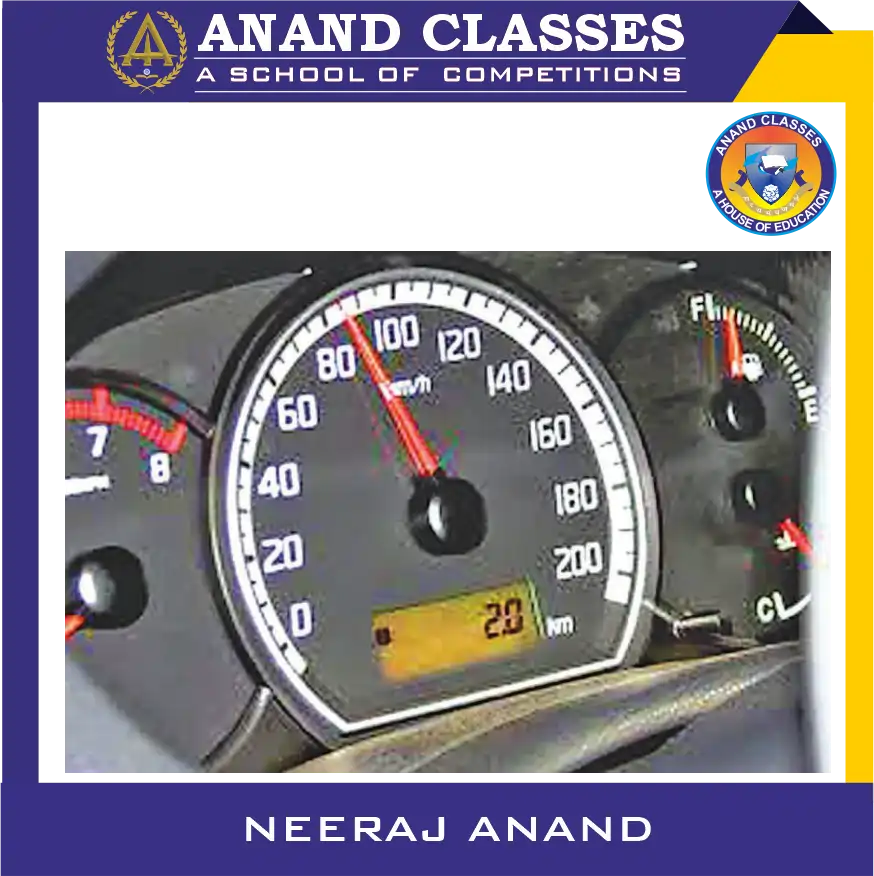
The speed of a running car at any instant of time is shown by an instrument called ‘speedometer’ which is fixed in the car. The speedometer gives the speed in kilometres per hour. The distance travelled by a car is measured by another instrument called ‘odometer’ which is also installed in the car. It records the distance in kilometres.
Mathematically,
If $s(t)$ represents the position of an object as a function of time $t$, the instantaneous speed $v$ at time $t$ is given by the derivative of $s(t)$ with respect to $t$ :
$$v_i = \left| \frac{ds(t)}{dt} \right|$$
This derivative represents the rate of change of position with respect to time, providing the speed at that specific instant.
How to calculate Instantaneous Speed ?
To calculate instantaneous speed, follow these steps :
Determine the Position Function : Identify the function $s(t)$ that describes the object’s position over time.
Differentiate the Position Function : Compute the derivative of $s(t)$ with respect to time tt to obtain the velocity function $v(t)$.
Evaluate the Magnitude : Take the absolute value of $v(t)$ at the desired time to find the instantaneous speed.
Example.1 : Consider an object whose position is given by $$s(t) = 5t^2 + 3t + 2$$. Find the instantaneous speed at t = 2 seconds.
Solution : To evaluate instantaneous speed, follow the steps :
Differentiate : $$v(t) = \frac{d}{dt}(5t^2 + 3t + 2) = 10t + 3$$
Evaluate : $$v(2) = 10(2) + 3 = 23 m/s$$
Instantaneous Speed : $$|v(2)| = |23| = 23 m/s$$
Example.2 : If the position of a particle is given by $s(t) = 4t^3 – 2t + 1$, what is its instantaneous speed at $\:t = 1 \:second $ ?
Solution : To evaluate instantaneous speed, follow the steps :
Differentiate $s(t)$ : $$v(t) = \frac{d}{dt}(4t^3 – 2t + 1) = 12t^2 – 2$$
Evaluate at $t = 1$ : $$v(1) = 12(1)^2 – 2 = 10 m/s$$
Instantaneous speed : $$|v(1)| = |10| = 10 m/s$$
Difference Between Instantaneous Speed and Average Speed
It’s essential to distinguish between instantaneous speed and average speed :
Instantaneous Speed : The speed of an object at a specific moment in time.
Average Speed : The total distance traveled divided by the total time taken.
For example, if a car travels 100 kilometers in 2 hours, its average speed is 50 km/h. However, during the trip, the car’s instantaneous speed may vary, sometimes exceeding or falling below the average speed.
Below is a detailed comparison :
| Feature | Instantaneous Speed | Average Speed |
|---|---|---|
| Definition | The speed of an object at a specific instant of time. | The total distance traveled divided by the total time taken. |
| Formula | $$v_i = \left| \frac{ds(t)}{dt} \right|$$ | $$v_{av} = \frac{\text{Total Distance Travelled}}{\text{Total Time Taken}}$$ |
| Time Consideration | Measured at a single instant. | Measured over a time interval. |
| Variation | Can change from moment to moment. | Represents the overall motion over a period of time. |
| Example | The reading on a car’s speedometer at a given instant. | The average speed of a car over a long journey. |
| Measurement Tool | Speedometer, derivative of position-time function. | Total distance and time measurement. |
Difference Between Uniform and Non-Uniform Motion
The difference between Uniform and Non Uniform motion can be tabulated as follows :
| Uniform motion | Non-uniform motion |
|---|---|
| In uniform motion, an object covers equal distances at equal intervals of time. | In a non-uniform motion, the object does not cover equal distances at equal intervals of time. |
| The average speed of the object during the whole journey is equal to its actual speed in uniform motion. | The average speed of the object during the whole journey is different from its actual speed in non-uniform motion. |
| Distance-time graph of an object with uniform motion is a straight line. | Distance-time graph of an object with non-uniform motion is a curved line. |
| Acceleration of the object is zero in Uniform Motion. | Acceleration of the object will be non-zero in Non-Uniform Motion. |
FAQs on Uniform Motion, Non-Uniform Motion and Speed for Class 11 CBSE, JEE and NEET
What is uniform motion?
Uniform motion is the type of motion in which an object covers equal distances in equal intervals of time. In this motion, the speed of the object remains constant throughout the journey. The distance-time graph of uniform motion is always a straight line. Examples of uniform motion include a train moving at constant speed on a straight track.
What is non-uniform motion?
Non-uniform motion is the motion in which an object covers unequal distances in equal intervals of time. In this case, the speed of the object changes continuously during motion. The distance-time graph of non-uniform motion is a curved line. A freely falling body and a moving vehicle in traffic are common examples of non-uniform motion.
What is the difference between uniform motion and non-uniform motion?
In uniform motion, the object moves with constant speed and covers equal distances in equal time intervals. In non-uniform motion, the speed changes and unequal distances are covered in equal intervals of time. The graph of uniform motion is a straight line, whereas the graph of non-uniform motion is curved. Uniform motion is simple and predictable, while non-uniform motion involves acceleration or deceleration.
What is speed in physics?
Speed is a physical quantity that tells us how fast or slow an object is moving. It is defined as the distance travelled by an object in a unit interval of time. Speed only gives the magnitude of motion and does not specify direction. It is commonly used in daily life to describe the motion of vehicles, runners, and machines.
What is the formula of speed?
The speed of an object is obtained by dividing the distance travelled by the time taken. It helps in determining how quickly an object moves from one place to another. The formula of speed is widely used in mechanics and motion-related calculations. It is one of the most important formulas in kinematics.
What are the units of speed?
The SI unit of speed is metre per second $(m/s)$. For small speeds, centimetre per second $(cm/s)$ is also used, while kilometre per hour $(km/h)$ is commonly used for vehicles and transport. All speed values must be expressed in the same unit while comparing different objects. Speed is a scalar quantity because it has magnitude only.
Why is speed called a scalar quantity?
Speed is called a scalar quantity because it only has magnitude and no direction associated with it. It tells how fast an object is moving but does not indicate the direction of motion. Unlike velocity, speed remains unaffected by the direction of travel. Therefore, speed is classified as a scalar physical quantity.
What is uniform speed?
Uniform speed refers to the condition when an object covers equal distances in equal intervals of time. In this type of motion, the speed remains constant throughout the journey. Uniform speed makes calculations of distance and time easier and more accurate. A car moving steadily on a highway at constant speed is an example of uniform speed.
What is non-uniform or variable speed?
Non-uniform or variable speed occurs when an object covers unequal distances in equal intervals of time. The speed keeps changing due to acceleration, braking, or changes in motion. Most vehicles moving on roads show variable speed because of traffic conditions. This type of motion is also associated with accelerated motion.
What is average speed?
Average speed is the total distance travelled divided by the total time taken during the complete journey. It gives an overall idea of the motion of an object when the speed changes during travel. Average speed is useful in real-life situations where maintaining constant speed is difficult. It represents the complete motion over a given time interval.
Why do we use average speed?
Average speed is used because the speed of moving objects generally changes during motion. Vehicles often slow down, stop, or accelerate due to traffic and road conditions. Average speed helps in describing the complete journey with a single value. It provides a practical way to study real-world motion.
What are the types of average speed?
Average speed is mainly divided into time-averaged speed and distance-averaged speed. Time-averaged speed is used when speeds are maintained for different time intervals. Distance-averaged speed is used when different distances are covered at different speeds. Both concepts are important in the study of motion and transportation problems.
What is instantaneous speed?
Instantaneous speed is the speed of an object at a particular instant of time. It tells how fast the object is moving at a specific moment during its motion. The reading shown by a vehicle’s speedometer represents instantaneous speed. It may continuously change during motion depending on acceleration or deceleration.
How is instantaneous speed measured?
Instantaneous speed is commonly measured using a speedometer installed in vehicles. Police radar guns are also used to determine the instantaneous speed of moving vehicles on roads. These instruments provide speed values at a particular moment. Instantaneous speed measurement is important in transportation and traffic control.
What is the difference between average speed and instantaneous speed?
Average speed describes the overall motion of an object during the entire journey. Instantaneous speed, on the other hand, gives the speed at a particular moment of time. Average speed depends on total distance and total time, while instantaneous speed depends on a specific instant. Both are important concepts used in mechanics and motion.
Which instruments are used to measure speed and distance?
The speed of a moving vehicle is measured using a speedometer. The total distance travelled by the vehicle is measured using an odometer. Both instruments are commonly installed in cars, buses, and motorcycles. They help drivers monitor speed and track travelled distance accurately.
What is the dimensional formula of speed?
The dimensional formula of speed is derived from the relation between distance and time. It shows that speed depends on length and time dimensions only. Speed has no dependence on mass. Dimensional formulas are important in physics for checking the correctness of equations and unit analysis.
What is accelerated motion?
Accelerated motion is the motion in which the speed or velocity of an object changes with time. An object may accelerate by increasing or decreasing its speed. Non-uniform motion is generally considered accelerated motion because the speed is not constant. Examples include moving vehicles, falling bodies, and running athletes.
How can we identify uniform and non-uniform motion using graphs?
Uniform motion is represented by a straight-line distance-time graph because the object covers equal distances uniformly with time. Non-uniform motion produces a curved graph because the speed changes continuously. Graphs provide a simple visual method to study motion. They are widely used in mechanics and kinematics.
Why is the motion of vehicles on roads usually non-uniform?
Vehicles moving on roads frequently accelerate, slow down, or stop due to traffic signals, road conditions, and turns. Because of these continuous changes in speed, their motion becomes non-uniform. Maintaining perfectly constant speed in practical situations is very difficult. Therefore, most real-life motions are non-uniform in nature.
Important Chapter Interlinks
Before studying Uniform Motion, Non-Uniform Motion, Speed, Average Speed, and Instantaneous Speed, it is important to understand the concepts of physical quantities, units, dimensions, and measurement errors discussed in the chapter Units and Measurements. Accurate measurement of distance and time forms the basis for calculating speed and analyzing motion in mechanics. In this chapter, students will learn about types of motion, speed-time relationships, distance-time graphs, speed conversion, and real-life applications of motion. These concepts are extremely important for board examinations as well as competitive exams like JEE Main and NEET, where conceptual and numerical problems based on motion and speed are frequently asked in previous year questions (PYQs).