The derivation of equations of Uniformly Accelerated Motion using the calculus method provides a deeper understanding of the relationship between displacement, velocity, acceleration, and time. By applying the fundamental concepts of differentiation and integration, the three equations of motion can be derived in a systematic and mathematical manner for bodies moving with uniform acceleration. This method not only strengthens the conceptual foundation of kinematics but also helps students understand the physical significance and applications of these equations in solving numerical problems related to motion.
Equations of Uniformly Accelerated Motion : Explanation, Derivation, and Applications
The three equations of motion describe the relationship between an object’s displacement, velocity, acceleration, and time under uniform acceleration. These equations play a crucial role in solving problems in kinematics, particularly for competitive exams like JEE, NEET, and CBSE Class 11 Physics.
The three equations of motion are :
First Equation : $\;v = u + at$
Second Equation : $\;s = ut + \frac{1}{2} at^2$
Third Equation : $\;v^2 – u^2 = 2as$
“This topic is closely connected with Equations of Motion“
“Important concepts connected to this topic is Equations of Motion Under Gravity for free fall, upward and vertical downward motion“
Derive First Equation of Motion : $v = u + at$ (Velocity-Time Relation)
The final velocity of an object moving with uniform acceleration is given by :
$$v = u + at$$
The instantaneous acceleration is defined as the rate of change of velocity of an object in uniformly accelerated motion is given by
$$a = \frac{dv}{dt}$$
Rearranging : $$dv = a \:dt$$
Suppose that velocity of the object at time $t$ = 0 is $u$ and at $t = t$ is $v$ i.e. when $t = 0, v = u$ ; and when $t = t, v = v$.
To determine how velocity changes over time, integrate both sides within proper limits, we have :
$$\int_{u}^{v} dv = \int_{0}^{t} a \:dt$$
Since acceleration $a$ is constant, it comes out of the integral :
$$\int_{u}^{v} dv = a \int_{0}^{t} dt$$
Evaluating the integrals :
$$\big[\ v\ \big]_u^v = a \big[\ t\ \big]_0^t$$
$$v \:-\: u = a\: (t \:-\: 0)$$
Simplifying : $$v = u + a\:t$$
Thus, we obtain the first equation of motion.
“Master related concepts such as Derivation for Displacement Travel in nth Second of Its Motion“
Derive Second Equation of Motion : $s = ut + \frac{1}{2} at^2$ (Displacement-Time Relation)
Suppose that the displacement of the object from the origin of position-axis is 0
at $t$ = 0 and $S$ at $t = t$.
The displacement ss of an object moving with uniform acceleration is given by : $s = ut + \dfrac{1}{2} at^2$
The instantaneous velocity is the rate of change of displacement of an object in uniformly accelerated motion is given by
$$v = \frac{ds}{dt}$$
Substituting $v = u + at$, we get
$$\frac{ds}{dt} = u + at$$
After Rearranging the above equation, we get :
$$ds = (u + at) dt$$
Integrating the above equation both sides from $s$ = 0 to $s$ and $t$ = 0 to $t$, we have :
$$\int_{0}^{s} ds = \int_{0}^{t} (u + at) dt$$
Splitting the integral :
$$\int_{0}^{s} ds = \int_{0}^{t} u dt + \int_{0}^{t} at dt$$
$$\int_{0}^{s} ds = u \int_{0}^{t} dt + a\int_{0}^{t} t dt$$
$$\big[\ s\ \big]_0^s = u \big[\ t \ \big]_0^t + a \left[ \frac{t^2}{2} \right]_0^t$$
$$\big[s – 0 \big] = u \big[t – 0 \big] + \frac{1}{2} a[t^2 – 0^2]$$
$$s = u t + \frac{1}{2} at^2$$
Thus, we obtain the second equation of motion.
“Build strong concepts by studying Distance and Displacement, Solved Numericals, Conceptual Questions Answers“
Third Equation of Motion : $v^2 – u^2 = 2as$ (Velocity-Displacement Relation)
The final velocity $v$ of an object moving with uniform acceleration is given by : $v^2 – u^2 = 2as$.
Suppose that when displacement of the object from the origin of position-axis is 0, the velocity of the object is $u$ and when the displacement is $s$, the velocity is $v$.
The instantaneous acceleration is defined as the rate of change of velocity of an object in uniformly accelerated motion is given by
$$a = \frac{dv}{dt}$$
Multiplying both sides by $ds/ds$ :
$$a = \frac{dv}{ds} \cdot \frac{ds}{dt} = \frac{dv}{ds}\cdot v$$
Rearranging the above equation, we have :
$$v dv = a ds$$
Integrating both sides from $u$ to $v$ and $s$ = 0 to $s = s$ :
$$\int_{u}^{v} v dv = a \int_{0}^{s} ds$$
$$\left[ \frac{v^2}{2} \right]_{u}^{v} = a \big[s \big]_0^s$$
$$\frac{v^2}{2} – \frac{u^2}{2} = a (s – 0) $$
$$\frac{v^2}{2} – \frac{u^2}{2} = as$$
Multiplying both sides by 2, we have :
$$v^2 – u^2 = 2as$$
Thus, we obtain the third equation of motion.
“Explore detailed notes on What is Mechanics, Statics, Dynamics, Kinematics, Kinetics“
Solved Numerical Examples Based on Equations of Uniformly Accelerated Motion Using Calculus Method
Q.1 : The displacement (in meters) of a particle moving along the X-axis is given by $x = 18t + 5t^2$. Calculate :
(i) The instantaneous velocity at $t = 2\text{ s}$
(ii) The average velocity between $t = 2\text{ s}$ and $t = 3\text{ s}$
(iii) The instantaneous acceleration
Solution : The given equation for the displacement of the particle as a function of time $t$ is :
$$x = 18t + 5t^2$$
(i) Instantaneous velocity at $t = 2\text{ s}$
Velocity ($v$) is the first derivative of displacement ($x$) with respect to time ($t$) :
$$v = \frac{dx}{dt} = \frac{d}{dt}(18t + 5t^2) = 18 + 10t$$
To find the instantaneous velocity at $t = 2\text{ s}$, substitute $t = 2$ into the velocity equation :
$$v_{(t=2\text{ s})} = 18 + 10(2)$$
$$v_{(t=2\text{ s})} = 18 + 20 = 38\text{ m/s}$$
(ii) Average velocity between $t = 2\text{ s}$ and $t = 3\text{ s}$
Average velocity is defined as the net displacement divided by the total time interval :
$$v_{\text{avg}} = \frac{x_2 – x_1}{t_2 – t_1}$$
First, find the position of the particle at $t_1 = 2\text{ s}$ ($x_1$) :
$$x_1 = 18(2) + 5(2)^2 = 36 + 5(4) = 36 + 20 = 56\text{ m}$$
Next, find the position of the particle at $t_2 = 3\text{ s}$ ($x_2$) :
$$x_2 = 18(3) + 5(3)^2 = 54 + 5(9) = 54 + 45 = 99\text{ m}$$
Now, substitute these values into the average velocity formula :
$$v_{\text{avg}} = \frac{99 – 56}{3 – 2}$$
$$v_{\text{avg}} = \frac{43}{1} = 43\text{ m/s}$$
(iii) Instantaneous acceleration
Acceleration ($a$) is the first derivative of velocity ($v$) with respect to time ($t$) :
$$a = \frac{dv}{dt} = \frac{d}{dt}(18 + 10t)$$
$$a = 10\text{ m/s}^2$$
(Note: Since the variable $t$ is eliminated during differentiation, the acceleration is constant and does not depend on time).
“For complete preparation, also study What is the Difference Between Speed and Velocity ?“
Q.2 : If the displacement of a body is proportional to the square of time, state whether the body is moving with uniform velocity or uniform acceleration.
Solution :
Suppose that the displacement ($x$) of the body is proportional to the square of time ($t^2$). This relationship can be written as :
$$x = k t^2$$
Where $k$ is a constant of proportionality.
1. Checking for Uniform Velocity
Velocity ($v$) is defined as the rate of change of displacement with respect to time ($t$). Taking the first derivative of the displacement equation :
$$v = \frac{dx}{dt} = \frac{d}{dt}(k t^2)$$
$$v = 2kt$$
Because the velocity equation contains the time variable ($t$), the velocity changes as time progresses. Therefore, the body is not moving with uniform velocity.
2. Checking for Uniform Acceleration
Acceleration ($a$) is defined as the rate of change of velocity with respect to time ($t$). Taking the derivative of the velocity equation:
$$a = \frac{dv}{dt} = \frac{d}{dt}(2kt)$$
$$a = 2k$$
Because $2k$ is a constant value, the acceleration does not change with time. Therefore, the body is moving with uniform acceleration.
For complete preparation, also study NCERT Exemplar Solutions Motion In a Straight Line Class 11 Physics Chapter 2
Q.3 : An object is covering distance in direct proportion to $t^3$, where $t$ is the time elapsed.
(a) What conclusions might you draw about the acceleration? Is it constant or increasing or decreasing or zero?
(b) What might you conclude about the force acting on the object?
Solution : Let the distance (or displacement along a straight line) be represented by $x$. Since $x$ is directly proportional to $t^3$, we can express it as :
$$x = k t^3$$
Where $k$ is a constant of proportionality.
(a) To find the acceleration, we first need to determine the velocity ($v$) by taking the first derivative of displacement with respect to time ($t$) :
$$v = \frac{dx}{dt} = \frac{d}{dt}(k t^3) = 3 k t^2$$
Next, we find the acceleration ($a$) by taking the derivative of velocity with respect to time ($t$) :
$$a = \frac{dv}{dt} = \frac{d}{dt}(3 k t^2) = 6 k t$$
Since $6k$ is a constant, we can rewrite this as a proportionality :
$$a \propto t$$
The acceleration of the moving object is not constant; it increases directly (uniformly) with time.
(b) According to Newton’s second law of motion, the force ($F$) acting on a body is the product of its mass ($m$) and its acceleration ($a$) :
$$F = m a$$
Substituting our expression for acceleration ($a = 6kt$) :
$$F = m(6kt) = (6mk)t$$
Since both mass ($m$) and $k$ are constant values, the entire term $6mk$ is a constant. Therefore :
$$F \propto t$$
The net force acting on the object is also not constant; the accelerating force increases uniformly with time.
Q.4 : A particle moves in a straight line. Its displacement $t$ seconds after leaving the fixed point $O$ is $x$ meters, where :
$$x = \frac{1}{2}t^2 + \frac{1}{30}t^3$$
Find :
(i) The speed of the particle when $t = 10\text{ s}$.
(ii) The value of $t$ for which the acceleration of the particle is twice its initial acceleration.
Solution : The given displacement equation of the particle is :
$$x = \frac{1}{2}t^2 + \frac{1}{30}t^3$$
(i) Find the speed of the particle when $t = 10\text{ s}$
Velocity ($v$) is the first derivative of displacement ($x$) with respect to time ($t$) :
$$v = \frac{dx}{dt} = \frac{d}{dt}\left(\frac{1}{2}t^2 + \frac{1}{30}t^3\right)$$
$$v = \left(\frac{1}{2} \times 2t\right) + \left(\frac{1}{30} \times 3t^2\right)$$
$$v = t + \frac{1}{10}t^2$$
To find the speed at $t = 10\text{ s}$, substitute $t = 10$ into the velocity equation :
$$v_{(t = 10)} = 10 + \frac{1}{10}(10)^2$$
$$v_{(t = 10)} = 10 + \frac{100}{10} = 10 + 10 = 20\text{ m/s}$$
(ii) Find the value of $t$ when acceleration is twice its initial acceleration
Acceleration ($a$) is the derivative of velocity ($v$) with respect to time ($t$) :
$$a = \frac{dv}{dt} = \frac{d}{dt}\left(t + \frac{1}{10}t^2\right)$$
$$a = 1 + \left(\frac{1}{10} \times 2t\right)$$
$$a = 1 + \frac{1}{5}t$$
First, find the initial acceleration, which occurs at the very start when $t = 0\text{ s}$ :
$$a_{(t = 0)} = 1 + \frac{1}{5}(0) = 1\text{ m/s}^2$$
According to the given condition, we need to find the time $t$ where the acceleration is twice this initial value :
$$a_{(t)} = 2 \times a_{(t = 0)}$$
Substituting our expressions into this condition :
$$1 + \frac{1}{5}t = 2 \times 1$$
$$1 + \frac{1}{5}t = 2$$
Subtract 1 from both sides :
$$\frac{1}{5}t = 1$$
Multiply both sides by 5 :
$$t = 5\text{ s}$$
Q:5 : A particle $P$ starts to move from a point $O$ and travels in a straight line. At time $t$ (in seconds) after $P$ starts to move, its velocity is $v$ (in $\text{m/s}$), given by :
$$v = 0.12t – 0.0006t^2 \text{.. (Equation 1)}$$
Find :
(i) Verify that the particle $P$ comes to instantaneous rest when $t = 200\text{ s}$, and find the acceleration with which it starts to return towards $O$.
(ii) Find the maximum speed of $P$ for $0 \le t \le 200\text{ s}$.
(iii) Find the displacement of $P$ from $O$ when $t = 200\text{ s}$.
(iv) Find the value of $t$ when $P$ reaches $O$ again.
Solution :
(i) Verification of rest at $t = 200\text{ s}$ and finding acceleration
To verify that the particle comes to an instantaneous rest, substitute $t = 200\text{ s}$ into the velocity equation :
$$v = 0.12(200) – 0.0006(200)^2$$
$$v = 24 – 0.0006(40000)$$
$$v = 24 – 24 = 0\text{ m/s}$$
Since $v = 0$, it is verified that the particle comes to instantaneous rest at $t = 200\text{ s}$.
To find the acceleration, take the derivative of velocity with respect to time :
$$a = \frac{dv}{dt} = \frac{d}{dt}\left(0.12t – 0.0006t^2\right)$$
$$a = 0.12 – 0.0012t$$
The acceleration with which it starts to return towards $O$ occurs at $t = 200\text{ s}$ :
$$a_{(t = 200)} = 0.12 – 0.0012(200)$$
$$a_{(t = 200)} = 0.12 – 0.24 = -0.12\text{ m/s}^2$$
(ii) Finding the maximum speed of $P$
For the speed to be maximum, the first derivative of velocity with respect to time must be zero ($\frac{dv}{dt} = 0$), which means acceleration must be zero :
$$a = 0.12 – 0.0012t = 0$$
$$0.0012t = 0.12$$
$$t = \frac{0.12}{0.0012} = 100\text{ s}$$
Now, substitute $t = 100\text{ s}$ back into the velocity equation to find the maximum speed ($v_{\text{max}}$) :
$$v_{\text{max}} = 0.12(100) – 0.0006(100)^2$$
$$v_{\text{max}} = 12 – 0.0006(10000)$$
$$v_{\text{max}} = 12 – 6 = 6\text{ m/s}$$
(iii) Finding the displacement of $P$ at $t = 200\text{ s}$
Velocity is defined as the rate of change of displacement ($S$), meaning $v = \frac{dS}{dt}$, or $dS = v \, dt$. Integrating both sides gives the displacement function:
$$S = \int v \, dt = \int \left(0.12t – 0.0006t^2\right) dt$$
$$S = 0.12 \left(\frac{t^2}{2}\right) – 0.0006 \left(\frac{t^3}{3}\right)$$
$$S = 0.06t^2 – 0.0002t^3 \qquad \text{…… (Equation 2)}$$
(Note: The integration constant is $0$ since displacement $S = 0$ at $t = 0$).
To find the displacement at $t = 200\text{ s}$, substitute $t = 200$ into the displacement equation :
$$S_{(t = 200)} = 0.06(200)^2 – 0.0002(200)^3$$
$$S_{(t = 200)} = 0.06(40000) – 0.0002(8000000)$$
$$S_{(t = 200)} = 2400 – 1600 = 800\text{ m}$$
(iv) Value of $t$ when $P$ reaches $O$ again
When the particle reaches its starting point $O$ again, its net displacement becomes zero ($S = 0$). Setting Equation 2 to zero :
$$0.06t^2 – 0.0002t^3 = 0$$
Factor out $t^2$:
$$t^2(0.06 – 0.0002t) = 0$$
Since $t = 0\text{ s}$ is the start of the motion, we solve for the second root:
$$0.06 – 0.0002t = 0$$
$$0.0002t = 0.06$$
$$t = \frac{0.06}{0.0002} = 300\text{ s}$$
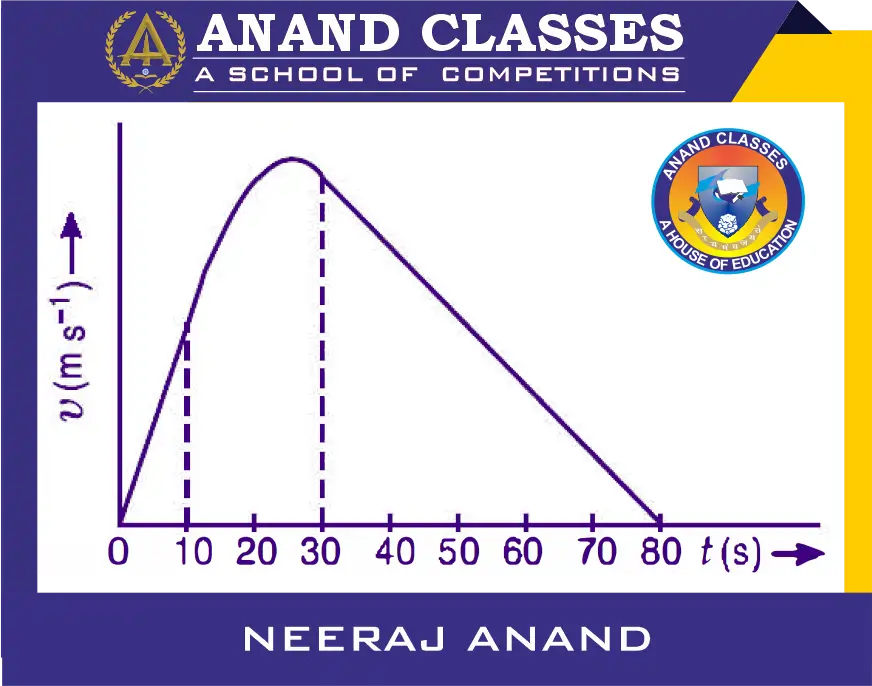
Q.6 : An object $P$ travels from $A$ to $B$ in a time of $80\text{ s}$. The figure shows the graph of $v$ against $t$, where $v\text{ m/s}$ is the velocity of $P$ at time $t\text{ s}$ after leaving $A$. The graph consists of straight line segments for the intervals $0 \le t \le 10\text{ s}$ and $30 \le t \le 80\text{ s}$, and a curved section whose equation is :
$$v = -0.01t^2 + 0.5t – 1 \qquad \text{for } 10 \le t \le 30\text{ s}$$
Find :
(i) The maximum velocity of $P$.
(ii) The total distance $AB$.
Solution :
(i) Finding the maximum velocity of $P$
The maximum velocity occurs within the curved section during the interval $10 \le t \le 30\text{ s}$. The equation for velocity in this interval is :
$$v = -0.01t^2 + 0.5t – 1 \qquad \text{…….. (Equation 1)}$$
For the velocity to be maximum, its first derivative with respect to time must equal zero ($\frac{dv}{dt} = 0$) :
$$\frac{dv}{dt} = \frac{d}{dt}\left(-0.01t^2 + 0.5t – 1\right) = 0$$
$$-0.02t + 0.5 = 0$$
$$0.02t = 0.5$$
$$t = \frac{0.5}{0.02} = 25\text{ s}$$
Now, substitute $t = 25\text{ s}$ into Equation 1 to calculate the maximum velocity ($v_{\text{max}}$) :
$$v_{\text{max}} = -0.01(25)^2 + 0.5(25) – 1$$
$$v_{\text{max}} = -0.01(625) + 12.5 – 1$$
$$v_{\text{max}} = -6.25 + 12.5 – 1 = 5.25\text{ m/s}$$
(ii) Finding the distance $AB$
The total distance $AB$ is the total area under the velocity-time graph from $t = 0$ to $t = 80\text{ s}$. We divide the journey into three parts: $S_1$, $S_2$, and $S_3$.
$$\text{Total Distance } AB = S_1 + S_2 + S_3$$
Step 1: Find the boundary velocities at $t = 10\text{ s}$ and $t = 30\text{ s}$
Substituting $t = 10\text{ s}$ into Equation 1:
$$v_{10} = -0.01(10)^2 + 0.5(10) – 1 = -1 + 5 – 1 = 3\text{ m/s}$$
Substituting $t = 30\text{ s}$ into Equation 1:
$$v_{30} = -0.01(30)^2 + 0.5(30) – 1 = -9 + 15 – 1 = 5\text{ m/s}$$
Step 2: Calculate distance $S_1$ (from $t = 0\text{ s}$ to $t = 10\text{ s}$)
The region under this straight line segment forms a right-angled triangle with a base of $10\text{ s}$ and a height of $v_{10} = 3\text{ m/s}$:
$$S_1 = \frac{1}{2} \times \text{base} \times \text{height} = \frac{1}{2} \times 10 \times 3 = 15\text{ m}$$
Step 3: Calculate distance $S_2$ (from $t = 10\text{ s}$ to $t = 30\text{ s}$)
The distance under the curved section is obtained by evaluating the definite integral of the velocity function:
$$S_2 = \int_{10}^{30} \left(-0.01t^2 + 0.5t – 1\right) dt$$
$$S_2 = \left[ -0.01\left(\frac{t^3}{3}\right) + 0.5\left(\frac{t^2}{2}\right) – t \right]_{10}^{30}$$
$$S_2 = \left[ -\frac{0.01}{3}t^3 + 0.25t^2 – t \right]_{10}^{30}$$
Evaluating at the upper limit ($t = 30$):
$$\text{Upper} = -\frac{0.01}{3}(30)^3 + 0.25(30)^2 – 30 = -90 + 225 – 30 = 105$$
Evaluating at the lower limit ($t = 10$):
$$\text{Lower} = -\frac{0.01}{3}(10)^3 + 0.25(10)^2 – 10 = -3.33 + 25 – 10 = 11.67$$
Subtracting the lower limit from the upper limit:
$$S_2 = 105 – 11.67 = 93.33\text{ m}$$
Step 4: Calculate distance $S_3$ (from $t = 30\text{ s}$ to $t = 80\text{ s}$)
The region under this straight line segment forms a right-angled triangle with a base of $80 – 30 = 50\text{ s}$ and a height of $v_{30} = 5\text{ m/s}$:
$$S_3 = \frac{1}{2} \times \text{base} \times \text{height} = \frac{1}{2} \times 50 \times 5 = 125\text{ m}$$
Total Distance Calculation
$$AB = S_1 + S_2 + S_3$$
$$AB = 15 + 93.33 + 125 = 233.33\text{ m}$$
Q.7 : A particle executes the motion described by :
$x(t) = x_0(1 – e^{-\gamma t}) \ \text{for } t \ge 0, \text{ and } x_0 > 0, \gamma > 0$
(a) Where does the particle start and with what velocity?
(b) Find the maximum and minimum values of $x(t)$, $v(t)$, and $a(t)$. Show that $x(t)$ and $a(t)$ increase with time while $v(t)$ decreases with time.
Solution :
The position equation of the particle as a function of time $t$ is :
$$x(t) = x_0(1 – e^{-\gamma t})$$
To find where the particle starts, substitute $t = 0$ into the position equation :
$$x(0) = x_0(1 – e^{-\gamma \times 0}) = x_0(1 – e^0)$$
Since $e^0 = 1$ :
$$x(0) = x_0(1 – 1) = 0$$
Thus, the particle starts at the origin ($x = 0$).
Velocity ($v$) is the first derivative of position ($x$) with respect to time ($t$) :
$$v(t) = \frac{dx}{dt} = \frac{d}{dt} \left[ x_0(1 – e^{-\gamma t}) \right]$$
$$v(t) = x_0 \left( 0 – e^{-\gamma t}(-\gamma) \right)$$
$$v(t) = \gamma x_0 e^{-\gamma t}$$
To find the initial velocity, substitute $t = 0$ into the velocity equation :
$$v(0) = \gamma x_0 e^{-\gamma \times 0} = \gamma x_0 e^0$$
$$v(0) = \gamma x_0 (1) = \gamma x_0$$
Thus, the particle starts with an initial velocity of $\gamma x_0$.
The position equation is $x(t) = x_0(1 – e^{-\gamma t})$.
As time $t$ increases from $0$ to $\infty$, the exponential term $e^{-\gamma t}$ decreases from $1$ towards $0$. Since a decreasing quantity is being subtracted from $1$, the value of $(1 – e^{-\gamma t})$ grows larger over time. Therefore, $x(t)$ increases with time.
Minimum value of $x(t)$ : Occurs at $t = 0$, where $e^{-\gamma t} = 1$:$$x_{\text{min}} = x_0(1 – 1) = 0$$
Maximum value of $x(t)$ : Occurs as $t \to \infty$, where $e^{-\gamma t} \to 0$:$$x_{\text{max}} = x_0(1 – 0) = x_0$$
The velocity equation is $v(t) = \gamma x_0 e^{-\gamma t}$.
As time $t$ increases, the exponential term $e^{-\gamma t}$ continually drops closer to $0$. Since it is multiplied by positive constants ($\gamma x_0$), $v(t)$ decreases with time.
Maximum value of $v(t)$ : Occurs at the start when $t = 0$, where $e^{-\gamma t} = 1$:$$v_{\text{max}} = \gamma x_0(1) = \gamma x_0$$
Minimum value of $v(t)$ : Occurs as $t \to \infty$, where $e^{-\gamma t} \to 0$:$$v_{\text{min}} = \gamma x_0(0) = 0$$
Acceleration ($a$) is the first derivative of velocity ($v$) with respect to time ($t$) :
$$a(t) = \frac{dv}{dt} = \frac{d}{dt} \left( \gamma x_0 e^{-\gamma t} \right)$$
$$a(t) = \gamma x_0 \left( e^{-\gamma t}(-\gamma) \right)$$
$$a(t) = -\gamma^2 x_0 e^{-\gamma t}$$
The negative sign indicates that acceleration acts in the opposite direction of motion (it is a retarding force). As time $t$ grows, $e^{-\gamma t}$ drops toward $0$, meaning the value of $a(t)$ becomes a smaller negative number (moves closer to zero). Because it shifts from a negative value toward zero, $a(t)$ increases with time.
Minimum value of $a(t)$ : Occurs at $t = 0$, where the deceleration is strongest ($e^{-\gamma t} = 1$) :
$$a_{\text{min}} = -\gamma^2 x_0(1) = -\gamma^2 x_0$$
Maximum value of $a(t)$ : Occurs as $t \to \infty$, where the retarding effect vanishes ($e^{-\gamma t} \to 0$) :
$$a_{\text{max}} = -\gamma^2 x_0(0) = 0$$
Q.8 : The relation between time $t$ and distance $x$ is $t = ax^2 + bx$, where $a$ and $b$ are constants. The acceleration is :
(A) $-2abv^2$
(B) $2bv^3$
(C) $-2av^3$
(D) $2av^2$
(A.I.E.E.E. 2005)
Solution :
The given equation relating time $t$ and position $x$ is :
$$t = ax^2 + bx \qquad \text{.. (Equation 1)}$$
Differentiating both sides of Equation 1 with respect to time ($t$) :
$$\frac{d}{dt}(t) = \frac{d}{dt}(ax^2 + bx)$$
Using the chain rule ($\dfrac{d}{dt} = \dfrac{d}{dx} \cdot \dfrac{dx}{dt}$) and knowing that velocity $v = \dfrac{dx}{dt}$ :
$$1 = 2ax \left(\frac{dx}{dt}\right) + b \left(\frac{dx}{dt}\right)$$
$$1 = 2axv + bv$$
Factor out velocity ($v$):
$$1 = v(2ax + b)$$
Rearranging to isolate velocity ($v$) :
$$v = \frac{1}{2ax + b} = (2ax + b)^{-1} \qquad \text{.. (Equation 2)}$$
Acceleration ($a_{\text{acc}}$) is the derivative of velocity ($v$) with respect to time ($t$). We will use the chain rule to differentiate Equation 2 with respect to $t$ :
$$a_{\text{acc}} = \frac{dv}{dt} = \frac{d}{dt}\left[ (2ax + b)^{-1} \right]$$
Applying the power rule and chain rule :
$$a_{\text{acc}} = -1 \cdot (2ax + b)^{-2} \cdot \frac{d}{dt}(2ax + b)$$
$$a_{\text{acc}} = -(2ax + b)^{-2} \cdot \left( 2a \frac{dx}{dt} + 0 \right)$$
Substitute $\dfrac{dx}{dt} = v$ :
$$a_{\text{acc}} = -\frac{1}{(2ax + b)^2} \cdot (2av)$$
From Equation 2, we know that $\dfrac{1}{2ax + b} = v$. Squaring both sides gives $\dfrac{1}{(2ax + b)^2} = v^2$. Substituting this back into our acceleration equation :
$$a_{\text{acc}} = -(v^2) \cdot (2av)$$
$$a_{\text{acc}} = -2av^3$$
The acceleration of the particle is $-2av^3$.
Hence, the correct option is (C).
Q.9 : A particle located at $x = 0$ at time $t = 0$ starts moving along the positive X-direction with a velocity $v$ that varies as $v = \alpha \sqrt{x}$ (where $\alpha$ is a positive constant). The displacement of the particle varies with time as:
(A) $t^{1/2}$
(B) $t^3$
(C) $t^2$
(D) $t$
(A.I.E.E.E. 2006)
Solution :
At initial time $t = 0$, the initial position is $x = 0$.
The velocity as a function of position is given by:$$v = \alpha \sqrt{x} = \alpha x^{1/2}$$
Velocity is defined as the rate of change of displacement with respect to time ($v = \dfrac{dx}{dt}$) :
$$\frac{dx}{dt} = \alpha x^{1/2}$$
Rearrange the equation to group all $x$ terms on one side and $t$ terms on the other side:
$$\frac{1}{x^{1/2}} \, dx = \alpha \, dt$$
$$x^{-1/2} \, dx = \alpha \, dt$$
Now, integrate both sides within the given boundary limits (from $x=0$ to $x$, and $t=0$ to $t$) :
$$\int_{0}^{x} x^{-1/2} \, dx = \int_{0}^{t} \alpha \, dt$$
Using the power rule for integration ($\int x^n dx = \frac{x^{n+1}}{n+1}$):
$$\left[ \frac{x^{-1/2 + 1}}{-1/2 + 1} \right]_{0}^{x} = \alpha \Big[ t \Big]_{0}^{t}$$
$$\left[ \frac{x^{1/2}}{1/2} \right]_{0}^{x} = \alpha t$$
$$2x^{1/2} = \alpha t$$
Divide both sides by $2$ :
$$x^{1/2} = \frac{\alpha}{2}t$$
Square both sides to completely isolate $x$ :
$$\left(x^{1/2}\right)^2 = \left(\frac{\alpha}{2}t\right)^2$$
$$x = \frac{\alpha^2}{4}t^2$$
Since $\alpha$ is a constant, the entire term $\frac{\alpha^2}{4}$ is also a constant. Therefore, we can write the relationship as a proportionality :
$$x \propto t^2$$
The displacement of the particle varies directly with the square of time ($t^2$).
Hence, the correct option is (C).
Q.10 : An object moving with a speed of $6.25\text{ m/s}$ is decelerating at a rate given by : $\dfrac{dv}{dt} = -2.5\sqrt{v}$
where $v$ is the instantaneous speed. The time taken by the object to come to rest would be :
(A) $1\text{ s}$
(B) $2\text{ s}$
(C) $4\text{ s}$
(D) $8\text{ s}$
(A.I.E.E.E. 2011)
Solution :
Initial speed ($u$) at $t = 0\text{ s}$ is $v = 6.25\text{ m/s}$
Final speed ($v_{\text{final}}$) at time $t$ is $0\text{ m/s}$ (since the object comes to rest)
The rate of change of velocity (deceleration) is given by:$$\frac{dv}{dt} = -2.5\sqrt{v} = -2.5v^{1/2}$$
Rearrange the differential equation to group the velocity variables ($v$) on the left side and the time variable ($t$) on the right side :
$$\frac{1}{v^{1/2}} \, dv = -2.5 \, dt$$
$$v^{-1/2} \, dv = -2.5 \, dt$$
Set up the definite integrals using the initial conditions ($t = 0$ when $v = 6.25$) and the final conditions ($t = t$ when $v = 0$) :
$$\int_{6.25}^{0} v^{-1/2} \, dv = \int_{0}^{t} -2.5 \, dt$$
Using the power rule for integration ($\int v^n dv = \frac{v^{n+1}}{n+1}$):
$$\left[ \frac{v^{-1/2 + 1}}{-1/2 + 1} \right]_{6.25}^{0} = -2.5 \Big[ t \Big]_{0}^{t}$$
$$\left[ \frac{v^{1/2}}{1/2} \right]_{6.25}^{0} = -2.5(t – 0)$$
$$2\Big[ \sqrt{v} \Big]_{6.25}^{0} = -2.5t$$
Substitute the upper and lower limits into the left side of the equation :
$$2\left( \sqrt{0} – \sqrt{6.25} \right) = -2.5t$$
Knowing that $\sqrt{6.25} = 2.5$:
$$2(0 – 2.5) = -2.5t$$
$$-5 = -2.5t$$
Divide both sides by $-2.5$ :
$$t = \frac{-5}{-2.5}$$
$$t = 2\text{ s}$$
The time taken by the object to come to rest is $2\text{ seconds}$.
Hence, the correct option is (B).
Q.11 : A car moves along a straight line, whose equation of motion is given by : $s = 12t + 3t^2 – 2t^3$
where $s$ is in meters and $t$ is in seconds. The velocity of the car at the start will be :
(A) $7\text{ m/s}$
(B) $9\text{ m/s}$
(C) $12\text{ m/s}$
(D) $16\text{ m/s}$
(C.B.S.E. PMT 1998)
Solution :
The given displacement equation of the car as a function of time $t$ is :
$$s = 12t + 3t^2 – 2t^3$$
Velocity ($v$) is defined as the first derivative of displacement ($s$) with respect to time ($t$) :
$$v = \frac{ds}{dt} = \frac{d}{dt}\left(12t + 3t^2 – 2t^3\right)$$
Applying the power rule for differentiation ($\frac{d}{dt}(t^n) = n t^{n-1}$):
$$v = 12(1) + 3(2t) – 2(3t^2)$$
$$v = 12 + 6t – 6t^2 \text{.. (Equation 1)}$$
For initial velocity, substituting $t = 0$ into Equation 1 :
$$v_{(t=0)} = 12 + 6(0) – 6(0)^2$$
$$v_{(t=0)} = 12 + 0 – 0$$
$$v_{(t=0)} = 12\text{ m/s}$$
The initial velocity of the car at the start of its motion is $12\text{ m/s}$.
Hence, the correct option is (C).
Q12 : A particle moves along a straight line $OX$. At a time $t$ (in seconds), the distance $x$ (in meters) of the particle from $O$ is given by :
$x = 40 + 12t – t^3$
How long would the particle travel before coming to rest?
(A) $16\text{ m}$
(B) $24\text{ m}$
(C) $40\text{ m}$
(D) $56\text{ m}$
(C.B.S.E. PMT 2006)
Solution :
The given position equation of the particle as a function of time $t$ is :
$$x(t) = 40 + 12t – t^3 \qquad \text{……. (Equation 1)}$$
To find out how far the particle travels, we first need to determine when (at what time $t$) it comes to rest, and then calculate its change in position.
The particle’s journey begins at $t = 0\text{ s}$. Let’s calculate its starting position ($x_0$) :
$$x_0 = 40 + 12(0) – (0)^3$$
$$x_0 = 40\text{ m}$$
$$v = \frac{dx}{dt} = \frac{d}{dt}\left(40 + 12t – t^3\right)$$
$$v = 0 + 12 – 3t^2$$
$$v = 12 – 3t^2 \ \text{… (Equation 2)}$$
By given velocity becomes zero ($v = 0$). Setting Equation 2 to zero :
$$12 – 3t^2 = 0$$
$$3t^2 = 12$$
$$t^2 = 4$$
$$t = 2\text{ s} $$
Now, substitute $t = 2\text{ s}$ back into the original position equation (Equation 1) to find where the particle is located when it stops ($x_{\text{rest}}$) :
$$x_{\text{rest}} = 40 + 12(2) – (2)^3$$
$$x_{\text{rest}} = 40 + 24 – 8$$
$$x_{\text{rest}} = 56\text{ m}$$
The total distance covered ($S$) is the difference between its position when it comes to rest and its initial starting position :
$$S = x_{\text{rest}} – x_0$$
$$S = 56\text{ m} – 40\text{ m} = 16\text{ m}$$
The particle will travel a distance of $16\text{ meters}$ before coming to rest.
Hence, the correct option is (A).
Q.13 : The displacement of a particle is represented by the following equation :
$s = 3t^3 + 7t^2 + 5t + 8$
where $s$ is in meters and $t$ is in seconds. The acceleration of the particle at $t = 1\text{ s}$ is :
(A) $18\text{ m/s}^2$
(B) $14\text{ m/s}^2$
(C) $32\text{ m/s}^2$
(D) zero
(C.B.S.E. PMT 2000)
Solution :
The given displacement equation of the particle as a function of time $t$ is :
$$s = 3t^3 + 7t^2 + 5t + 8$$
$$v = \frac{ds}{dt} = \frac{d}{dt}\left(3t^3 + 7t^2 + 5t + 8\right)$$
$$v = 3(3t^2) + 7(2t) + 5(1) + 0$$
$$v = 9t^2 + 14t + 5 \text{.. (Equation 1)}$$
Acceleration ($a$) is defined as the first derivative of velocity ($v$) with respect to time ($t$), which is also the second derivative of displacement ($\dfrac{d^2s}{dt^2}$) :
$$a = \frac{dv}{dt} = \frac{d}{dt}\left(9t^2 + 14t + 5\right)$$
$$a = 9(2t) + 14(1) + 0$$
$$a = 18t + 14 \text{… (Equation 2)}$$
To find the acceleration at the specific time of $1\text{ second}$, substitute $t = 1$ into Equation 2 :
$$a_{(t=1)} = 18(1) + 14$$
$$a_{(t=1)} = 18 + 14$$
$$a_{(t=1)} = 32\text{ m/s}^2$$
The acceleration of the particle at $t = 1\text{ s}$ is $32\text{ m/s}^2$.
Hence, the correct option is (C).
Q.14 : The position $x$ of a particle varies with time ($t$) as :
$x = at^2 – bt^3$
The acceleration of the particle will be zero at time :
(A) $\frac{2a}{3b}$
(B) $\frac{a}{b}$
(C) $\frac{a}{3b}$
(D) zero
(C.B.S.E. PMT 1997)
Solution :
The given position equation of the particle as a function of time $t$ is :
$$x = at^2 – bt^3$$
$$v = \frac{dx}{dt} = \frac{d}{dt}\left(at^2 – bt^3\right)$$
$$v = a(2t) – b(3t^2)$$
$$v = 2at – 3bt^2 \text{.. (Equation 1)}$$
$$a_{\text{acc}} = \frac{dv}{dt} = \frac{d}{dt}\left(2at – 3bt^2\right)$$
$$a_{\text{acc}} = 2a(1) – 3b(2t)$$
$$a_{\text{acc}} = 2a – 6bt \text{.. (Equation 2)}$$
According to the question, we need to find the time $t$ when the acceleration ($a_{\text{acc}}$) becomes zero. Setting Equation 2 to zero :
$$2a – 6bt = 0$$
Rearranging the equation to solve for $t$ :
$$6bt = 2a$$
$$t = \frac{2a}{6b}$$
Simplifying the fraction by dividing the numerator and denominator by 2 :
$$t = \frac{a}{3b}$$
The acceleration of the particle will be zero at time $\dfrac{a}{3b}$.
Hence, the correct option is (C).
Q.15 : The displacement $x$ of a particle varies with time $t$ as :
$x = a e^{-\alpha t} + b e^{\beta t}$
where $a$, $b$, $\alpha$, and $\beta$ are positive constants. The velocity of the particle will :
(A) be independent of $\alpha$ and $\beta$
(B) drop to zero, when $\alpha = \beta$
(C) go on decreasing with time
(D) go on increasing with time
(C.B.S.E. PMT 2005)
Solution :
The position equation of the particle as a function of time $t$ is given by :
$$x = a e^{-\alpha t} + b e^{\beta t}$$
$$v = \frac{dx}{dt} = \frac{d}{dt}\left(a e^{-\alpha t} + b e^{\beta t}\right)$$
Using the exponential chain rule ($\frac{d}{dt}[e^{kt}] = k e^{kt}$) :
$$v = a(-\alpha e^{-\alpha t}) + b(\beta e^{\beta t})$$
$$v = -a\alpha e^{-\alpha t} + b\beta e^{\beta t} \text{.. (Equation 1)}$$
Option (A) : Equation 1 clearly contains both $\alpha$ and $\beta$, so the velocity is not independent of them.
Option (B) : If we substitute $\alpha = \beta$ into the equation, $v = -a\alpha e^{-\alpha t} + b\alpha e^{-\alpha t} = \alpha e^{-\alpha t}(b – a)$. This expression will only equal zero if $b = a$. Since we are not given that $b = a$, the velocity does not automatically drop to zero when $\alpha = \beta$.
To determine whether the velocity is increasing or decreasing with time, we need to look at its rate of change, which is the acceleration ($a_{\text{acc}}$). Differentiating Equation 1 with respect to time :
$$a_{\text{acc}} = \frac{dv}{dt} = \frac{d}{dt}\left(-a\alpha e^{-\alpha t} + b\beta e^{\beta t}\right)$$
$$a_{\text{acc}} = -a\alpha(-\alpha e^{-\alpha t}) + b\beta(\beta e^{\beta t})$$
$$a_{\text{acc}} = a\alpha^2 e^{-\alpha t} + b\beta^2 e^{\beta t}$$
Since $a, b, \alpha$, and $\beta$ are all explicitly stated to be positive constants, and exponential functions ($e^k$) always yield positive outputs for real inputs :
The term $a\alpha^2 e^{-\alpha t}$ is always positive.
The term $b\beta^2 e^{\beta t}$ is always positive.
Because we are adding two strictly positive values together, the acceleration is always greater than zero ($a_{\text{acc}} > 0$) for all values of $t \ge 0$.
Since the acceleration is consistently positive, the velocity goes on increasing with time.
Hence, the correct option is (D).
Q.16 : The acceleration of a particle is increasing linearly with time $t$ as $bt$. The particle starts from the origin with an initial velocity $v_0$. The distance travelled by the particle in time $t$ will be :
(A) $v_0t + \frac{1}{6}bt^3$
(B) $v_0t + \frac{1}{3}bt^3$
(C) $v_0t + \frac{1}{3}bt^2$
(D) $v_0t + \frac{1}{2}bt^2$
(C.B.S.E. PMT 1995)
Solution :
Acceleration as a function of time : $a(t) = bt$
Initial position at $t = 0$ : $x(0) = 0$ (starts from the origin)
Initial velocity at $t = 0$: $v(0) = v_0$
Acceleration is defined as the rate of change of velocity with respect to time ($a = \frac{dv}{dt}$). We can set up the differential equation :
$$\frac{dv}{dt} = bt$$
$$dv = bt \, dt$$
Now, integrate both sides within the appropriate limits (from initial velocity $v_0$ to final velocity $v$, and time $0$ to $t$) :
$$\int_{v_0}^{v} dv = \int_{0}^{t} bt \, dt$$
$$[v]_{v_0}^{v} = b \left[ \frac{t^2}{2} \right]_{0}^{t}$$
$$v – v_0 = \frac{1}{2}bt^2$$
Rearranging to solve for velocity ($v$) :
$$v = v_0 + \frac{1}{2}bt^2 \text{.. (Equation 1)}$$
Velocity is defined as the rate of change of displacement with respect to time ($v = \frac{dx}{dt}$). Substituting this into Equation 1 :
$$\frac{dx}{dt} = v_0 + \frac{1}{2}bt^2$$
$$dx = \left(v_0 + \frac{1}{2}bt^2\right) dt$$
Now, integrate both sides within the limits (from initial position $0$ to final position $S$, and time $0$ to $t$) :
$$\int_{0}^{S} dx = \int_{0}^{t} \left(v_0 + \frac{1}{2}bt^2\right) dt$$
$$S = \left[ v_0t + \frac{1}{2}b\left(\frac{t^3}{3}\right) \right]_{0}^{t}$$
$$S = v_0t + \frac{1}{6}bt^3$$
The total distance travelled by the particle in time $t$ is $v_0t + \frac{1}{6}bt^3$.
Hence, the correct option is (A).
Q.17 : The deceleration experienced by a moving motor boat, after its engine is cut off, is given by : $\dfrac{dv}{dt} = -kv^3$
where $k$ is a constant. If $v_0$ is the magnitude of the velocity at cut-off, the magnitude of the velocity at a time $t$ after the cut-off is :
(A) $\frac{v_0}{2}$
(B) $v_0$
(C) $\frac{v_0}{\sqrt{2v_0^2kt + 1}}$
(D) $v_0 e^{-kt}$
(C.B.S.E. PMT 1994)
Solution :
The differential equation for deceleration is : $$\frac{dv}{dt} = -kv^3$$
At initial time $t = 0$ (the moment the engine is cut off), the initial velocity is $v = v_0$.
Rearrange the differential equation to group the velocity variables ($v$) on the left side and the time variable ($t$) on the right side :
$$\frac{1}{v^3} \, dv = -k \, dt$$
$$v^{-3} \, dv = -k \, dt$$
Set up the definite integrals using the boundary conditions (from initial velocity $v_0$ to final velocity $v$, and from time $0$ to $t$) :
$$\int_{v_0}^{v} v^{-3} \, dv = \int_{0}^{t} -k \, dt$$
Using the power rule for integration ($\int v^n dv = \frac{v^{n+1}}{n+1}$):
$$\left[ \frac{v^{-3 + 1}}{-3 + 1} \right]_{v_0}^{v} = -k \Big[ t \Big]_{0}^{t}$$
$$\left[ \frac{v^{-2}}{-2} \right]_{v_0}^{v} = -k(t – 0)$$
$$-\frac{1}{2} \left[ \frac{1}{v^2} \right]_{v_0}^{v} = -kt$$
$$\left[ \frac{1}{v^2} \right]_{v_0}^{v} = 2kt$$
Substitute the upper and lower limits :
$$\frac{1}{v^2} – \frac{1}{v_0^2} = 2kt$$
$$\frac{1}{v^2} = 2kt + \frac{1}{v_0^2}$$
$$\frac{1}{v^2} = \frac{2v_0^2kt + 1}{v_0^2}$$
$$v^2 = \frac{v_0^2}{2v_0^2kt + 1}$$
$$v = \sqrt{\frac{v_0^2}{2v_0^2kt + 1}}$$
$$v = \frac{v_0}{\sqrt{2v_0^2kt + 1}}$$
The magnitude of the velocity at a time $t$ after the cut-off is $\dfrac{v_0}{\sqrt{2v_0^2kt + 1}}$.
Hence, the correct option is (C).
Important Chapter Links
Learn more about important topics of Physics Class 11 CBSE related to Units and Measurements such as physical quantities, SI units, dimensional analysis, significant figures, errors in measurements, accuracy and precision, scientific notation, and unit conversion. Similar concepts include vectors and scalars, motion in a straight line, mathematical tools in physics, and experimental methods in measurements. Students should also study dimensional formulae, propagation of errors, and applications of measurements in numerical problems to build a strong foundation for CBSE, JEE, NEET, NDA, and other competitive