Motion in a Plane (Vectors) MCQs for Class 11 Physics with Answers and Solutions provides a comprehensive set of multiple-choice questions covering vector addition, subtraction, resolution of vectors, scalar and vector products, unit vectors, and applications of vectors in two-dimensional motion. These practice questions are designed to help students build a strong foundation, improve analytical thinking, and gain confidence for Class 11 Physics examinations as well as competitive exams such as JEE Main, JEE Advanced, and NEET.
Topicwise and Chapterwise Solved MCQs on Motion in a Plane of Topic Vectors for Class 11 Physics
The following are topicwise solved MCQs on Motion in a Plane (Vectors) for Class 11 Physics with detailed answers and solutions.
TOPIC 1: MCQs Based on Topic Scalars and Vectors
Amongst the following quantities, which is not a vector quantity?
(a) Force
(b) Acceleration
(c) Temperature
(d) Velocity
Solution.(c)
Temperature is not a vector quantity because it has magnitude only. However, force, acceleration and velocity have both a magnitude and a direction. So, these are vectors in nature.
In order to describe the motion in two or three dimensions, we use
(a) positive sign
(b) vectors
(c) negative sign
(d) Both (b) and (c)
Solution.(b)
In order to describe two-dimensional or three-dimensional motions, we use vectors. However, direction of the motion of an object along a straight line is shown by positive and negative signs.
If length and breadth of a rectangle are 1.0 m and 0.5 m respectively, then its perimeter will be a
(a) free vector
(b) scalar quantity
(c) localised vector
(d) Neither (a) nor (b)
Solution.(b)
The perimeter of the rectangle would be the sum of the lengths of the four sides, i.e.,
1.0 m + 0.5 m + 1.0 m + 0.5 m = 3.0 m
Since length of each side is a scalar, thus the perimeter is also a scalar.
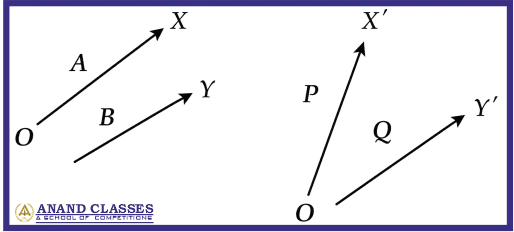
Set of vectors and , and are as shown below:
Length of and is equal, similarly length of and is equal. Then, the vectors which are equal, are
(a) and
(b) and
(c) and
(d) and
Solution.(c)
Two vectors are said to be equal, if and only if they have the same magnitude and direction. Among the given vectors and are equal vectors as they have same magnitude (length) and direction. However, and are not equal even though they are of same magnitude because their directions are different.
, if
(a) λ > 0
(b) λ < 0
(c) λ = 0
(d) λ ≠ 0
Solution.(a)
, if λ, as multiplication of vector with a positive number λ gives a vector whose magnitude is changed by the factor λ but the direction is same as that of .
If a vector is multiplied by a negative number, we get a vector whose
(a) magnitude and direction both are changed
(b) only direction is changed
(c) only magnitude is changed
(d) only direction is reversed
Solution.(d)
Multiplying a vector with a negative number gives a vector whose magnitude is changed by the factor but direction is reversed.
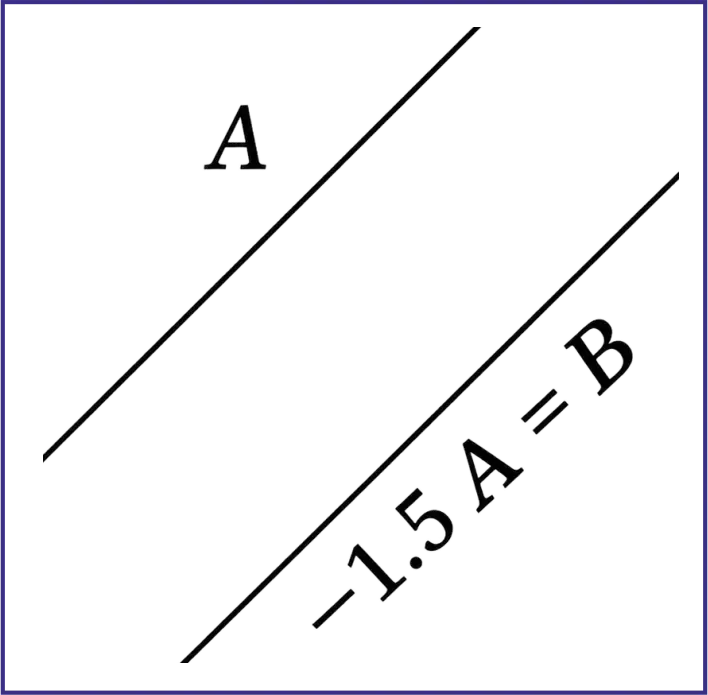
Choose the correct option regarding the given figure:
(a)
(b)
(c)
(d)
Solution.(d)
. So when is multiplied by , then its direction gets reversed and magnitude would be times .
Thus, .
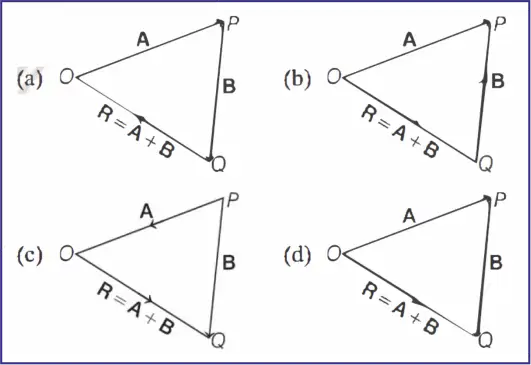
and are two inclined vectors and is their sum. Choose the correct figure for the given description:
(a)
(b)
(c)
(d)
Solution.(d)
Vectors by definition obey the triangle law of addition. According to which, if vector is placed with its tail at the head of vector , then when we join the tail of to the head of , the line represents a vector , i.e., the sum of the vectors and . Thus, figure given in option (d) is correct.
Among the following properties regarding null vector which is incorrect?
(a)
(b)
(c)
(d)
Solution.(b)
Null vector is a vector whose magnitude is zero and its direction cannot be specified. So, it means .
Thus, . Hence, property given in option (b) is incorrect.
Suppose an object is at point P at time t, moves to P’ and then comes back to P. Then, displacement is a
(a) unit vector
(b) null vector
(c) scalar
(d) None of these
Solution. (b)
Since in the given case, the initial and final positions coincide, so the displacement will be zero. Thus, it is a null vector.
Find the correct option about vector subtraction :
(a)
(b)
(c)
(d) None of the above
Solution.(c)
To subtract from , we can add and .
So, .
Hence, option (c) is correct about vector subtraction.
TOPIC 2: MCQs Based on Topic Resolution of Vectors
If is a vector with magnitude A, then the unit vector in the direction of vector is
(a)
(b)
(c)
(d)
Solution(d) In general, a vector can be written as :
where is a unit vector along . If is a unit vector along , then we can write :
Unit vector of is
(a)
(b)
(c)
(d)
Solution.(c)
Given,
Unit vector :
Consider a vector that lies in xy-plane. If Ax and Ay are the magnitudes of its x and y-components respectively, then the correct representation of can be given by
(a)
(b)
(c)
(d) None of these
Solution.(c)
Vector along X-axis (x-component) :
Vector along Y-axis (-component) :
Magnitude of a vector is 5 and magnitude of its y-component is 4. So, the magnitude of the x-component of this vector is
(a) 8
(b) 3
(c) 6
(d) 8
Solution.(b)
Given, , Qy = 4, Qx = ?
Substituting the given values, we get :
A vector is inclined at an angle 60° to the horizontal. If its rectangular component in the horizontal direction is 50 N, then its magnitude in the vertical direction is
(a) 25 N
(b) 75 N
(c) 87 N
(d) 100 N
Solution.(c)
Given vector angle θ = 60°. Then,
Three vectors are given as , and
then which of the following is correct?
(a) , and are equal vectors
(b) and are parallel but is not parallel
(c) , and are parallel
(d) None of the above
Solution. (c)
Given,
So, , and are parallel with unequal magnitude. Thus, they are not equal vectors.
Two vectors and are inclined at an angle θ and is their resultant. Keeping the magnitude and the angle of the vectors same, if the direction of and is interchanged, then there is a change in which of the following with regard to ?
(a) Magnitude
(b) Direction
(c) Both magnitude and direction
(d) None of the above
Solution.(b)
Since the magnitude and angle between the vectors is unchanged, so the magnitude of the resultant will be same. However, the direction of will get changed.
Consider vectors , and as:
Then, for a vector , its y-component has the form
(a)
(b)
(c)
(d)
Solution.(c)
As — (ii),
on comparing Eqs. (i) and (ii), we get the -component of :
Unit vector in the direction of the resultant of vectors and is
(a)
(b)
(c)
(d)
Solution.(c) Resultant vector of and is :
Unit vector in the direction of is :
Two forces and of magnitude 2F and 3F, respectively, are at an angle θ with each other. If the force is doubled, then their resultant also gets doubled. Then, the angle θ is
(a) 60°
(b) 120°
(c) 30°
(d) 90°
[JEE Main 2019]
Solution.(b)
Resultant force Fr of any two forces F1 (i.e., P) and F2 (i.e., Q) with an angle θ between them can be given by vector addition as:
In first case and :
In second case and (Force gets doubled), and (Given). By putting these values in Eq. (i), we get:
Multiplying Eq. (ii) by 4 and comparing with Eq. (iii), we get :
It is found that . This necessarily implies
(a)
(b) are parallel
(c) are perpendicular
(d)
Solution.(a)
Given that
where is the angle between and .
If and are anti-parallel, then . Hence, from Eq. (i):
Hence, the given condition can only be implied if either or and are anti-parallel provided .
Find the value of difference of unit vectors and whose angle of intersection is θ.
(a) 2 sin θ/2
(b) 2 cos θ/2
(c) sin θ/2
(d) cos θ/2
Solution.(a)
Difference of unit vectors and can be given as :
Given, and . The value of is
(a)
(b)
(c)
(d)
Solution.(a) Given,
Similarly, for
Adding Eq. (i) and Eq. (ii):
For two vectors and , is always true, when
(a)
(b) and and are parallel or anti-parallel
(c) when either or is zero
(d) None of the above
Solution.(c)
Given,
Thus, is always true, when either or is zero or and are perpendicular to each other.
Two vectors and have equal magnitudes. The magnitude of is times the magnitude of . The angle between and is :
(a)
(b)
(c)
(d)
Solution.(c)
Given,
Let magnitude of is and for is .
Now,
And,
Given, or
Dividing Eq. (ii) with Eq. (iii), we get
Rain is falling vertically with a speed of 35 m/s. Wind starts blowing after sometime with a speed of 12 m/s in east to west direction. In which direction from vertical should a boy waiting at a bus stop hold his umbrella?
(a) tan-1(0.45), west
(b) tan-1(0.343), west
(c) tan-1(0.343), east
(d) tan-1(0.24), east
Solution.(c)
The velocity of the rain and wind are represented by vectors and .
Using the rule of vector addition, we see that the resultant of and is R.
The magnitude of R is
The direction that makes with the vertical is given by
Therefore, the boy should hold his umbrella in the vertical plane at an angle of about with the vertical towards the east.
Topic -3 : MCQs Based on Motion in a Plane
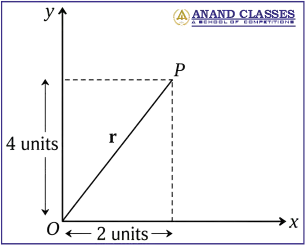
Position vector of a particle P located in a plane with reference to the origin of an xy-plane as shown in the figure below is given by:
(a)
(b)
(c)
(d)
Solution.(a)
Position vector r of an object in xy-plane at point P with its components along X and Y-axes as x and y, respectively is given as .
Given, x = 2 units and y = 4 units. So, position vector at P will be given as
.
Suppose a particle moves along a curve and the positions of the particle are represented by P at t and P’ at t’, where coordinates of P are (2, 3) and P’ are (5, 6). The net displacement will be :
(a) zero
(b)
(c)
(d)
Solution.(d)
Position vector of the particle at P,
Position vector of the particle at P’,
Displacement of the particle is
A particle is moving such that its position coordinates (x, y) are (2 m, 3 m) at t = 0 seconds, (6 m, 7 m) at time 2 seconds and (13 m, 14 m) at time t = 5 seconds. The average velocity vector from t = 0 seconds to t = 5 seconds is:
(a)
(b)
(c)
(d)
Solution.(b)
Position vector of the particle at :
,
,
,
Displacement in to :
The position of a particle is given by . Then the direction of at t = 1 seconds is:
(a) 45° with X-axis
(b) 63° with Y-axis
(c) 30° with Y-axis
(d) 53° with X-axis
Solution.(d)
Given,
At t = 1 seconds,
Thus, its direction is
θ = 53° with X-axis
The x and y-coordinates of the particle at any time are x = 5t – 2t2 and y = 10t respectively, where x and y are in metres and t in seconds. The acceleration of the particle at t = 2 seconds is:
(a) 0
(b) 5 m/s2
(c) -4 m/s2
(d) -8 m/s2
[NEET 2017]
Solution.(c)
Given,
x = 5t – 2t2
Also,
y = 10 t
Net acceleration of the particle,
The position vector of a particle changes with time according to the relation . What is the magnitude of the acceleration (in m/s2) at t = 1 seconds ?
(a) 50
(b) 100
(c) 25
(d) 40
[JEE Main 2019]
Solution.(a)
Position vector of particle is given as
So, magnitude of acceleration at t = 1 seconds is
In a three-dimensional system, the position coordinates of a particle (in motion) are given below:
, ,
The velocity of the particle will be:
(a)
(b)
(c)
(d)
[JEE Main 2019]
Solution.(a)
Given that the position coordinates of a particle:
So, the position vector of the particle is
Therefore, the velocity of the particle is
The magnitude of velocity is
A particle starts from the origin at t = 0 with a velocity and moves in the xy-plane under the action of a force which produces a constant acceleration of . What is the y-coordinate of the particle at the instant its x-coordinate is 84 m?(a) 36 m
(b) 24 m
(c) 39 m
(d) 18 m
Solution.(a)
Given, initial velocity of the particle at t=0 seconds,
and
acceleration, .
The position of the particle is given by
As,
Comparing Eqs. (i) and (ii), we get
Given, x(t) = 84 m
Solving the above quadratic equation, the value of t is given as,
(Neglecting the negative values as time can never be negative)
t = 6 seconds
At , .
When an object is shot from the bottom of a long smooth inclined plane kept at an angle of 60° with the horizontal, it can travel a distance x1 along the plane. But when the inclination is decreased to 30° and the same object is shot with the same velocity, it can travel a distance x2. Then x1 : x2 will be:
(a) √2 : 1
(b) 1 : √3
(c) 1 : 2√3
(d) 1 : √2
[NEET 2019]
Solution.(b)
The motion of object shot in two cases can be depicted as below :
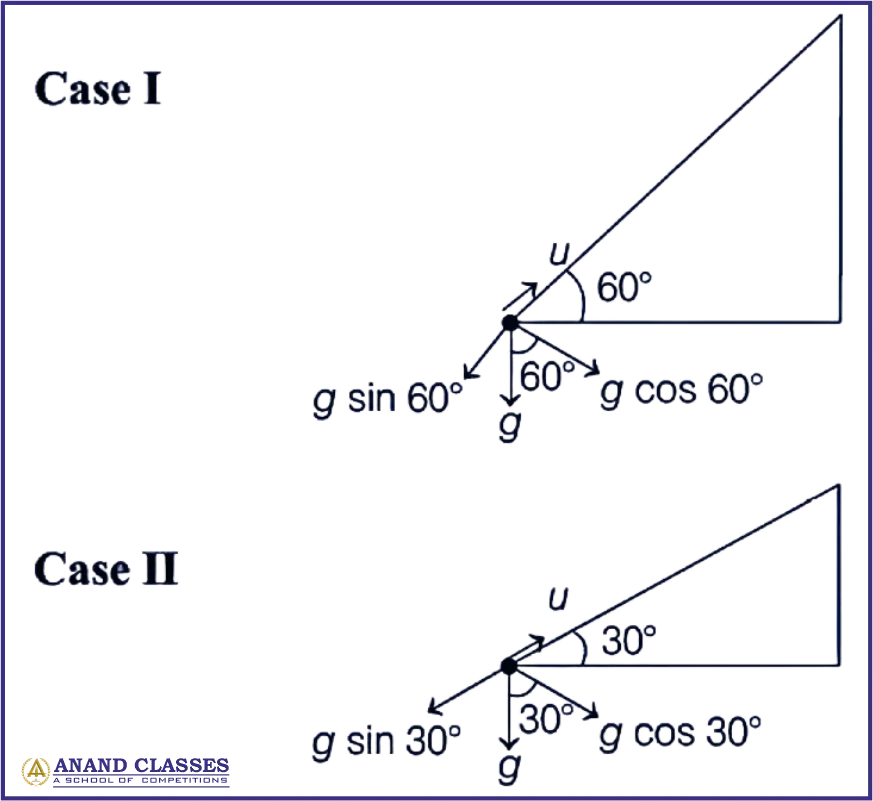
Case I: Inclination θ = 60°
Case II: Inclination θ = 30°
Using third equation of motion,
As the object stops finally, so .
For inclined motion, and .
Substituting these values in Eq. (i), we get
For Case I,
For Case II,
TOPIC 4: MCQs Based on Topic Relative Velocity in Two Dimensions
If two objects P and Q move along parallel straight lines in opposite directions with velocities and respectively, then the relative velocity of P w.r.t. Q is:
(a)
(b)
(c)
(d)
Solution.(c)
Relative velocity of P w.r.t. Q is given by
Buses A and B are moving in the same direction with velocities and , respectively. Then, the relative velocity of A w.r.t. B is:
(a)
(b)
(c)
(d)
Solution.(b)
Given, ,
Relative velocity of A w.r.t. B:
Rain is falling vertically with a speed of 35 m/s. A woman rides a bicycle with a speed of 12 m/s in east to west direction. The direction in which she should hold her umbrella is :
(a) at with vertical towards east
(b) at with vertical towards west
(c) at with vertical towards west
(d) at with vertical towards east
Solution.(b)
Velocity of rain is and is the velocity of the bicycle the woman is riding. Both these velocities are with respect to the ground.
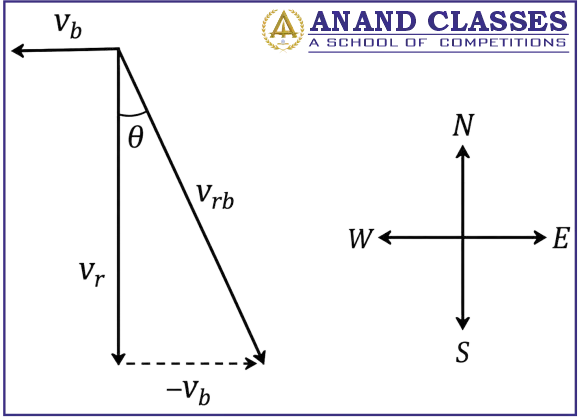
Since the woman is riding a bicycle, the velocity of rain as experienced by her is the velocity of rain relative to the bicycle:
The angle made by the relative velocity with the vertical is given by
Therefore, the woman should hold her umbrella at an angle of about with the vertical towards the west.
Frequently linked concepts include Relative Velocity in a Plane: Relative Velocity of Rain w.r.t. Moving Man Solved Examples
A car driver is moving towards a fired rocket with a velocity of . He observed the rocket to be moving with a speed of 10 m/s. A stationary observer will see the rocket to be moving with a speed of :
(a) 5 m/s
(b) 6 m/s
(c) 7 m/s
(d) 8 m/s
Solution.(b)
The velocity of car driver,
Velocity of rocket
Relative velocity of rocket w.r.t. car
Since the speed of the rocket observed by the car driver is :
Relative speed of rocket w.r.t. a stationary observer
Gain deeper understanding by studying JEE Main PYQs Solutions for Vectors (Class 11 Physics Motion in a Plane)
The stream of a river is flowing with a speed of 2 km/h. A swimmer can swim at a speed of 4 km/h. What should be the direction of the swimmer with respect to the flow of the river to cross the river straight?
(a) 60°
(b) 120°
(c) 90°
(d) 150°
[JEE Main 2019]
Solution.(b)
Let the velocity of the swimmer be vs = 4 km/h and velocity of river be vr = 2 km/h.
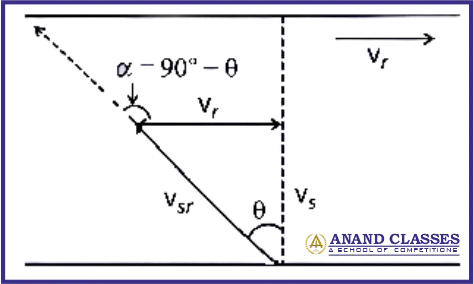
Also, angle of swimmer with the flow of the river (downstream) is α = 90°+θ.
From diagram, angle θ is:
For complete preparation, also study JEE Main Vectors Chapterwise PYQs Solutions (Motion in a Plane)
A man standing on a road has to hold his umbrella at 30° with the vertical to keep the rain away. He throws the umbrella and starts running at 10 km/h. He finds that raindrops are hitting his head vertically. The actual speed of the raindrops is:
(a) 20 km/h
(b) 10√3 km/h
(c) 20√3 km/h
(d) 10 km/h
Solution.(a)
When the man is at rest with respect to the ground, the rain comes to him at an angle 30° with the vertical.
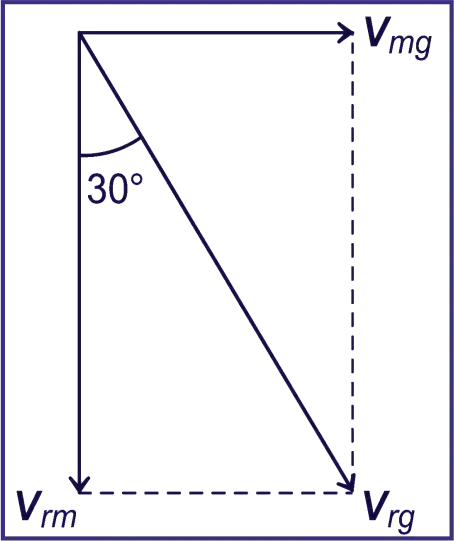
Here, velocity of the rain with respect to the ground,
velocity of the man with respect to the ground.
When the man throws the umbrella and starts running, then
.
From vector components:
Practice more questions from NEET PYQs Solutions for Vectors (Class 11 Physics Motion in a Plane)
A girl can swim with a speed of 5 km/h in still water. She crosses a river 2 km wide, where the river flows steadily at 2 km/h and she makes strokes normal to the river current. Find how far down the river she goes when she reaches the other bank.
(a) 1 km
(b) 2 km
(c) 800 m
(d) 750 m
Solution.(c)
Given, speed of girl,
Speed of river,
Width of river,
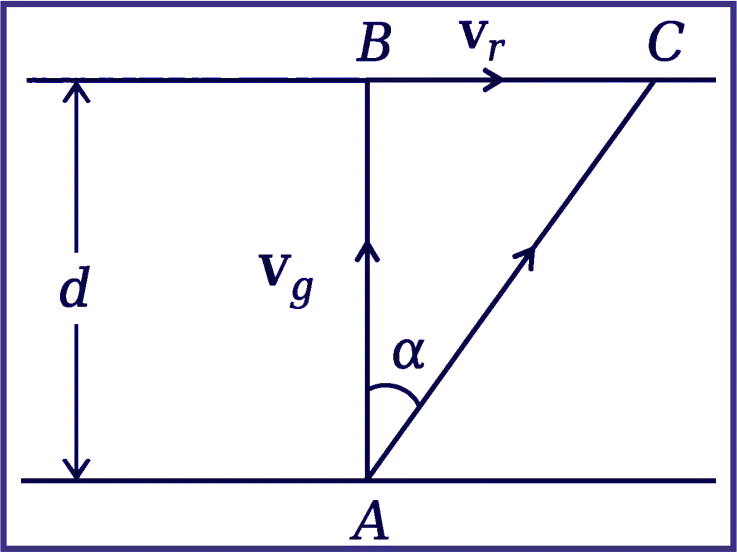
Since the girl crosses the river normal to the flow of the river, time taken by the girl to cross the river:
In this time, the girl will go down the river by the distance AC due to river current.
Enhance your preparation with NCERT Solutions for Vectors Class 11 Physics Chapter Motion in a Plane
A girl riding a bicycle with a speed of 5 m/s towards east direction sees raindrops falling vertically downwards. On increasing her speed to 15 m/s, rain appears to fall making an angle of 45° with the vertical. Find the magnitude of the velocity of the rain.
(a) 5 m/s
(b) 5√5 m/s
(c) 25 m/s
(d) 10 m/s
Solution.(b)
Given, velocity of girl,
Let velocity of rain,
Relative velocity of rain
Now, it is vertical, so
On increasing the speed of the girl to , relative velocity becomes .