Coulomb’s Law of Electrostatics Force is the fundamental law that describes the magnitude and direction of the electrostatic force between two stationary point charges. In this article, you will learn the vector form of Coulomb’s Law, its characteristics, limitations, and real-life examples in a simple and exam-oriented manner.
Coulomb’s law In Electrostatics
In 1785, the French physicist Charles Augustin Coulomb (1736-1806) experimentally measured the electric forces between small charged spheres by using a torsion balance. He formulated his observations in the form of Coulomb’s law which is electrical analogue of Newton’s law of Universal Gravitation in mechanics.
Coulomb performed several experiments to measure the extent of force between two point charged bodies.
Coulomb’s law states that the force of attraction or repulsion between two stationary point charges* is
(i) directly proportional to the product of the magnitudes of the two charges and
(ii) inversely proportional to the square of the distance between them. This force acts along the line joining the two charges.
[*Point Charges : When linear sizes of charged bodies are much smaller than the distance separating them, the size may be ignored. The charged bodies are then treated as point charged bodies.]
Suppose two point charges q1 and q2 are separated in vacuum by a distance r.
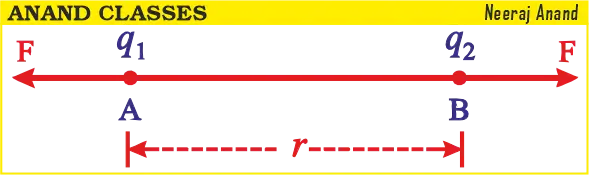
According to Coulomb’s law, the force F of attraction or repulsion between them is such that
or
…(1)
where k is electrostatic force constant.
The value of electrostatic force constant k depends on the nature of medium separating the charges, and on the system of units.
When the charges are situated in free space (air/vacuum), then in cgs system, k = 1.
In SI, k = 9 × 10⁹ N m2 C-2
We write, …(2)
where ε0 is called absolute electrical permittivity of the free space.
From (1), the magnitude of force is
…(3)
Explore more concepts related to Electric Charge Quantization, Additivity, Charging by Induction, Solved Numericals
Units, Dimensions and Value of absolute electrical permittivity(ε0)
From (3),
As SI unit of charge is coulomb (C), therefore,
Units of
Dimensions of
From (2),
or …(4)
…(5)
Coulomb’s Law in Vector Form
According to Coulomb’s law, the force of interaction F between any two point charges q1 and q2 is directly proportional to the product of the charges, and inversely proportional to the square of the distance (r) between them. i.e.,
where k is electrostatic force constant.
As force is a vector, it is better to write Coulomb’s law in the vector notation. In Figure.
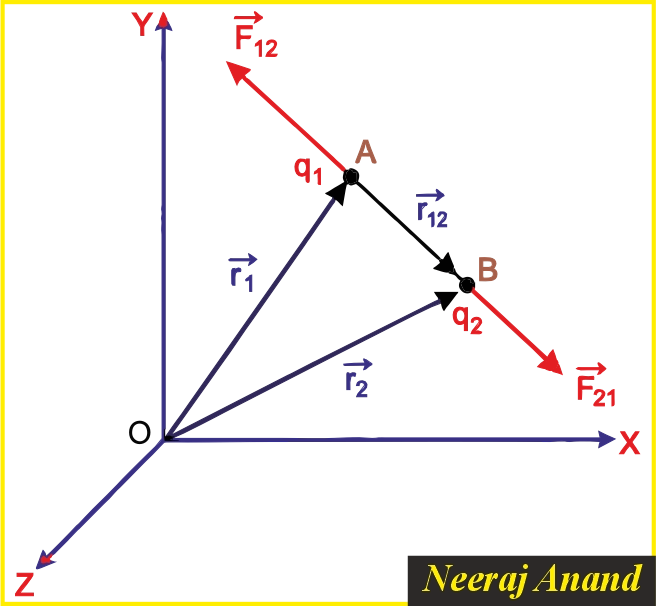
let
therefore the vector leading from q1 to q2 is
…(6)
In the same way, vector leading from q2 to q1 is
The magnitude of is and magnitude of is
As the direction of a vector is specified by a unit vector along the vector, we define
…(7)
If force on q1 due to q2 and force on q2 due to q1, then as is clear from Figure, Coulomb’s force law between two point charges q1 and q2 located at and in vacuum is expressed as
…(8)
It should be clearly understood, that eqn. (8) is valid for any sign of q1 and q2, whether positive or negative.
If q1 and q2 are of same sign (either both positive or both negative); q1q2 > 0; is along , which denotes repulsion for like charges; Figure(a).
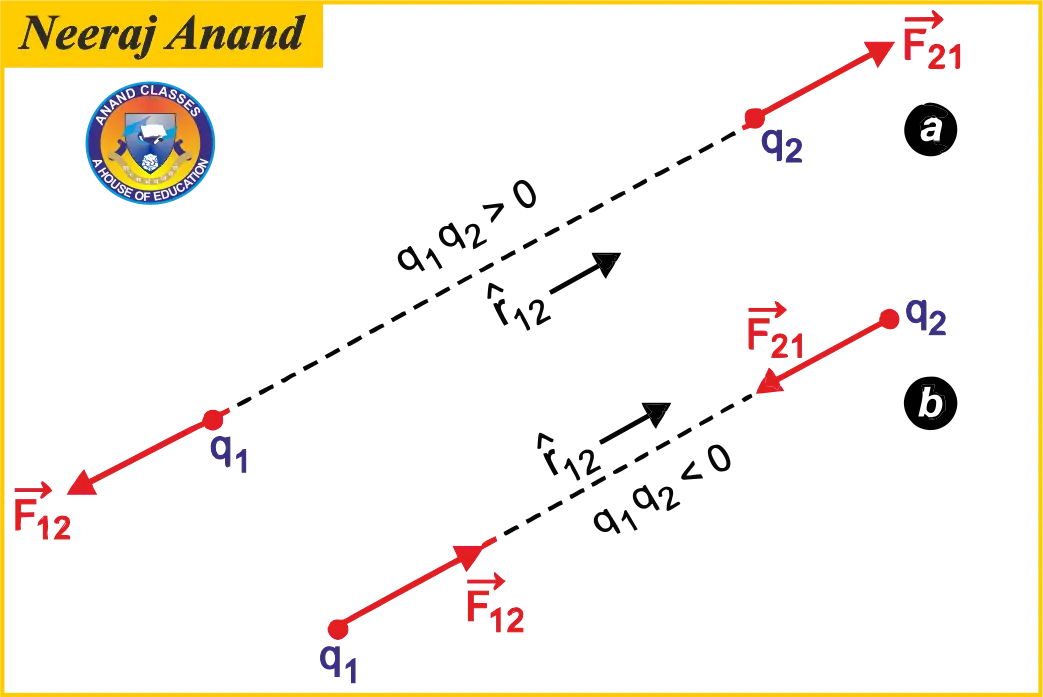
If q1 and q2 are of opposite sign (i.e., one is positive and other is negative), q1q2 < 0; is along , which denotes attraction between unlike charges, Figure(b).
Thus, eqn. (8) takes care of both the cases of like and unlike charges correctly.
The force , on charge q1 due to charge q2 is obtained from eqn. (8), by simply interchanging 1 and 2, i.e.,
…(9)
Therefore, force on q1 due to q2 is equal and opposite to the force on q2 due to q1. Thus, Coulomb’s law is in accordance with Newton’s third law of motion.
Note that eqns. (8) and (9) give us the forces between two charges q1 and q2 in vacuum only.
Units of Electric Charge and Define Electric Charge
The SI unit of charge is coulomb.
We can define unit charge from eqn. (3). Suppose q1 = q2 = q; r = 1 m and F = 9 × 10⁹ N
From (3), or or .
Hence, Unit charge in SI (i.e. one coulomb) is that much charge which when placed in vacuum at a distance of one metre from an equal and similar charge would repel it with a force of .
The cgs unit of charge is 1 electrostatic unit (e.s.u.) of charge or stat coulomb.
It is also called one franklin (Fr), in honour of an American scientist Franklin for his contributions to the study of electrostatics.
As charge on an electron is 4.8 × 10⁻¹⁰ stat coulomb, therefore,
1.6 × 10⁻¹⁹ coulomb = 4.8 × 10⁻¹⁰ stat coulomb
or
1 coulomb = 3 × 10⁹ stat coulomb…(10)
Yet another unit of charge is electromagnetic unit (e.m.u.) of charge, where
1 e.m.u. of charge = 3 × 10¹⁰ e.s.u. of charge (stat coulomb)
1 e.m.u. of charge = 10 coulomb
Dielectric Constant or Relative Electrical Permittivity of Medium
When the charges are situated in a medium other than free space (vacuum or air), the force between them is given by
…(11)
where ε is called absolute electrical permittivity of the intervening medium.
The force between the same two charges held the same distance apart in vacuum is
…(12)
Dividing (12) by (11), we get
…(13)
where εr is called relative electrical permittivity of the medium. It is also called dielectric constant of the medium and is denoted by K.
From (13), we may define, Dielectric constant of a medium is the ratio of absolute electrical permittivity of the medium to the absolute electrical permittivity of free space.
Also, Dielectric constant of a medium may be defined as the ratio of force of interaction between two point charges separated by a certain distance in air/vacuum to the force of attraction/repulsion between the same two point charges, held the same distance apart in the medium.
The value of K depends only on the nature of medium. For example,
for vacuum, K = 1·00000;
for air, K = 1.0006;
for hydrogen, K = 1·00026;
for glass, K = 3 to 4;
for mica, K = 3 to 6;
for water, K = 81 and so on.
From (13),
ε = ε0K
Using it in (11),
Thus, force between two given charges held a given distance apart in water (K = 81) is only 1/81 of the force between them in air/vacuum.
Characteristics of Coulomb’s Electrostatic Force
The important characteristics of Electrostatic force or Coulomb’s force are as follows :
(i) The Coulomb force is a central force as it acts along a line joining the two point charges.
(ii) The Coulomb force is a conservative force as the work done in taking a charge from one point to another in the electric field of another charge is independent of the path followed.
(iii) Electrostatic force between two charges is spherically symmetric.
(iv) Electrostatic force between two charges obeys inverse square law.
(v) Electrostatic force between two charges is attractive for unlike charges and it is repulsive for like charges.
(vi) Electrostatic force between two charges is not affected by the presence or absence of any other charge.
(vii) Coulomb’s law governing electrostatic force between two charges corresponds to Newton’s Law of gravitation.
(viii) Coulomb’s law is in accordance with Newton’s third law of motion i.e., forces of action and reaction are equal and opposite.
Dissimilarity and Similarity Between Electrostatic Forces and Gravitational Forces
Dissimilarity between Electrostatic Forces and Gravitational Forces are as follows:
(i) Electrostatic forces are between two charges and gravitational forces are between two masses.
(ii) Electrostatic forces may be attractive or repulsive. But gravitational forces are always attractive.
(iii) Electrostatic force between two protons is 1036 times stronger than gravitational force between them.
(iv) Electrostatic forces operate over distances which are not large. Gravitational forces operate over very large distances.
(v) Electrostatic force depends on the medium between the two charges. Gravitational force does not depend upon the medium between the two masses.
Similarity between Electrostatic Forces and Gravitational Forces are as follows:
(i) Both the forces obey inverse square law.
(ii) Both forces are proportional to product of charges (or masses) of interacting particles.
(iii) Both are central forces.
(iv) Both are conservative forces.
Important Conceptual and Short Answer Type Questions for Class 12 Physics CBSE Board Exam
Important Conceptual and Short Answer Questions for Class 12 Physics CBSE Board Exam provide concise, exam-oriented questions with clear answers to strengthen conceptual understanding and help students score high in the CBSE Class 12 Physics Board Examination.
Class 12 CBSE Board Question
If two objects repel one another, you know both carry either positive charge or negative charge. How would you determine whether these charges are positive or negative?
Answer :
To determine the polarity of charge on the two objects, we bring one of the objects near a positively charged glass rod. If the object is repelled away from the rod, it must be positively charged (as like charges repel). However, if the object is attracted towards the glass rod, it must be negatively charged (as unlike charges attract).
Class 12 CBSE Board Question
Is coulomb’s law in electrostatics valid in all situations ?
Answer :
Coulomb’s law is not applicable in all situations. It is appliable under the following conditions :
1. The electric charges must be at rest.
2. The electric charges must be point charges, i.e., size of charges must be smaller than separation between the charges.
3. The separation between the charges must be greater than nuclear size (10-15 m) because if distance is less than 10-15 m, then strong nuclear forces dominate over the electrostatic forces. Thus coulomb’s law is valid for distances greater than nuclear distances between charges.
Class 12 CBSE Board Question
Does Coulomb’s law of electric force obey Newton’s third law of motion ?
Answer :
Yes, it obeys. Forces exerted by two charges on each other are always equal and opposite.
Class 12 CBSE Board Question
Is the electric force between two electrons greater than the gravitational force between them ? If so, by what factor ?
Answer :
Yes, electric force between two electrons is greater than gravitational force between them by a factor of 1042.
Class 12 CBSE Board Question
Electrostatic forces are much stronger than gravitational forces. Give one example.
Answer :
A charged glass rod can lift a piece of paper against the gravitational pull of earth on this piece.
Class 12 CBSE Board Question
What is the dimensional formula for ε0 ?
Answer :
The dimensional formula for ε0 is [M-1 L-3 T4 A2].
Class 12 CBSE Board Question
Write down the value of absolute permittivity of free space.
Answer :
Absolute permittivity of free space ε0 = 8.854 × 10⁻¹² C2 N-1 m-2.
Class 12 CBSE Board Question
What is the relevance of large value of K (= 81) for water ?
Answer :
It makes water a great solvent. This is because binding force of attraction between oppositely charged ions of the substance in water becomes 1/81 of the force between these ions in air.
Class 12 CBSE Board Question
Force of attraction between two point charges placed at a distance d is F. What distance apart should they be kept in the same medium so that force between them is F/3 ?
Answer :
According to Coulomb’s Law, the electrostatic force F between two point charges q1 and q2 placed at a distance d in a medium is:
Let d‘ be the new distance required so that the new force F is equal to F/3. The expression for F‘ is:
Substituting F‘ = F/3 into the equation:
Taking the ratio of F‘ to F :
Solving for d‘:
The two point charges should be placed at a distance of apart.
Class 12 CBSE Board Question
In coulomb’s law, on what factors does the value of electrostatic force constant K depend ?
Answer :
The value of K depends on nature of medium separating the charges and on the system of units.
Class 12 CBSE Board Question
How is force between two charges affected when each charge is doubled and distance between them is also doubled ?
Solution. As
Therefore F becomes time time, i.e., force remains the same.
Class 12 CBSE Board Question
When two charges q1 and q2 are kept at some distance apart, force acting between these charges is F. If a third charge q3 is placed quite close to q2 will happen to the force between q1 and q2 ?
Answer :
As force between any two charges doesn’t depend upon the presence of any other charge, so force between q1 and q2 will remain F only.
Class 12 CBSE Board Question
Does the coulomb force that one charge exerts on another, change if other charges are brought nearby ?
Answer :
No, the coulomb force due to one charge on another charge is not changed.
Class 12 CBSE Board Question
Dielectric constant of a medium is unity. What will be its permittivity?
Answer :
We know that dielectric constant of a medium is
Class 12 CBSE Board Question
What is the importance of expressing Coulomb’s law in vector form?
Answer :
As in vector form
It shows two charges exert equal and opposite forces on each other. So Newton’s third law is obeyed.
As Coulombian force acts along and , i.e., along the line joining the centres of two charges, so they are central forces.
Class 12 CBSE Board Question
At what range Coulomb’s Forces Exists ? For which charges Coulomb’s law is applicable ?
Answer.
Coulomb’s law has been verified over distances ranging from nuclear dimensions (=10-15 m) to macroscopic distances (=1018 m). Further, the law is applicable only to point charges. This is the limitation of Coulomb’s Law.
Class 12 CBSE Board Question
Which force is stronger, Coulomb’s law of electrostatic force or Newton’s law of gravitational force ? Give one evidence.
Answer.
Coulomb’s law of electrostatic force between two charges corresponds to Newton’s law of gravitational force between two masses, i.e., , where G is universal gravitational constant = 6.67 × 10⁻¹¹ Nm2kg-2. This value is much smaller compared to the value of electrostatic force constant, k = 9 ×10⁹ Nm2C-2. That is why electrostatic forces are far more stronger than the gravitational forces. This is evident from the fact that a charged glass rod attracts a piece of paper against the gravitational pull of earth on the paper. Further, whereas electrostatic force may be attractive or repulsive depending on the sign of charges, gravitational force is always attractive.
CBSE Board Class 12 Physics Solved Numerical Problems
Solved Numerical Problems for Class 12 Physics CBSE Board Exam provide step-by-step solutions to important numerical questions, helping students master problem-solving techniques and improve accuracy for the CBSE Class 12 Physics Board Examination.
CBSE Board Class 12 Numerical Problem
Two equal like charges in air repel each other with a force F. By what percentage should each charge be increased so that the force between them in a medium of dielectric constant 2 reduces by 28%?
Solution.
Let q1 = q2 = q; and r be the distance between them.
…(i)
Let the charge be reduced to q1‘ = q2‘= q‘
Now,
Percentage increase in charge:
CBSE Board Class 12 Numerical Problem
Two small balls having equal positive charge q coulomb are suspended by two insulating strings of equal length l metre from a hook fixed to a stand. The whole set up is taken in a satellite into space where there is no gravity. What is the angle between the two strings and the tension in each string?
Ans. In a satellite, there is a condition of weightlessness. Therefore, mg = 0. On account of electrostatic force of repulsion between the balls, the strings would become horizontal. Therefore, angle between the strings = 180°.
Also, tension in each string = force of repulsion
CBSE Board Class 12 Numerical Problem
An attractive force of 5 N is acting between two charges of +2μC and -2μC placed at some distance. If the charges are mutually touched and placed again at the same distance, what will be the new force between them?
Ans. On touching, charges neutralise. Therefore, F = 0
CBSE Board Class 12 Numerical Problem
Two point charges of +2μC and +6μC repel each other with a force of 12 N. If each is given an additional charge of -4μC, what will be the new force?
Ans. q1 = +2μC, q2 = +6μC, F = 12 N. After giving additional charge, new charges :
q1‘ = +2 – 4 = -2μC, q2‘ = +6 – 4 = 2μC, F‘ = ?
CBSE Board Class 12 Numerical Problem
The electrostatic force of repulsion between two positively charged ions carrying equal charges is 3.7 × 10⁻⁹ N, when they are separated by a distance of 0.5nm. How many electrons are missing from each ion?
Solution: Given :
F = 3.7 × 10⁻⁹ N, r = 0.5nm = 5 × 10⁻¹⁰ m, q1 = q2 = q
As per Coulomb’s Law:
Substituting the values:
Number of electrons missing from each ion:
CBSE Board Class 12 Numerical Problem
Two identical metallic spheres A and B, each carrying a charge q repel each other with a force F. A third metallic uncharged sphere C of the same size is made to touch the spheres A and B alternately and then removed away. What is the force of repulsion between A and B?
Solution:
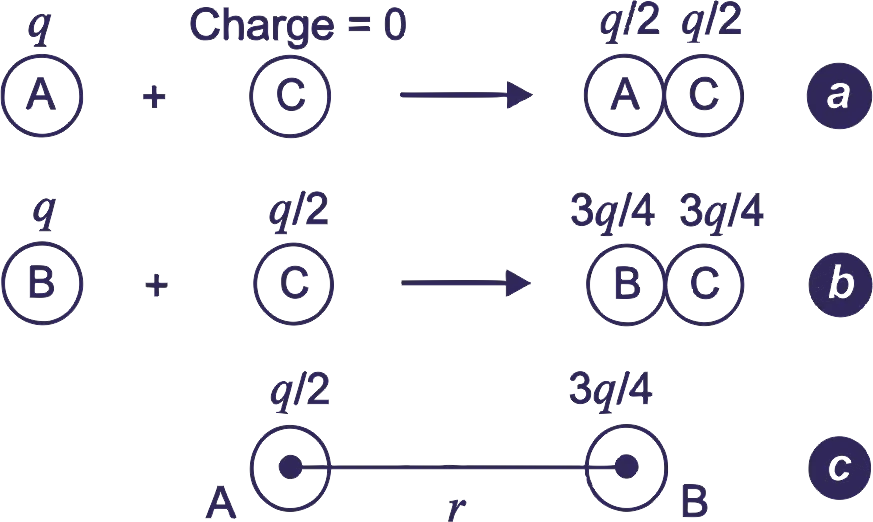
Let r be the distance between two spheres A and B. Then force of repulsion between spheres A and B is
When uncharged sphere C of same size is placed in contact with sphere A, each sphere acquires a charge
When the sphere C is placed in contact with sphere B, the charge is redistributed equally between B and C. Thus, charge on B or C is
Net force of repulsion between spheres A and B is
CBSE Board Class 12 Numerical Problem
A charge of magnitude Q is divided into two parts q and (Q – q) such that the two parts exert maximum force on each other. Calculate the ratio Q/q.
Solution:
According to Coulomb’s Law, the electrostatic force between the two charges separated by a fixed distance r is:
Since Q and r are constant, F is a function of q.
For the force F to be maximum, its first derivative with respect to q must be equal to zero :
Since is a non-zero constant:
Differentiating term-by-term with respect to q:
Q – 2q = 0
Q = 2q
Q/q = 2
CBSE Board Class 12 Numerical Problem
A free pith ball P of 10 g carries a positive charge of 5 × 10⁻⁸ C. What must be the nature and magnitude of charge that should be given to another pith ball Q fixed 7 cm below the former ball, so that upper ball is stationary?
Solution. Here, m = 10 g = 10 × 10-3 kg,
q1 = 5 × 10⁻⁸ C, r = 7 cm = 7 × 10⁻² m
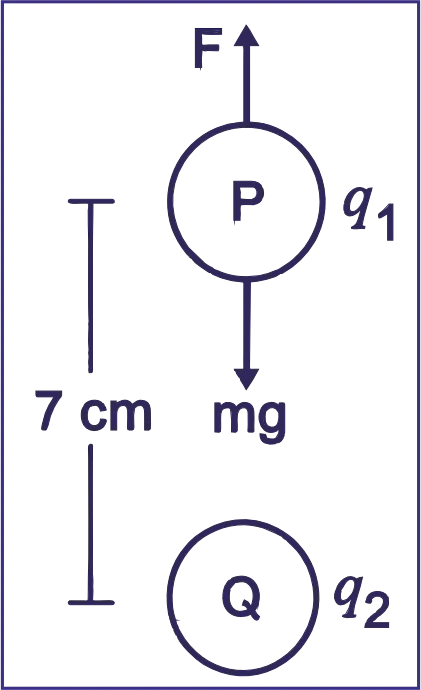
Second ball Q must carry positive charge so that force of repulsion balances the weight of ball P. When ball remains stationary,
F = mg
CBSE Board Class 12 Numerical Problem
A particle of mass m and carrying charge –q1 is moving around a charge +q2 along a circular path of radius r. Prove that the period of revolution of the charge –q1 about +q2 is given by:
Solution:
Suppose charge –q1 moves around the charge +q2 with speed v along a circular path of radius r.
The electrostatic force of attraction between the two charges provides the necessary centripetal force for circular motion:
Electrostatic force of attraction = Centripetal force
Solving for v2 :
The period of revolution (T) of the charge –q1 around +q2 is the time taken to complete one full circular orbit of circumference 2πr :
Squaring both sides:
Substituting the expression for v2:
Taking the square root on both sides:
(Hence proved)
CBSE Board Class 12 Numerical Problem
Coulomb’s law for electrostatic force between two point charges and Newton’s law for gravitational force between two stationary point masses, both have inverse square dependence on the distance between the charges/masses (a) compare the strength of these forces by determining the ratio of their magnitudes (i) for an electron and a proton (ii) for two protons (b) estimate the accelerations for electron and proton due to electrical force of their mutual attraction when they are 1 Å apart. (NCERT Solved Example)
Solution. (a) (i) For an electron and proton
(ii) Similarly, for two protons,
(b) Force of mutual attraction between an electron and a proton,
Acceleration of electron
Acceleration of proton
CBSE Board Class 12 Numerical Problem
A charged metallic sphere A is suspended by a nylon thread. Another charged metallic sphere B carried by an insulating handle is brought close to A such that the distance between their centres is 10 cm as shown in Figure(a). The resulting repulsion of A is noted (for example, by shining a beam of light and measuring the deflection of its shadow on a calibrated screen). Spheres A and B are touched by uncharged spheres C and D respectively, as shown in Figure.(b). C and D are then removed and B is brought closer to A to a distance of 5.0 cm between their centres, as shown in Figure(c). What is the expected repulsion of A on the basis of Coulomb’s Law? Spheres A and C and spheres B and D have identical sizes. Ignore the sizes of A and B in comparison to separation between their centres. (NCERT Solved Example)
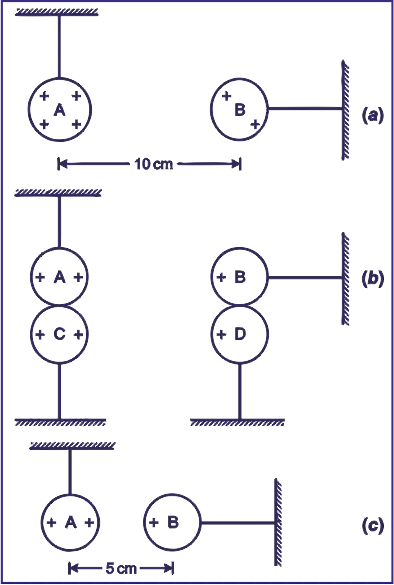
Solution. Let the original repulsive force between A and B be
As A and C have same size, charges are shared equally. Again, as B and D have same size, their charges are also shared equally. As charges on A and B are halved, and distance between them is also halved from 10 cm to 5 cm, therefore,
CBSE Board Class 12 Numerical Problem
Two electrons and a positive charge q are held along a straight line. At what position and for what value of q will the system be in equilibrium? Check whether it is stable, unstable or neutral equilibrium.
Solution. Let two electrons of charges –e each be held at A and B. The third charge +q must be placed at the centre O of AB. The forces on +q, due to two electrons being equal and opposite, cancel each other and it is in equilibrium.
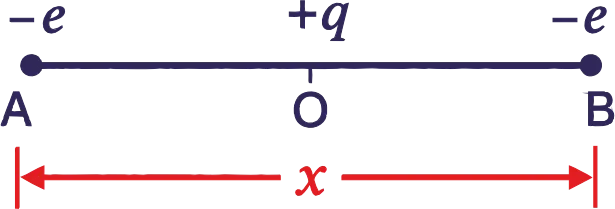
For the charge (-e) at A to be in equilibrium, Figure shows above,
Force on charge at A due to –e charge at B + Force on charge at A due to +q charge at O = 0.
or
e = 4q or q = e/4
If charge at O is moved slightly towards A, it would not return to O on its own and shall continue to move towards A. Hence equilibrium is unstable.
CBSE Board Class 12 Numerical Problem
Two point charges 4 µC and 1 µC are separated by a distance of 2 m in air. Find the point on the line joining the charges at which net electric field of the system is zero.
Solution. Here, q1 = 4 µC = 4 × 10⁻⁶ C, q2 = 1 µC = 1 × 10⁻⁶ C, d = 2 m
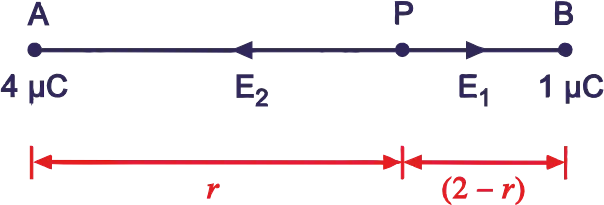
Let electric field of the system be zero at P, where AP = r, Figure. At P,
E1 = E2
r = 4-2r
3r = 4
r = 4/3 m
CBSE Board Class 12 Numerical Problem
Two particles, each having a mass of 5g and charge 1.0 × 10⁻⁷ C, stay in limiting equilibrium on a horizontal table with a separation of 10 cm between them. The coefficient of friction (μ) between each particle and the table is the same. Find μ.
Solution. Here q1 = q2 = 1.0 × 10⁻⁷ C,
r = 10 cm = 0.10 m, m = 5g = 5 × 10⁻³ kg
The mutual electrostatic force between the two particles is
The limiting force of friction between a particle and the table is
As the two forces balance each other, therefore
0.049μ = 0.009
μ = 0.009/0.049 = 0.18
CBSE Board Class 12 Numerical Problem
(a) Two insulated charged copper spheres A and B have their centres separated by a distance of 50 cm. What is the mutual force of electrostatic repulsion if the charge on each is 6.5 × 10⁻⁷ C ? The radii of A and B are negligible compared to the distance of separation. Also compare this force with their mutual gravitational attraction if each weighs 0.5 kg.
(b) What is the force of repulsion if (i) each sphere is charged double the above amount, and the distance between them is halved; (ii) the two spheres are placed in water? (Dielectric constant of water = 80). [NCERT]
Solution. (a) Here
q1 = q2 = 6.5 × 10⁻⁷ C, r = 50 cm = 0.50 m
Using Coulomb’s law,
The mutual gravitational attraction,
Clearly,
(b) (i) When charge on each sphere is doubled, and the distance between them is halved, the force of repulsion becomes
(ii) The force between two charges placed in a medium of dielectric constant is given by
For water, K = 80
CBSE Board Class 12 Numerical Problem
Two insulated charged copper spheres A and B have their centres separated by a distance of 50 cm and the charge on each sphere is 6.5 × 10⁻⁷ C. A third sphere of the same size but uncharged is brought in contact with the first, then brought in contact with the second, and finally removed from both. What is the new force of repulsion between A and B? [NCERT]
Solution. Charge on each of the spheres A and B is q = 6.5 × 10⁻⁷ C
When a similar but uncharged sphere C is placed in contact with sphere A, each sphere shares a charge q/2, equally.
Now when the sphere C (with charge q/2) is placed in contact with sphere B (with charge ), the charge is redistributed equally, so that
Therefore new force of repulsion between A and B is
CBSE Board Class 12 Numerical Problem
Two similarly equally charged identical metal spheres A and B repel each other with a force of 2.0 × 10⁻⁵ N. A third identical uncharged sphere C is touched to A, then placed at the midpoint between A and B. Calculate the net electrostatic force on C.
Solution. Let the charge on each of the spheres A and B be q. If the separation between A and B is r, then electrostatic force between spheres A and B will be
When sphere C is touched to A, the spheres share charge each, because both are identical.
Therefore force on C due to A
Force on C due to B
Since these forces act in opposite directions, therefore net force on C is
CBSE Board Class 12 Numerical Problem
Two identical charges, Q each, are kept at a distance r from each other. A third charge q is placed on the line joining the above two charges such that all the three charges are in equilibrium. What is the magnitude, sign and position of the charge q ?
Solution. Suppose the three charges be placed in the manner, as shown in Figure.
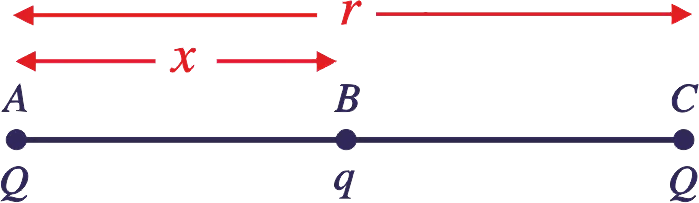
The charge q will be in equilibrium if the forces exerted on it by the charges at A and C are equal and opposite.
Since the charge at A is repelled by the similar charge at C, so it will be in equilibrium if it is attracted by the charge q at B, i.e., the sign of charge q should be opposite to that of charge Q.
Therefore force of repulsion between charges at A and C = Force of attraction between charges at A and B
CBSE Board Class 12 Numerical Problem
Two point charges +4e and +e are ‘fixed’ a distance ‘a‘ apart. Where should a third point charge q be placed on the line joining the two charges so that it may be in equilibrium? In which case the equilibrium will be stable and in which unstable?
Solution. Suppose the three charges are placed as shown in Figure. Let the charge q be positive.
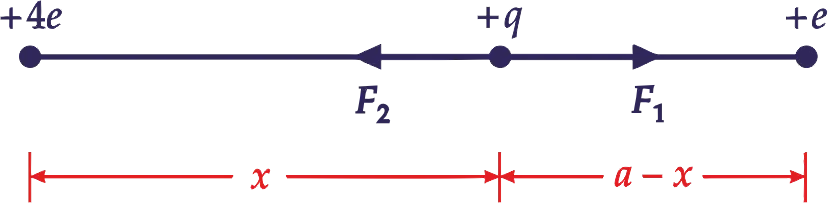
For the equilibrium of charge +q, we must have Force of repulsion F1 between +4e and +q = Force of repulsion F2 between +e and +q
4(a – x)2 = x2
2(a – x) = ±x
x = 2a/3 or 2a
As the charge q is placed between +4e and +e, so only x = 2a/3 is possible. Hence for equilibrium, the charge q must be placed at a distance 2a/3 from the charge +4e.
We have considered the charge q to be positive. If we displace it slightly towards charge e, from the equilibrium position, then F1 will decrease and F2 will increase and a net force (F2 – F1) will act on q towards left i.e., towards the equilibrium position. Hence the equilibrium of positive q is stable.
Now if we take charge q to be negative, the forces F2 and F1 will be attractive, as shown in Figure.
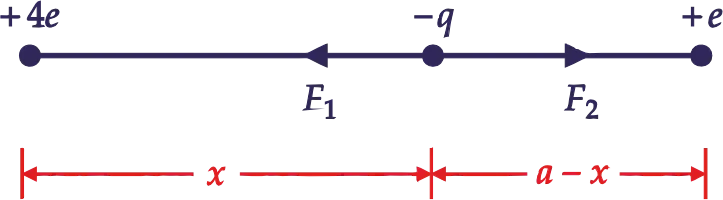
The charge will still be in equilibrium at x = 2a/3. However, if we displace charge q slightly towards right, then F1 will decrease and F2 will increase. A net force (F2 – F1) will act on –q towards right i.e., away from the equilibrium position. So the equilibrium of the negative q will be unstable.
CBSE Board Class 12 Numerical Problem
Two ‘free’ point charges +4e and +e are placed a distance ‘a‘ apart. Where should a third point charge q be placed between them such that the entire system may be in equilibrium? What should be the magnitude and sign of q? What type of equilibrium will it be?
Solution. Suppose the charges are placed as shown in Figure.
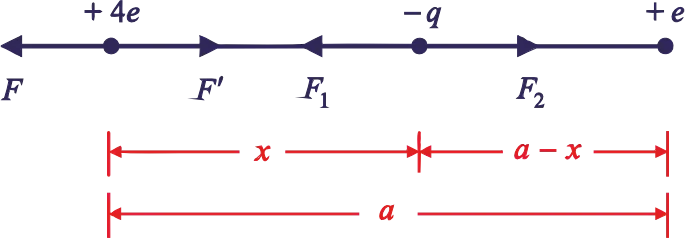
As the charge +e exerts repulsion F on charge +4e, so for the equilibrium of charge +4e, the charge –q must exert attraction F‘ on +4e. This requires the charge q to be negative.
For equilibrium of charge +4e,
F = F‘
For equilibrium of charge –q,
Attraction F1 between +4e and q = Attraction F2 between +e and q
Hence,
The equilibrium of the negative charge q will be unstable.
CBSE Board Class 12 Numerical Problem
Two point charges of charge values Q and q are placed at distances x and x/2 respectively from a third charge of charge value 4q, all charges being in the same straight line. Calculate the magnitude and nature of charge Q, such that the net force experienced by the charge q is zero.
Solution. Suppose the three charges are placed as shown in Figure.

For the equilibrium of charge q, the charge Q must have the same sign as that of q or 4q, so that the forces FA and FB are equal and opposite.
FA = FB
Q = 4q
CBSE Board Class 12 Numerical Problem
A charge Q is to be divided on two objects. What should be the values of the charges on the two objects so that the force between the objects can be maximum?
Solution. Let q and Q – q be the charges on the two objects. Then force between the two objects is
where r is the distance between the two objects.
For F to be maximum,
Q – 2q = 0
q = Q/2
i.e., the charge should be divided equally on the two objects.
CBSE Board Class 12 Numerical Problem
Two identical spheres, having charges of opposite sign attract each other with a force of 0.108 N when separated by 0.5 m. The spheres are connected by a conducting wire, which then removed, and thereafter they repel each other with a force of 0.036 N. What were the initial charges on the spheres?
Solution. Let +q1 and –q2 be the initial charges on the two spheres.
(a) When the two spheres attract each other,
(b) When the two spheres are connected by the wire, they share the charges equally.
Force of repulsion between them is
…(1)
Now
…(2)
On solving equations (1) and (2), we get
which are the initial charges on the two spheres.
CBSE Board Class 12 Numerical Problem
Two small spheres each having mass m kg and charge q coulomb are suspended from a point by insulating threads each l metre long but of negligible mass. If θ is the angle, each thread makes with the vertical when equilibrium has been attained, show that
Solution. The given situation is shown in Figure.
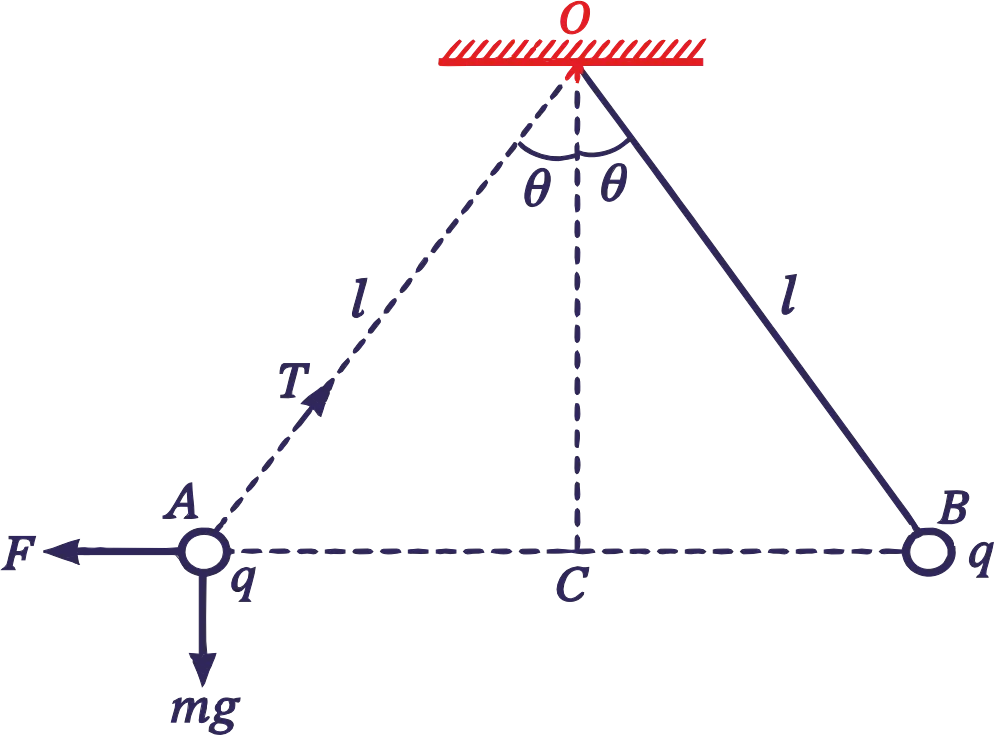
Each of the spheres A and B is acted upon by the following forces:
(i) its weight mg,
(ii) tension T in the string,
(iii) the force of repulsion F given by
….(1)
As the forces are in equilibrium, the three forces on sphere A can be represented by the three sides of △AOC taken in the same order. Hence
…(2)
But , , .
From (1) and (2), we have
For Which Examinations Coulomb’s Law of Electrostatics Topic Important?
The concepts covered in Coulomb’s Law of Electrostatics: Vector Form, Limitations, Characteristics, and Examples are useful for CBSE Class 12 Physics Board Examination and a wide range of competitive examinations in India, including JEE Main, JEE Advanced, NEET, CUET, NDA, IMU CET, IISER IAT, NEST, BITSAT, VITEEE, SSC JE, RRB, ISRO, DRDO, AAI, KVS, JNV, APS, AWES, TGT, PGT, Lecturer, Master Cadre, Polytechnic Lecturer, Defence, Engineering, and various Central and State Government recruitment examinations of India where Electrostatics forms an important part of the Physics syllabus.