
Cross Product (Vector Product) is a fundamental concept in Vector Algebra and one of the most important topics in Class 11 Physics. It forms the basis for understanding advanced concepts such as torque, angular momentum, magnetic force, rotational motion, and three-dimensional vector analysis. Mastering the cross product is essential for solving conceptual and numerical problems in JEE Main, JEE Advanced, NDA, IMU CET, CUET, NEET, and other competitive examinations. In this article, you’ll learn the key formulas, properties, right-hand thumb rule, and exam-oriented solved examples to strengthen your understanding of vector products.
What is Cross Product or Vector Product of Two Vectors ?
The vector product or cross product of two vectors and is another vector , whose magnitude is equal to the product of the magnitudes of the two vectors and sine of the smaller angle between them. It is represented as :
and is read as “ cross “. If θ is the smaller angle between and , then :
where is a unit vector in the direction of that is perpendicular the plane containing vectors and .
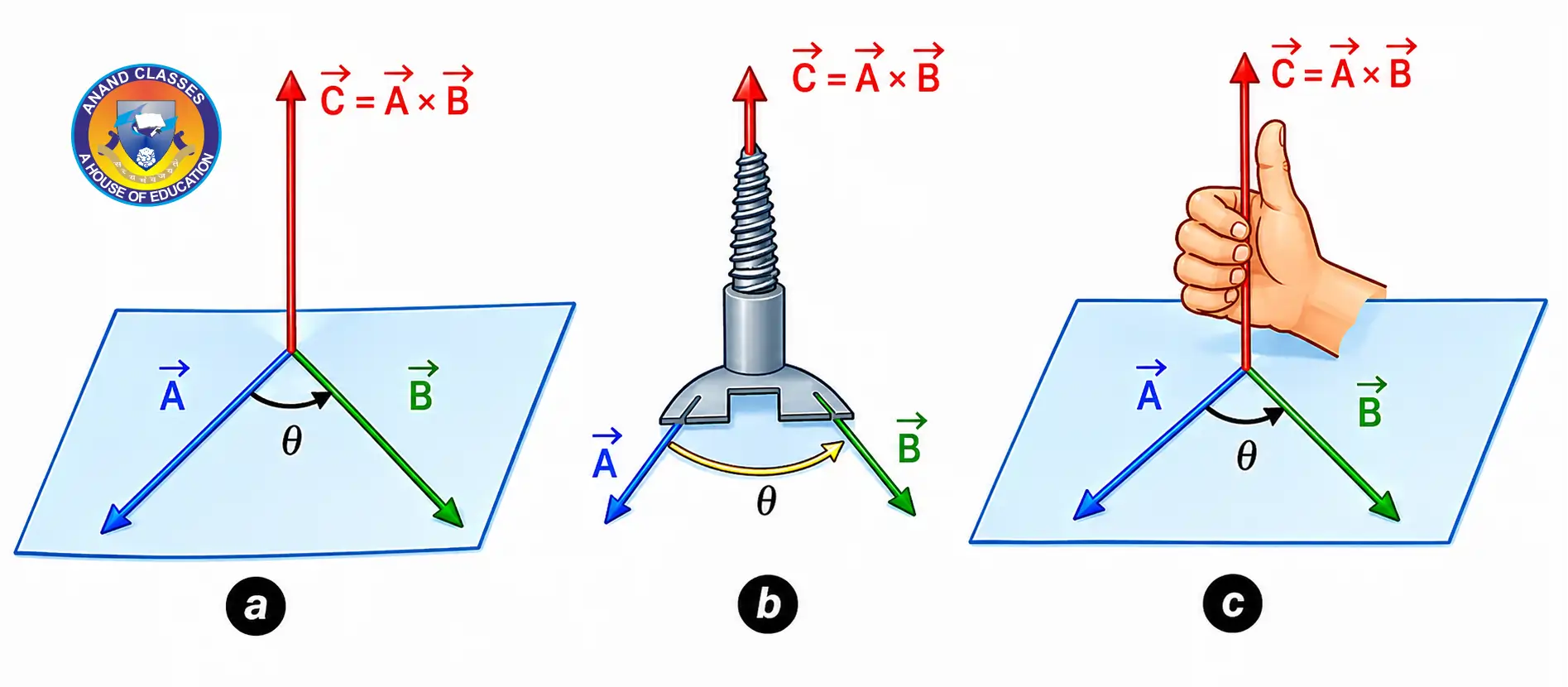
The direction of (i.e., the vector product of two vectors) is perpendicular to the plane containing and (see Figure.(a)), pointing in the direction given by (i) Right-handed screw rule or (ii) Right-hand Thumb Rule.
(i) What is Right handed screw rule for cross product of two vectors ?
It states that if a right-handed screw, placed with its axis perpendicular to the plane containing the two vectors and , is rotated from the direction of to the direction of through the smaller angle, then the sense of the advancement of the tip of the screw gives the direction of or .
If the two vectors and lie in the plane of paper as shown in Figure.(a) then the direction of the cross product according to this rule will be perpendicular to the plane of paper directed upwards (see Figure.(b)).
(ii) What is Right hand thumb rule for cross product of two vectors ?
It states that if we curl the fingers of our right hand, keeping the thumb erect, in such a way that the fingers point in the direction of rotation from to through the smaller angle, then the thumb points in the direction of or (see Figure.(c))
How to calculate a unit vector perpendicular to plane containing vectors and ?
A unit vector () perpendicular to vectors as well as is given by :
Explore more concepts related to Dot Product (Scalar Product) of Two Vectors: Formula, Properties & Solved Examples
What is Geometrical Interpretation of Vector Product (Cross Product) of two Vectors ?
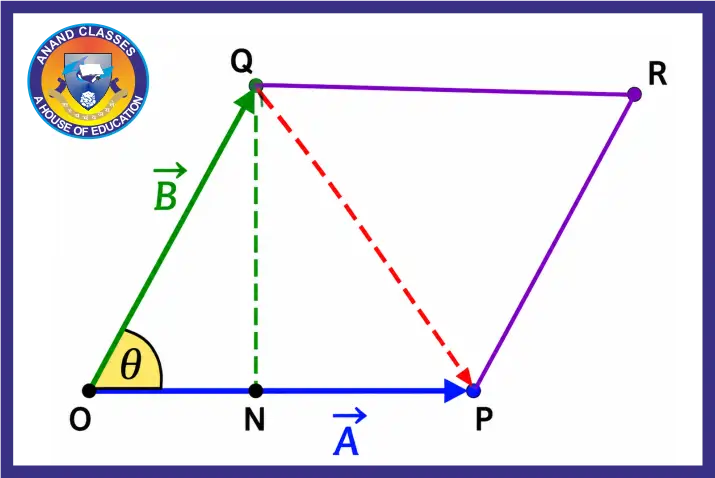
Consider two vectors and represented in magnitude and direction by and with ∠POQ = θ (see Figure). Complete the parallelogram OPRQ. Join P with Q, and drop QN ⊥ OP.
The magnitude of the cross product of and is given by:
In triangle ONQ, sin θ = NQ/OQ implies NQ = OQ sin θ. Thus :
Thus, the magnitude of the vector product of two vectors :
- Is equal to the area of the parallelogram whose two adjacent sides are represented by the two vectors.
- Is equal to twice the area of the triangle whose two sides are represented by the two vectors.
This is the geometrical interpretation of vector product of two vectors.
Students should also study Position and Displacement Vector in Space Explanation With Solved Examples
Discuss Special Cases of Cross Product of two Vectors
Following are some special cases of Cross Product (Vector Product) of Two Vectors.
What is the cross product of two parallel or antiparallel vectors?
(i) When two vectors are parallel or antiparallel : θ = 0° or 180° and sin θ = 0.
It means the cross product of two parallel or antiparallel vectors is zero.
Therefore, for unit vectors :
What is the cross product of two perpendicular vectors?
(ii) When two vectors are perpendicular: θ = 90° and sin θ = 1.
Therefore, for unit vectors:
;
;
What is the cross product of two equal vectors?
(ii) When two vectors are equal : It means both vectors have same magnitude and same direction. That is θ = 0° and sin θ = 0.
It means the cross product of two equal vectors is zero.
What is the cross product of three coplanar vectors?
If , and are coplanar, then
.
How to calculate volume of parallelopiped using cross product of vectors ?
Volume () of the parallelopiped with adjacent edges as , and is given by the scalar triple product:
How to calculate Vector triple product of three vectors ?
Vector triple product of three vectors is resolved as:
Noteworthy Point
Angle between and is always 90°.
What are the Properties of Cross Product (Vector Product) of Vectors ?
The important properties of Cross Product (Vector Product) of Vectors are discuss as follows :
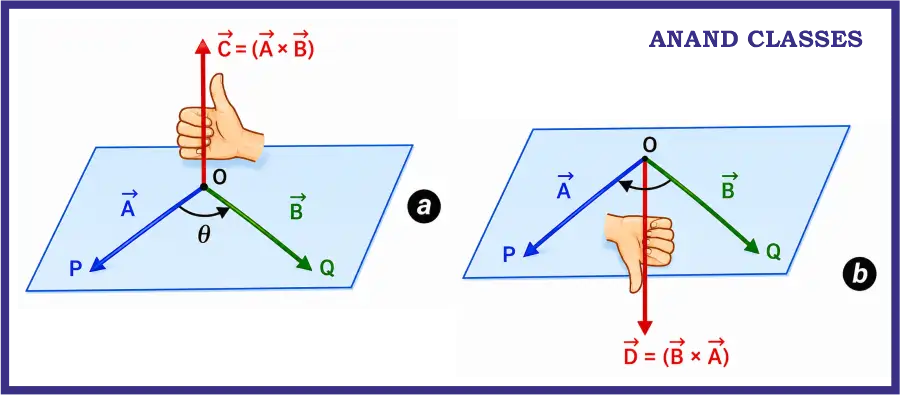
Prove that Cross product of two vectors is anticommutative :
Proof: Let
,
where points upwards.
On the other hand,
,
where points downwards.
Clearly, ,
making .
As a consequence:
;
;
Prove that Cross product of two vectors is distributive :
Prove that Cross product of two vectors is associative :
Prove that cross product of two vectors does not change sign under reflection :
The cross product of two vectors does not change sign under reflection :
What are the important practical examples of cross product of two vectors ?
Torque (τ) acting on a particle is the cross product of its position vector () and force vector ():
Angular Momentum (L) of a particle is the cross product of its position vector () and linear momentum vector ():
Linear velocity (v) in rotational motion is the cross product of its angular velocity () and its position vector () :
Tangential acceleration (a) is the cross product of its angular acceleration vector () and its position ():
Centripetal acceleration (ac) is the cross product of its angular velocity vector () and its linear velocity vector ():
Explain Cross product of Two Vectors in Cartesian Coordinates
Let the two vectors,
.
Then :
This result can be written compactly using a matrix determinant format :
Conceptual Questions and Answers on Cross Product (Vector Product) of Two Vectors
What is the cross product or vector product of two vectors?
The cross product (or vector product) of two vectors is a vector whose magnitude equals the product of the magnitudes of the two vectors and the sine of the smaller angle between them. It is given by
where and are the magnitudes of the vectors, is the smaller angle between them, and is a unit vector perpendicular to the plane containing and .
What is the formula for the cross product of two vectors?
The cross product of two vectors is calculated using
where is determined using the right-hand rule.
How is the direction of the cross product determined?
The direction of is perpendicular to the plane containing the two vectors. It is determined using either the Right-Hand Thumb Rule or the Right-Handed Screw Rule.
What is the Right-Hand Thumb Rule for the cross product?
Curl the fingers of your right hand from vector toward vector through the smaller angle. The extended thumb points in the direction of the cross product,
What is the Right-Handed Screw Rule?
Imagine a right-handed screw placed perpendicular to the plane containing and . Rotate the screw from toward through the smaller angle. The direction in which the screw advances gives the direction of
How do you calculate a unit vector perpendicular to two vectors?
A unit vector perpendicular to both and is
What is the geometrical interpretation of the cross product?
The magnitude of the cross product is
It represents:
- the area of the parallelogram formed by and .
- twice the area of the triangle formed by the same two vectors.
What is the cross product of two parallel vectors?
If two vectors are parallel or antiparallel, then
so
Therefore,
What is the cross product of two perpendicular vectors?
If then and
The magnitude of the cross product is maximum when the vectors are perpendicular.
What is the cross product of two equal vectors?
Since equal vectors have the same direction, so
What are the cross products of the Cartesian unit vectors?
The standard cross products are
Reversing the order changes the sign:
Also,
Why is the cross product anti-commutative?
The cross product changes sign when the order of the vectors is reversed:
This property is called anti-commutativity.
Is the cross product distributive over vector addition?
Yes. The cross product satisfies the distributive property:
More generally,
How do you calculate the cross product in Cartesian coordinates?
This result can be written compactly using a matrix determinant format :
What is the scalar triple product?
The scalar triple product is
It gives the volume of the parallelepiped formed by the three vectors.
How do you calculate the volume of a parallelepiped using vectors?
The volume is
What is the vector triple product formula?
The vector triple product is
This identity is commonly known as the BAC–CAB rule.
What is the condition for three vectors to be coplanar?
If three vectors are coplanar, then their scalar triple product is zero:
What is the angle between and ?
Since is always perpendicular to the plane containing and , while lies in the same plane, the angle between them is 90°.