Scalars and Vectors are fundamental concepts in physics used to describe physical quantities. Scalar quantities are completely specified by magnitude alone, whereas vector quantities require both magnitude and direction for their complete description. Understanding the types of vectors, units, modulus or magnitude of vectors, negative vectors, equal vectors, orthogonal vectors, position vectors, collinear vectors, co-initial vectors and coplanar vectors is essential for solving problems in mechanics and other branches of physics. This topic forms an important part of Class 11 Physics and serves as a foundation for JEE Main, JEE Advanced, NEET, NDA, IMUCET, and other competitive examinations.
Scalars and Vectors Class 11 Physics Notes With Detail Explanation
Build a strong foundation in Physics with comprehensive study material on Scalars and Vectors. This section includes easy-to-understand notes, solved examples, practice questions, and exam-oriented content designed to help students prepare effectively for Class 11 physics examinations as well as JEE Main, JEE Advanced, NEET, NDA, IMUCET, and other competitive exams.
Master related concepts such as Polygon Law and Triangle Law of Vectors Addition, Lami’s Theorem Analytical Method
What do you understand by Scalars and Vectors ?
In physics, some quantities possess only magnitude and some quantities possess both magnitude and direction. To understand these physical quantities, it is very important to know the properties of vectors and scalars. All the measurable physical quantities can be divided into two classes, namely (i) scalar quantities and (ii) vector quantities.
Strengthen your fundamentals with JEE Main PYQs Previous Year Questions MCQs Topicwise Papers and Solutions Motion in a Straight Line
What are Scalar Physical Quantities ?
The physical quantities, which have a magnitude but no direction are called scalars. In physics a number of quantities can be described by scalars.
Mass, length, distance covered, time, density, work, specific heat, temperature, charge, etc are a few examples of scalars.
A scalar can be completely described by a number representing its magnitude.
A scalar may be positive or negative. They can be added, subtracted, multiplied and divided according to the simple rules of algebra.
Important exam-related topics include Relative Velocity Formula Explained With Solved Examples
What are Vector Physical Quantities ?
The physical quantities, which possess both magnitude and direction, are called vectors. In physics certain quantities can be described only by vectors.
Displacement, velocity, acceleration, force, momentum, gravitational field, electric field, etc are a few examples of vector quantities.
It may be pointed out that the vectors cannot be added, subtracted, multiplied or divided as one may do in case of scalars. It is because, in addition to magnitude, vectors have direction also. Vectors are added, subtracted and multiplied according to the rules of vector algebra. The division of a vector by another vector is not a valid operation in vector algebra.
Strengthen your fundamentals with NCERT Exemplar Solutions Motion In a Straight Line Class 11 Physics Chapter 2
How vectors are represented graphically ?
Graphicaly, a vector can be represented by a straight line with arrow head on it, i.e., an arrowed line. Here the length of line drawn on suitable scale represents the magnitude of vector and arrow head represents the direction of a vector. The starting point of arrowed line is called tail or origin of vector and the end of the arrowed line is called tip or head of the vector.
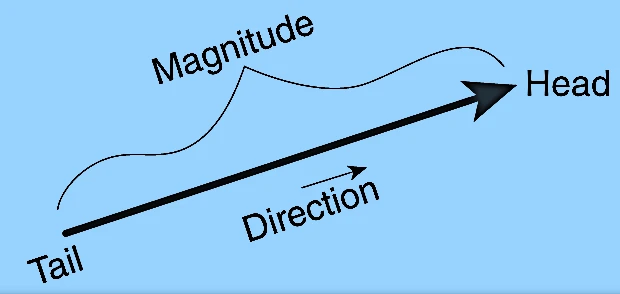
In writing, a vector can be represented by a single letter with arrow head on it. The force which is a vector quantity can be represented by $\vec{F}$.
What are the classification of vectors ?
Vectors can be classified as (a) Polar vectors (b) Axial vectors
(a) Polar vectors. These are those vectors which have a starting point or a point of application and act along the direction of motion of body. For example : displacement, force etc. are polar vectors.
(b) Axial vectors. These are those vectors which represent rotational effect and act along the axis of rotation in accordance with right hand screw rule.
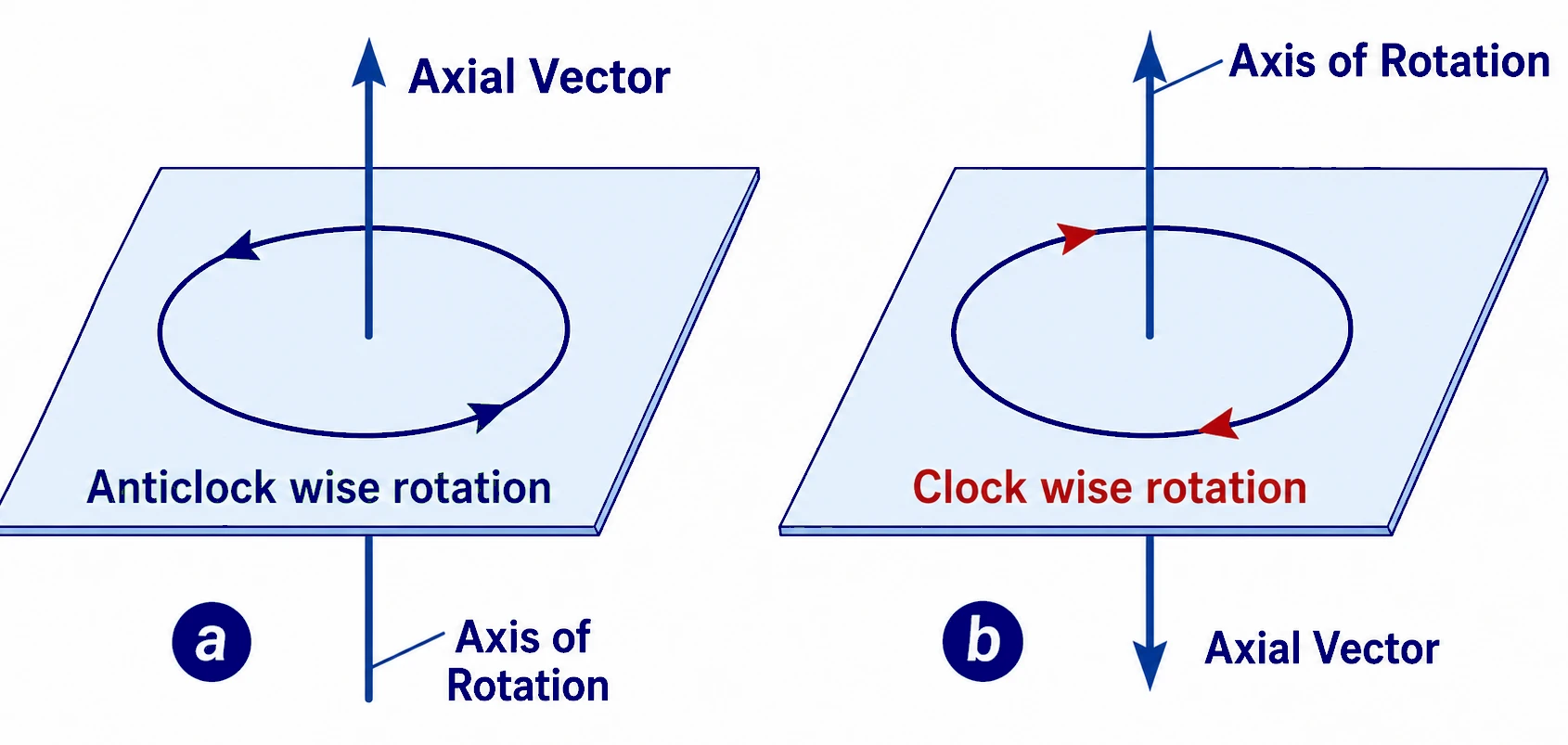
For example : angular velocity, angular momentum, acceleration, torque, etc do not have a point of application. The rotational effect produced by them is represented along the axis of rotation of the object. For a vector having anticlockwise or clockwise rotational effect, will have its direction along the axis of rotation.
Enhance your preparation with JEE Main Motion in a Straight Line MCQs PYQs Previous Year Questions and Solutions
What is Modulus or Magnitude of a Vector ?
The magnitude of a vector is called modulus of that vector. It is always a positive quantity. Sometimes the magnitude of a vector is also called ‘norm’ of the vector. For a vector $\vec{A}$, the magnitude or norm or modulus of a given vector is denoted by I$\vec{A}$I or simply ‘A’.
Similar concepts include Multiplication of Vector by Real Number and Scalar
What is Unit Vector ?
A unit vector of the given vector is a vector of unit magnitude and has the same direction as that of the given vector.
A unit vector of $\vec{A}$ is written as $\hat{A}$ and is read as ‘A cap’ or ‘A hat. Since, magnitude of $\vec{A}$ is A, hence
$\vec{A} = A \hat{A} $
$ \hat{A} = \dfrac{\vec{A}}{A}=\dfrac{vector}{\text{modulus of the vector}}$
Thus, a unit vector in a given direction is also defined as a vector in that direction divided by the magnitude of the given vector. It is unitless and dimesionless vector and represents direction only. Thus, we can say that the unit vector specifies only the direction of the vector quantity.
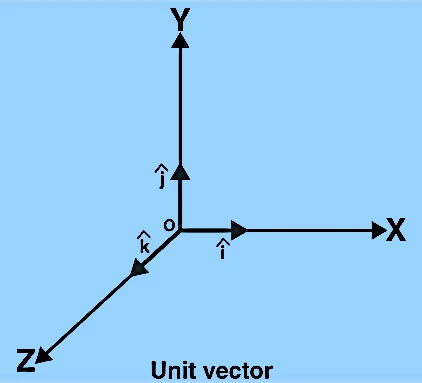
In cartesian coordinates $\hat{i}$, $\hat{j}$, $\hat{k}$ are the unit vectors along x-axis, y-axis and z-axis respectively.
What are Rectangular Unit Vectors ?
Rectangular unit vectors are the unit vectors along the positive direction of the axes of the co-ordinate system. In cartesian coordinates $\hat{i}$, $\hat{j}$, $\hat{k}$ are the unit vectors along positive x-axis, y-axis and z-axis respectively. Hence $\hat{i}$, $\hat{j}$, $\hat{k}$ are rectangular unit vectors as shown in the following diagram (in next section).
What are Orthogonal Unit Vectors ?
Two vectors which are perpendicular to each other are called orthogonal vectors. In cartesian coordinates $\hat{i}$, $\hat{j}$, $\hat{k}$ are the unit vectors along x-axis, y-axis and z-axis respectively. These three unit vectors are directed perpendicular to each other, the angle between any two of them is 90°. $\hat{i}$, $\hat{j}$, $\hat{k}$ are examples of orthogonal vectors.
It must be carefully noted that any two unit vectors must not be considered as equal, because they might have the same magnitude, but the direction in which the vectors are taken might be different.
| Exam Tip |
|---|
| 1. Magnitude of a unit vector is unity. 2. A unit vector of a given vector tells the direction of that vector. 3. A unit vector has no units and no dimensions. |
What are Equal Vectors ?
Two vectors are said to be equal lf they have equal magnitude and same direction. When we are talking about the equality of two vectors, they must represent the same physical quantity.
If two vectors $\vec{A}$ and $\vec{B}$ are represented by two equal parallel lines drawn with same scale, having arrow heads in the same direction as shown then $\vec{A}$ and $\vec{B}$ are equal vectors, i.e., $\vec{A}$ = $\vec{B}$ .The angle between equal vectors is 0°.
For two vectors to be equal, it does not matter, whether the two vectors have their tails at the same point or not. If the scale selected for both the vectors is the same, they are represented by two equal and parallel lines with arrow heads in the same direction. The two vectors $\vec{A}$ and $\vec{B}$ will be equal, if on shifting the vector $\vec{B}$ parallel to itself, both the tail and tip of the vector $\vec{B}$ coincide exactly with the tail and tip of the vector $\vec{A}$. It forms a test for checking the equality of the two vectors.
Note.
If a vector is moved parallel to itself, it represents a vector equal to itself i.e. the same vector.
What is a Negative Vector ?
A negative vector of a given vector is a vector of same magnitude but acting in a direction opposite to that of the given vector.
The negative vector of $\vec{A}$ is represented as $-\vec{A}$. In Figure, $-\vec{A}$ is equal in magnitude but opposite in direction to the vector $\vec{A}$.
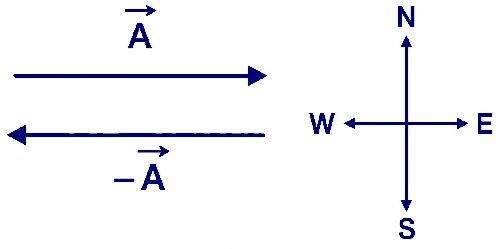
The angle between negative vectors is π rad or 180°. If the vector $\vec{A}$ is from west to east, then the vector $-\vec{A}$ will represent a vector of the same magnitude but having opposite direction i.e. from east to west.
What are Co-initíal vectors ?
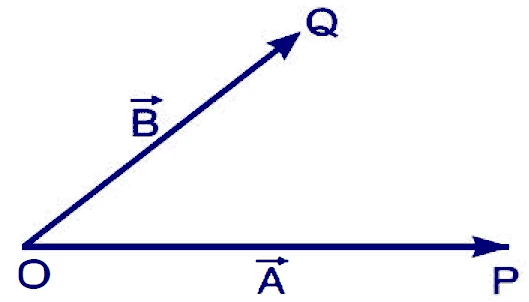
The vectors are said to be co-initíal, if their initial point is common.
In Figure, two vectors $\vec{A}$ and $\vec{B}$ drawn along OP and OQ respectively have been drawn from the common initial point O. Therefore, $\vec{A}$ and $\vec{B}$ are called co-initial vectors.
What are Collinear vectors ?
These are those vectors which are having equal or unequal magnitudes and are acting along the parallel straight lines.
Two vectors having equal or unequal magnitudes, which either act along the same line or along the parallel lines in the same direction or along the parallel lines in opposite direction, are called collinear vectors. Angle between collinear vectors is either 0 or 180°.

If $\vec{A}$ and $\vec{B}$ are two collinear vectors, they can be represented along a line in the same direction, Fig.(1) or along the parallel lines in same direction, Fig.(2) or along parallel lines in opposite direction, Fig.(3).
What are Coplanar Vectors ?
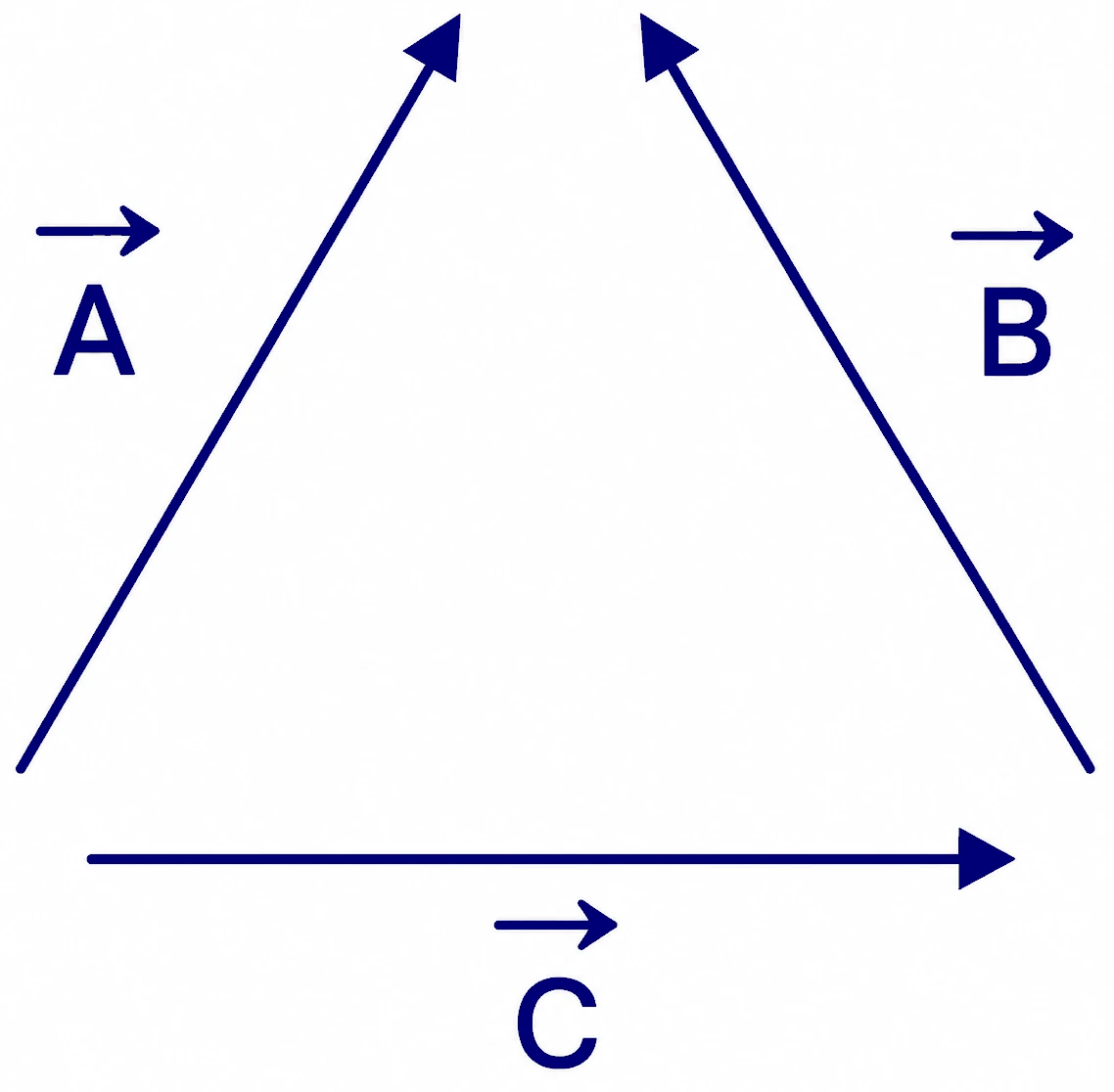
Coplanar Vectors are those vectors which are acting in the same plane. In Figure, the three vectors $\vec{A}$, $\vec{B}$ and $\vec{C}$ are acting in the plane of paper, hence they are coplanar vectors.
What are Localised Vectors and Non-localised Vectors ?
Localised Vector : It is that vector whose initial point is fixed. It is also called fixed vector.
Non-localised vector : It is that vector whose initial point is not fixed. It is also called a free vector.
What is Position Vector and Displacement Vector in a Plane ?
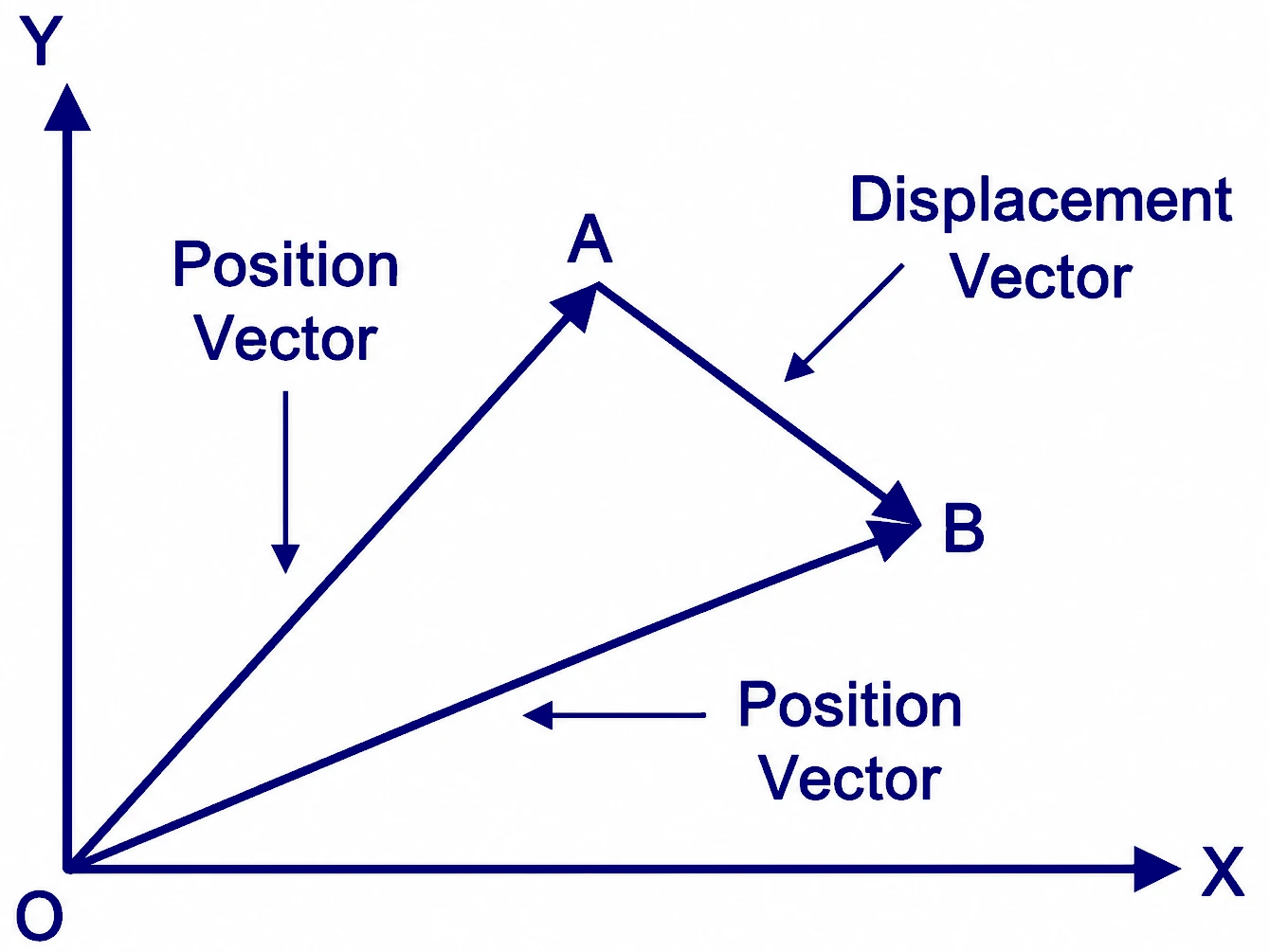
Position vector of an object at an înstant is a vector drawn from the origin to the position of object at that instant.
Consider the motion of an object in X-Y plane with origin at O. Let at any time t1, the object be at point A. If we draw an arrow with its tail at point O and head at point A, as shown in Figure, then $\vec{OA}$ is called position vector of the object at point A at time t1 and is generally represented by $\vec{r_1}$.
The position vector $\vec{OA}$ of the object at a point provides two important informations.
1. It tells the straight line distance of the object from the origin or the starting point.
2. It tells the direction of the position of the object with respect to the origin.
Let at time t2, the obiect reach at point B as shown in Figure. Then $\vec{OB}$ is the position vector of the object at point B at time t2 and is generally represented by $\vec{r_2}$.
Here $\vec{AB}$, where tail or initial position is at A and head or tip is at B, is called the displacement vector of the object in time interval (t2 – t1) and is generally represented by $\vec{r}$.
$\vec{r} = \vec{r_2} – \vec{r_1} $
Hence, displacement vector is that vector which tells how much and in which direction an ohject has changed its position in a given interval of time.
If the coordinates of points A and B are (x1, y1) and (x2, y2) respectively, then position vector, $\vec{OA} =\vec{r_1} = x_1 \hat{i} + y_1 \hat{j}$, position vector, $\vec{OB} = \vec{r_2} = x_2 \hat{i} + y_2 \hat{j}$ and displacement vector,
$\vec{AB} = \vec{r} = \vec{r_2} – \vec{r_1} $
$ \vec{r} = [x_2 \hat{i} + y_2 \hat{j}] – [x_1 \hat{i} + y_1 \hat{j}] $
$\vec{AB} = (x_2 – x_1)\hat{i} + (y_2 – y_1) \hat{j}$.
Both the position vector and the displacement vector described above are the examples of vectors in a plane or in two dimensions.
Similarly in three dimensions (or in space) if the coordinates of points A and B are (x1, y1, z1) and (x2, y2, z2) respectively, then position vector, $\vec{OA} =\vec{r_1} = x_1 \hat{i} + y_1 \hat{j} + z_1 \hat{k}$, position vector, $\vec{OB} = \vec{r_2} = x_2 \hat{i} + y_2 \hat{j}+ z_2 \hat{k} $ and displacement vector,
$\vec{AB} = \vec{r} = \vec{r_2} – \vec{r_1} $
$ \vec{r} = [x_2 \hat{i} + y_2 \hat{j} + z_2{k}] – [x_1 \hat{i} + y_1 \hat{j} + z_1{k}] $
$\vec{AB} = (x_2 – x_1)\hat{i} + (y_2 – y_1) \hat{j} + (z_2 – z_1) \hat{k} $
Both the position vector and the displacement vector described above are the examples of vectors in a space or in three dimensions.
Short Conceptual Questions and Answers Based on Scalars and Vectors
What are scalar physical quantities?
Scalar physical quantities are those quantities that have only magnitude and no direction. They can be completely described by a numerical value along with the appropriate unit. Examples of scalar quantities include mass, time, temperature, distance, energy, and density.
What are vector physical quantities?
Vector physical quantities are those quantities that possess both magnitude and direction. A vector cannot be completely described by magnitude alone. Examples of vector quantities include displacement, velocity, acceleration, force, and momentum.
How are vectors represented graphically?
Vectors are represented graphically by an arrowed line segment. The length of the line indicates the magnitude of the vector, while the arrowhead indicates its direction. The starting point is called the tail and the endpoint is called the head of the vector.
What is the magnitude or modulus of a vector?
The magnitude or modulus of a vector represents its numerical value or size without considering direction. It is always a positive quantity and indicates how large the vector quantity is.
What is a unit vector?
A unit vector is a vector whose magnitude is equal to one and whose direction is the same as that of the given vector. It is used to specify direction only and has no units or dimensions.
What are orthogonal vectors?
Orthogonal vectors are vectors that are perpendicular to each other. The angle between two orthogonal vectors is 90°. In Cartesian coordinates, the unit vectors along the x, y, and z axes are mutually orthogonal.
What are equal vectors?
Two vectors are said to be equal when they have the same magnitude and the same direction, regardless of their initial positions. Equal vectors represent the same vector quantity.
What is a negative vector?
A negative vector is a vector that has the same magnitude as the given vector but acts in the opposite direction. The angle between a vector and its negative vector is 180°.
What are collinear vectors?
Collinear vectors are vectors that act along the same straight line or along parallel lines. They may have equal or unequal magnitudes and can act in the same or opposite directions.
What are coplanar vectors?
Coplanar vectors are vectors that lie in the same plane. Any number of vectors acting within a single plane are called coplanar vectors.
What is a position vector?
A position vector is a vector drawn from the origin to the location of an object. It specifies both the distance and direction of the object with respect to the chosen origin.
What is the difference between a position vector and a displacement vector?
A position vector describes the location of an object relative to the origin, whereas a displacement vector describes the change in position of the object between two points. Displacement depends only on the initial and final positions.