Relative Velocity Formula is an important concept in kinematics that helps determine the velocity of one object with respect to another moving object. It is widely used to analyze the motion of cars, trains, boats, aircraft, and particles moving in the same or different directions. Understanding relative velocity enables students to solve a variety of motion-related problems and develop a deeper understanding of reference frames and moving observers. The topic is essential for Class 11 Physics, JEE Main, NEET, NDA, and other competitive examinations.
What is Relative Motion ?
Earth always seems to be stationary to human beings, but in reality, Earth is constantly revolving around the Sun, and it is a Universal Truth. Then, why do Humans not feel the Earth moving? The answer is simple- Relative Motion.
It means that the motion is always relative in Practical life. An object that is moving with a speed of v to a certain person means that the speed is measured while taking the person as a frame of reference. Similarly, when we are moving in a vehicle at a certain speed, the ground and the trees seem to be moving backward, but in reality, they are stationary and cannot move. These are real-life examples and proof of the existence of Relative motion.
Enhance your preparation with NCERT Exemplar Solutions Motion In a Straight Line
What is the Concept of Relative Velocity in One Dimension ?
To introduce the concept of relative velocity, consider two trains moving on two straight and parallel tracks with the same speed and in the same direction. Although both the trains are in motion w.r.t. trees, buildings, etc along the two sides of the tracks, yet to the observer of one train, the other train does not seem to be moving at all. In other words, the velocity of the train appears to be zero. ln fact, it is not so and it is only the relative velocity of the one train w.r.t. the observer in the other train, which would be zero.
Let two objects P and P’ be moving with uniform velocities v and v‘ along two straight and parallel tracks . Let x0 and x‘0 be their distances from the origin at t = 0 (initially). If at any time t, x and x‘ are the respective positions (distances) of the two objects w.r.t. the origin of the position-axis, then for the object P,
x = x0 + vt
x‘ = x‘0 + v‘t
Subtracting the equations , we have
x‘ – x = (x0‘ – x0) + (v‘ – v)t
The above equation gives displacement of the object P’ from the object P at any time t. The relative displacement i.e. x‘ – x may be positive, zero or negative.
(i) When x‘- x is positive : It means that the object P’ is to the right of the object P.
(ii) When x‘ – x is zero : It implies that the object P’ and P are just in front of each other.
(iii) When x‘ – x is negative : It indicates that the object P’ is to the left of the object P.
Further, in equation, v‘ – v is the relative velocity of the object P’ with respect to the object P. The relative velocity v‘ – v may also be positive, zero or negative.
(i) When v‘ – v is positive : The equation tells that relative distance between the two objects will increase by an amount v‘ – v after each unit of time.
(ii) When v‘ – v is zero : For v‘ – v = 0, the equation reduces to x‘ – x = (x0‘ –x0) i.e. two objects will remain always at the same constant distance from each other, which is equal to the relative distance between them initially (at t = 0).
(iii) When v‘ – v is negative : The equation tells that the distance between the two objects will go on decreasing by the amount v‘ – v after each unit of time. After some time, the two objects will meet or come together and then the object P’ which was to the right of P will get more and more to the left of P.
To strengthen your concepts, learn about JEE Main Motion in a Straight Line MCQs PYQs Previous Year Questions and Solutions
Explain Relative Velocity Formula in Different Cases ?
Relative velocity is the velocity of one object as observed from another moving object. It helps describe how fast one object appears to move with respect to another reference frame. The relative velocity is defined as the velocity of an object with respect to another observer. It is the time rate of change of relative position of one object with respect to another object.
In Mathematics, the relative velocity is the vector difference of the velocities between the two bodies :
Relative velocity = Velocity of the first body – Velocity of the second body
If Va and Vb represent the velocities of two bodies A and B respectively at any instant, then, the relative velocity of A with respect to B is represented by Vab.
Then, Vab = Va – Vb ……(1)
Similarly, the relative velocity of B with respect to A is given by,
Vba = Vb – Va ……(2)
So, from the equations (1) and (2), we can write
Vba = – Vab
This implies that
Relative velocity of A with respect to B = – Relative velocity of B with respect to A
Henceforth, the magnitude of both relative velocities are equal to each other.
Thus, when the two objects A and B move in the same direction along a straight line, the magnitude of the relative velocity of the object A w.r.t. Bis equal to the magnitude of the velocity of the object A minus the magnitude of velocity of the object B.
| Noteworthy Point |
|---|
| Relative velocity is that when two objects are moving towards each other, their relative velocity is the sum of their individual velocities, not the difference. This is because their speeds combine as they close the gap, making the rate at which they approach each other faster than either would if they were stationary. |
Relative Velocity for two objects moving in same direction with equal velocities.
Let us suppose two cars A and B are moving in the same direction with equal velocities (Va = Vb). For a person seated in A, the car B would appear to be at rest, if he forgets for a moment the fact that he himself is in motion. Hence the velocity of B relative to A is zero.
Vba = Vb – Va = 0 (as Va = Vb)
Similarly, in the case of a person seated in car B and observing car A. The relative velocity of A with respect to B is also zero.
Vab = Va – Vb = 0 (as Va = Vb)
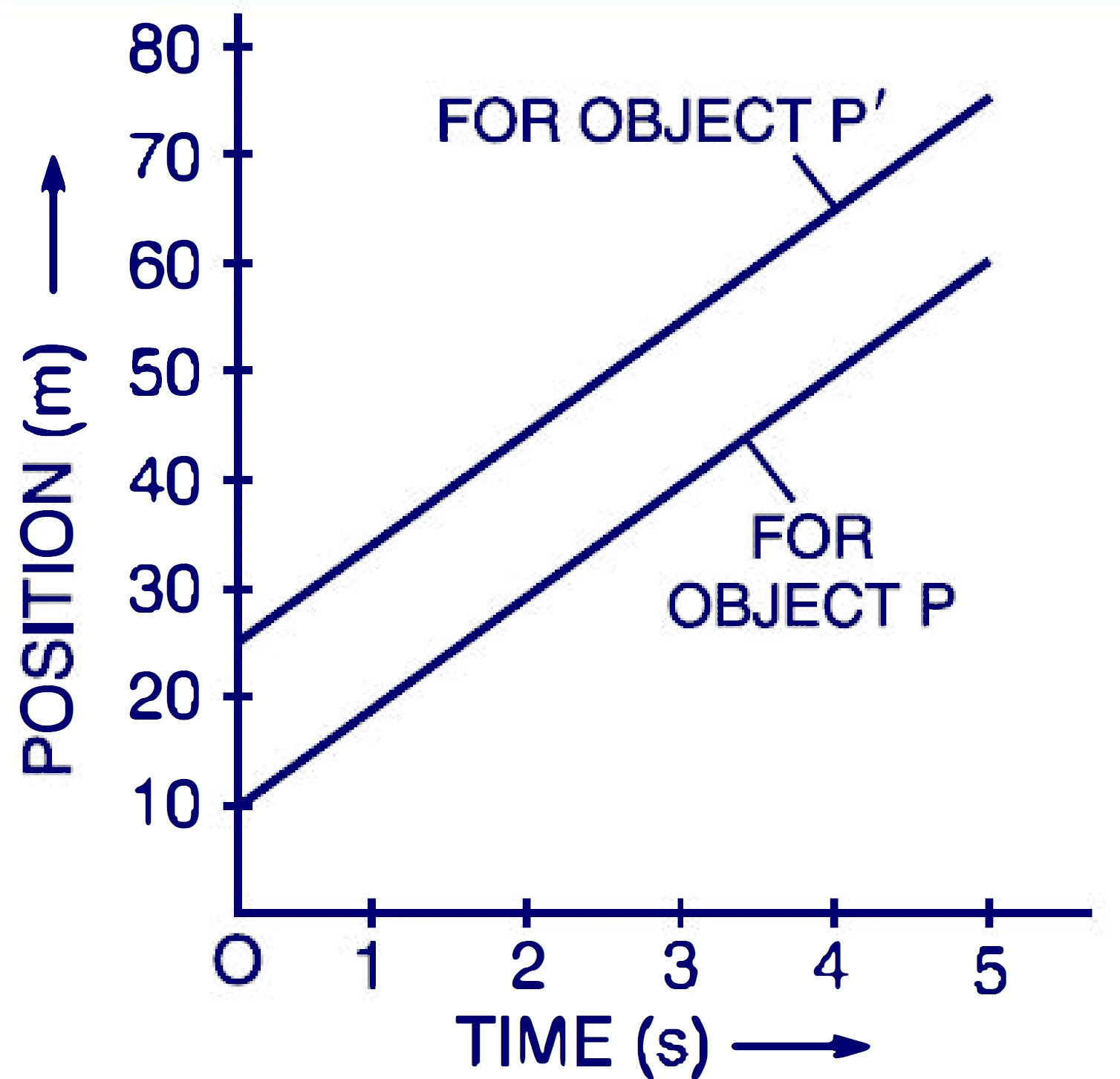
So, if Vb – Va = 0, means the two cars are moving in the same direction and are keeping the same distance between them always. So their position-time graphs are two parallel straight lines.
Position – time graphs for two objects moving with equal velocities (v‘ – v (relative velocity) is zero)
Consider two objects P and P’ moving with uniform velocity of 10 m/s along a straight line in the same direction. Further, suppose that initially the two objects are at distances 10 m and 25 m respectively from the origin.
Thus, v‘ = v = 10 m/s ; x0 = 10 m ; x‘0 = 25 m
The positions (distances from the origin ) of the two objects at t = 0, t = 1 s, t = 2 s, ……. will be as given in the following table :
| Time, t(s) | Position of object P, x(m) | Position of object P′, x′(m) |
| 0 | 10 | 25 |
| 1 | 20 | 35 |
| 2 | 30 | 45 |
| 3 | 40 | 55 |
| 4 | 50 | 65 |
| 5 | 60 | 75 |
Both objects are moving at a constant velocity of 10 m/s, as they both cover exactly 10 meters every 1 second. Object P’ starts 15 meters ahead of Object P (at t = 0) and maintains this exact 15 m lead throughout the entire duration since they are traveling at the exact same speed. If we draw the position-time graphs for the two objects P and P’ ,these will be as shown in Figure. Thus, position-time graph for two objects moving with equal velocities along a straight path will be the two parallel lines.
Read more about Equations of Motion Under Gravity for free fall, upward and vertical downward motion
Relative Velocity for two objects moving in same direction with unequal velocities
In this case let Car A is moving with a velocity Va and Car B, (starting from the same point or Xa(0) = Xb(0), be moving with a greater velocity Vb in the same direction. Then, the person in car A feels that Car B is moving away from him with velocity,
Vba = Vb – Va
And for an observer in car B, car A appears to go back with a velocity,
Vab = Va – Vb = – (Vb – Va)
Velocity of A with respect to B = – (Velocity of B with respect to A)
That is, the velocity of A relative to B is the negative of the velocity of B relative to A.
Here if Va> Vb. If Car A which is having the higher velocity and moving behind the Car B, then Car A will overtake the Car B at some instant and the position-time graphs of the two cars will intersect at a point.
Vab = Va – Vb ≠ 0 and
Vba = Vb – Va ≠ 0 as Va> Vb
Position – time graphs for two objects moving with unequal velocities (v‘ – v (relative velocity) is non zero)
Consider that two objects P and P’ are initially at distances of 10 m and 25 m respectively from the origin of position axis. Further, suppose that the object P is moving with a velocity of 20 m/s and the object P’ is moving with a velocity of
10 m/s.
Thus, x0 = 10 m ; v = 20 m/s and x‘0 = 25 m ; v‘ = 10 m/s
Then, distance of two objects from the origin at t = 0, t = 1s, t = 2 s …… will be
as in the table given below :
| Time, t(s) | Position of object P, x(m) | Position of object P′, x′(m) |
| 0 | 10 | 25 |
| 1 | 30 | 35 |
| 2 | 50 | 45 |
| 3 | 70 | 55 |
| 4 | 90 | 65 |
| 5 | 110 | 75 |
The position-time graph for the two objects P and P’ will be as shown in Figure. Thus, if two objects move with unequal velocities, then the position-time graphs
will be straight lines inclined to time-axis and intersect each other. The time co-ordinate corresponding to the point of intersection tells their time of meeting and the corresponding position co-ordinate tells the position of meeting. Further, in the present example, v‘ – v is negative. It follows from the Figure that the distance between the two objects decreases initially and after they meet, the two objects get more and more away from each other. Also, before meeting, object P’ is to the right of P (graph for P’ is above that for P) and after they meet, the object P’ goes to the left of P (graph for P’ comes below that for P).

The following points may be noted for the motion of two objects with unequal velocities :
(i) The sign of the relative displacement (x‘ – x) reverses after the time of meeting
of the two objects. If before meeting, (x‘ – x) is positive; then after they meet, x‘ – x will become negative and vice-versa.
(ii) If the velocities of the two objects are of opposite signs, then the magnitude of their relative velocity v‘ – v is greater than the magnitudes of both v and v‘. In such a case, the two objects move very fast w.r.t. each other. In practice, when two trains cross each other in the opposite directions, they appear to be moving very fast w.r.t. each other.
Understand related topics like Derive Equations of Motion Using Calculus Method, Solved Numerical Examples
However if Vb> Va. If the car with greater velocity(in this case car B) is moving ahead, there is no chance of overtaking the othercar A and hence the position-time graphs will not intersect, both the lines move far from each other as shown in the graph
Vab = Va – Vb ≠ 0 and
Vba = Vb – Va ≠ 0 as Vb > Va
Clearly, If Vb– Va ≠ 0, means the two cars are moving with unequal velocities. Their position-time graphs are straight lines inclined to the time axis and one of them will be steeper than the other.

Relative Velocity for two objects moving in opposite direction
If both the objects (cars) are moving in opposite directions, the relative velocity of Vba or Vab will be,
Vba = Vb – (- Va) = Vb + Va,
Similarly,
Vab = Va – (- Vb) = Va + Vb
or
Vab = Vba = Va + Vb
Thus, when the two objects A and B move in the opposite directions, magnitude of the relative velocity of object A w.r.t. the object B is equal to the sum of the magnitudes of their velocities.

It means, when two cars A and B are moving in opposite directions each seems to go very fast relative to the other.
What is the Difference between Velocity and Relative Velocity ?
The difference between velocity and relative velocity is that velocity is measured with respect to a reference point which is relative to a different point. While relative velocity is measured in a frame where an object is either at rest or moving with respect to the absolute frame.
Strengthen your fundamentals with JEE Main PYQs Previous Year Questions MCQs Topicwise Papers and Solutions Motion in a Straight Line
What is the Dimension and Unit of Relative Velocity ?
The dimension of relative velocity is similar to the unit of velocity may be expressed as : [ M0L1T-1].
SI Unit of Relative Velocity is m/s
CGS Unit of Relative Velocity cm/s
FAQs on Relative Velocity Formula
What is relative velocity in physics?
The relative velocity is defined as the velocity of an object with respect to another observer. It is the time rate of change of relative position of one object with respect to another object. It helps describe how fast one object appears to move with respect to another reference frame.
Why is the concept of relative velocity important?
Relative velocity is important for analyzing the motion of vehicles, trains, boats, aircraft, and other moving objects. It is widely used in mechanics and real-life motion problems.
What factors affect relative velocity?
Relative velocity depends on the velocities of the two objects involved and the directions in which they are moving. A change in either velocity or direction changes the relative velocity.
Where is relative velocity used in everyday life?
Relative velocity is commonly observed when two cars move on a highway, when trains pass each other, or when a passenger observes the motion of nearby objects from a moving vehicle.
How do solved examples help in understanding relative velocity?
Solved examples demonstrate how to apply the concept of relative velocity to different situations, helping students develop a clear understanding of motion analysis and problem-solving techniques.
State if the statement is true or false: Relative velocity can be negative.
The above statement is true. Relative velocity can be negative. As relative velocity is the difference between two velocities irrespective of their magnitude, it can be negative.
Is relative velocity important for competitive exams?
Yes, relative velocity is an important topic for CBSE, JEE Main, NEET, NDA, and various engineering entrance examinations because it tests conceptual understanding and analytical skills.
Solved Examples Based on Topic Relative Velocity
CBSE Board Question.
Bus A travel with a speed of 50 m/s towards North and bus B travel with a speed of 80 m/s towards South. What is the relative velocity?
Solution:
Speed of bus A = Va = 50 m/s (towards north)
Speed of bus B = Vb = 80 m/s (towards south)
As both the buses are moving in opposite direction, so relative velocity is :
Vab = Va – (- Vb)
Vab = 50 – (-80)
Vab = 100 m/s
CBSE Board Question.
Two cars, initially 1000 m distant apart, start moving towards each other with speeds 3 m/s and 2 m/s along a straight road. When would they meet?
Solution :
The relative velocity of two cars (say 1 and 2) is : V21 = V2-V1
Let us consider that the direction V1 is moving in a positive direction.
Here, V1 = 3 m/s and V2 = – 2 m/s. So, relative velocity of two cars (of 2 w.r.t 1) is : ⇒ V21 = 3 + 2 = 5 m/s
This means that car “2” is approaching car “1” with a speed of 5 m/s along the straight road. Similarly, car “1” is approaching car “2” with a speed of 5 m/s along the straight road. So can say that two cars are approaching at a speed of 5 m/s. Now, let the two cars meet after time (t) :
t = Displacement ⁄ Relative velocity = 1000/5 = 200 sec.
CBSE Board Question.
How long will a girl sitting near the window of a train travelling at 36 km/h see a train passing by in the opposite direction with a speed of 18 km/h? The length of the slow-moving train is 120 m.
Solution:
Given : Velocity of train = Vt = 36 Km/h = 36 × 5/18 m/s = 10 m/s
Velocity of passenger moving in opposite direction = Vp = 18 Km/h = 18 × 5/18 m/s = 5 m/s
The relative velocity of the slow-moving train with respect to the girl is Vtp= Vt – (-Vp) = Vt + Vp
Vtp = (10 + 5) m/s = 15 m/s.
As the girl will watch the full length of the other train, to find the time taken to watch the full train :
t = Distance ⁄ Relative speed = 120/15 = 8 sec.
CBSE Board Question.
A motorcycle travelling on the highway at a velocity of 120 km/h passes a car travelling at a velocity of 90 km/h. From the point of view of a passenger on the car, what is the velocity of the motorcycle?
Solution:
Let us represent the velocity of the motorcycle as VA and the velocity of the car as VB.
Now, the velocity of the motorcycle relative to the point of view of a passenger is given as
VAB = VA – VB
Substituting the values in the above equation, we get
VAB = 120 km/h – 90 km/h = 30 km/h
Hence, the velocity of the motorcycle relative to the passenger of the car is 30 km/h.
CBSE Board Question.
Two railway tracks are parallel to west-east direction. Along one track, train A moves with a speed of 30 m/s from west to east, while along the second track, train B moves with a speed of 48 m/s from east to west. Calculate (i) relative speed of B w.r.t. A and (ii) relative speed of ground w.r.t. B.
Solution :
To solve relative velocity problems in one dimension, we first define a coordinate system by choosing a positive direction.
Positive direction : West to East (+)
Negative direction : East to West (-)
Velocity of train A (vA) : +30 m/s (moving West to East)
Velocity of train B (vB) : -48 m/s (moving East to West)
Velocity of the ground (vG) : 0 m/s (stationary)
(i) Relative Velocity of Train B with respect to Train A (vBA)
The formula for the relative velocity of an object B relative to an object A is :
vBA = vB – vA
Substituting the given values :
vBA = -48 m/s – 30 m/s = -78 m/s
The negative sign indicates that, to an observer on train A, train B appears to be moving from East to West at a speed of 78 m/s.
(ii) Relative Velocity of the Ground with respect to Train B (vGB)
The formula for the relative velocity of the ground (G) relative to train B is :
vGB = vG – vB
Substituting the values :
vGB = 0 m/s – (-48 m/s = +48 m/s
The positive sign indicates that, to a passenger on train B, the ground appears to be moving from West to East at a speed of 48 m/s.
CBSE Board Question.
A jet airplane travelling at the speed of 500 km/h ejects the burnt gases at a speed of 1,200 km/h relative to the jet airplane. Find the speed of the burnt gases w.r.t. a stationary observer on earth.
Solution :
To correctly solve this problem, we must establish a fixed coordinate system by assigning a positive direction.
Positive direction (+) : Moving away from the stationary observer on the ground.
Negative direction (-) : Moving towards the stationary observer on the ground.
Velocity of the jet airplane (vJ) relative to the observer : vJ = +500 km/h (Since it is moving away from the observer).
Relative velocity of the burnt gases (vGJ) with respect to the jet airplane : vGJ = -1,200 km/h (Since gases are ejected backward, meaning they travel towards the observer).
Let vG be the actual velocity of the burnt gases with respect to the stationary observer on Earth.
The formula for the relative velocity of the gases (G) with respect to the jet (J) is given by :
vGJ = vG – vJ
Rearranging the formula to isolate the velocity of the gases (vG) :
vG = vGJ + vJ
Substituting the known values into the equation :
vG = (-1,200 km/h + 500 km/h
vG = -700 km/h
The negative sign indicates that the direction of motion is opposite to our designated positive direction.
Therefore, the speed of the burnt gases with respect to the stationary observer on Earth is 700 km/h traveling towards the observer.
CBSE Board Question.
Two parallel rail tracks run northsouth. Train A moves north with a speed of 54 km/h and train B moves south with a speed of 90 km/h. What is the (a) relative vlocity of B w.r.t. A? (b) relative velocity of ground w.r.t. B ? (c) velocity of a monkey running on the roof of the train A against its motion (with a velocity of 18 km/h w.r.t. the train A) as observerd by a man standing on the ground?
Solution :
To solve this one-dimensional relative velocity problem, we must first choose a coordinate axis and define our positive direction.
Positive direction (+) : South to North
Negative direction (-) : North to South
(a) Relative Velocity of Train B with respect to Train A
vBA = vB – vA
Substituting the given values :
vBA = (-90 km/h) – (54 km/h) = -144 km/h
The negative sign indicates direction. To an observer sitting in train A, train B appears to be moving at a speed of 144 km/h due South.
(b) Relative Velocity of the Ground with respect to Train B
vGB = vG – vB
Substituting the values :
vGB = 0 km/h – (-90 km/h) = +90 km/h
The positive sign indicates direction. To a passenger on train B, the ground appears to be moving at a speed of 90 km/h due North.
(c) Velocity of the Monkey as Observed by a Man on the Ground
vMA = vM – vA
To find the monkey’s actual velocity relative to the ground (vM), we rearrange the equation to isolate vM :
vM = vA + vMA
Substituting our values :
vM = 54 km/h + (-18 km/h) = +36 km/h
The positive sign indicates direction. A stationary observer standing on the ground will see the monkey moving at a speed of +36 km/h due North.
CBSE Board Question.
The distance between the two towns M and N is 400 km. Two cars A and B set off simultaneously from the towns M and N towards each other. The car A from M travels at a speed of vA= 60 km/h and the car B from N at a speed of vB = 40 km/h. Find analytically, the point, where they will meet and the time that will elapse before they meet.
Solution :
To solve this one-dimensional relative velocity problem, we must first choose a fixed coordinate axis and define our positive direction.
Positive direction (+) : Moving from Town M towards Town N (Direction of Car A)
Negative direction (-): Moving from Town N towards Town M (Direction of Car B)
Distance between towns M and N ($x$): $400 \text{ km}$
Velocity of car A ($v_A$): $+60 \text{ km h}^{-1}$ (moving towards N)
Velocity of car B ($v_B$): $-40 \text{ km h}^{-1}$ (moving towards M, hence the negative sign)
(i) Time elapsed before they meet (t)
The magnitude of the relative velocity of car A with respect to car B ($v_{AB}$) determines how fast the gap between them closes:
$$v_{AB} = v_A – v_B$$
Substituting the given values :
$$v_{AB} = 60 \text{ km h}^{-1} – (-40 \text{ km h}^{-1}) = 100 \text{ km h}^{-1}$$
The time (t) after which they meet is calculated by dividing the total separation distance by their relative closing speed :
$$t = \frac{x}{|v_{AB}|} = \frac{400 \text{ km}}{100 \text{ km h}^{-1}} = 4 \text{ hours}$$
(ii) Position where they will meet
To find the exact location of their meeting point, we calculate the distance covered by either car during this time.
Using Car A (starting from Town M):
$$\text{Distance from Town M } (s) = v_A \times t$$
$$s = 60 \text{ km h}^{-1} \times 4 \text{ h} = 240 \text{ km}$$
CBSE Board Question.
When two bodies move uniformly towards each other, the distance between them diminishes by 16 m every 10 s. If the bodies move with velocities of the same magnitude and in the same direction as before, the distance between them will increase by 3 m every 5 s. What is the velocity of each body ?
Solution :
Let $v_A$ and $v_B$ be the magnitudes of the velocities of the two bodies, $A$ and $B$, respectively.
When two bodies move directly toward one another, they travel in opposite directions. Consequently, their relative speed is the sum of their individual speeds as they close the gap between them more quickly.
Relative Velocity Formula : $$v_{\text{relative}} = v_A – (-v_B) = v_A + v_B$$
The distance between them decreases by 16 m every 10 s.
$$v_{\text{relative}} = \frac{\text{Distance}}{\text{Time}} = \frac{16\text{ m}}{10\text{ s}} = 1.6\text{ m s}^{-1}$$
This gives us our first linear equation :
$$v_A + v_B = 1.6 $$
When the two bodies move in the same direction, one body will draw away from the other (assuming body $A$ is faster, i.e., $v_A > v_B$). Their relative speed is the difference between their individual speeds.
Relative Velocity Formula : $$v_{\text{relative}}’ = v_A – v_B$$
The distance between them increases by 3 m every 5 s
$$v_{\text{relative}}’ = \frac{\text{Distance}}{\text{Time}} = \frac{3\text{ m}}{5\text{ s}} = 0.6\text{ m s}^{-1}$$
$$v_A – v_B = 0.6 $$
To find the individual velocities, we can solve above Equations simultaneously using the elimination method.
$$(v_A + v_B) + (v_A – v_B) = 1.6 + 0.6$$
$$2v_A = 2.2$$
$$v_A = \frac{2.2}{2} = 1.1\text{ m s}^{-1}$$
$$1.1 + v_B = 1.6$$
$$v_B = 1.6 – 1.1 = 0.5\text{ m s}^{-1}$$
CBSE Board Question.
When two bodies move uniformly towards each other, the distance between them decreases by 6 metres/second. If both the bodies move in the same direction with their between them increases by 4 metres/second. What are the speeds of the two bodies.
Solution : Let u and v be the velocities of two bodies. As per question,
u + v = 6
u – v = 4
On solving we get u = 5 m/s and v = 1m/s
CBSE Board Question.
A person in a car, moving at a constant velocity, throws a ball straight up into the air.
(a) At what point, does the ball land?
(b) Where does the ball land if the car slows down?
(c) Where does the ball land if the car speeds up?
(d) Where does it land if the car rounds a turn?
Solution:
(a) The ball lands at the point from which it was thrown, i.e. back to the thrower’s hand.
(b) It lands in front of the point from which it was thrown.
(c) It lands behind the point from which it was thrown.
(d) The ball will land to the left of the point from which it was thrown if the car takes a right turn and vice versa.
Important Chapter-1 Links
To strengthen your understanding, you should also study Dimensional Analysis and Dimensional Formulae of Physical Quantities and the Principle of Dimensional Homogeneity, which are closely related to unit conversion. It is also helpful to revise Units and Measurements for basic concepts and practice JEE Main Previous Year Questions (PYQs) and IMU CET PYQs to improve problem-solving skills. Exploring these related topics on this website will help you master numerical applications effectively.