Relative velocity of rain with respect to a moving man is one of the most important applications of relative velocity in two-dimensional motion. It explains how the velocity and direction of falling rain appear to change for a person who is moving horizontally. By representing the velocities of the rain and the observer as vectors, we can determine the apparent direction of rainfall, the angle at which rain strikes the observer, and the speed at which it appears to fall. This concept is widely used in physics problems involving rain, wind, boats, aircraft, and other cases of motion in a plane. In this article, you will learn the theory, vector diagrams, derivations, formulas, and solved examples of relative velocity of rain with respect to a moving man.
Derivation of Relative Velocity of Two Objects A w.r.t. B in a Plane Using Vectors
The relative velocity of object A moving with velocity w.r.t. object B moving with velocity is given by :
Let the two objects be moving in a plane, and θ be the angle between the directions of motion of the objects A and B, where and .
To find the relative velocity of object A w.r.t. B, superimpose velocity on both the objects A and B. The object B is brought to rest and object A possesses two velocities along and along OP’, inclined at an angle (180° – θ).
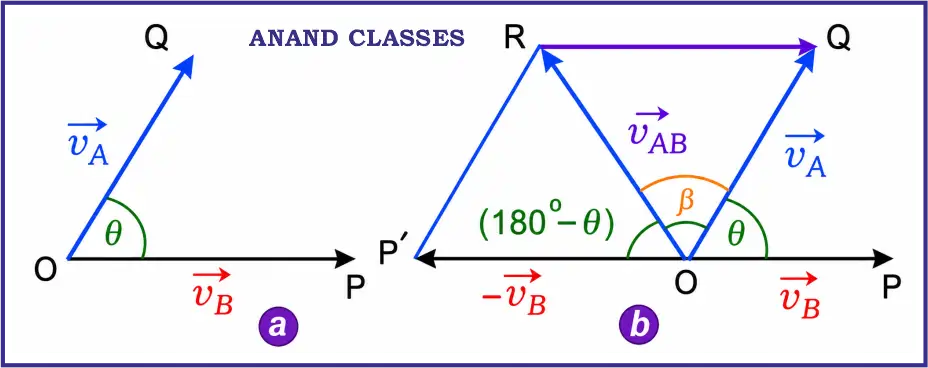
The relative velocity of object A w.r.t. B is the resultant of velocities and acting at an angle (180° – θ), which will be represented by the diagonal of the parallelogram OQRP’, according to the parallelogram law of vectors addition.
In magnitude, the relative velocity of A w.r.t B is given by :
If makes an angle β with the direction of , then :
You may also like to study Cross Product (Vector Product) of Two Vectors: Formula, Properties & Solved Examples
Discuss Relative Velocity of Rain with respect to the Moving Man
Consider a man walking west with velocity , represented by . Let the rain be falling vertically downwards with velocity , represented by . To find the relative velocity of rain w.r.t. man (i.e., ), bring the man to rest by imposing a velocity on the man and apply this velocity on the rain too.
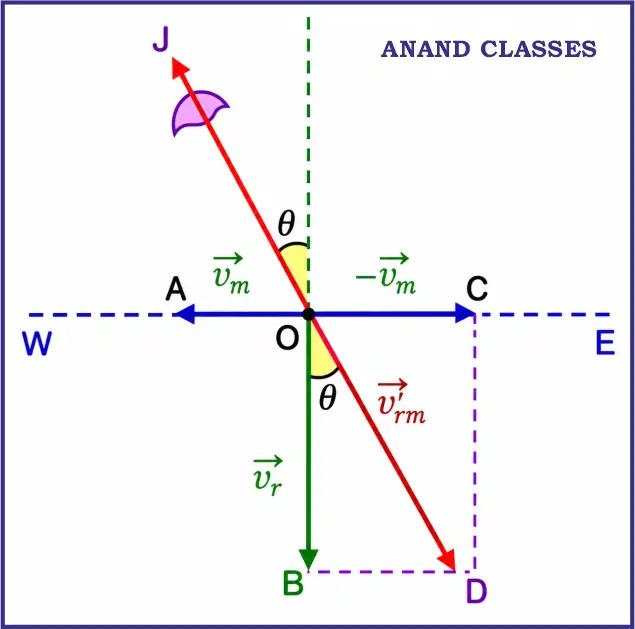
Now the relative velocity of rain w.r.t. man will be the resultant velocity of and , which will be represented by diagonal of rectangle .
Then:
If θ is the angle which makes with the vertical direction :
Here, angle θ is from the vertical towards west and is written as θ, west of vertical.
IMPORTANT NOTE
In the above problem, if the man wants to protect himself from the rain, he should hold his umbrella in the direction of the relative velocity of rain w.r.t. man i.e., the umbrella should be held making an angle west of vertical.
For better understanding, also read Dot Product (Scalar Product) of Two Vectors: Formula, Properties & Solved Examples
Solved Problem Based on Relative Velocity of Rain with respect to the Moving Man
The following are problems based on Relative Velocity of Rain with respect to the Moving Man.
Example.1
A man is walking on a level road at a speed of 3.0 km/h. Rain drops fall vertically with a speed of 4.0 km/h. Find the velocity of the raindrops with respect to the man. In which direction should the man hold his umbrella to protect himself from rain?
Solution.
Here, represented by ; represented by .
To find the relative velocity of rain w.r.t. man, bring the man to rest by imposing a velocity on the man and apply this velocity on the rain also. Now the relative velocity of rain w.r.t. man will be the resultant velocity of and , which will be represented by diagonal of rectangle OBDC.
i.e.,
θ = 36°52′ with the vertical in forward direction
IMPORTANT NOTE
If the man wants to protect himself from the rain in the above example, he should hold his umbrella making an angle 36°52′ with the vertical in the forward direction i.e., the direction of relative velocity of rain w.r.t. man.
Students should also study Position and Displacement Vector in Space Explanation With Solved Examples
Example.2
Rain is falling vertically with a speed of 35 m/s. Wind starts blowing after sometime with a speed of 12 m/s in East to West direction. In which direction should a boy waiting at a bus stop hold his umbrella?
Solution :
The boy can protect himself from the rain if he holds his umbrella in the direction of resultant velocity of and , i.e., along the direction OC as shown in Figure.
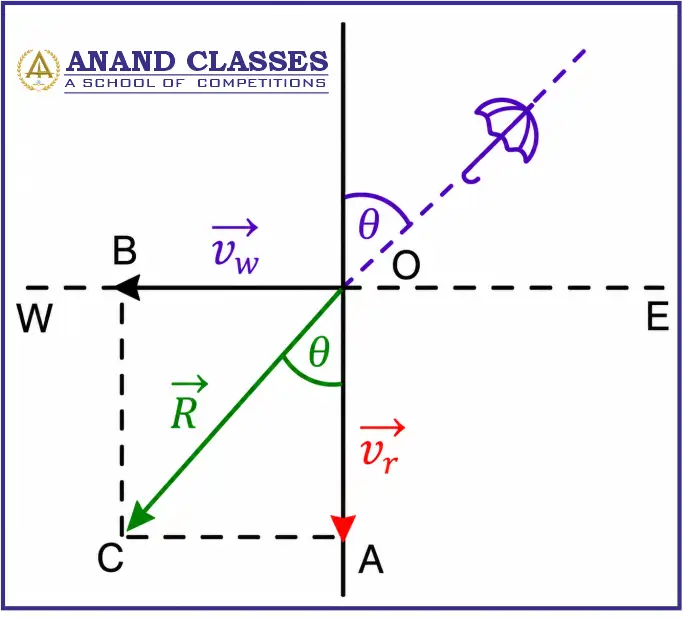
If θ is the angle which makes with the vertical direction, then :
To strengthen your concepts, learn about Rectangular Components of Vector in Three Dimensions (Space), Direction Cosines and Vector Addition
Example.3
A car travelling at a speed of 30 m/s due north along the highway makes a left turn on to a side road which heads towards due west. It takes 40 seconds for the car to complete the turn. At the end of 40 soconds, the car has a speed of 20 m/s along the side road. Determine the magnitude of average acceleration over the 40 second interval.
Solution:
Initial velocity,
Final velocity,
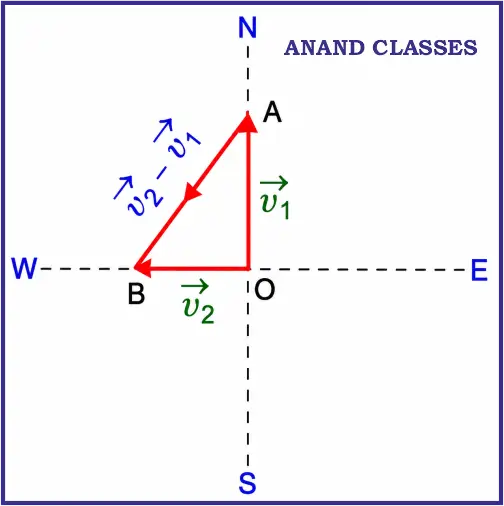
Change in velocity:
Average acceleration,
Understand related topics like Resolution of a Vector and Rectangular Components of a Vector
Example.4
Rain is falling vertically with a speed of 35 m/s. A woman rides a bicycle with a speed of 12 m/s in East to West direction. What is the direction in which she should hold her umbrella?
Solution:
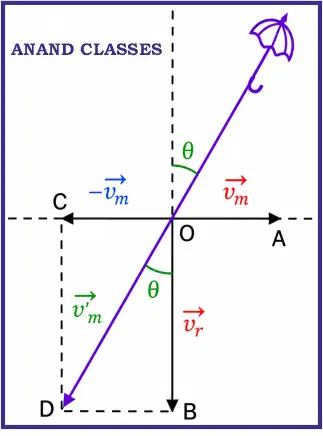
The woman can protect herself from the rain if she holds her umbrella in the direction of relative velocity of rain w.r.t. bicycle.
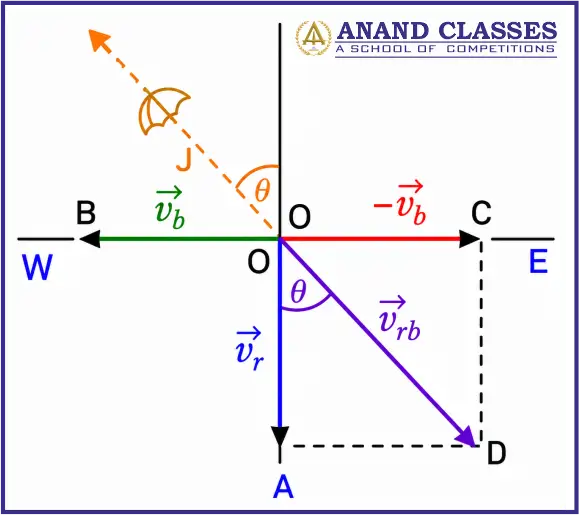
To find the relative velocity of rain w.r.t. bicycle, bring the bicycle at rest by imposing a velocity on the bicycle and apply this velocity on the rain also. Now the relative velocity of rain w.r.t. bicycle will be the resultant of and which will be represented by diagonal of rectangle OADC.
Example.4
To a person going westwards with a speed of 6 km/h, rain appears to fall vertically downwards with a speed of 8 km/h. Find the actual speed of the rain and its direction.
Solution:
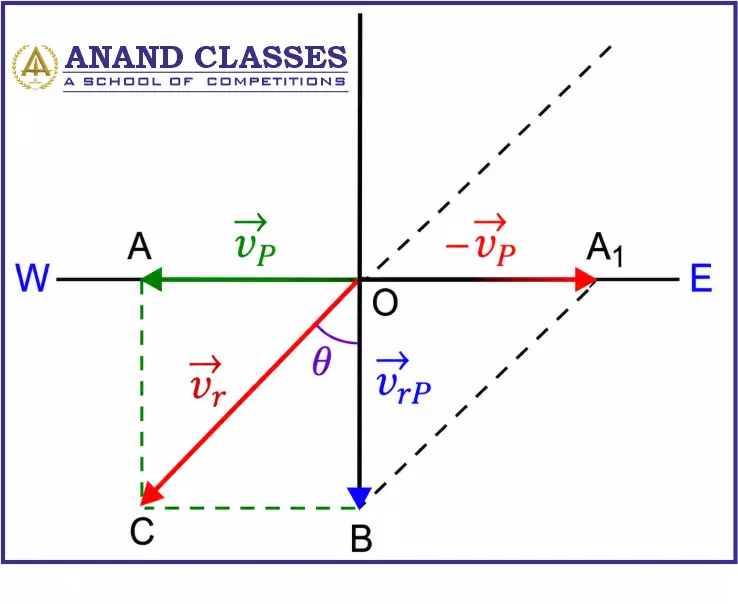
Relative velocity of rain w.r.t. person,
Let be the velocity of rain, then
Magnitude of :
Let be the angle which makes with the vertical, then
Example.5
A person standing on a road has to hold his umbrella at 60° with the vertical to keep the rain away. He throws the umbrella and starts running at 20 m/s. He finds that rain drops are hitting his head vertically. Find the speed of the rain drops with respect to (a) the road (b) the moving person.
Solution:
When the person is at rest with respect to ground, the rain is coming to him at an angle 60° with the vertical i.e. along OB. When a person after throwing his umbrella runs on the ground with velocity 20 m/s, the relative velocity of rain w.r.t. person is along OC as shown in Figure.
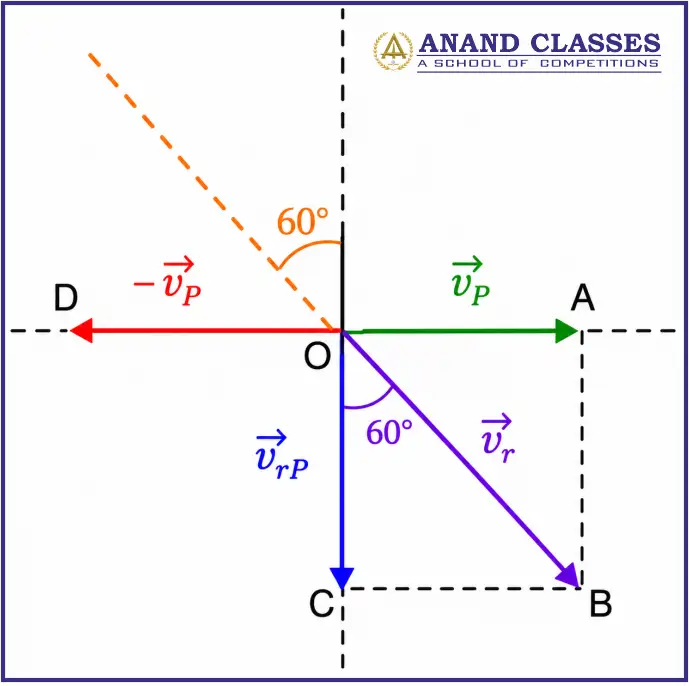
Here, ∠BOC = 60°
Velocity of rain w.r.t. ground,
Velocity of person w.r.t. ground, where,
Velocity of rain w.r.t. person,
(a) Velocity of rain w.r.t. ground:
In △OCB,
(b) Velocity of rain w.r.t. person:
In △OCB,
Example.6
To a person going East in a car with a velocity of 50 km/h, a bus appears to move towards North with a velocity 50√3 km/h. What is the actual velocity and direction of motion of the bus?
Solution:
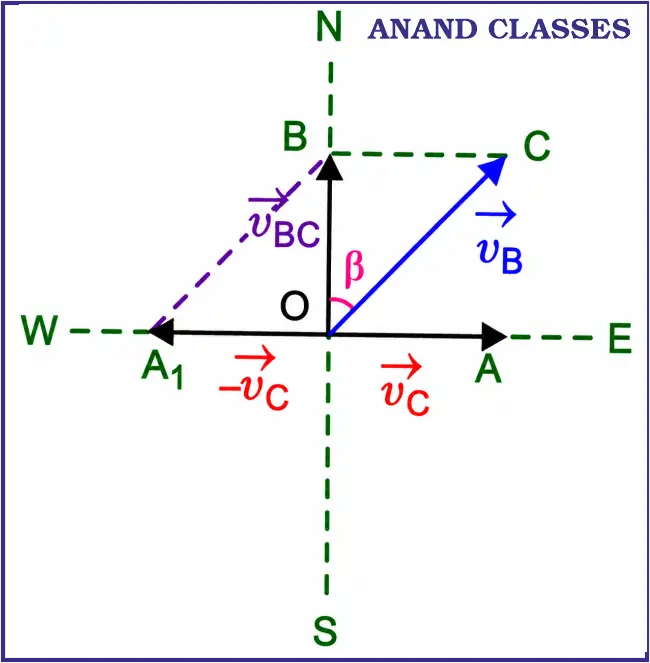
Refer to Figure, the true velocity of car,
Relative velocity of bus w.r.t. car,
is the resultant velocity of and . Therefore, the true velocity of bus must be represented by . Let . Then:
Example.7
A train is moving with a velocity 72 km/h in the North-East direction. If another train is moving with a velocity 54 km/ h in the North-West direction, then what is the relative velocity of the second train w.r.t. the first train?
Solution:
Refer to Figure,
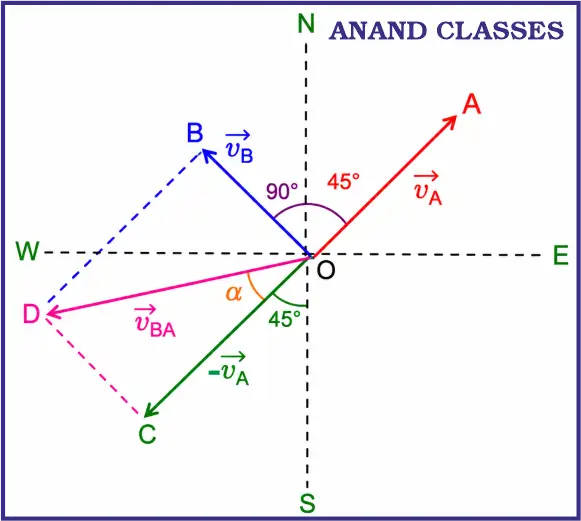
Velocity of first train, where
where
Velocity of second train, where
Relative velocity of B w.r.t. A is:
FAQs on Relative Velocity of Rain with Respect to a Moving Man
The following are conceptual short questions answers for CBSE class 11 physics.
What is the relative velocity of rain with respect to a moving man?
The relative velocity of rain with respect to a moving man is the velocity of the rain as observed by the moving man. It is given by the vector difference
where is the velocity of the rain and is the velocity of the man.
What is meant by relative velocity in a plane?
Relative velocity in a plane is the velocity of one object as observed from another object when both are moving in two dimensions. It is obtained by subtracting the velocity vector of the observer from that of the object.
Why does rain appear to fall at an angle to a moving person?
When a person moves horizontally, the rain acquires an apparent horizontal component opposite to the person’s motion. As a result, the rain no longer appears to fall vertically but at an angle.
What is the formula for the relative velocity of rain?
The relative velocity of rain with respect to a moving observer is
The magnitude of the relative velocity is
where the components depend on the chosen coordinate system.
How do you calculate the angle at which rain appears to fall?
If the rain falls vertically with speed and the man moves horizontally with speed , then the apparent angle made by the rain with the vertical is
In which direction should a person hold an umbrella while walking?
A moving person should tilt the umbrella in the direction from which the rain appears to come. This direction is opposite to the horizontal component of the person’s motion relative to the rain.
How should a person move to avoid getting wet from vertically falling rain?
If the rain falls vertically, moving faster makes the rain appear more inclined. Therefore, the umbrella should be tilted further forward as the person’s speed increases.
What happens if the man is standing still?
If the man is at rest,
so
The rain appears to fall in its actual direction.
What happens if the man runs faster?
As the speed of the man increases, the horizontal component of the relative velocity increases. Consequently, the rain appears to fall at a larger angle with the vertical.
Can the rain appear to fall horizontally?
Yes. If the horizontal component of the relative velocity becomes much larger than its vertical component, the rain appears nearly horizontal to the moving observer.
How is relative velocity represented using vectors?
Relative velocity is represented by vector subtraction:
Graphically, it is obtained by adding the velocity of the rain to the negative of the man’s velocity.
What is the importance of relative velocity of rain in physics?
The concept helps solve problems involving:
- rain and moving pedestrians,
- moving vehicles,
- boats crossing rivers,
- aircraft flying in wind,
- wind velocity problems, and
- projectile motion involving moving observers.
What assumptions are commonly made in rain-man relative velocity problems?
Most problems assume:
- the rain falls with constant velocity,
- the man’s speed is constant,
- air resistance is neglected,
- both motions occur in the same vertical plane.
How is the apparent speed of rain calculated?
The apparent speed is the magnitude of the relative velocity:
It is calculated using vector addition and the Pythagorean theorem when the velocity components are perpendicular.
What is the difference between actual velocity and relative velocity?
The actual velocity is the velocity of the rain with respect to the ground, whereas the relative velocity is the velocity observed by a moving person. Relative velocity depends on the motion of both the rain and the observer.
Why is relative velocity important in competitive physics exams?
Relative velocity is a frequently tested concept in JEE Main, JEE Advanced, NEET, and other engineering and medical entrance exams because it combines vector addition with two-dimensional motion and has many practical applications.