The parallelogram law of vector addition and subtraction of vectors are fundamental concepts in vector algebra used to determine the resultant magnitude and direction of two vectors acting simultaneously. Vector subtraction widely applied in mechanics, motion, force analysis, and engineering problems. These concepts play an important role in Class 11 Physics, JEE Main, NEET, and competitive examinations.
What is Parallelogram Law of Vectors Addition ?
Parallelogram law of vectors states that if two vectors acting on a particle at the same time are represented in magnitude and direction by the two adjacent sides of a parallelogram drawn from a point, their resultant vector is represented in magnitude and direction by the diagonal of the parallelogram drawn from the same point.
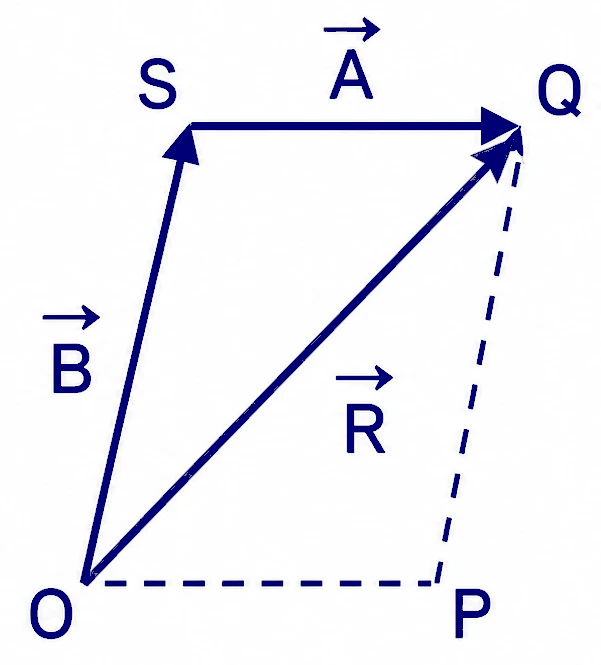
The two vectors and are represented in magnitude and direction by two sides and of a parallelogram OPQS drawn from a point O then their resultant vector is represented in magnitude and direction by the side i.e., diagonal of the parallelogram drawn from the same point. This method of finding the resultant of two vectors is called parallelogram law of vectors. Thus,
= +
= +
What is Parallelogram Law of Vectors Addition – Analytical Method ?
Parallelogram law of vectors states that if two vectors acting on a particle at the same time are represented in magnitude and direction by the two adjacent sides of a parallelogram drawn from a point, their resultant vector is represented in magnitude and direction by the diagonal of the parallelogram drawn from the same point.
Let the two vectors and , inclined at angle θ be acting on a particle at the same time. Let they be represented in magnitude and direction by two adjacent sides and of a parallelogram OPQS drawn from a point O. According to parallelogram law of vectors, their resultant vector will be represented by the diagonal of the parallelogram.
Magnitude of Resultant Vector R
Geometric Construction : Draw QN perpendicular to OP produced.
In the figure, OP = A (Magnitude of vector ), OS = PQ = B (Magnitude of vector ), OQ = R (Magnitude of the resultant vector ) and ∠SOP = ∠QPN = θ.
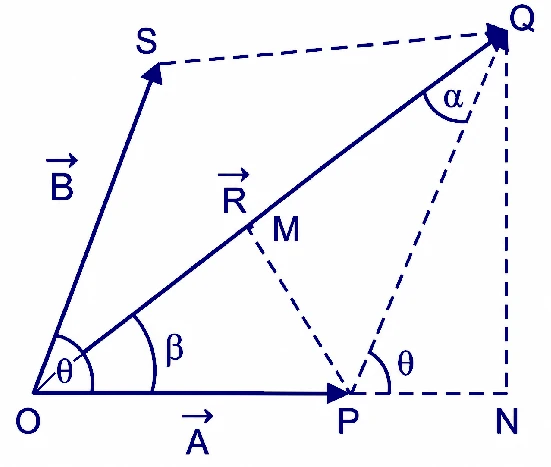
Step 1: Resolve Components in Right-Angled Triangle △QNP
Using basic trigonometry in △QNP :
cos θ = PN/PQ, PN = PQ cos θ = B cos θ
sin θ = QN/PQ, QN = PQ sin θ = B sin θ
Step 2: Apply Pythagorean Theorem to △ONQ
In the large right-angled triangle △ONQ, we have :
OQ2 = ON2 + QN2
Since ON = OP + PN, we can substitute it into the equation :
OQ2 = (OP + PN)2 + QN2
Step 3: Substitute Vector Magnitudes and Expand
Substitute the values we defined earlier into the equation :
R2 = (A + B cos θ)2 + (B sin θ)2
R2 = A2 + 2AB cos θ + B2
R2 = A2 + B2 + 2AB cos θ
R =
Direction of the Resultant Vector
Let the resultant vector make an angle β with the direction of vector . Then, from right angled triangle QNO,
Drop a perpendicular PM on OQ. Let ∠PQO = α .
In △OQN, QN = OQ sin β = R sin β
In △PQN, QN = PQ sin θ = B sin θ
Therefore, R sin β = B sin θ, hence
Similarly, PM = A sin β =B sin α , hence
Therefore, the final result,
It is known as the law of sines.
Case 1: When Two Vectors act in the Same Direction (θ = 0o)
When two vectors and are parallel and point in the exact same direction, the angle between them is θ = 0o.
Magnitude of the Resultant
We know that cos 0o = 1. Substituting this into the magnitude formula :
R = A + B
Rmax = A + B
When two vectors act in the same direction, the magnitude of the resultant vector is simply the algebraic sum of their individual magnitudes. This is the maximum possible value for the resultant of two vectors.
Direction of the Resultant (β)
We know that sin 0o = 0 and cos 0o = 1. Substituting these into the direction formula :
β = 0o
The resultant vector acts along the exact same direction as vector and vector .
Thus, for two vectors acting in the same direction, the magnitude of the resultant vector is equal to the sum of the magnitudes of two vectors and acts along the direction of vector and vector .
Case 2 : When Two Vectors act in the Opposite Direction (θ = 180o)
When two vectors and are anti parallel and point in the exact opposite direction, the angle between them is θ = 180o.
Magnitude of the Resultant
We know that cos 180o = -1. Substituting this into the magnitude formula :
R = A – B or B – A
Rmin = | A – B |
When two vectors act in the opposite direction, the magnitude of the resultant vector is simply the difference of their individual magnitudes. This is the minimum possible value for the resultant of two vectors.
Direction of the Resultant (β)
We know that sin 180o = 0 and cos 180o = -1. Substituting these into the direction formula :
β = 0o or 180o
The resultant vector acts along the direction of vector whose magnitude is large.
Thus, for two vectors acting in opposite directions, the magnitude of the resultant vector is equal to the difference of the magnitudes of the two vectors and acts in the direction of bigger vector.
Case 3 : When Two Vectors act right angle to each other (θ = 90o)
When two vectors and are perpendicular to each other, the angle between them is θ = 90o.
Magnitude of the Resultant
We know that cos 90o = 0. Substituting this into the magnitude formula :
When two vectors act perpendicular to each other, the magnitude of the resultant vector is square root of sum of squares of their individual magnitudes.
Direction of the Resultant (β)
We know that sin 90o = 1 and cos 90o = 0. Substituting these into the direction formula :
β =
| Noteworthy Point |
|---|
| It should also be noted that while finding the resultant of two vectors by the parallelogram law, the two vectors and have to be co-initial vectors. |
Key Rules and Special Cases of Vector Addition for Competitive Exams and CBSE Class 11 Physics
1. Maximum and Minimum Resultants
The magnitude of the resultant of two vectors is maximum when they act in the same direction (θ = 0o) and minimum when they act in opposite directions (θ = 180o).
Maximum Resultant : Rmax = A + B
Minimum Resultant : Rmin = | A – B |
2. Tail-to-Tail or Head-to-Head Rule
While finding the resultant of two vectors and using the parallelogram law of vector addition, both vectors must be co-initial or co-terminus. This means they should either both act towards a point or both act away from a point to correctly identify the angle θ between them.
3. Resultant of Two Equal Vectors
The resultant of two vectors of equal magnitude can be zero if and only if they act in exactly opposite directions (θ = 180o).
4. Minimum Number of Equal Vectors for a Zero Resultant
The minimum number of equal vectors required to produce a net resultant of zero is two. The angle between them must be 180o so they perfectly cancel each other out.
5. Condition for Three Unequal Vectors to Equal Zero
The resultant of three unequal vectors can be zero if they satisfy two conditions:
(a) They must be coplanar (exist in the same 2D plane).
(b) They can be represented in magnitude and direction by the three sides of a triangle taken in the same order (cyclic order).
6. Minimum Number of Non-Coplanar Vectors for a Zero Resultant
The minimum number of non-coplanar vectors (vectors pointing in different 3D planes) whose resultant can be zero is four. This forms a closed 3D shape (a tetrahedron) when taken in order.
This concept is linked with Polygon Law and Triangle Law of Vectors Addition, Lami’s Theorem Analytical Method
Subtraction of Two Vectors
Subtraction of a vector from a vector is defined as the addition of vector (negative of vector ) to vector .
The standard geometric laws of vector addition (Triangle Law and Parallelogram Law) apply equally to vector subtraction.
Geometric Construction & Proof
Consider two vectors and . To find :
Coincide the tail of vector with the head of vector . Let vector be represented by line segment and vector be represented by .
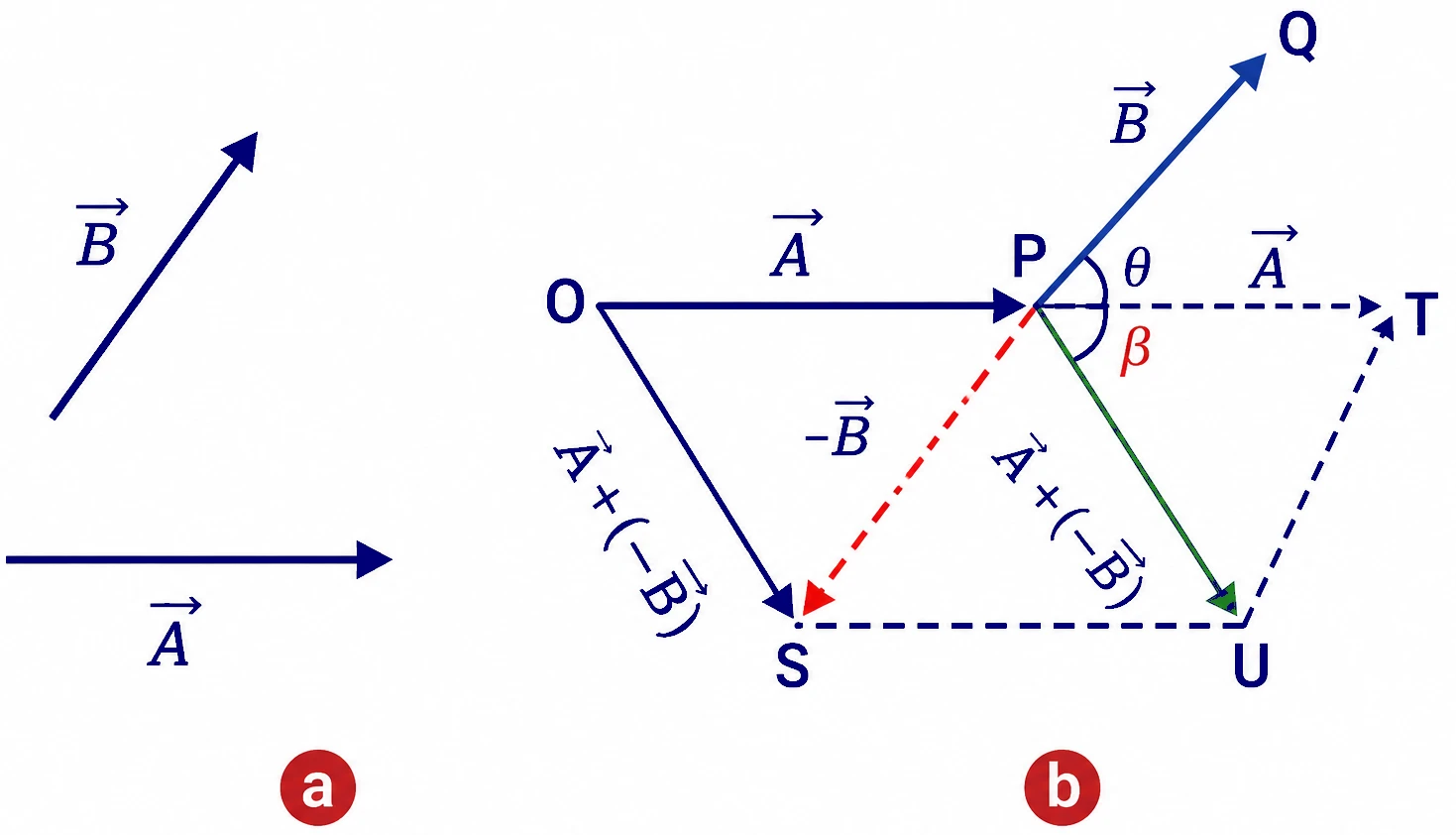
Produce the line QP backward and cut PS equal to PQ. The directed line segment PS now represents . Join O to S. According to the Triangle Law of vectors in △OPS :
= = + = =
Thus, the diference of two vectors is represented by side , which is the resultant vector of vector and . Draw = and = .
Then will be represented by . If θ is the angle between vectors and , then angle between and is (180° – θ). According to parallelogram law of vectors addition ;
Since cos(180o – θ) = – cos θ :
Direction (β) :
Since sin(180o – θ) = – sin θ :
Similar topics for practice include Multiplication of Vector by Real Number and Scalar
Important Properties of Vector Subtraction
Not Commutative : The vector subtraction does not follow commutative law.
(Note: and have the same magnitude but point in exactly opposite directions).
Not Associative : The vector subtraction does not follow associative law.
| Noteworthy Point |
|---|
| Vectors addition is commutative and associative by nature. But vector subtraction is neither Commutative nor associative by nature. |
Practical Physical Examples of Vector Subtraction
1. Change in Momentum During a Collision
Consider a particle colliding normally (perpendicularly) with a wall and rebounding in the exact opposite direction with the same speed and momentum magnitude p.
Initial momentum :
Final momentum : (due to opposite direction)
The change in momentum () is calculated using vector subtraction :
2. Change in Velocity in Circular Motion
Let a particle move along a circular path of constant radius with a uniform speed v. We want to find the change in its velocity when it completes exactly half a revolution.
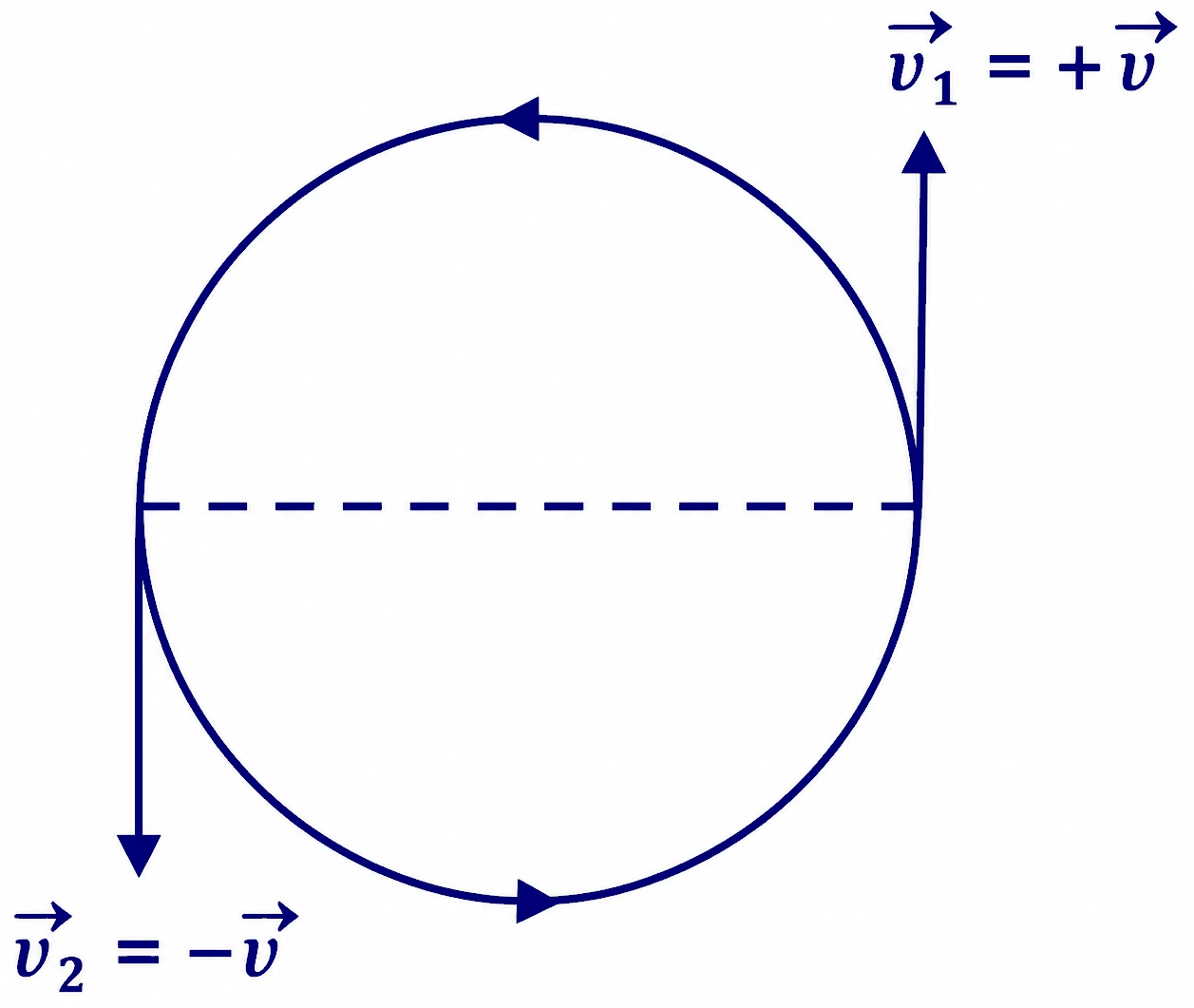
Velocity at the starting point:
Velocity at the half-way point: (direction completely reverses)
The change in velocity () is :
3. Change in Velocity and direction during direction change of a particle
A particle moving with velocity v towards northward direction changes its direction and moves towards eastward with the same speed. To find the change in its velocity.
Initial Velocity (): Moving northward with speed .
Final Velocity (): Moving eastward with the same speed .
The change in velocity is defined as the final velocity minus the initial velocity:
To solve this using vector addition, we rewrite the subtraction as adding a negative vector:
Since points North, the negative vector points directly South ().
Now, we add (East) and (South) together using the parallelogram law of vectors. The resultant vector is the diagonal .
Because North/South and East are perpendicular to each other, the angle between and is 900.
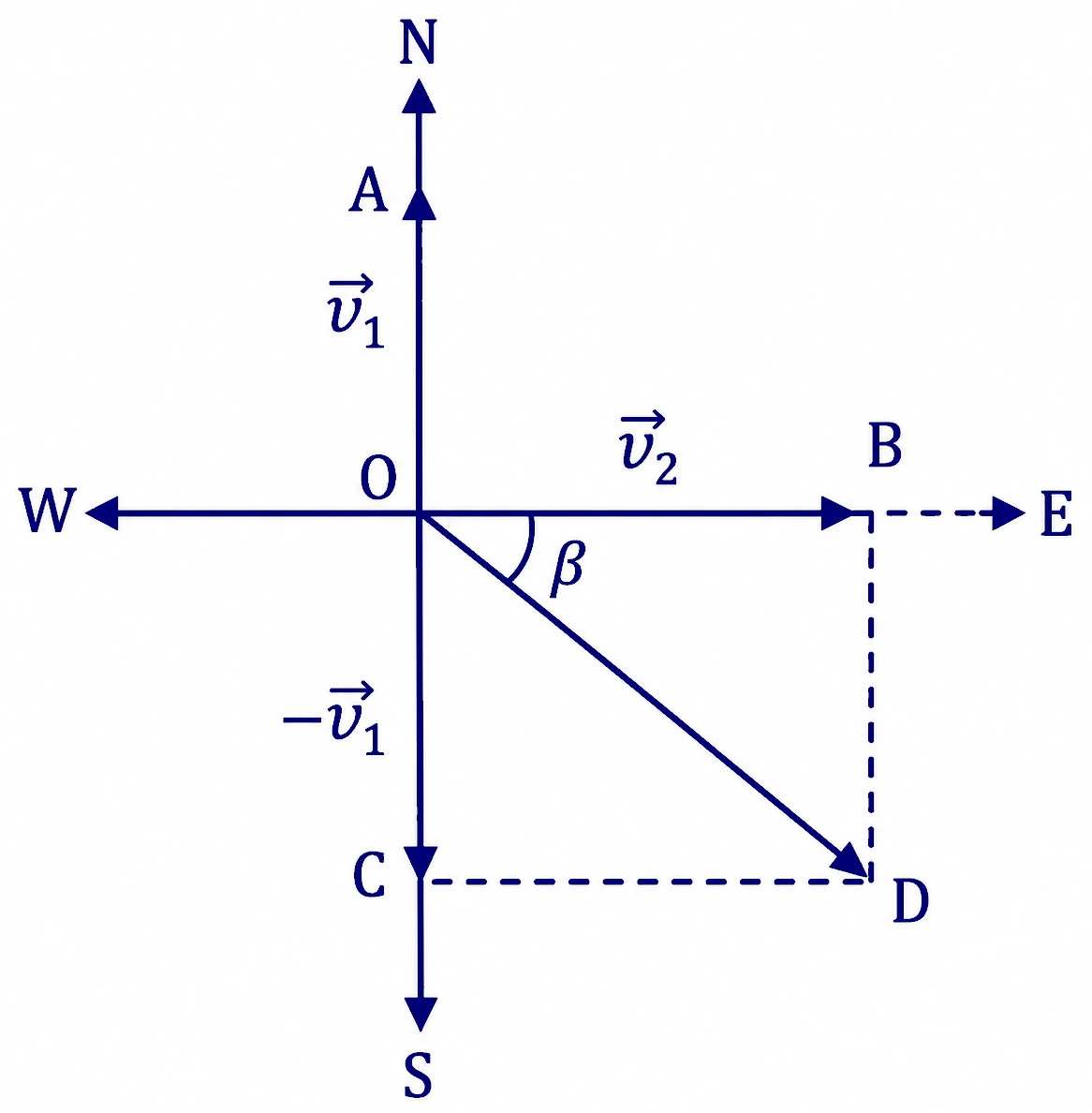
Using the vector magnitude formula:
Since and both speeds equal :
To find the exact direction of the change in velocity, calculate the angle relative to the East axis:
Thus, the direction of will be along south-east direction.
Conceptual Short Questions and Answers Based on Parallelogram Law of Vector Addition and Subtraction of Vectors
What is the parallelogram law of vector addition?
The parallelogram law states that if two vectors acting at a point are represented by two adjacent sides of a parallelogram, then their resultant is represented by the diagonal of the parallelogram passing through that point.
What is the resultant vector?
The resultant vector is a single vector that represents the combined effect of two or more vectors acting together.
When is the resultant vector maximum?
The resultant vector is maximum when both vectors act in the same direction.
When is the resultant vector minimum?
The resultant vector is minimum when both vectors act in opposite directions.
What happens when two vectors are perpendicular to each other?
When two vectors act at right angles, the resultant is obtained using the Pythagorean theorem.
What is meant by co-initial vectors?
Co-initial vectors are vectors that start from the same point.
What is vector subtraction?
Vector subtraction means adding the negative of a vector to another vector.
Does vector subtraction follow commutative law?
No, vector subtraction does not follow commutative law.
Does vector subtraction follow associative law?
No, vector subtraction does not follow associative law.
What is the direction of the resultant vector in opposite vectors?
The resultant vector acts in the direction of the vector having greater magnitude.
What is the minimum number of equal vectors required to produce zero resultant?
Two equal vectors acting in opposite directions can produce zero resultant.
Why is the parallelogram law important?
The parallelogram law helps in finding the magnitude and direction of the resultant vector in physics and engineering problems.
Where are vectors used in real life?
Vectors are used in mechanics, engineering, navigation, projectile motion, circular motion, and force analysis.
What is the difference between scalar and vector quantities?
Scalars have only magnitude, while vectors have both magnitude and direction.