The concepts of position vector and displacement vector in three-dimensional space form the foundation of vector algebra and mechanics. These concepts are widely used in kinematics, coordinate geometry, and engineering to describe the position and motion of objects in three dimensions. A thorough understanding of position and displacement vectors is essential for students preparing for Class 11 Physics, JEE Main, JEE Advanced, NDA, IMU CET, CUET, NEET, and other competitive examinations, as they frequently appear in vector algebra, mechanics, and coordinate geometry problems.
What is a Position Vector in Physics?
A position vector is a vector that represents the location of a point in space relative to a fixed reference point, known as the origin. It is drawn as a straight line from the origin to the point.
Consider a particle in a space. Let at an instant t, its position be P whose position coordinates from three mutually perpendicular axes with origin at O be (x, y, z) as shown in Figure below.
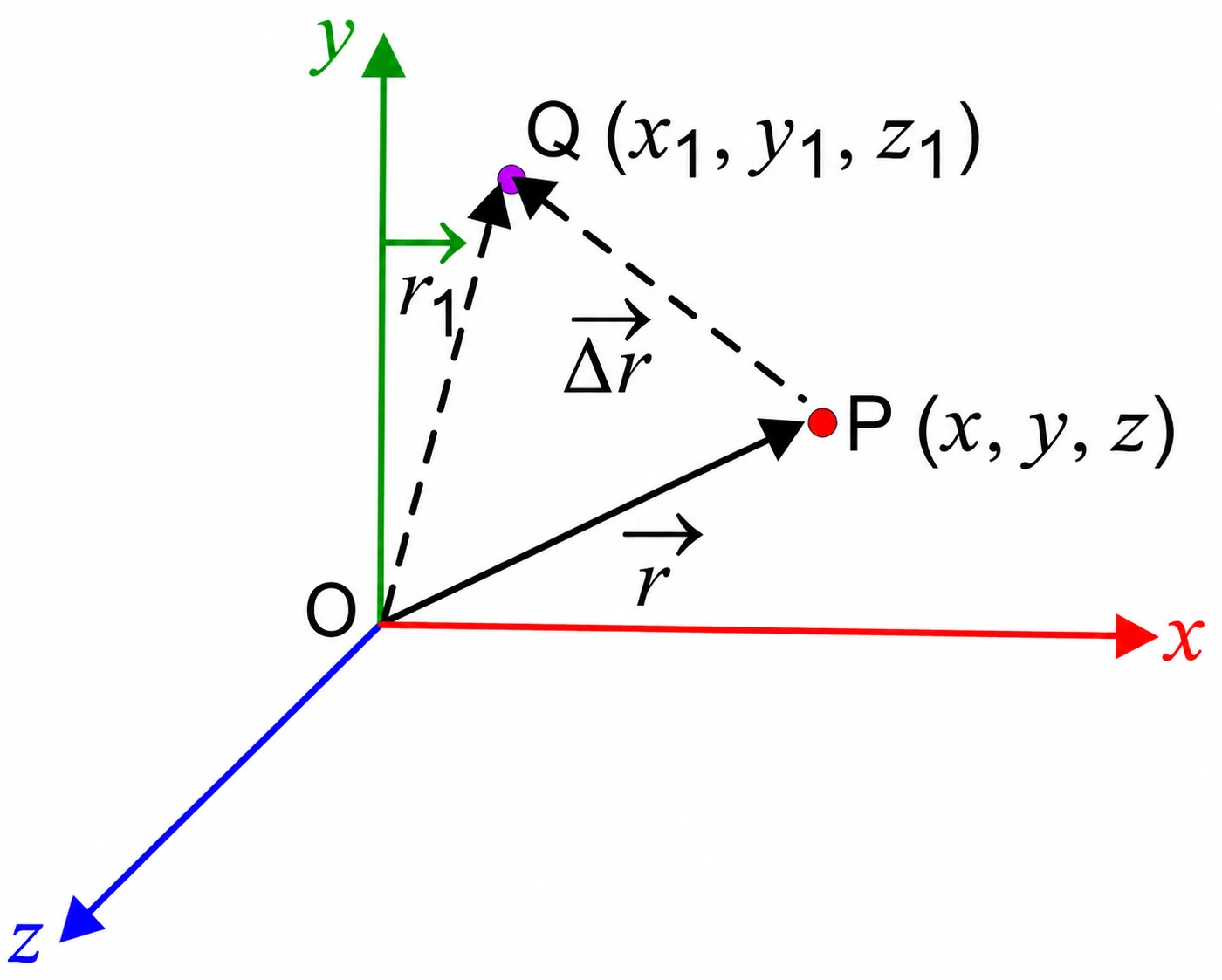
The position vector of the particle at P w.r.t origin O is given by :
Magnitude of is given by :
Enhance your preparation with Rectangular Components of Vector in Three Dimensions (Space), Direction Cosines and Vector Addition
How do you calculate the Displacement Vector in Space between two points?
Let the particle be at P(x, y, z) at time t and let it reach point Q(x1, y1, z1) at time t1, in Figure above. The position vector of particle at P is :
The position vector of particle at Q is :
The position vector of the particle in the time interval (t1 – t), (i.e., displacement) is given by :
Magnitude of displacement vector is :
Explore detailed notes on Resolution of a Vector and Rectangular Components of a Vector
Difference between a Position Vector and a Displacement Vector
| Feature | Position Vector | Displacement Vector |
| Definition | A vector that specifies the exact location of a particle at a particular instant in time with respect to a chosen reference point (usually the origin). | A vector that represents the overall change in position of a particle over a given time interval. |
| Dependence on Origin | Highly Dependent. If you shift the origin (reference point), the position vector changes completely. | Independent. Shifting the origin does not change the straight-line distance or direction between the two points. |
| Time Frame | Describes the particle at a single, specific instant in time (t). | Describes the particle over a duration or interval of time (Δt = tf – ti). |
| Mathematical Notation | Denoted generally as or . | Denoted generally as or . |
| Formula (In 3D Cartesian Space) | ||
| Relationship to Path | Contains no information about how the particle arrived at that location. | Represents only the net shortcut; it does not reveal the actual path or curves taken by the object. |
| Physical Significance | Serves as the baseline state variable in kinematics to describe a particle’s trajectory. | Used directly to calculate physical quantities like average velocity () and work done (). |
For complete preparation, also study Parallelogram Law of Vectors Addition and Subtraction of Vectors
What are the Properties of Position and Displacement Vectors in Space ?
- Both are vector quantities (magnitude and direction)
- Position vector is measured from fixed reference
- Displacement vector is independent of path
- Displacement can be zero if initial and final positions coincide
- Magnitude of displacement ≤ actual distance travelled
Important exam-related topics include Polygon Law and Triangle Law of Vectors Addition, Lami’s Theorem Analytical Method
What is the Role of Position and Displacement Vectors in Kinematics ?
Position and displacement vectors are foundational for describing motion parameters such as velocity and acceleration. The change in position over time leads to velocity, while the change in velocity provides acceleration analysis, as addressed in Displacement, Velocity And Acceleration.
These vectors also facilitate the study of relative motion, which is explained under Relative Velocity In Kinematics.
What are Frequent Applications and Related Areas of Position and Displacement Vectors ?
Applications of position and displacement vectors extend to projectile motion, analysis of movement in one and two dimensions, and graphical representation of motion. For specific applications, refer to Motion In One Dimension.
Mastery of these concepts is fundamental for solving kinematics problems and for advanced topics in physics and mathematics.
Frequently linked concepts include Multiplication of Vector by Real Number and Scalar
Solved Examples Based on Position and Displacement Vector in Space
Example 1:
Given two points P = (-4, 6, -1) and Q = (5, 11, -6), determine the position vector PQ.
Solution:
If two points are given in the xyz-coordinate system, then we can use the following formula to find the position vector PQ :
Where (x1, y1, z1), represents the coordinates of point P and (x2, y2, z2) represents the point Q coordinates. Thus, by simply putting the values of points P and Q in the above equation, we can find the position vector PQ :
Thus, the position vector is equivalent to a vector that starts at the origin. This vector is directed to a point 9 units along the +x-axis, 5 units +y-axis and 5 units along the -z-axis.
Example 2:
The position vector of a particle moving in a plane at any time t is given by : . Find the displacement of the particle between the time interval t = 1 second and t = 4 second.
Solution :
Displacement () is a vector quantity that represents the shortest straight-line path from the starting point to the ending point. It depends only on the initial and final positions of the particle and is completely independent of the actual path taken.
The mathematical formula for the displacement vector is:
where is the final position vector and is the initial position vector.
To find where the particle is at the beginning of the interval t = 1 second, substitute t = 1 into the given position equation:
To find where the particle is at the end of the interval t = 4 second, substitute t = 4 into the position equation:
Subtract the initial position vector from the final position vector to get displacement vector.
The displacement of the particle is .
Example 3:
The position vector of a particle moving in space is given by the function: , where a and b are constants. Find the ratio of the magnitude of displacement to the total distance travelled by the particle during the time interval from t = 0 to t = T.
Solution :
Displacement () : The direct, straight-line vector pointing from the initial position to the final position.
Distance (S): The total length of the actual path traveled by the particle. It is calculated by integrating the speed over time: .
Generally, Distance ≥ Displacement. They are only equal (giving a ratio of 1) if the particle moves along a strictly straight line without reversing its direction.
To Calculating the Magnitude of Displacement () :
Initial Position (at t = 0) :
Final Position (at t = T) :
Displacement Vector ():
Magnitude of Displacement:
To Calculating Total Distance Travelled (S):
To calculate the distance, we must first find the velocity and speed of the particle.
Velocity (): Differentiate the position vector with respect to time
Speed (v): Calculate the magnitude of the velocity vector:
Distance (S): Integrate the speed from time t = 0 to t = T
Using the integration rule , evaluate it at the boundaries:
Finding the Required Ratio:
Now, divide the magnitude of displacement by the total distance:
The ratio of displacement to distance travelled is 1.
Understand related topics like Scalars Vectors Types, Unit, Modulus or Magnitude, Negative, Equal, Orthogonal, Position, Collinear, Coplanar, Co-initial Vectors
Short Conceptual Questions and Answers Based on Position and Displacement Vector in Space
What is a position vector?
A position vector is a vector that represents the location of a point in space relative to a fixed reference point, known as the origin. It is drawn as a straight line from the origin to the point. For a point P with coordinates (x, y, z), its position vector, denoted as or , is given by .
How is a displacement vector defined and how does it differ from a position vector?
A displacement vector represents the change in an object’s position. It is the shortest straight-line distance from the initial point to the final point, indicating both magnitude and direction of the movement. While a position vector specifies a single location relative to the origin, a displacement vector describes the net result of a movement between two locations and is independent of the path taken.
Why is the origin crucial when defining a position vector but not for a displacement vector?
The origin is crucial for a position vector because its definition depends entirely on this reference point; changing the origin changes the position vector of a point. However, a displacement vector represents the difference between two position vectors. If the origin is shifted, both the initial and final position vectors change by the same amount, but their difference (the displacement vector) remains exactly the same. This makes displacement an independent quantity, describing only the movement itself.
Can an object have zero displacement but non-zero distance travelled? Explain with an example.
Yes, this is a key difference between the two concepts. Distance is a scalar quantity representing the total path length covered, while displacement is a vector representing the net change in position. A common example is an athlete running one full lap around a 400 m circular track.
- Distance travelled: 400 metres.
- Displacement: Zero, because the athlete ends at the exact same point where they started, so their initial and final position vectors are identical.
What is the physical meaning of a negative displacement vector?
In physics, the negative sign on a vector simply indicates its direction. A negative displacement vector (has the exact same magnitude as its positive counterpart but points in the precise opposite direction. For example, if a displacement of +5m means moving 5 metres east, a displacement of -5m means moving 5 metres west.
Give a real-world example of how position and displacement vectors are used.
A prime example is GPS navigation. A GPS receiver calculates your position vector relative to a coordinate system fixed to the Earth (using signals from satellites). When you move from your home to your school, the GPS tracks the change. Your home has an initial position vector , and your school has a final position vector . The navigation system calculates the displacement vector to determine the most direct route and display your movement on a map.
If a particle’s position vector changes in direction but its magnitude remains constant, what kind of path is it following?
If the magnitude of a particle’s position vector remains constant while its direction changes, the particle is moving along a path where its distance from the origin is always the same. In a two-dimensional plane, this path is a circle with the origin at its center. In three-dimensional space, it would be moving on the surface of a sphere centered at the origin. This is a fundamental concept in describing uniform circular motion.
JEE Main PYQs Previous Year Questions With Solutions of Chapter Units and Measurements Class 11 Physics
Build a strong foundation by first exploring Class 11 Physics Notes for clear concepts and complete theory.
Next, understand the basics in depth through the Units and Measurements chapter to strengthen your fundamentals.
Once your concepts are clear, practice Units and Measurements JEE Main PYQs Set-1 to get familiar with question patterns.
Then move to Units and Measurements JEE Main PYQs Set-2 to improve accuracy and problem-solving speed.
Further enhance your preparation with Units and Measurements JEE Main PYQs Set-3 for advanced practice and better exam readiness.