Rectangular components of a vector in three dimensions is a fundamental topic in vector algebra and physics. Any vector in space can be resolved into three mutually perpendicular components along the x-axis, y-axis, and z-axis, making it easier to analyze its magnitude, direction, and applications in mechanics. A clear understanding of three-dimensional vector components is essential for students preparing for Class 11 Physics, JEE Main, JEE Advanced, NDA, IMU CET, CUET, NEET, and other competitive examinations, where vectors play a crucial role in solving problems related to motion, forces, displacement, and coordinate geometry.
WHAT ARE RECTANGULAR COMPONENTS OF A VECTOR IN THREE DIMENSIONS (SPACE) ?
Consider a vector represented by , as shown in Figure. Taking O as origin, construct a rectangular parallelopiped with its three edges along the three rectangular axes i.e., X, Y and Z axes.
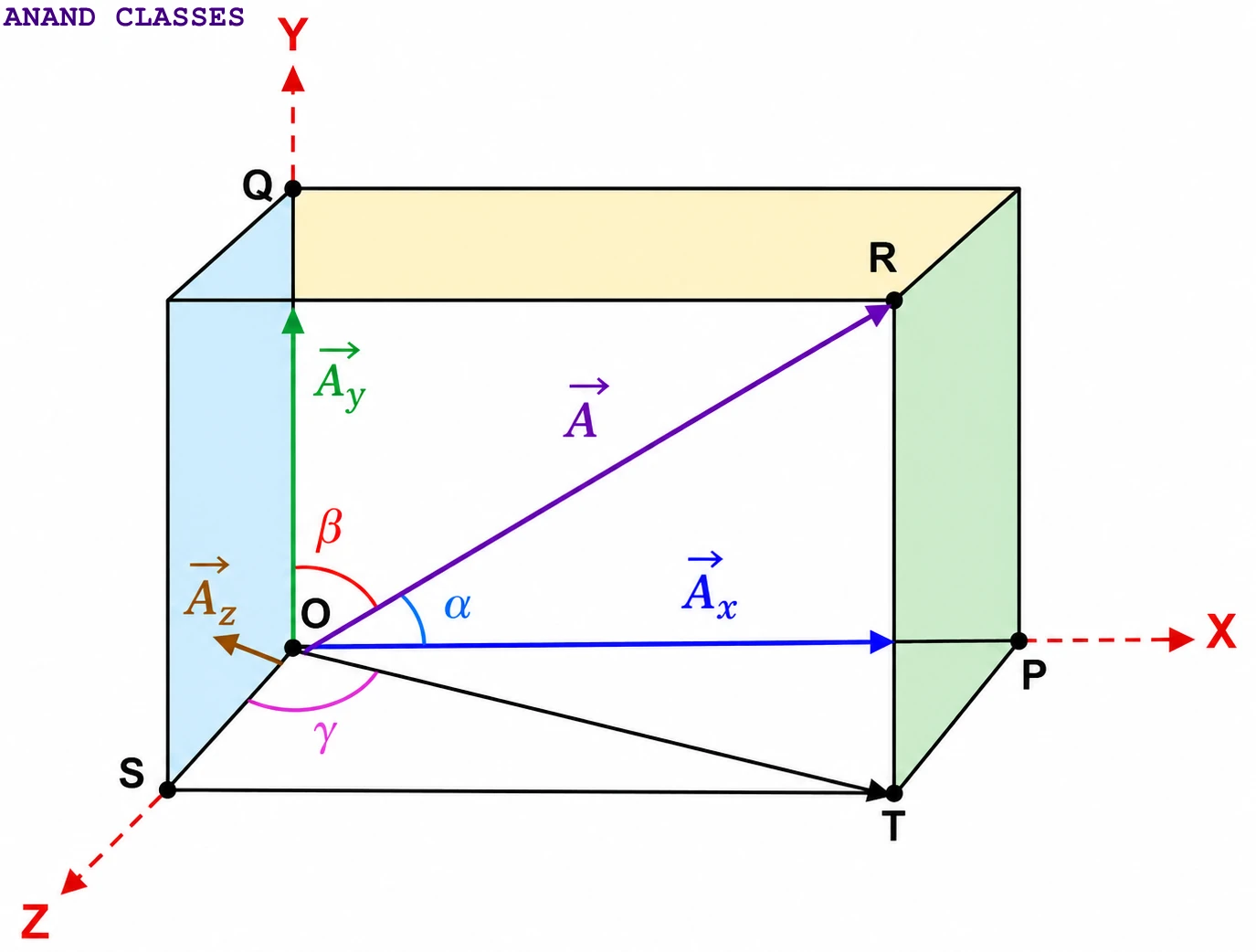
Here, we note that represents the diagonal of the parallelopiped whose intercepts along X, Y and Z axes are , , and respectively; which are three rectangular components of .
Using triangle law of vectors addition :
Using parallelogram law of vectors addition :
Therefore,
Let , , be the unit vectors along X, Y and Z axes respectively, then :
Therefore,
Magnitude of :
In triangle △ORT,
Similar concepts include Resolution of a Vector and Rectangular Components of a Vector
What are Direction Cosines of a Vector ?
If α, β and γ are the angles which the makes with X, Y and Z axes respectively as shown in above diagram, then :
Here, cos α, cos β and cos γ are called the direction cosines of the vector . Putting the values of Ax, Ay and Az in the equation
we get :
cos2α + cos2β + cos2γ = 1
It means sum of the squares of the direction cosines of a vector is always unity. If l, m and n are direction cosines of , then l = cos α, m = cos β, and n = cos γ. Hence,
l2 + m2 + n2 = 1
which is an identity of direction cosines.
Related topics include Parallelogram Law of Vectors Addition and Subtraction of Vectors
VECTORS ADDITION, WHEN VECTORS ARE IN TERMS OF RECTANGULAR COMPONENTS
Consider two vectors and in the x–y plane. Let :
If is the resultant of and , then :
If and are the rectangular component vectors of in the x-y plane, then :
Hence,
It means, each component of the resultant vector is the sum of the corresponding components of and . If we take the two vectors in three dimensions, then :
,
Then
where,
IMPORTANT NOTE : The above method can be extended to addition and subtraction of any number of vectors.
Explore more concepts related to Polygon Law and Triangle Law of Vectors Addition, Lami’s Theorem Analytical Method
Solved Examples Based on Rectangular Components of Vector in Three Dimensions (Space), Direction Cosines and Vector Addition
Example.1
If , find (i) and (ii) the direction cosines of the vector .
Solution : (i)
(ii)
;
and
Example.2
If a line makes angles 90°, 135°, and 45° with the x, y, and z axes respectively, find its direction cosines.
Solution
Let the direction cosines of the line be l, m, n.
l = cos 90° = 0, m = cos 135° = -1/√2, n = cos 45° = 1/√2
Therefore, the direction cosines of the line are :
< 0, -1/√2, -1/√2 >
Example.3
Find the direction cosines of a line which makes equal angles with the coordinate axes. 30
Solution.
Let the direction cosines of the line be l, m, n and let it make the same angle α with each coordinate axis. Thus,
l = cos α, m = cos α, n = cos α
Using the identity:
l2 + m2 + n2 = 1
Substitute values :
cos2α + cos2α + cos2α = 1
3 cos2α = 1
cos2α = 1/3
cos α = ±1/√3
Therefore, the direction cosines of a line equally inclined to all coordinate axes are:
< ±1/√3, ±1/√3, ±1/√3 >
Example.4
If a line has the direction ratios <-18, 12, -4>, find its direction cosines.
Solution
Given direction ratios : <-18, 12, -4>
The direction cosines are obtained by dividing each direction ratio by the magnitude:
Thus, the direction cosines are:
$ <frac{-18}{22}, frac{12}{22}, frac{-4}{22} >$
Simplifying each term:
$ <-frac{9}{11}, frac{6}{11}, -frac{2}{11}> $
Therefore, the direction cosines of the line are:
$ <-frac{9}{11}, frac{6}{11}, -frac{2}{11}> $
Example.5
f a line makes angles α, β, γ with the positive direction of coordinate axes, prove that sin2α + sin2β + sin2γ = 2
Solution :
cos2α + cos2β + cos2γ = 1
(1 – sin2α) + (1 – sin2β) + (1 – sin2γ) = 1
3 – (sin2α + sin2β + sin2γ) = 1
(sin2α + sin2β + sin2γ) = 2
Example.6
A vector , when added to the resultant of the vectors and gives a unit vector along y-axis. Find the magnitude of .
Solution.
Resultant of and is
Unit vector along . As per question
Example.7
If and , find a vector having the same magnitude as and parallel to .
Solution. Here,
Unit vector in the direction of is
The vector having the same magnitude as and parallel to is
Example.8
A room has dimensions 3 m × 4 m × 5 m. A fly starting at one corner ends up at the diametrically opposite corner. (a) What is the magnitude of its displacement? (b) If the fly were to walk, what is the length of the shortest path it can take?
Solution.
(a) If the starting point of fly which is one corner of room is taken as origin of coordinates, then the coordinates of diametrically opposite corner of room are (3, 4, 5). So displacement is
and
(b) When the fly were to walk, then shortest distance travelled is
Example.9
A unit vector is represented by . If the values of a and b are 0.6 and 0.8 respectively, find the value of c.
Solution. Given,
Here,
Example.10
Find a unit vector in the direction of the vector .
Solution: Let
Example.11
Given and , what are the magnitudes of the two vectors? Are these two vectors equal?
Solution:
The magnitudes of and are equal. However, their corresponding components are not equal i.e., and . Hence, the two vectors are not equal.
Example.12
If and , find the length of and .
Solution:
Here, and
Also,
Example.13
Find a unit vector parallel to the resultant of the vectors and .
Solution:
Here, ;
Let be resultant of vectors and . Then,
FAQs on Rectangular Components of a Vector in Three Dimensions (Space)
What are rectangular components of a vector in three dimensions?
Rectangular components of a vector in three-dimensional space are the three mutually perpendicular components of the vector along the x-axis, y-axis, and z-axis.
How is a vector represented in three dimensions?
A vector (vec{A}) in three-dimensional space is represented as:
where are its components along the x, y, and z axes respectively.
What are (hat{i}), (hat{j}), and (hat{k})?
They are unit vectors along the positive directions of the x-axis, y-axis, and z-axis respectively.
Why do we resolve vectors into rectangular components?
Resolving vectors into rectangular components simplifies vector addition, subtraction, and the calculation of magnitude and direction.
What is the formula for the magnitude of a vector in three dimensions?
The magnitude of a vector is:
What are direction cosines of a vector?
The cosines of the angles that a vector makes with the positive x-axis, y-axis, and z-axis are called its direction cosines.
How are direction cosines represented?
If α, β and γ are the angles made by a vector with the x, y, and z axes respectively, then l = cos α, m = cos β, and n = cos γ
How are vector components related to direction cosines?
The components of a vector are:
where (A) is the magnitude of the vector.
What is the relation among the direction cosines?
The direction cosines satisfy :
cos2α + cos2β + cos2γ = 1
or
l2 + m2 + n2 = 1
How do you find the resultant of two vectors using components?
If and
then the resultant is:
How are vector components added?
Corresponding components are added separately:
How are vector components subtracted?
Corresponding components are subtracted separately :
What is a unit vector?
A unit vector is a vector whose magnitude is equal to 1.
How do you find a unit vector in the direction of a vector?
If (vec{A}) is a vector, then the unit vector along its direction is:
Can a vector have negative components?
Yes. A vector component can be positive or negative depending on its direction relative to the coordinate axes.
What is the geometric interpretation of vector components in space?
The components represent the projections of the vector along the three mutually perpendicular coordinate axes.
How do rectangular components help in solving physics problems?
They simplify calculations involving forces, velocities, accelerations, electric fields, magnetic fields, and displacement in three dimensions.
What is the significance of the relation l2 + m2 + n2 = 1?
It confirms that (l), (m), and (n) are valid direction cosines of a vector.
How can the magnitude of a resultant vector be calculated?
If the resultant vector is
then:
What is the difference between a vector and its components?
A vector has both magnitude and direction, while its components are the projections of the vector along specified coordinate axes.
What are the applications of three-dimensional vectors?
Three-dimensional vectors are used in mechanics, engineering, navigation, robotics, computer graphics, astronomy, and electromagnetism.
How is displacement represented in three-dimensional space?
Displacement is represented as:
where (x), (y), and (z) are the coordinates of the final position relative to the origin.
Why are rectangular components called mutually perpendicular components?
Because the x-axis, y-axis, and z-axis are all perpendicular to one another.
Can the method of rectangular components be applied to more than two vectors?
Yes. Any number of vectors can be added or subtracted by separately combining their corresponding x, y, and z components.
Why are rectangular components important for Class 11 Physics, JEE, NDA, and IMU CET?
Rectangular components form the foundation of vector algebra and are extensively used in mechanics, projectile motion, electrostatics, magnetic fields, and advanced problem-solving in Class 11 Physics, JEE Main, JEE Advanced, NDA, IMU CET, CUET, and other competitive examinations.
Important Units and Measurements Chapter Links
To strengthen your understanding, you should also study Dimensional Analysis and Dimensional Formulae of Physical Quantities and the Principle of Dimensional Homogeneity, which are closely related to unit conversion. It is also helpful to revise Units and Measurements for basic concepts and practice JEE Main Previous Year Questions (PYQs) and IMU CET PYQs to improve problem-solving skills. Exploring these related topics on this website will help you master numerical applications effectively.