Learn Forces Between Multiple Charges using the Principle of Superposition, including Coulomb’s law, vector addition, resultant electrostatic force, and solved numerical problems. This topic provides a clear understanding of how to calculate the net force acting on a charge due to two or more charges and explains the direction and magnitude of individual electrostatic forces.
Forces Between Multiple Charges : Principle of Superposition
The mutual electric force between two charges is given by Coulomb’s law. However, when we have to calculate the force on a charge due to several stationary charges, we use the principle of superposition in addition to Coulomb’s law.
According to superposition principle, total force on any charge due to a number of other charges at rest is the vector sum of all the forces on that charge due to other charges, taken one at a time. The forces due to individual charges are unaffected by the presence or absence of other charges.
Suppose point charges are situated at points with position vectors respectively w.r.t. the origin O of the rectangular co-ordinate system XYZ.
In general, total force on a test charge at position due to all the discrete charges can be written as
…(1)
The component forces are shown in Figure.
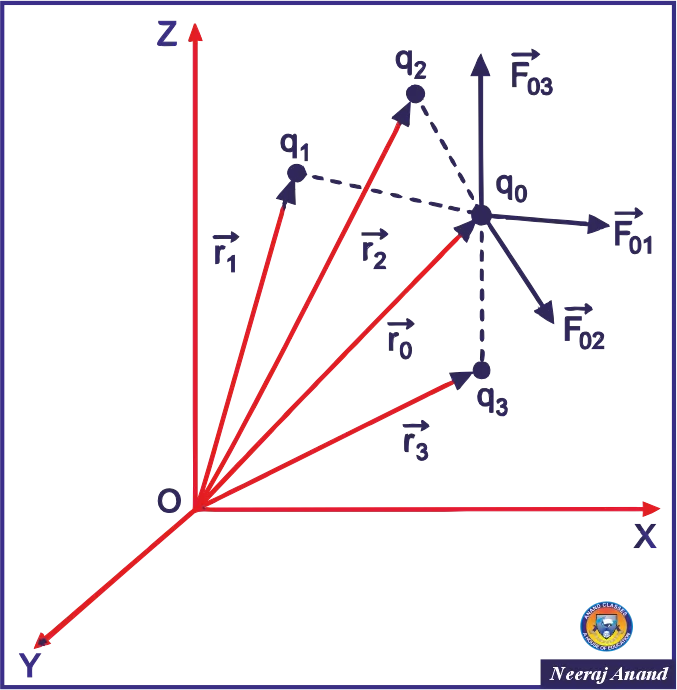
Here, force on due to , force on due to and so on, force on due to .
According to Coulomb’s law,
This is the force on due to , even though other charges are present.
Similarly, force on due to , even when other charges are present is given by
Putting these values in equation. (1), we get total force on charge as
…(2)
The direction of net force on charge due to discrete charges can be determined using polygon law of vectors.
Similar concepts include Coulomb’s Law of Electrostatics: Formula, Vector Form, Examples & Numericals
| Retain in Memory |
|---|
| We can use superposition principle for computing (i) net force (ii) net field (iii) net flux (iv) net potential as well as net potential energy at the observation point P due to any configuration of charges. |
Continuous Charge Distribution
As charge can exist only as integral multiple of basic charge (e), therefore, charge distribution is always discrete, on account of atomicity of charge. However, it is impractical to work in terms of discrete charges always.
For example, on the surface of a charged conductor, we cannot specify the charge distribution in terms of the locations of the microscopic charged constituents. However, we can consider a small area element ΔS on the surface of the conductor. This area element is very small on the macroscopic scale, but big enough to include a very large number of electrons. If ΔQ is the amount of charge on this element, we define surface charge density (σ) at the area element by
We can repeat the process at different points on the surface of the conductor and thus arrive at a continuous function σ, called the surface charge density. At the microscopic level, charge distribution is discontinuous, as there are discrete charges separated by intervening space, where there is no charge. Therefore, σ represents macroscopic surface charge density which is a smoothed out average of the microscopic charge density over an area element ΔS which is small macroscopically but large microscopically.
On the same basis, when charge is distributed along a line, straight or curved, we define linear charge density,
where Δl is a small line element of wire on the macroscopic scale that includes a large number of microscopic charged constituents and ΔQ is the charge contained in that line element. The units of λ are C/m.
The volume charge density is defined in a similar manner as
where ΔQ is the charge included in the macroscopically small volume element ΔV that includes a large number of microscopic charged constituents. The units of ρ are C/m3.
Note that the notion of continuous charge distribution is similar to the continuous mass distribution in mechanics. For example, when we talk of density of a liquid, we are referring to its macroscopic density treating it as a continuous fluid and ignoring its discrete molecular constitution.
You may also like to study Electric Charge Quantization, Additivity, Charging by Induction, Solved Numericals
Force due to Continuous Distribution of Charge
The force due to a continuous charge distribution can be obtained in almost the same way as for a system of discrete charges.
Suppose a continuous charge distribution in space has a volume charge density ρ. With respect to any suitably chosen origin O, let the position vector of any point in the charge distribution be . The volume charge density ρ is a function of , i.e., it may vary from point to point. Divide the charge distribution into small volume elements of size ΔV. Therefore, charge in this volume element is ΔQ = ρΔV.
Consider any general point P inside or outside the charge distribution with position vector .
Using Coulomb’s law, force due to charge element ΔQ on a small test charge q0 at P is
where r‘ is the distance between the charge element and point P; and is unit vector directed from charge element to the point P. As is clear from Figure(a), .
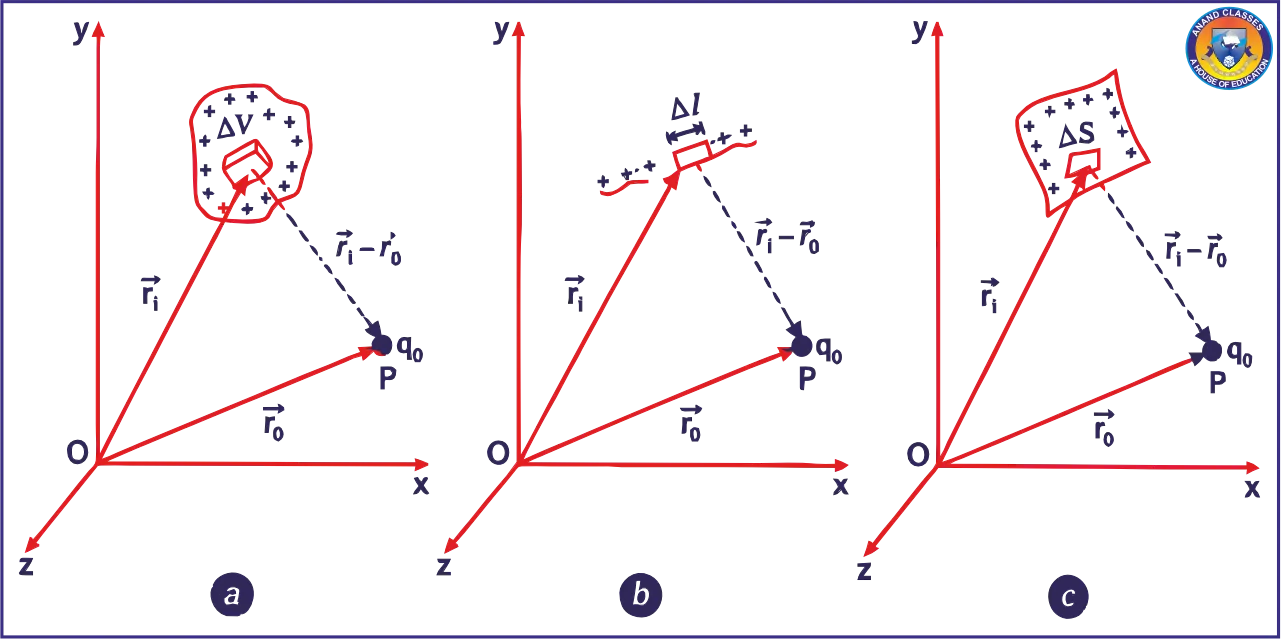
By the superposition principle, total force due to entire volume charge distribution is obtained by summing over the forces due to different volume elements.
…(3)
When the sum becomes an integral and total force can be written as
…(4)
Proceeding as above, we can write total force due to continuous line distribution of charge as shown in Figure(b) as
…(5)
And total force due to continuous surface distribution of charge as shown in Figure(c) as
…(6)
CBSE Board Class 12 Physics Solved Numerical Problems for Forces Between Multiple Charges (Principle of Superposition)
Solved Numerical Problems for Class 12 Physics CBSE Board Exam provide step-by-step solutions to important numerical questions, helping students master problem-solving techniques and improve accuracy for the CBSE Class 12 Physics Board Examination.
CBSE Board Class 12 Numerical Problem
An infinite number of charges each equal to 4μC are placed along x-axis at x = 1 m, x = 2 m, x = 4 m, x = 8 m and so on. Find the total force on a charge of 1C placed at the origin. [IIT 95]
Solution. Here q = 4μC = 4 × 10⁻⁶ C, q0 = 1 C
By the principle of superposition, the total force acting on a charge of 1C placed at the origin is
Sum of the infinite geometric progression:
CBSE Board Class 12 Numerical Problem
A particle carrying charge +q is held at the centre of a square of each side one metre. It is surrounded by eight charges arranged on the square as shown in Figure. If q = 2μ C, what is the net force on the particle?
Solution. As is clear from Figure, forces on the particle at O due to (-2q,-2q); (-3q,-3q) and (+4q,+4q) are equal and opposite. They cancel out in pairs. However, forces due to +7q and -7q add up.
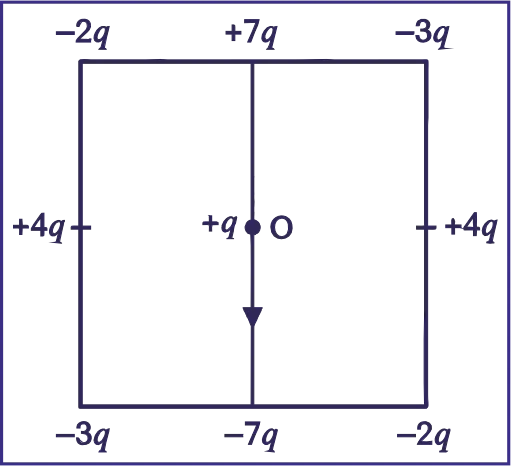
Therefore, net force on the particle at O is
F = 3 × 14 × 4 × 10-3 N
F = 2.016 N
CBSE Board Class 12 Numerical Problem
Ten positively charged particles are kept fixed on x-axis at points x = 10 cm, 20 cm, 30 cm, …., 100 cm. The first particle has charge 1.0 × 10⁻⁸ C; second 8 × 10⁻⁸ C, third 27 × 10-8 C, and so on. Tenth particle will have charge 1000 × 10-8 C. Find the magnitude of electric force acting on a 1C charge placed at the origin.
Solution. By superposition principle, force on charge 1 C placed at origin
CBSE Board Class 12 Numerical Problem
Find the magnitude of the resultant force on a charge of 1 µC held at P due to two charges of +2 × 10⁻⁸ C and -10 × 10-8 C at A and B respectively. Given AP = 10 cm and BP = 5 cm, ∠APB = 90° as shown in Figure.
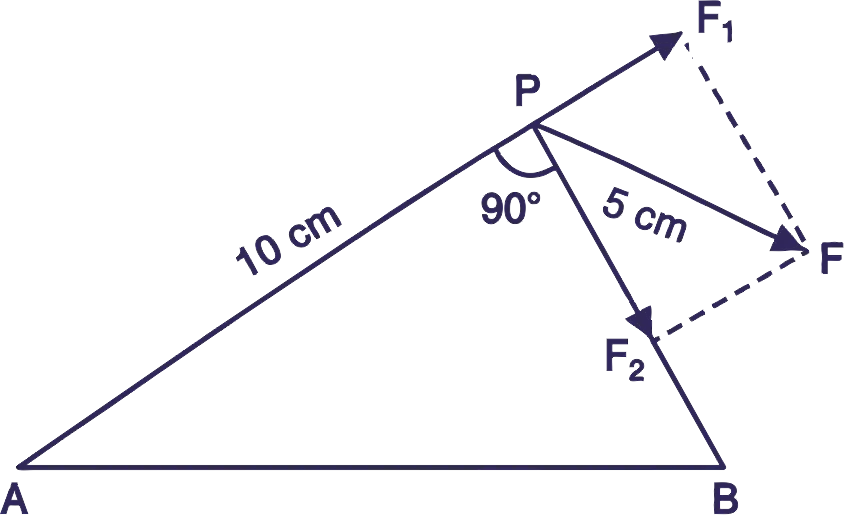
Solution. Here, F = ?, Charge at P, q = 1 µC = 10-6 C
Charge at A, q1 = +2 × 10⁻⁸ C, Charge at B, q2 = -10 × 10-8 C
AP = 10 cm = 0.1 m, BP = 5 cm = 0.05 m, ∠APB = 90°
Force at P due to q1 charge at A, along AP produced
Force at P due to q2 charge at B, along PB
As angle between and is 90°,
CBSE Board Class 12 Numerical Problem
Consider three charges q1, q2, q3 each equal to q at the vertices of an equilateral triangle of side l. What is the force on a charge Q (with the same sign as q) placed at the centroid of the triangle? (NCERT Solved Example)
Solution. As shown in Figure, draw AD⊥BC.
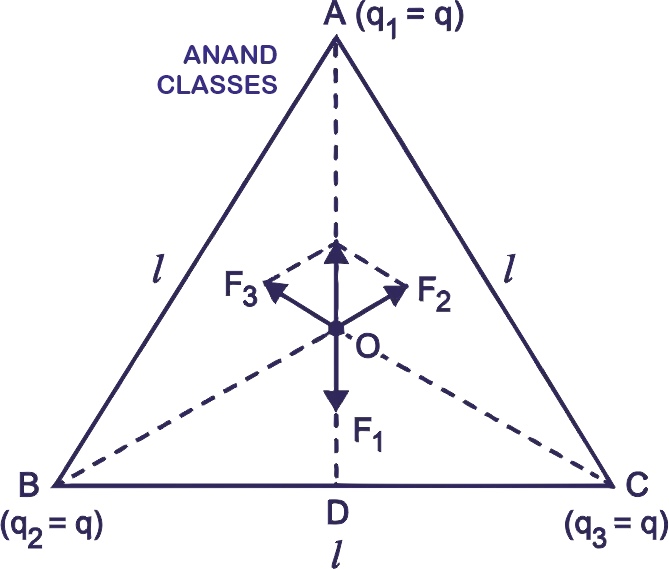
Distance AO of the centroid O from A
Force on Q at O due to charge q1 = q at A
Similarly, force on Q due to charge q2 = q at B
and force on Q due to charge q3 = q at C
Angle between forces F2 and F3 = 120°
By parallelogram law, resultant of and along OA
CBSE Board Class 12 Numerical Problem
Consider the charges q, q and –q placed at the vertices of an equilateral triangle of each side l. What is the force on each charge? (NCERT Solved Example)
Solution.
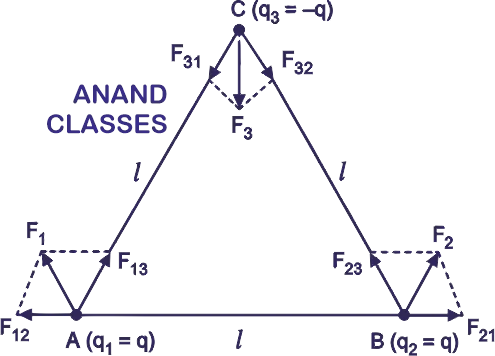
As is clear from Figure, force on q1 = q at A
where and unit vector along BC
Force on (q2 = q) at B,
where unit vector along AC
Force on q3 = –q at C,
where unit vector along the direction bisecting ∠BCA.
We can show that
CBSE Board Class 12 Numerical Problem
Three point charges +q each are kept at the vertices of an equilateral triangle of side ‘l‘. Determine the magnitude and sign of the charge to be kept at its centroid so that the charges at the vertices remain in equilibrium.
Solution. At any vertex, the charge will be in equilibrium if the net electric force due to the remaining three charges is zero.
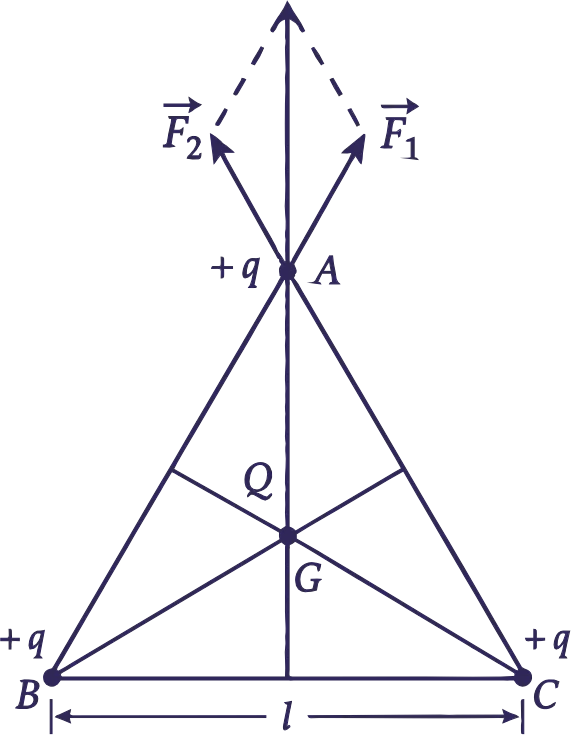
Let Q be the charge required to be kept at the centroid G. Then,
This must be equal and opposite to .
CBSE Board Class 12 Numerical Problem
Charges of +5μC, +10μC and -10μC are placed in air at the corners A, B and C of an equilateral triangle ABC, having each side equal to 5 cm. Determine the resultant force on the charge at A.
Solution. The charge at B repels the charge at A with a force,
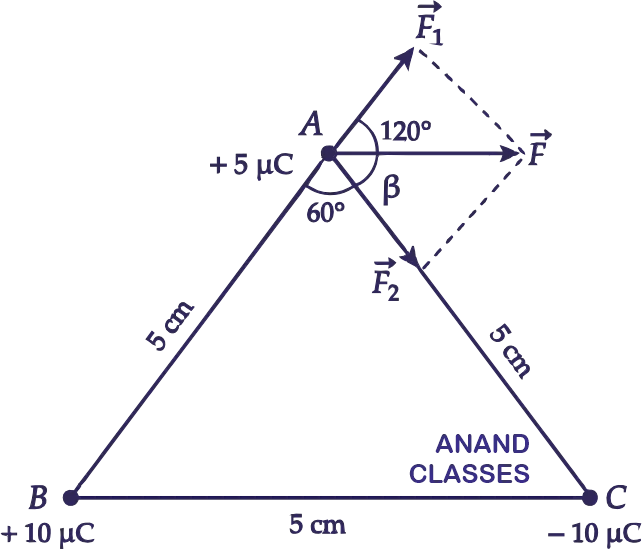
The charge at C attracts the charge at A with a force
By the parallelogram law of vector addition, the magnitude of resultant force on charge at A is
Let the resultant force make an angle β with the force F2. Then
β = 60°
i.e., the resultant force is parallel to BC.
CBSE Board Class 12 Numerical Problem
Four equal point charges each 16μC are placed on the four corners of a square of side 0.2 m. Calculate the force on any one of the charges.
Solution. As shown in Figure, suppose the four charges are placed at the corners of the square ABCD.
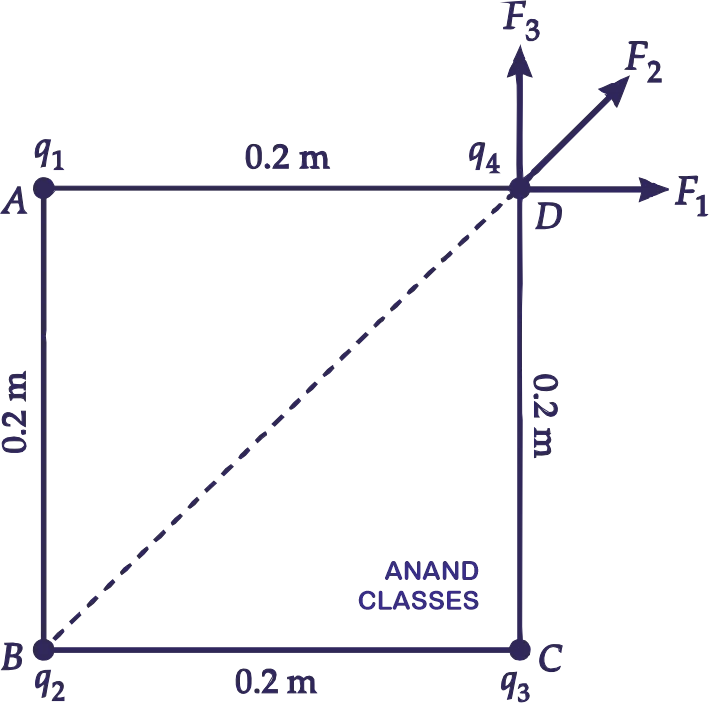
Let us calculate the total force on q4.
Here, AB = BC = CD = AD = 0.2 m
Force exerted on by is
Force exerted on by is
Force exerted on by is
As and are perpendicular to each other, so their resultant force is
Hence total force on is
CBSE Board Class 12 Numerical Problem
Three point charges of +2μC, 3μC and -3μC are kept at the vertices A, B and C respectively of an equilateral triangle of side 20 cm as shown in Figure.(a). What should be the sign and magnitude of the charge to be placed at the midpoint (M) of side BC so that the charge at A remains in equilibrium?
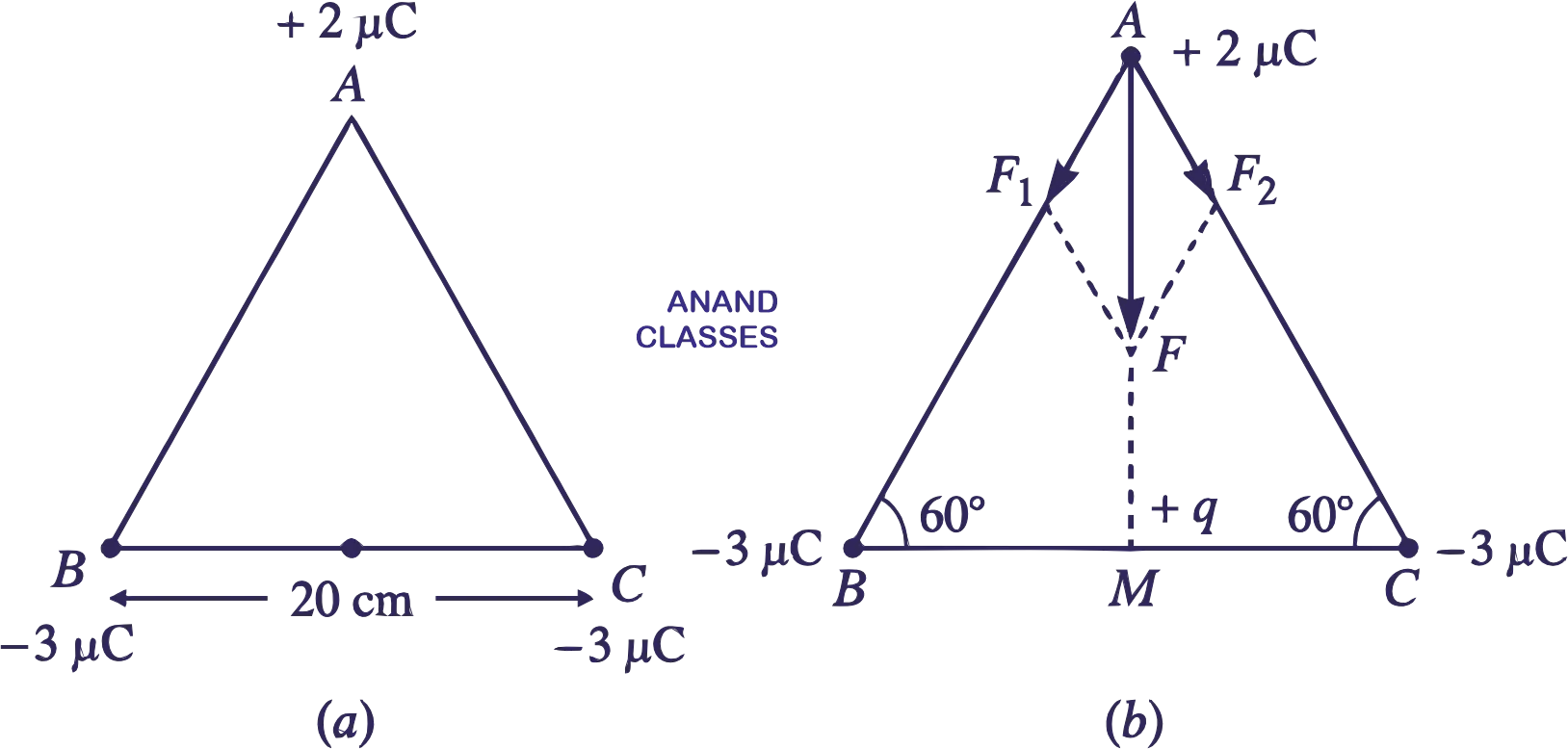
Solution. As shown in Figure.(b), the force exerted on charge +2μC by charge at B,
Force exerted on charge +2μC by charge at C,
Resultant force of and
For the charge at A to be equilibrium, the charge q to be placed at point M must be a positive charge so that it exerts a force on +2μC charge along MA.
Now,
Net force on charge at will be zero if