Electric field intensity due to a uniformly charged spherical shell and a non-conducting charged solid sphere can be determined conveniently using Gauss’s law. This article explains the electric field inside, on the surface, and outside a uniformly charged spherical shell and solid sphere, including the variation of electric field with distance from the centre. It also covers important results, derivations, and numerical problems based on electric field intensity for spherical charge distributions.
Derivation of Electric Field Intensity Due To A Uniformly Charged Spherical Shell Using Gauss’s Law
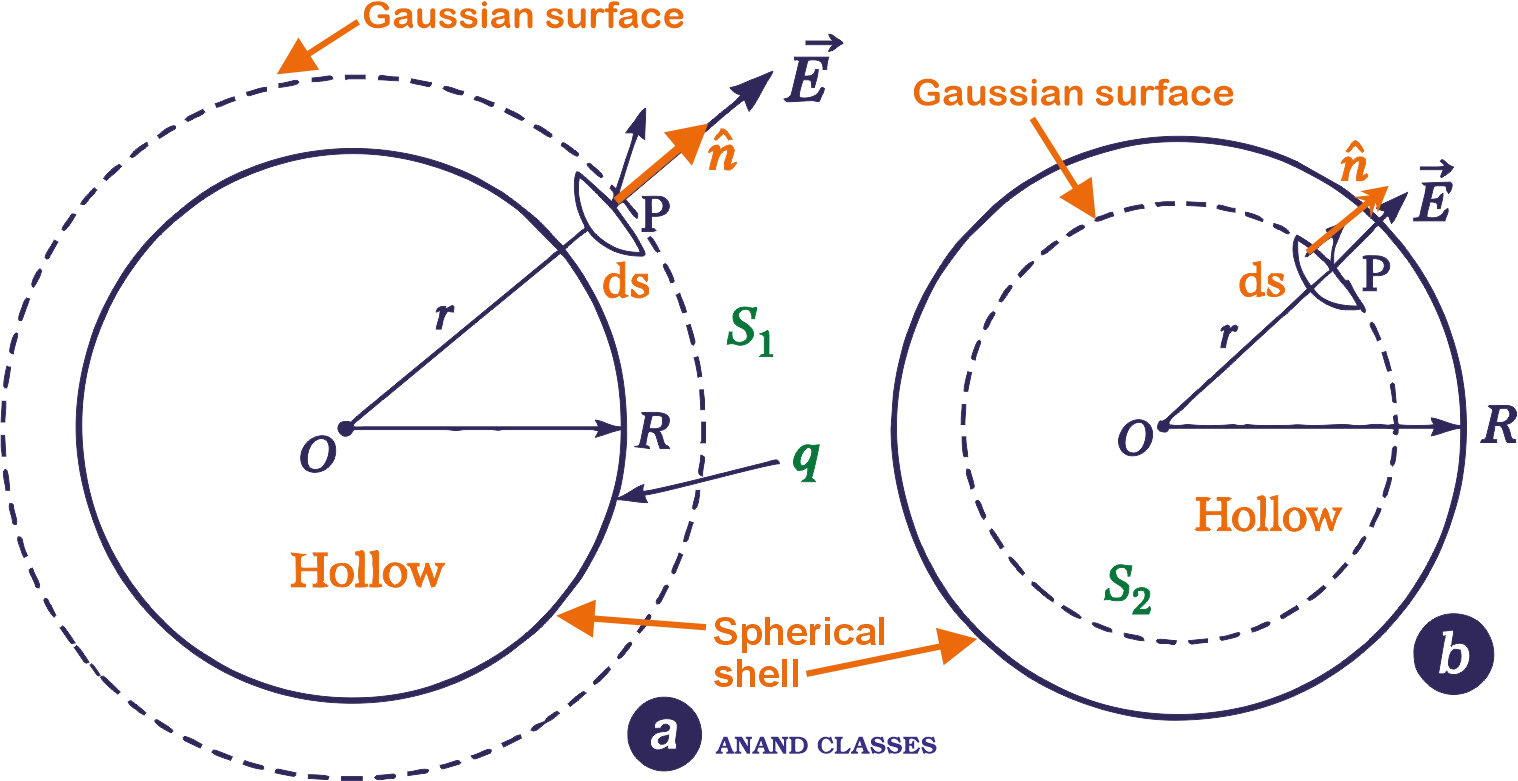
Consider a thin spherical shell of radius R with centre O. Let a charge +q be distributed uniformly over the surface of the shell.
(a) Field outside the shell (r > R)
To calculate electric field intensity at any point P, where OP = r, imagine a sphere S₁ with centre O and radius r, as shown in Figure.(a). The surface of this sphere is a Gaussian surface at every point of which electric intensity is the same, directed radially outwards (as is unit vector n̂, so that θ = 0°).
According to Gauss’s theorem,
where (4πr²) is area of the sphere S₁.
This is exactly the field produced by a charge q placed at the centre O. Hence we conclude that for points outside the spherical shell, the field due to uniformly charged shell is as if the entire charge of the shell is concentrated at the centre of the shell.
(b) At a point on the surface of the shell (r = R)
Put r = R in the above Equation,
If σ is surface density of charge on the shell, then q = 4π R² σ
(c) Field inside the shell (r < R)
In Figure.(b), the point P where we have to find electric intensity is inside the shell. The Gaussian surface is the surface of a sphere S₂ passing through P and with centre at O. The radius of sphere S₂ is r < R.
The electric flux through the Gaussian surface, as calculated above is E × 4π r². As charge inside a spherical shell is zero, the Gaussian surface encloses no charge (i.e. q = 0). Gauss’s theorem gives
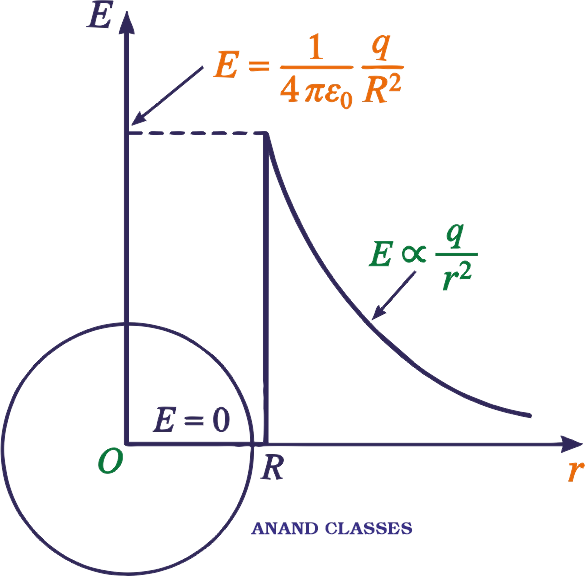
Hence, the field due to a uniformly charged spherical shell is zero at all points inside the shell. The variation of electric field intensity (E) with distance (r) from the centre of a uniformly charged spherical shell is shown in Figure.
| Noteworthy Points |
|---|
| (i) When a uniform spherical shell carries charge Q, electric field at any point inside the shell is zero. (ii) The shell behaves as if the entire charge is concentrated at its centre. (iii) Electric intensity at any point on the surface of the shell is maximum. (iv) Outside the shell, E varies inversely as the square of distance from the centre. (v) Obviously, a charged particle inside the spherical shell will not experience any force. However, outside the shell, charged particle will be attracted or repelled. |
Derivation of Electric Field Intensity Due To A Non-Conducting Charged Solid Sphere Using Gauss’s Law
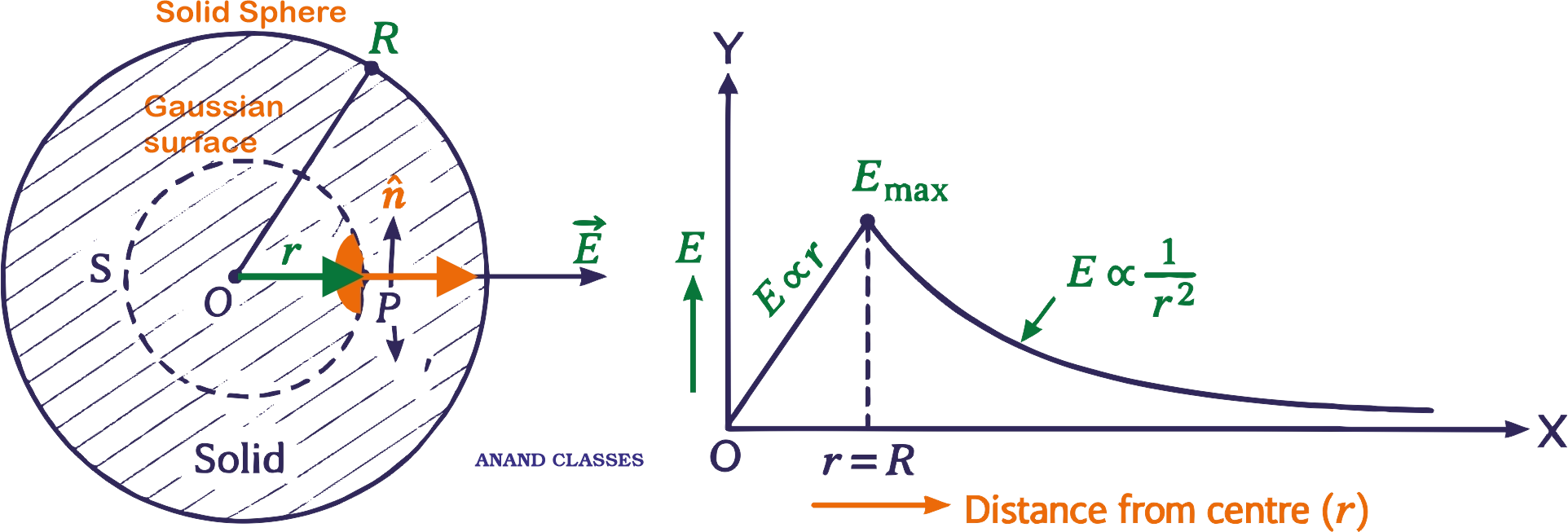
Suppose a non conducting solid sphere of radius R and centre O has uniform volume density of charge ρ. We have to calculate electric field intensity (E) at any point P inside the solid sphere, where OP = r. With O as centre and r as radius, imagine a sphere S, which acts as a Gaussian surface as shown in Figure. At every point on the surface of S, magnitude of electric field intensity (E) is same, directed radially outwards.
If q‘ is the charge enclosed by the sphere S, then according to Gauss’s law
where ε is electrical permittivity of the material of the insulating sphere.
Now, charge inside S, i.e.,
q′ = volume of S × volume density of charge
q′ = 4/3πr³ × ρ
Clearly, E ∝ r
i.e. electric intensity at any point inside a non-conducting charged solid sphere varies directly as the distance of the point from the centre of the sphere.
At the centre of the sphere, r = 0, ∴ Emin = 0
i.e. at the centre of the sphere where r = 0, the electric field is zero.
At the surface of the sphere, r = R
i.e. at the boundary (surface) of the sphere where r = R, the electric field reaches its maximum value.
For outside the sphere (r > R) :
According to Gauss’s theorem,
where (4πr²) is area of the Gaussian sphere.
For outside the sphere, E ∝ 1/r². Therefore the results are summarize as follows :
Inside the sphere (r < R) : E ∝ r, increasing linearly from zero at the center to a maximum at the surface.
Outside the sphere (r > R) : E ∝ 1/r², decreasing quadratically as you move away from the surface.
At the centre of the sphere (r = 0) : E = 0
All these results are plotted in Figure, which represents the variation of electric field intensity E with distance (r) from the centre of a non conducting uniformly charged solid sphere.
Solved Numerical Problems on Applications of Gauss’s Law – Electric Field due to a Uniformly Charged Spherical Shell and Solid Sphere
Solved numerical problems based on applications of Gauss’s Law – Electric Field due to a Uniformly Charged Spherical Shell and Solid Sphere help students apply Gauss’s law, electric field formulas, and electric flux for CBSE Class 12 Physics, JEE, and NEET-level questions.
A conducting sphere of radius 10 cm has an unknown charge. If the electric field 20 cm from the centre of the sphere is 1.5 × 10⁵ N/C and points radially inwards, what is the net charge on the sphere?
Solution : Given
Radius of sphere (R) = 10 cm = 0.1 m,
Distance from the centre (r) = 20 cm = 0.2 m,
Electric field (E): -1.5 × 10⁵ N/C (Negative sign indicates the field points radially inwards)
The electric field outside a charged conducting sphere is given by :
E = (1 / (4πε₀)) × (q / r²)
Rearranging the formula to solve for the charge (q):
q = [E × r²] / [1 / (4πε₀)]
Substituting the given values (where 1 / (4πε₀) = 9 × 10⁹ N·m²/C²) :
q = [(-1.5 × 10⁵ N/C) × (0.2 m)²] / [9 × 10⁹ N·m²/C²]
q = [-1.5 × 10⁵ × 0.04] / [9 × 10⁹]
q = -6000 / (9 × 10⁹)
q = -6.67 × 10⁻⁷ C ≈ -6.7 × 10⁻⁷ C
The net charge on the sphere is -6.7 × 10⁻⁷ C (or -0.67 µC).
A spherical conductor of radius 12 cm has a charge of 1.6 × 10⁻⁷ C distributed uniformly over its surface. What is the electric field :
(i) Inside the sphere?
(ii) Just outside the sphere?
(iii) At a point 18 cm from the centre of the sphere?
Solution : Given : Charge (q) = 1.6 × 10⁻⁷ C,
Radius of sphere (R) = 12 cm = 0.12 m
(i) Inside the sphere
E = 0
The charge resides entirely on the outer surface of a spherical conductor, making the electric field inside zero.
(ii) Just outside the sphere
Here, r = R = 0.12 m. The charge may be assumed to be concentrated at the centre of the sphere.
E = [1 / (4πε₀)] × (q / R²)
E = (9 × 10⁹ × 1.6 × 10⁻⁷) / (0.12)²
E = 10⁵ N C⁻¹
(iii) At a point 18 cm from the centre
Here, r = 18 cm = 0.18 m.
E = [1 / (4πε₀)] × (q / r²)
E = (9 × 10⁹ × 1.6 × 10⁻⁷) / (0.18)²
E = 4.44 × 10⁴ N C⁻¹
A spherical conducting shell of inner radius r₁ and outer radius r₂ has a charge Q. A charge q is placed at the centre of the shell.
(a) What is the surface charge density on the
(i) inner surface,
(ii) outer surface of the shell?
(b) Write the expression for the electric field at a point x > r₂ from the centre of the spherical shell.
Solution :
(a) Surface charge density
(i) On the inner surface :
σinner = –q / (4π r₁²)
(ii) On the outer surface :
σouter = (Q + q) / (4π r₂²)
(b) Electric field outside the shell
At a point x > r₂ from the centre of the shell, the net charge (Q + q) acts as if it is concentrated at the centre.
E = [1 / (4πε₀)] × [(Q + q) / x²]
Is it possible to transfer all the charge from a conductor to another insulated conductor?
Ans. Yes, it is possible. For this to happen, place the charged conductor inside a hollow conductor so that it touches the inside wall of the hollow conductor. Now, whatsoever charge is given to the charged conductor, it gets immediately transferred to the hollow conductor. It is because of the fact that in case of a charged conductor, the charge always resides on its surface.
In fact, it forms the principle of Van de Graaff generator.
Electrostatics: Electric Field due to Uniformly Charged Spherical Shell & Solid Sphere Using Gauss’s Law Presentation Video
Watch the video to understand Electric Field due to Uniformly Charged Spherical Shell & Solid Sphere Using Gauss’s Law through important concepts, solved numericals, and short questions with answers, specially useful for CBSE Class 12, JEE, and NEET preparation.
