Vectors NEET Previous Year Questions (PYQs) with Solutions are essential for mastering the Motion in a Plane chapter in Class 11 Physics. These carefully solved questions help students understand vector addition, subtraction, resolution of vectors, scalar and vector products, and their applications in problem-solving. The Class 11 Physics study material of Anand Classes, written by Neeraj Anand, provides detailed, step-by-step solutions to NEET PYQs, enabling students to strengthen concepts, improve accuracy, and boost confidence for NEET and CBSE examinations.
Why Practice NEET Previous Year Questions (PYQs) for Vectors from the Motion in a Plane Chapter Class 11 Physics?
Practicing NEET Previous Year Questions (PYQs) is one of the most effective ways to master Vectors from the Motion in a Plane chapter of Class 11 Physics. Solving authentic exam questions helps students strengthen conceptual understanding, identify frequently asked topics, improve problem-solving speed, and gain confidence for the examination. Prepared by Neeraj Anand and published by Anand Technical Publishers under the Anand Classes brand, these detailed solutions are designed to make learning simple, systematic, and exam-oriented.
Why Choose Anand Classes NEET PYQs Solutions for Vectors?
Anand Classes NEET PYQs Solutions for Vectors provide step-by-step explanations, shortcut techniques where applicable, and concept-based approaches to every question. Written by Neeraj Anand and published by Anand Technical Publishers under the Anand Classes brand, this study resource helps students develop accuracy, avoid common mistakes, and prepare effectively for NEET Medical, CBSE, and other medical entrance examinations.
Who Can Benefit from These NEET Vectors PYQs Solutions?
These Vectors NEET PYQs with Solutions are specially designed for Class 11 students, NEET aspirants, and anyone revising the Motion in a Plane chapter. Whether you are building your concepts for the first time or revising before the exam, these solved previous-year questions provide structured practice and a deeper understanding of the topics most frequently tested in competitive examinations.
NEET PYQ
If the magnitude of sum of two vectors is equal to the magnitude of difference of the two vectors, the angle between these vectors is
(a) 90°
(b) 45°
(c) 180°
(d) 0°
[NEET 2016, CBSE AIPMT 1991]
Ans. (a)
Suppose two vectors are and .
It is given that
Let angle between and is .
Continue learning with NEET Units and Measurements PYQs Previous Year Questions and Solutions
NEET PYQ
If vectors and are functions of time, then the value of at which they are orthogonal to each other, is
(a)
(b)
(c)
(d)
[CBSE AIPMT 2015]
Ans. (c)
For perpendicular vector, we have
Thus, time taken by vectors which are orthogonal to each other is .
Strengthen your fundamentals with River Boat and Man Problem: Boat cross a river along shortest path and in shortest time
NEET PYQ
Six vectors to have the magnitudes and directions indicated in the figure. Which of the following statements is true?
(a)
(b)
(c)
(d)
[CBSE AIPMT 2010]
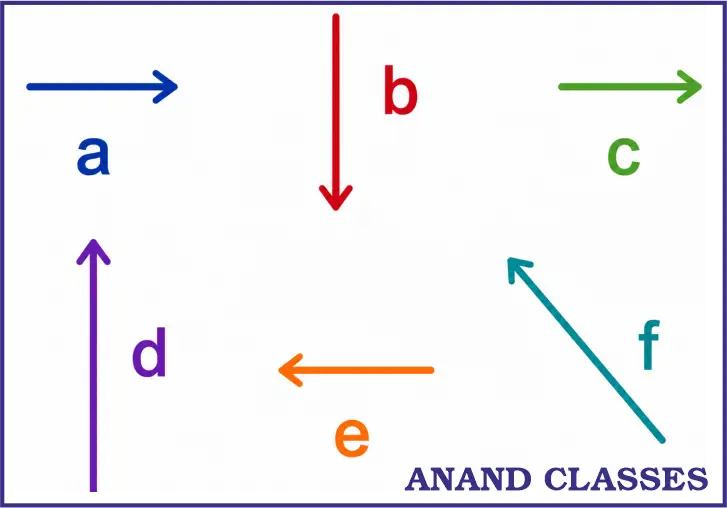
Ans. (c)
If two non-zero vectors are represented by the two adjacent sides of a parallelogram, then the resultant is given by the diagonal of the parallelogram passing through the point of intersection of the two vectors.
![[CBSE AIPMT 2010] NEET PYQ Solution : If two non-zero vectors are represented by the two adjacent sides of a parallelogram, then the resultant is given by the diagonal of the parallelogram passing through the point of intersection of the two vectors.](https://physicsanandclasses.co.in/wp-content/uploads/2026/07/CBSE-AIPMT-2010-NEET-PYQ-Solution.webp "NEET PYQs Solutions for Vectors (Class 11 Physics Motion in a Plane) 3")
NEET PYQ
and are two vectors and is the angle between them.
If , then the value of is
(a)
(b)
(c)
(d)
[CBSE AIPMT 2007]
Ans. (a)
Given,
Important exam-related topics include Relative Velocity in a Plane: Relative Velocity of Rain w.r.t. Moving Man Solved Examples
NEET PYQ
If a vector is perpendicular to the vector , then the value of is
(a) -1
(b) 1/2
(c) -1/2
(d) 1
[CBSE AIPMT 2005]
Ans. (c)
If two vectors are perpendicular to each other then their dot product is always equal to zero.
Let,
According to the above hypothesis:
Learn the applications of this concept in Cross Product (Vector Product) of Two Vectors: Formula, Properties & Solved Examples
NEET PYQ
If , then the value of is
(a)
(b)
(c)
(d)
[CBSE AIPMT 2004]
Ans. (a)
Given,
… (i)
but
and
Substituting these values in Eq. (i), we get
or
The addition of vectors and can be given by the law of parallelogram.
Build strong concepts by studying Dot Product (Scalar Product) of Two Vectors: Formula, Properties & Solved Examples
NEET PYQ
The vector sum of two forces is perpendicular to their vector differences. In that case, the forces
(a) are not equal to each other in magnitude
(b) cannot be predicted
(c) are equal to each other
(d) are equal to each other in magnitude
[CBSE AIPMT 2003]
Ans. (d)
Let and be two forces. The sum of the two forces:
The difference of the two forces:
Since, sum of the two forces is perpendicular to their differences as given, so
or
or
or or
Thus, the forces are equal to each other in magnitude.
NEET PYQ
If a unit vector is represented by , then the value of c is
(a) 1
(b) √0.11
(c) √0.01
(d) 0.39
[CBSE AIPMT 1994]
Ans. (b)
Unit vector can be found by dividing a vector with its magnitude i.e.,
.
Let us represent the unit vector by . We also know that the modulus of a unit vector is 1, i.e.,
or
NEET PYQ
Which of the following is not a vector quantity?
(a) Speed
(b) Velocity
(c) Torque
(d) Displacement
[CBSE AIPMT 1995]
Ans. (a)
Speed is a scalar quantity. It gives no idea about the direction of motion of the object. Velocity is a vector quantity, as it has both magnitude and direction. Displacement is a vector as it possesses both magnitude and direction. Torque is a turning effect of force which is a vector quantity.
NEET PYQ
The angle between the two vectors and will be
(a) 0°
(b) 45°
(c) 90°
(d) 180°
[CBSE AIPMT 1994]
Ans. (c)
Angle between two vectors is given from dot product
Also,
NEET PYQ
The resultant of will be equal to
(a) zero
(b)
(c) zero vector
(d) unit vector
[CBSE AIPMT 1992]
Ans. (c)
From the properties of vector product, the cross product of any vector with zero is a null vector or zero vector.
NEET PYQ
The angle between and is .
The value of the triple product is
(a) A2B
(b) zero
(c) AB sin θ
(d) AB cos θ
[CBSE AIPMT 1989]
Ans. (b)
In scalar triple product of vectors, the positions of dot and cross can be interchanged, i.e.,
but
Alternative:
Let . The direction of is perpendicular to and from cross product formula.
So, (since, and are to each other).
NEET PYQ
The magnitudes of vectors , and are 3, 4 and 5 units respectively. If , the angle between and is
(a)
(b)
(c)
(d)
[CBSE AIPMT 1988]
Ans. (a)
As . Given
is perpendicular to .
NEET PYQ
The speed of a swimmer in still water is 20 m/s. The speed of river water is 10 m/s and is flowing due east. If he is standing on the south bank and wishes to cross the river along the shortest path the angle at which he should make his strokes w.r.t. north is given by
(a) 0°
(b) 60° west
(c) 45° west
(d) 30° west
[NEET (National) 2019]
Ans. (d)
Given,
Speed of river, vR = 10 m/s
Speed of swimmer in still water, vSN = 20 m/s.
![[NEET (National) 2019] PYQ : The speed of a swimmer in still water is 20 m/s. The speed of river water is 10 m/s and is flowing due east. If he is standing on the south bank and wishes to cross the river along the shortest path the angle at which he should make his strokes w.r.t. north is given by](https://physicsanandclasses.co.in/wp-content/uploads/2026/07/NEET-National-2019-PYQ.webp "NEET PYQs Solutions for Vectors (Class 11 Physics Motion in a Plane) 4")
For the shortest path to cross the river, he should swim at an angle (90° + θ) with the stream flow. From the vector diagram, the component must balance the river flow:
vSN sin θ = vR
So, the angle θ with respect to North is given by :
θ = 30°
As the river is flowing in the East direction, he should swim towards the West of North. Therefore, the angle is 30° west.
NEET PYQ
Two particles A and B, move with constant velocities and . At the initial moment, their position vectors are and respectively. The condition for particles A and B for their collision is
(a)
(b)
(c)
(d)
[CBSE AIPMT 2015]
Ans. (a)
For two particles A and B moving with constant velocities and to collide, the direction of the relative velocity of one with respect to the other must be directed straight toward the relative position of the other particle.
![[CBSE AIPMT 2015] PYQ : Two particles A andB,move with constant velocities v1 and v2 . At the initial moment, their position vectors arer1 andr2 respectively. The condition for particles A andB for their collision is](https://physicsanandclasses.co.in/wp-content/uploads/2026/07/CBSE-AIPMT-2015-PYQ.webp "NEET PYQs Solutions for Vectors (Class 11 Physics Motion in a Plane) 5")
For collision to occur, these unit vectors must be equal:
Alternate Method:
Let be the time at which they collide. The final position vectors must be equal:
Taking the magnitude on both sides:
Dividing the vector equation by its magnitude equation:
NEET PYQ
A person swims in a river aiming to reach exactly the opposite point on the bank of a river. His speed of swimming is 0.5 m/s at an angle of 120° with the direction of flow of water. The speed of water in the stream is
(a) 1.0 m/s
(b) 0.5 m/s
(c) 0.25 m/s
(d) 0.43 m/s
[CBSE AIPMT 1999]
Ans. (c)
Let u be the speed of the stream and v be the speed of the person starting from A. He wants to reach point B directly opposite to A.
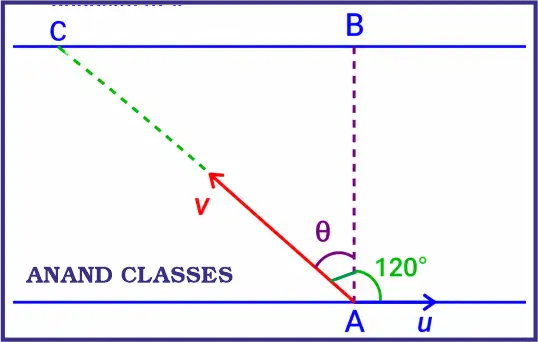
Since the total angle with the stream is 120°, the angle with the vertical (perpendicular to the bank) is :
θ = 120° – 90° = 30°
To reach the directly opposite point, the horizontal component of the swimmer’s velocity must perfectly balance the river flow velocity (u):
u = v sin θ = v sin 30°
NEET PYQ
The speed of a boat is 5 km/h in still water. It crosses a river of width 1.0 km along the shortest possible path in 15 min. The velocity of the river water is (in km/h)
(a) 5
(b) 1
(c) 3
(d) 4
[CBSE AIPMT 1998]
Ans. (c)
![[CBSE AIPMT 1998] PYQ : The speed of a boat is 5 km/h in still water. It crosses a river of width 1.0 km along the shortest possible path in 15 min. The velocity of the river water is (in km/h)](https://physicsanandclasses.co.in/wp-content/uploads/2026/07/CBSE-AIPMT-1998-PYQ.webp "NEET PYQs Solutions for Vectors (Class 11 Physics Motion in a Plane) 7")
Let velocity of river, velocity of boat in still water (5 km/h), and w = width of river = 1.0 km. Time taken t = 15 min = 15/60 h = 1/4 h.
The shortest path is a straight line perpendicular across the river. In this case, the resultant velocity is along AB :
Alternative Method:
![[CBSE AIPMT 1998] PYQ : The speed of a boat is 5 km/h in still water. It crosses a river of width 1.0 km along the shortest possible path in 15 min. The velocity of the river water is (in km/h)](https://physicsanandclasses.co.in/wp-content/uploads/2026/07/CBSE-AIPMT-1998-NEET-PYQ.webp "NEET PYQs Solutions for Vectors (Class 11 Physics Motion in a Plane) 8")
Motion along the Y-axis :
For the boat to reach point B directly opposite, the horizontal components must balance :
NEET PYQ
A boat is sent across a river with a velocity of 8 km/h. If the resultant velocity of the boat is 10 km/h, then the velocity of the river is :
(a) 12.8 km/h
(b) 6 km/h
(c) 8 km/h
(d) 10 km/h
[CBSE AIPMT 1993]
Ans. (b)
Let vb be the velocity of the boat relative to water 8 km/h, vr be the velocity of the river, and vres be the resultant velocity of the boat 10 km/h.
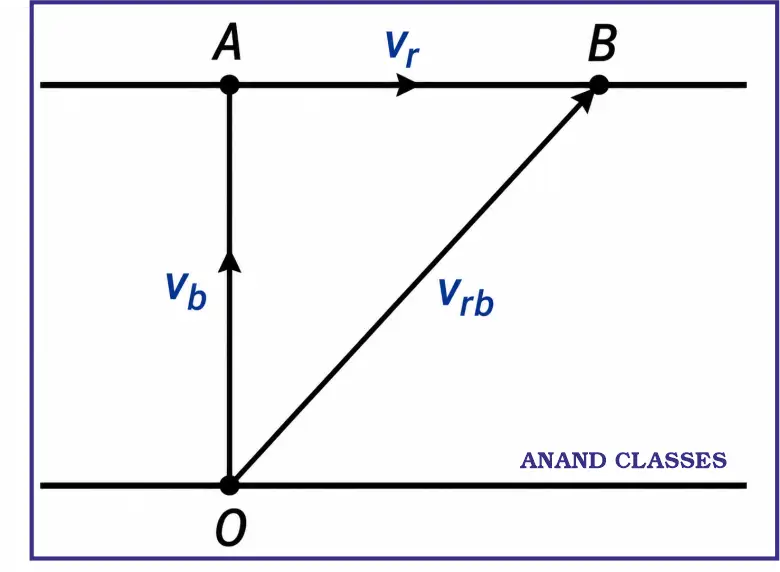
From the right-angled vector triangle :
NEET PYQ
A bus is moving on a straight road towards North with a uniform speed of 50 km/h. If the speed remains unchanged after turning through 90°, the increase in the velocity of the bus in the turning process is :
(a) 70.7 km/h along South-West direction
(b) zero
(c) 50 km/h along West
(d) 70.7 km/h along North-West direction
[CBSE AIPMT 1989]
Ans. (a)
![[CBSE AIPMT 1989] NEET PYQ : A bus is moving on a straight road towards North with a uniform speed of 50 km/h. If the speed remains unchanged after turning through 90°, the increase in the velocity of the bus in the turning process is :](https://physicsanandclasses.co.in/wp-content/uploads/2026/07/CBSE-AIPMT-1989-NEET-PYQ.webp "NEET PYQs Solutions for Vectors (Class 11 Physics Motion in a Plane) 10")
Let the initial velocity be
(due North).
After turning 90° to the left, the final velocity is
(due West).
The change (increase) in velocity is given by:
Direction:
Since is West and is South, the resultant vector points directly towards the South-West direction.
Important Units and Measurement Chapter Links
To strengthen your understanding, you should also study Dimensional Analysis and Dimensional Formulae of Physical Quantities and the Principle of Dimensional Homogeneity, which are closely related to unit conversion. It is also helpful to revise Units and Measurements for basic concepts and practice JEE Main Previous Year Questions (PYQs) and IMU CET PYQs to improve problem-solving skills. Exploring these related topics on this website will help you master numerical applications effectively.
Further enhance your preparation with Units and Measurements JEE Main PYQs Set-3 for advanced practice and better exam readiness.