
NCERT Exemplar Solutions for Class 11 Physics Chapter 2 Motion In a Straight Line provide detailed and step-by-step explanations of important numerical and conceptual questions based on kinematics. These solutions help students understand displacement, distance, speed, velocity, acceleration, graphical representation of motion, and equations of motion in a simple and clear manner. The chapter is very important for CBSE board exams, JEE Main, NEET, and other competitive examinations because it builds the foundation of mechanics and problem-solving skills in physics.
NCERT Exemplar Questions and Answers for Class 11 Physics Chapter 2 Motion In a Straight Line
NCERT Exemplar Solutions for Motion In a Straight Line Class 11 Physics help students develop a clear understanding of the concepts of motion, velocity, acceleration, and graphical analysis of motion. The solutions are prepared in an easy-to-understand format so that students can improve their conceptual knowledge and numerical problem-solving skills for school exams and competitive exams.
Important exam-related topics include JEE Main Motion in a Straight Line MCQs PYQs Previous Year Questions and Solutions
Why is Motion In a Straight Line important in Class 11 Physics?
Motion In a Straight Line is one of the fundamental chapters of physics that forms the base for mechanics and higher-level physics topics.
Practice more questions from Derive Equations of Motion Using Calculus Method, Solved Numerical Examples
Are NCERT Exemplar questions useful for JEE and NEET preparation?
Yes, NCERT Exemplar questions are highly useful for JEE Main, NEET, and other competitive exams because they include conceptual and application-based problems.
For complete preparation, also study What is Uniform Motion, Non-Uniform Motion and Speed? Average Speed, Instantaneous Speed, Units and Examples
Q.1 : NCERT Exemplar
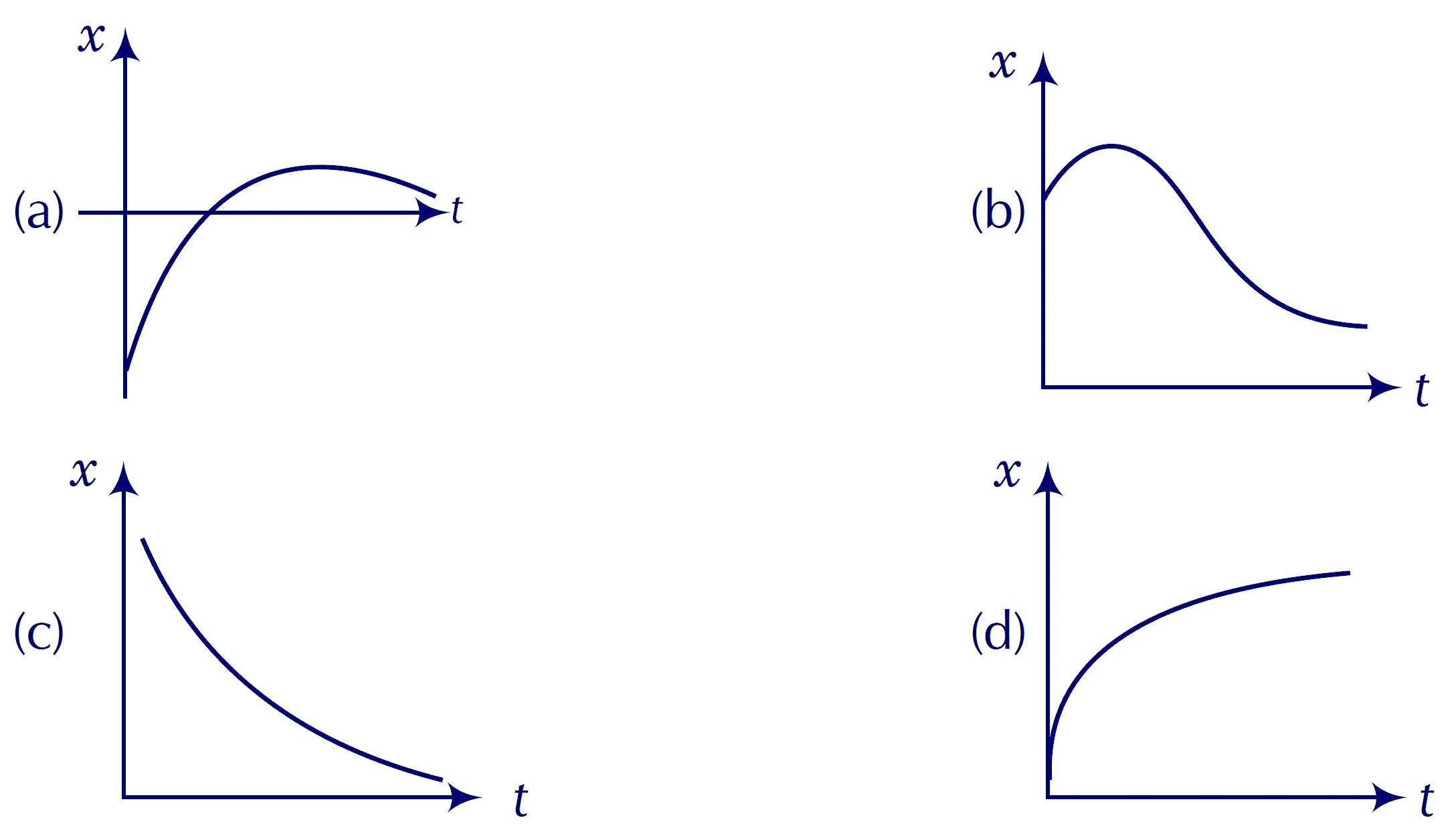
Among the four graph shown in the figure there is only one graph for which average velocity over the time interval (0, T ) can vanish for a suitably chosen T. Which one is it?
Ans. (b)
In graph (b) for one value of displacement there are two different points of time.
Hence, for one time, the average velocity is positive and for other time is equivalent negative.
As there are opposite velocities in the interval 0 to T hence average velocity can vanish in (b). This can be seen in the figure given below :

Here, OA = BT (same displacement) for two different points of time.
| Thinking Process |
|---|
| In this problem, we have to locate the graph which is having same displacement for two timings. When there are two timings for same displacement the corresponding velocities will be in opposite directions. |
Q.2 : NCERT Exemplar
A lift is coming from 8th floor and is just about to reach 4th floor. Taking ground floor as origin and positive direction upwards for all quantities, which one of the following is correct?
(a) x < 0, v < 0, a > 0
(b) x > 0, v < 0, a < 0
(c) x > 0, v < 0, a > 0
(d) x > 0, v > 0, a < 0
Ans. (a)
As the lift is coming in downward directions displacement will be negative. We have to see whether the motion is accelerating or retarding. We know that due to downward motion displacement will be negative. When the lift reaches 4th floor is about to stop hence, motion is retarding in nature hence, x < 0; a > 0.
As displacement is in negative direction, velocity will also be negative i.e., v < 0. This can be shown on the below figure.

Q.3 : NCERT Exemplar
In one dimensional motion, instantaneous speed v satisfies 0 ≤ v < v0
(a) The displacement in time T must always take non-negative values
(b) The displacement x in time T satisfies – v0 T < x < v T
(c) The acceleration is always a non-negative number
(d) The motion has no turning points
Ans. (b)
For maximum and minimum displacement we have to keep in mind the magnitude and direction of maximum velocity. As maximum velocity in positive direction is v0 maximum velocity in opposite direction is also v0.
Maximum displacement in one direction = v0T
Maximum displacement in opposite directions = – v0T
Hence, –v0T < x < v0T
Note : We should not confuse with direction of velocities i.e., in one direction it is taken as positive and in another direction is taken as negative.
Q.4 : NCERT Exemplar
A vehicle travels half the distance $l$ with speed $v_1$ and the other half with speed $v_2$. What is its average speed?
(a) $\dfrac{v_1 + v_2}{2} $
(b) $\dfrac{2v_1v_2}{v_1 + v_2 + 1}$
(c) $\dfrac{2v_1v_2}{v_1 + v_2}$
(d) $\dfrac{l(v_1 + v_2)}{v_1v_2}$
Ans. (c)
| Thinking Process |
|---|
| To find the average speed of an object undergoing non-uniform motion, we cannot simply take the arithmetic mean of the speeds. Instead, we must calculate the total distance covered throughout the journey and divide it by the total time taken to cover that distance. |
$$\text{Average Speed } (v_{av}) = \frac{\text{Total Distance}}{\text{Total Time}}$$
Let the total distance of the journey be $l$.
The first half of the distance is $\dfrac{l}{2}$.
The second half of the distance is $\dfrac{l}{2}$.
Using the formula $\text{Time} = \dfrac{\text{Distance}}{\text{Speed}}$
Time taken to cover the first half ($t_1$) = $\dfrac{l / 2}{v_1} = \dfrac{l}{2v_1}$
Time taken to cover the second half ($t_2$) = $\dfrac{l / 2}{v_2} = \dfrac{l}{2v_2}$
$$t = t_1 + t_2 = \dfrac{l}{2v_1} + \dfrac{l}{2v_2}$$
$$t = \frac{l}{2} \left( \frac{1}{v_1} + \frac{1}{v_2} \right)$$
$$t = \frac{l}{2} \left( \frac{v_1 + v_2}{v_1 v_2} \right) = \frac{l(v_1 + v_2)}{2v_1 v_2}$$
Substitute the total distance ($l$) and total time ($t$) back into the primary average speed equation :
$$v_{av} = \dfrac{l}{\dfrac{l(v_1 + v_2)}{2v_1 v_2}}$$
$$v_{av} = \dfrac{2v_1 v_2}{v_1 + v_2}$$
The average speed of the vehicle is the harmonic mean of the two individual speeds, which is $\dfrac{2v_1 v_2}{v_1 + v_2}$. This matches option (c).
Q.5 : NCERT Exemplar
The displacement of a particle is given by x = (t – 2)2, where x is in meters and t is in seconds. The distance covered by the particle in the first 4 seconds is :
(a) 4 m
(b) 8 m
(c) 12 m
(d) 16 m
Ans. (b)
If a moving particle slows down, comes to a stop, and reverses its direction, simply calculating its displacement will give an incorrect value for the total distance covered. Therefore, we must first find out if the particle changes direction during the given time interval (t = 0 to t = 4 seconds). Given equation is :
x = (t – 2)2
Velocity (v) is the rate of change of position with respect to time. Differentiating x with respect to t :
$$v = \frac{dx}{dt} = \frac{d}{dt}(t – 2)^2 = 2(t – 2)\text{ m/s}$$
To find if the particle turns around, we look for the time when it momentarily comes to rest (v = 0) :
2(t – 2) = 0 means at t = 2 seconds, particle is at rest.
This shows that from t = 0 to t = 2 seconds, the particle is slowing down (retarding) and moving backward. At t = 2 seconds, it stops completely and reverses its direction, moving forward from t = 2 to t = 4 seconds.
Because the direction changes at t = 2 s, we split the journey into two separate intervals :
Initial position at t = 0 s :
$$x_0 = (0 – 2)^2 = 4\text{ m}$$
Turning point position at t = 2s :
$$x_2 = (2 – 2)^2 = 0\text{ m}$$
Final position at t = 4 s :
$$x_4 = (4 – 2)^2 = 4\text{ m}$$
Now, we calculate the absolute path length for each segment of the journey :
First segment (from t = 0 s to t = 2 s : The particle moves backward from position 4 m to position 0 m.
$$\text{Distance}_1 = |x_2 – x_0| = |0 – 4| = 4\text{ m}$$
Second segment (from t = 2 s to t = 4 s : The particle moves forward from position 0 m back to position 4 m.
$$\text{Distance}_2 = |x_4 – x_2| = |4 – 0| = 4\text{ m}$$
$$\text{Total Distance} = \text{Distance}_1 + \text{Distance}_2 = 4\text{ m} + 4\text{ m} = 8\text{ m}$$
Alternative Graphical Method (Velocity-Time Graph)
We can plot the velocity function v = 2(t – 2) from t = 0 to t = 4 seconds :
At t = 0 s, v = -4 m/s
At t = 2 s, v = 0 m/s
At t = 4 s, v = 4 m/s
The total distance traveled corresponds to the total area bounded by the velocity-time graph and the time axis, treating all regional areas as absolute positive values.
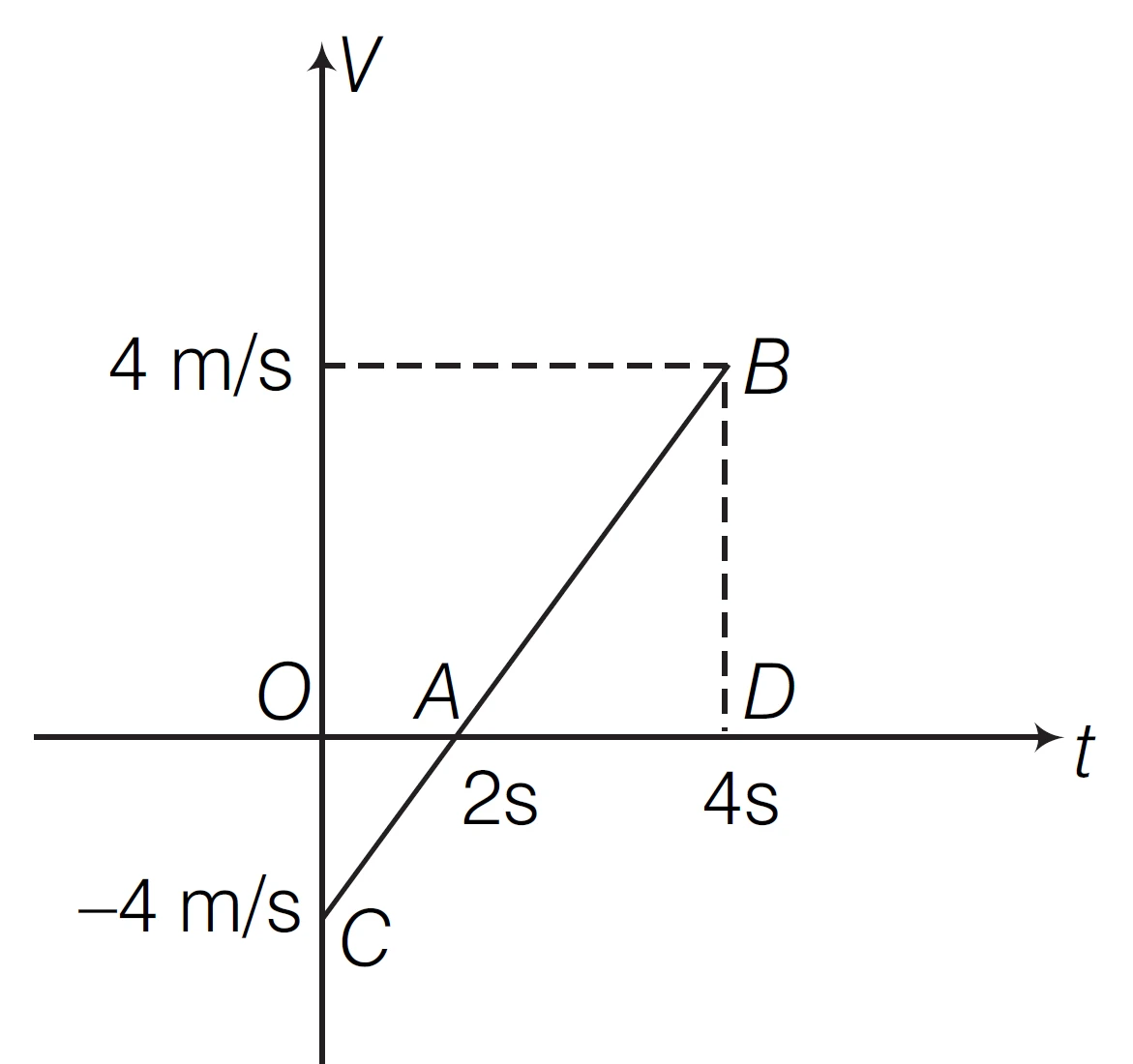
$\text{Area of Triangle 1 (from 0 to 2s)} = \frac{1}{2} \times \text{base} \times \text{height} = \frac{1}{2} \times 2 \times |-4| = 4\text{ m}$
$\text{Area of Triangle 2 (from 2 to 4s)} = \frac{1}{2} \times \text{base} \times \text{height} = \frac{1}{2} \times 2 \times 4 = 4\text{ m}$
$\text{Total Distance} = \text{Area}_1 + \text{Area}_2 = 4\text{ m} + 4\text{ m} = 8\text{ m}$
The total distance covered by the particle in the first 4 seconds is 8 m.
Q.6 : NCERT Exemplar
At a metro station, a girl walks up a stationary escalator in time t1. If she remains stationary on the escalator, then the escalator take her up in time t2. The time taken by her to walk up on the moving escalator will be
a) (t1 + t2)/2
b) t1t2/(t2 – t1)
c) t1t2/(t2 + t1)
d) t1 – t2
Ans. (c)
When the girl walks up a moving escalator, her net velocity with respect to the ground increases. Because both the girl and the escalator are moving in the same direction, their individual velocities add up. We can solve this by defining a fixed distance for the escalator length and calculating the combined rate of motion.
Let the total length (displacement) of the escalator be $L$.
Case 1 : When the escalator is stationary, the girl walks up by herself. Her velocity ($v_g$) is:$$v_g = \frac{L}{t_1}$$
Case 2 : When the girl stands still, the moving escalator carries her up. The velocity of the escalator ($v_e$) is:$$v_e = \frac{L}{t_2}$$
When the girl walks up while the escalator is actively moving, her net velocity ($v_{\text{net}}$) relative to the ground is the sum of both individual speeds :
$$v_{\text{net}} = v_g + v_e$$
Substitute the values of $v_g$ and $v_e$ into the equation :
$$v_{\text{net}} = \frac{L}{t_1} + \frac{L}{t_2}$$
$$v_{\text{net}} = L \left( \frac{1}{t_1} + \frac{1}{t_2} \right)$$
$$v_{\text{net}} = L \left( \frac{t_1 + t_2}{t_1 t_2} \right)$$
Let $t$ be the total time taken to cover the length $L$ at this combined speed. Using the time formula $\text{Time} = \dfrac{\text{Distance}}{\text{Velocity}}$:
$$t = \frac{L}{v_{\text{net}}}$$
Substitute our expression for $v_{\text{net}}$ into this formula :
$$t = \dfrac{L}{L \left( \dfrac{t_1 + t_2}{t_1 t_2} \right)}$$
$$t = \dfrac{t_1 t_2}{t_1 + t_2}$$
The time taken by her to walk up the moving escalator is $\dfrac{t_1 t_2}{t_1 + t_2}$.
Q.7 : NCERT Exemplar (More Than One Options)
The variation of quantity A with quantity B, plotted in figure. Describes
the motion of a particle in a straight line
(a) Quantity B may represent time
(b) Quantity A is velocity if motion is uniform
(c) Quantity A is displacement if motion is uniform
(d) Quantity A is velocity if motion is uniformly accelerated

Ans. (a, c, d)
When we are calculating velocity of a displacement-time graph we have to take slope similarly we have to take slope of velocity-time graph to calculate acceleration. When slope is constant, motion will be uniform.
When we are representing motion by a graph it may be displacement-time, velocity-time or acceleration-time hence, B may represent time. For uniform motion velocity-time graph should be a straight line parallel to time axis. For uniform motion velocity is constant hence, slope will be positive.
Hence quantity A is displacement. For uniformly accelerated motion slope will be positive and A will represent velocity.
Q.8 : NCERT Exemplar
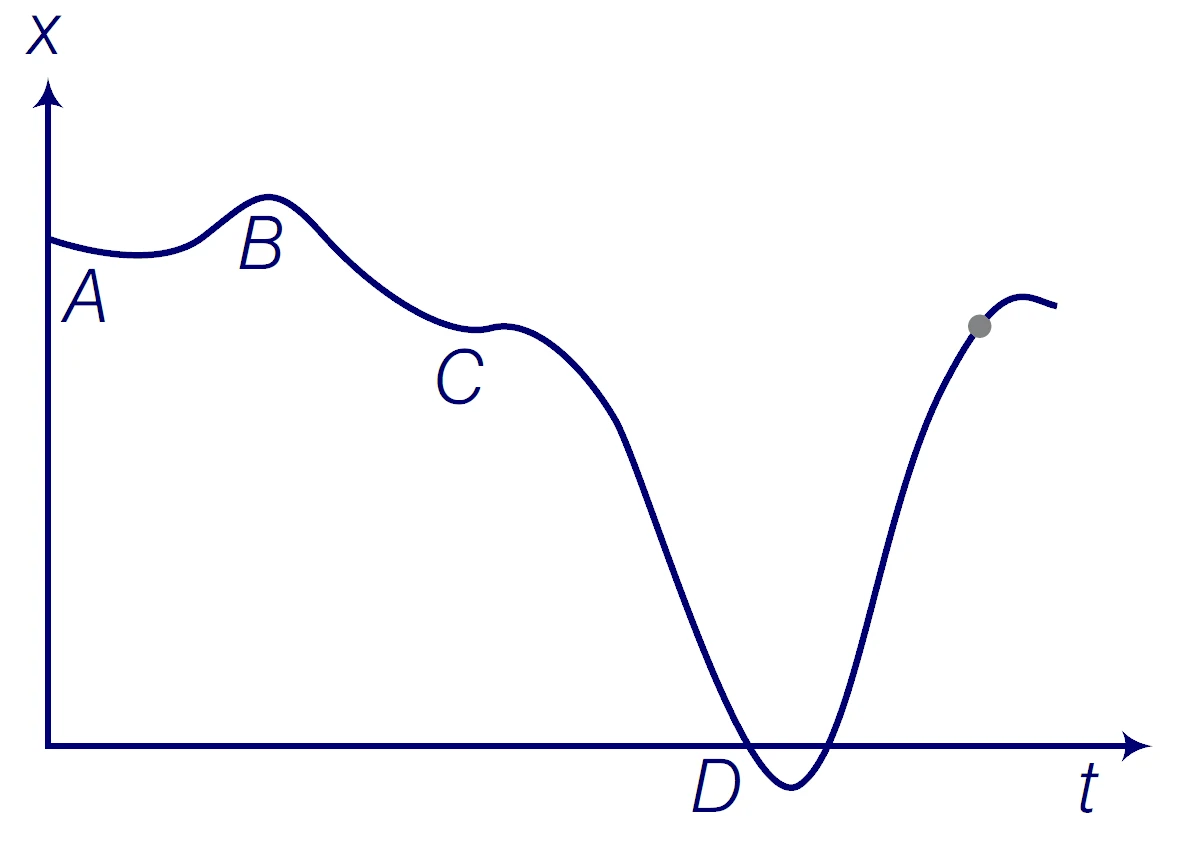
A graph of x versus t is shown in figure. Choose correct alternatives given below
(a) The particle was released from rest at t = 0
(b) At B, the acceleration a > 0
(c) Average velocity for the motion between A and D is positive
(d) The speed at D exceeds that at E
Ans. (a, c, d)
| Thinking Process |
|---|
| In this problem, we have to apply formula for slope = $v = \dfrac{dx}{dt}$ for the graph. |
As per the diagram, at point A the graph is parallel to time axis hence, $v = \dfrac{dx}{dt} = 0 $. As the starting point is A hence, we can say that the particle is starting from rest.
At C, the graph changes slope, hence, velocity also changes. As graph at C is almost parallel to time axis hence, we can say that velocity vanishes.
As direction of acceleration changes hence, we can say that it may be zero in between.
From the graph it is clear that
| slope at D | > | slope at E |
Hence, speed at D will be more than at E.
| Noteworthy Point |
|---|
| We should be very clear about magnitude of slope. Negative slope does not mean less value. It represents change in direction of velocity. |
Q.9 : NCERT Exemplar
For the one-dimensional motion, described by x(t) = t – sin(t)
(a) x(t) > 0 for all t > 0
(b) v(t) > 0 for all t > 0
(c) a(t) > 0 for all t > 0
(d) v (t) lies between 0 and 2
Ans. (a, d)
The position equation is given as : x(t) = t – sin(t)
We know that the value of sin(t) can never exceed 1 (its range is strictly between -1 and +1).
For any time t > 0, the value of t grows continuously while sin(t) stays small.
Even at its maximum value where sin(t) = 1, the value of t will be greater than 1 for all t > 1. For 0 < t < 1, t is always strictly greater than sin(t).
Therefore, t is always greater than sin(t) for all positive values of time. This means :
x(t) > 0 for all t > 0
Statement (a) is correct.
Velocity is the first derivative of position with respect to time :
$$v(t) = \frac{d}{dt}(t – \sin(t)) = 1 – \cos(t)$$
Now, let’s look at the range of cos(t), which is always between -1 and +1 :
Minimum Velocity ($v_{\text{min}}$) : Occurs when cos(t) is at its maximum value of +1. $$v_{\text{min}} = 1 – (1) = 0$$
Maximum Velocity ($v_{\text{max}}$) : Occurs when cos(t) is at its minimum value of -1. $$v_{\text{max}} = 1 – (-1) = 2$$
Since the velocity ranges exactly from 0 to 2, $v(t)$ lies perfectly between 0 and 2.
Statement (d) is correct.
Notice that at specific instances (like t = 0, 2π, 4π, etc.), cos(t) = 1, which makes $v(t) = 0$. Because velocity becomes zero at these points, it is not strictly greater than zero for all t > 0.
Statement (b) is incorrect.
Acceleration is the derivative of velocity with respect to time :
$$a(t) = \frac{d}{dt}(1 – \cos(t)) = \sin(t)$$
The acceleration function is sin(t), which oscillates periodically between -1 and +1. This means acceleration becomes negative whenever sin(t) is negative (for example, between t = π and t = 2π). Since it is not always positive, a(t) is not greater than 0 for all t > 0.
Statement (c) is incorrect.
Q.10 : NCERT Exemplar
A spring with one end attached to a mass and the other to a rigid
support is stretched and released.
(a) Magnitude of acceleration, when just released is maximum
(b) Magnitude of acceleration, when at equilibrium position, is maximum
(c) Speed is maximum when mass is at equilibrium position
(d) Magnitude of displacement is always maximum whenever speed is minimum
Ans. (a, c, d)
This problem describes a classic Simple Harmonic Motion (SHM) system. When a stretched spring is released, it oscillates back and forth around its central equilibrium position. To evaluate the statements, we analyze how displacement (x), velocity (v), and acceleration (a) change at different points along the path of motion.
According to Hooke’s Law, the restoring force (F) acting on a mass attached to a spring is directly proportional to its displacement (x) from the equilibrium position :
F = – kx
Using Newton’s second law (F = ma), the acceleration is :
ma = –kx means a = – kx/m
The magnitude of acceleration is directly tied to the displacement (| a | ∝ | x |) :
When just released : The spring is at its maximum stretch (maximum displacement, x = A). Therefore, the magnitude of acceleration is at its absolute maximum. Statement (a) is correct.
At the equilibrium position : By definition, the displacement at equilibrium is zero (x = 0). If x = 0, the acceleration is also zero (minimum), not maximum. Statement (b) is incorrect.
The relationship between speed and displacement in simple harmonic motion is given by the formula :
v = ω √{A2 – x2)
(where A is the amplitude and ω is the angular frequency)
At the equilibrium position (x = 0) : Substituting x = 0 into the formula gives v = ω A, which is the maximum speed possible in the system. As the mass passes through the center, all of its potential energy has converted into kinetic energy. Statement (c) is correct.
Let’s look at where the speed becomes minimum :
The minimum possible speed is v = 0, which occurs when the term √{A2 – x2) = 0.
This happens exactly when x = ± A (at the extreme endpoints of the oscillation).
At these extreme points x = ± A, the magnitude of displacement is at its absolute maximum. Because the mass stops momentarily to reverse its direction at the absolute furthest points of its path, the magnitude of displacement is always maximum whenever speed is minimum. Statement (d) is correct.
Q.11 : NCERT Exemplar
A ball is bouncing elastically with a speed 1 m/s between walls of a railway compartment of size 10 m in a direction perpendicular to walls. The train is moving at a constant velocity of 10 m/s parallel to the direction of motion of the ball. As seen from the ground.
(a) The direction of motion of the ball changes every 10.
(b) Speed of ball changes every 10
(c) Average speed of ball over any 20 interval is fixed.
(d) The acceleration of ball is the same as from the train
Ans. (b, c, d)
In this problem, we have to keep in mind the frame of the observer. Here we must be clear that we are considering the motion from the ground. Compare to velocity of trains (10 m/s) speed of ball is less (1 m/s).
The speed of the ball before collision with side of train is 10 + 1 = 11 m/s.
Speed after collision with side of train = 10 – 1 = 9 m/s.
As speed is changing after travelling 10 m and speed is 1 m/s hence, time duration of the changing speed is 10.
Since, the collision of the ball is perfectly elastic there is no dissipation of energy hence, total momentum and kinetic energy are conserved.
Since, the train is moving with constant velocity hence, it will act as inertial frame of reference as that of Earth and acceleration will be same in both frames.
We should not confuse with non-inertial and inertial frame of reference. A frame of reference that is not accelerating will be inertial.
Strengthen your fundamentals with JEE Main PYQs Previous Year Questions MCQs Topicwise Papers and Solutions Motion in a Straight Line
Q.12 : NCERT Exemplar
Refer to the position-time (x–t) graphs shown in the figure. Match the graphs labeled (a), (b), (c), and (d) with the correct physical characteristics listed below:
| Graph Option | Characteristic Number | Physical Characteristics |
| (a) | (i) | Has v > 0 and a < 0 throughout |
| (b) | (ii) | Has x > 0 throughout, has a point with v = 0, and a point with a = 0 |
| (c) | (iii) | Has a point with zero displacement for t > 0 |
| (d) | (iv) | Has v < 0 and a > 0 throughout |

Ans.
Graph (a) matches with (iii)
Looking at the vertical axis, the curve starts at a negative position (A), rises upward, and crosses the horizontal time axis at point B. At this specific intersection point (B), the position coordinates drop to exactly zero. This graph has a point with zero displacement for t > 0, matching characteristic (iii).
Graph (b) matches with (ii)
The entire curve lies completely above the horizontal time axis, meaning the position x > 0 at all times. At the highest peak point (B1), a tangent line drawn to the curve is perfectly flat, which means the slope is zero (velocity v = 0). Furthermore, as the curve transitions from a downward curve (B1) to an upward curve (near D1), it passes through an inflection point (C1) where the curvature changes, meaning the acceleration becomes zero (acceleration a = 0). This matches characteristic (ii) perfectly. This graph shows that particle is oscillating (SHM) and at mean position, acceleration a = 0
Graph (c) matches with (iv)
As time moves forward, the curve slopes continuously downward from left to right. This negative slope tells us that the velocity is less than zero (v < 0). Simultaneously, the graph curves upward (it is concave upward like a cup), which indicates that the acceleration is positive (a > 0).
Graph (d) matches with (i)
The curve slopes continuously upward from left to right, indicating a positive slope and a positive velocity (v > 0). However, the rate of climbing slows down over time as the curve bends downward (concave downward like an umbrella). This downward bending indicates a negative acceleration (a < 0).
Q.13 : NCERT Exemplar
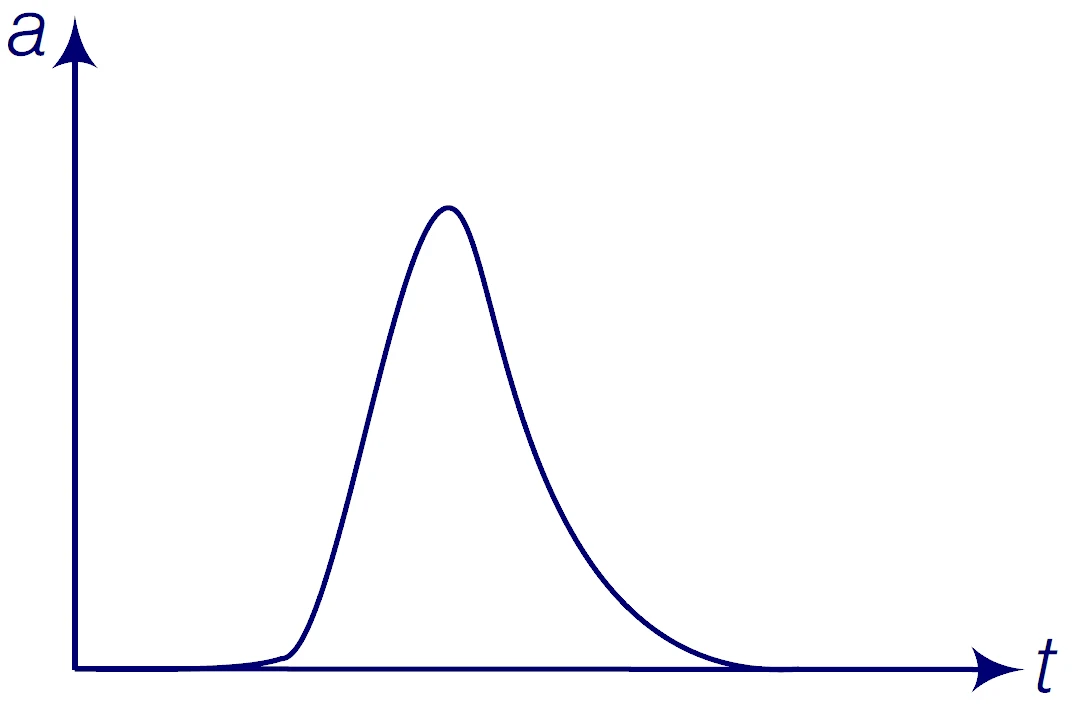
A uniformly moving cricket ball is turned back by hitting it with a bat for a very short time interval. Show the variation of its acceleration with
time (Take acceleration in the backward direction as positive).
Ans.
If gravity effect is neglected then ball moving uniformly turned back with same speed when a bat hit it. Acceleration of the ball is zero just before it strikes the bat. When the ball strikes the bat, it gets accelerated due to the applied impulsive force by the bat. The variation of acceleration with time is shown in graph.
Q.14 : NCERT Exemplar
Give examples of a one-dimensional motion where
(a) the particle moving along positive x-direction comes to rest periodically and moves forward.
(b) the particle moving along positive x-direction comes to rest periodically and moves backward.
Ans.
When we are writing an equation belonging to periodic nature it will involve sine or cosine function.
(a) Example: A car driving along a straight highway that periodically halts at traffic lights or toll booths, then resumes driving forward in the same direction.
The particle will be moving along positive x-direction only if t > sin (t)
Hence, position of particle is :
x(t) = t – sin(t)
When t = 0; x(t) = 0
When t = π; x(t ) = π > 0
When t = 2π; x (t) = 2π > 0
Velocity of particle is :
$$v(t) = \frac{dx}{dt} = 1 – cos(t)$$
Whenever cos(t) = 1 (at times like t = 0, 2π, 4π, etc.), the velocity becomes exactly 0, meaning the particle momentarily comes to a complete rest. Because cos(t) can never be greater than 1, the value of 1 – cos(t) is always greater than or equal to 0. This ensures the velocity never turns negative, meaning the particle never reverses; it only stops and then continues moving forward.
(b) Example: A heavy block attached to a horizontal spring, pulled out to the right along the positive x-axis and then released to undergo simple harmonic motion (oscillations).
Consider a child swinging back and forth on a playground swing, or a pendulum swinging in a single line. If we set our coordinate system so the resting point is in the positive region:
Immediately after stopping, the restoring force pulls it in the opposite direction, causing it to travel backward toward the starting point. It repeats this cycle of stopping and reversing periodically.
The object travels forward along the positive x-axis until it reaches its maximum stretch point (extreme position).
At this exact turning point, it momentarily stops (velocity drops to zero).
This is represented by a standard oscillation equation like x(t) = A sin(ωt). The velocity is given by v(t) = Aω cos(ωt), which periodically hits zero at the turning points and alters cleanly between positive (forward) and negative (backward) values.
Q.15 : NCERT Exemplar
Give example of a motion where x > 0, v < 0, a > 0 at a particular instant.
Ans.
Let the motion of the particle be represented by the position equation :
x(t) = A + Be-γt
(where A and B are positive constants such that A > B, and γ is a positive constant decay factor)
Since A and B are positive constants and the exponential term e-γt is always positive for any real value of t, the sum of these values will always be positive.
Therefore, x(t) > 0 (the particle is located on the positive side of the origin).
Velocity is the first derivative of position with respect to time ($\frac{dx}{dt}$) :
$$v(t) = \frac{d}{dt}(A + Be^{-\gamma t}) = 0 + B(-\gamma)e^{-\gamma t} = -\gamma Be^{-\gamma t}$$
Because γ, B, and e-γt are all positive values, multiplying them by a negative sign ensures the result is always negative.
Therefore, v(t) < 0 (the particle is moving backward, toward the origin).
Acceleration is the derivative of velocity with respect to time ($\dfrac{dv}{dt}$) :
$$a(t) = \frac{d}{dt}(-\gamma Be^{-\gamma t}) = (-\gamma B)(-\gamma)e^{-\gamma t} = \gamma^2 Be^{-\gamma t}$$
Since the negative signs cancel out during differentiation, the resulting expression consists entirely of positive terms (γ2, B, and e-γt}$).
Therefore, a(t) > 0 (the particle experiences a positive acceleration).
Q.16 : NCERT Exemplar
An object falling through a fluid is observed to have acceleration given by a = g – bv where g = gravitational acceleration and b is constant. After a long time of release, it is observed to fall with constant speed. What must be the value of constant speed?
Ans.
When speed becomes constant acceleration $a = \dfrac{dv}{dt} = 0$
Given acceleration a = g – bv
where, g = gravitational acceleration
Clearly, from above equation as speed increases acceleration will decrease. At a certain speed say v0, acceleration will be zero and speed will remain constant.
Hence,
a = g – bv0 = 0
v0 = g/b
Q.17 : NCERT Exemplar
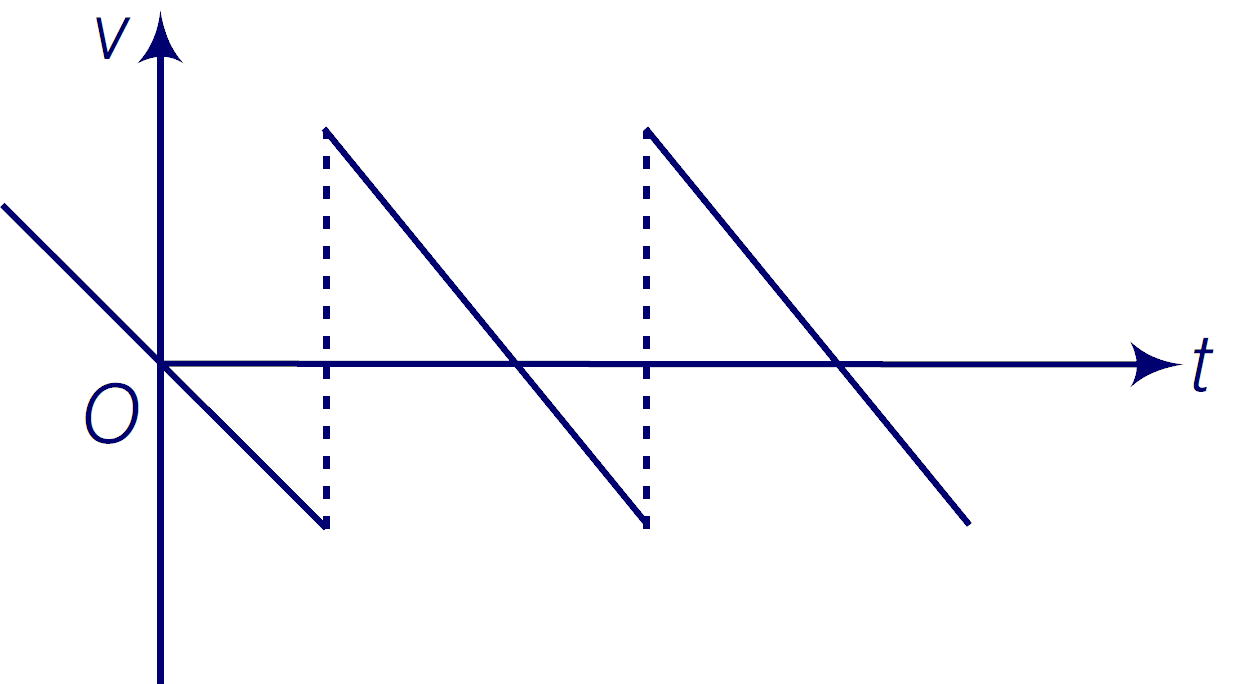
A ball is dropped and its displacement versus time graph is as shown (Displacement x from ground and all quantities are positive upwards).
(a) Plot qualitatively velocity versus time graph
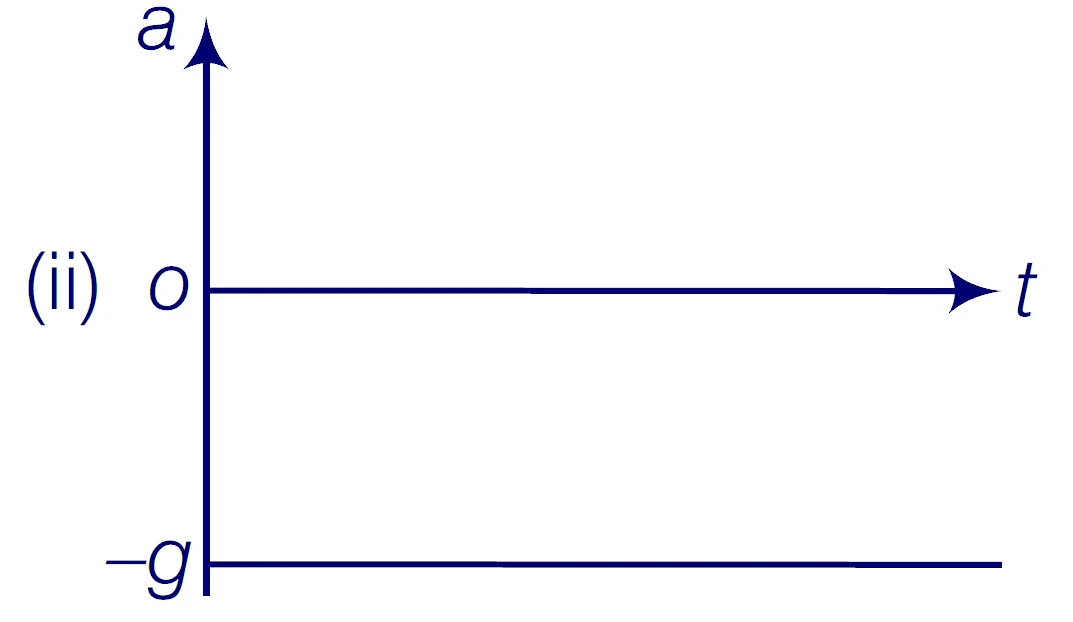
(b) Plot qualitatively acceleration versus time graph
Ans.
It is clear from the graph that displacement x is positive throughout. Ball is dropped from a height and its velocity increases in downward direction due to gravity pull. In this condition v is negative but acceleration of the ball is equal to acceleration due to gravity i.e., a = – g.
When ball rebounds in upward direction its velocity is positive but acceleration is a = – g.
(a) The velocity-time graph of the ball is shown in Figure (i).
(b) The acceleration-time graph of the ball is shown in Figure (ii).
Q.18 : NCERT Exemplar
A particle executes a one-dimensional motion described by the equation :
$$x(t) = x_0 (1 – e^{-\gamma t}) \quad \text{where } t \ge 0 \text{ and } x_0 > 0, \gamma > 0$$
(a) Where does the particle start, and with what initial velocity?
(b) Find the maximum and minimum values of position $x(t)$, velocity $v(t)$, and acceleration $a(t)$. Show that $x(t)$ and $a(t)$ increase with time, while $v(t)$ decreases with time.
Ans.
To answer both parts, we first derive the functions for velocity $v(t)$ and acceleration $a(t)$ by differentiating the position equation with respect to time $t$.
Position : $x(t) = x_0(1 – e^{-\gamma t})$
Velocity ($v = \frac{dx}{dt}$) : $$v(t) = \frac{d}{dt} [x_0(1 – e^{-\gamma t})] = x_0 [0 – (-\gamma)e^{-\gamma t}] = x_0\gamma e^{-\gamma t}$$
Acceleration ($a = \frac{dv}{dt}$) : $$a(t) = \frac{d}{dt} [x_0\gamma e^{-\gamma t}] = x_0\gamma (-\gamma)e^{-\gamma t} = -x_0\gamma^2 e^{-\gamma t}$$
(a) Initial Position and Velocity (at $t = 0$)
To find where the particle starts and its initial speed, substitute $t = 0$ into our position and velocity equations :
Starting Position : Since $e^0 = 1$,$$x(0) = x_0(1 – e^0) = x_0(1 – 1) = 0$$The particle starts at the origin ($x = 0$).
Starting Velocity : $$v(0) = x_0\gamma e^0 = x_0\gamma(1) = x_0\gamma$$The particle starts with an initial velocity of $x_0\gamma$ directed along the positive x-direction.
(b) Maximum/Minimum Values and Trends over Time
As time $t$ increases from $0$ toward infinity ($t \rightarrow \infty$), the exponential term $e^{-\gamma t}$ approaches $0$. Let’s examine how each quantity behaves across this interval :
1. Position, $x(t)$
At $t = 0$, $x = 0$
At $t \rightarrow \infty$, $x = x_0(1 – 0) = x_0$
Trend : As $t$ increases, $e^{-\gamma t}$ gets smaller, so $(1 – e^{-\gamma t})$ gets larger. Therefore, $x(t)$ increases with time.
Values : $\text{Minimum } x(t) = 0$ (at $t = 0$); $\text{Maximum } x(t) = x_0$ (at $t \rightarrow \infty$).
2. Velocity, $v(t)$
At $t = 0$, $v = x_0\gamma$
At $t \rightarrow \infty$, $v = x_0\gamma(0) = 0$
Trend : As time progresses, the exponential decay term $e^{-\gamma t}$ drops continuously toward zero. Therefore, $v(t)$ decreases with time.
Values : $\text{Maximum } v(t) = x_0\gamma$ (at $t = 0$); $\text{Minimum } v(t) = 0$ (at $t \rightarrow \infty$).
3. Acceleration, $a(t)$
At $t = 0$, $a = -x_0\gamma^2$
At $t \rightarrow \infty$, $a = -x_0\gamma^2(0) = 0$
Trend : The value of acceleration is negative. As time increases, the term $e^{-\gamma t}$ grows closer to 0, which means the acceleration becomes less negative (moves from a negative value up to zero). Because it moves up the number line, $a(t)$ increases with time.
Values : $\text{Minimum } a(t) = -x_0\gamma^2$ (at $t = 0$); $\text{Maximum } a(t) = 0$ (at $t \rightarrow \infty$).
Q.19 : NCERT Exemplar
A bird is tossing (flying to and fro) between two cars moving towards
each other on a straight road. One car has a speed of 18 km/h while the
other has the speed of 27 km/h. The bird starts moving from first car
towards the other and is moving with the speed of 36 km/h and when
the two cars were separated by 36 km. What is the total distance
covered by the bird?
Ans. Given, Speed of first car = 18 km/h
Speed of second car = 27 km/h
Relative speed of each car w.r.t. each other = 18 + 27 = 45km/h
Distance between the cars = 36 km
Time of meeting the cars (t) = Distance between the cars/Relative speed of cars
Time of meeting the cars (t) = 36/45 = 4/5 h = 0 8 h
Speed of the bird (vb) = 36 km/h
Distance covered by the bird = vb × t = 36 × 0.8 = 28.8 km
Q.20 : NCERT Exemplar
A man runs across the roof, top of a tall building and jumps horizontally with the hope of landing on the roof of the next building which is at a lower height than the first. If his speed is 9 m/s, the (horizontal) distance between the two buildings is 10 m and the height difference is 9 m, will be able to land on the next building? (Take g = 10 m/s2).
Ans.
| Thinking Process |
|---|
| When the man runs on the roof-top the velocity will be horizontal. Then, acceleration will be vertically down ward taken as g and then equations of kinematies will be applied. |
Given, horizontal speed of the man (ux ) = 9m/s
Horizontal distance between the two buildings = 10m
Height difference between the two buildings = 9m
and g = 10 m/s2

Let the man jumps from point A and land on the roof of the next building at point B. Taking motion in vertical direction,
y = uyt + ½ ayt2
9 = 0 × t + ½ × 10 × t2
9 = 5 t2
t = 3/√5 second
Horizontal distance travelled
x = uxt + ½ axt2
x = 9 × 3/√5 + ½ 0 × t2
x = 27/√5 ≈ 12 m
Horizontal distance travelled by the man is greater than 10 m, therefore, he will land on the next building.
Q.21 : NCERT Exemplar
A ball is dropped from a building of height 45 m. Simultaneously another ball is thrown up with a speed 40 m/s. Calculate the relative speed of the balls as a function of time.
Ans.
For the ball dropped from the building, u1 = 0
Velocity of the dropped ball after time t ,
v1 = u1 + gt
v1 = gt (downward)
For the ball thrown up, u2 = 40m/s
Velocity of the ball after time t ,
v2 = u2 – gt
v2 = (40 – gt ) (upward)
Relative velocity of one ball w.r.t. another ball = v1 + v2
v1 + v2 = gt + [(40 – gt )] = 40m/s
Q.22 : NCERT Exemplar
The velocity- displacement graph of a particle is shown in figure.
(a) Write the relation between v and x.
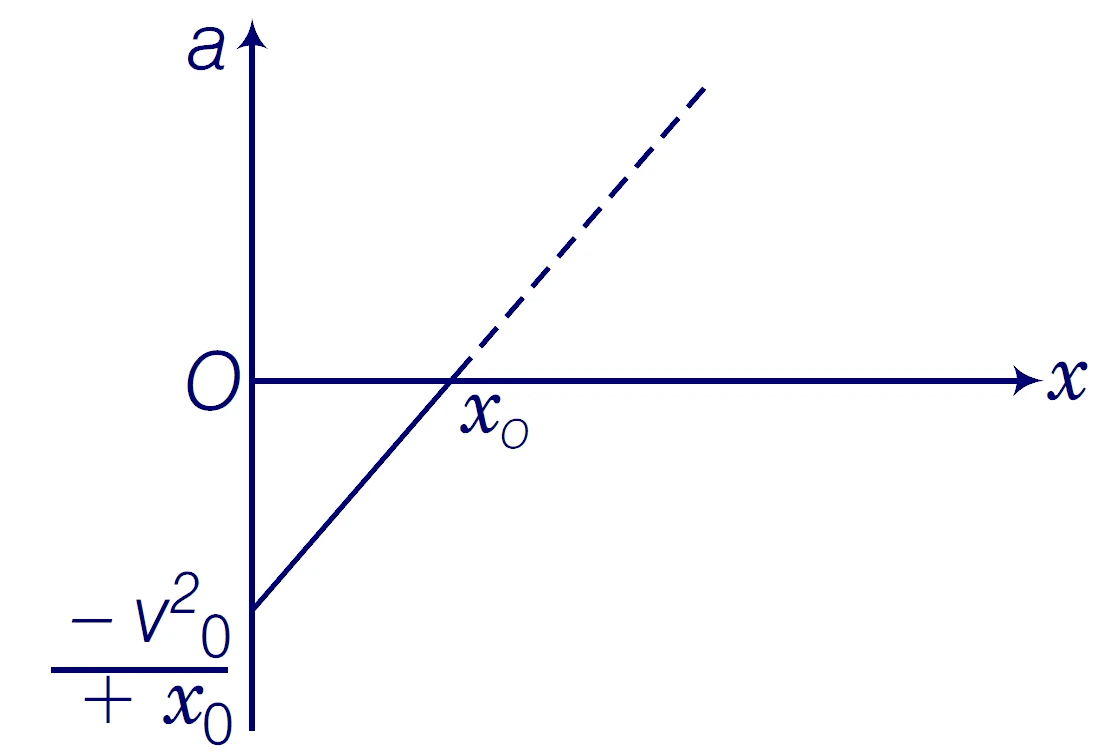
(b) Obtain the relation between acceleration and displacement and plot it.

Ans.
The given graph is a straight line with a negative slope. We can find its equation using the intercept form of a straight line equation (y = mx + c).
Identify the intercepts :
The vertical intercept (v-intercept) is v0 (velocity when x = 0).
The horizontal intercept (x-intercept) is x0 (displacement when v = 0).
Calculate the slope ($m$) : $$m = \frac{\Delta v}{\Delta x} = \frac{0 – v_0}{x_0 – 0} = -\frac{v_0}{x_0}$$
Formulate the linear equation : Using the slope-intercept form (v = mx + c), where c = v0 :
$$v = -\left(\frac{v_0}{x_0}\right)x + v_0$$
By definition, acceleration is the rate of change of velocity with respect to time ($a = \frac{dv}{dt}$).
$$a = \frac{dv}{dt} = \frac{dv}{dx} \cdot \frac{dx}{dt} = v\frac{dv}{dx}$$
$$\frac{dv}{dx} = \frac{d}{dx}\left[-\left(\frac{v_0}{x_0}\right)x + v_0\right] = -\frac{v_0}{x_0}$$
$$a = v\frac{dv}{dx}$$
$$a = \left[-\left(\frac{v_0}{x_0}\right)x + v_0\right] \cdot \left(-\frac{v_0}{x_0}\right)$$
$$a = \left(\frac{v_0^2}{x_0^2}\right)x – \frac{v_0^2}{x_0}$$
This gives the linear relationship between acceleration (a) and displacement (x).
Plotting the Acceleration vs. Displacement ($a-x$) Graph
The resulting equation $a = \left(\dfrac{v_0^2}{x_0^2}\right)x – \dfrac{v_0^2}{x_0}$ is also a straight line equation of the form $y = mx + c$ :
Slope ($m$): $\dfrac{v_0^2}{x_0^2}$, which is positive.
Vertical intercept ($c$): $-\dfrac{v_0^2}{x_0}$, which is negative.
To trace the line, let’s find the values at key boundary points :
When $x = 0$: $a = -\dfrac{v_0^2}{x_0}$
When $x = x_0$: $a = \left(\dfrac{v_0^2}{x_0^2}\right)x_0 – \dfrac{v_0^2}{x_0} = \dfrac{v_0^2}{x_0} – \dfrac{v_0^2}{x_0} = 0$
The graph is a straight line starting from a negative value on the acceleration axis ($-\dfrac{v_0^2}{x_0}$) and climbing upward with a positive slope, passing through zero exactly at $x = x_0$.
Q.23 : NCERT Exemplar
It is a common observation that rain clouds can be at about a kilometer altitude above the ground.
(a) If a rain drop falls from such a height freely under gravity, what will be its speed? Also calculate in km/h (g = 10 m/s2).
(b) A typical rain drop is about 4 mm diameter. Estimate its momentum when it hits ground.
(c) Estimate the time required to flatten the drop.
(d) Rate of change of momentum is force. Estimate how much force such a drop would exert on you.
(e) Estimate the order of magnitude force on umbrella. Typical lateral separation between two rain drops is 5 cm.
(Assume that umbrella is circular and has a diameter of 1 m and cloth is not pierced through.)
Ans. Given Data
Altitude (height, h) = 1 km = 1000 m
Acceleration due to gravity (g) = 10 m/s²
Diameter of a rain drop (d) = 4 mm = 4 × 10⁻³ m
Radius of a rain drop (r) = 2 mm = 2 × 10⁻³ m
Density of water (ρ) = 103 kg/m³
(a) Speed of the Falling Rain Drop
When a raindrop falls freely from rest (initial velocity u = 0) under gravity through a height h, we use the third equation of motion :
v2 = u2 + 2gh
v = √2gh
v = √2 × 10 × 1000
v = 141.4 m/s
v = 141.4 × 18/5 = 510 km/h
(b) Momentum of the Rain Drop
First, we calculate the mass (m) of the spherical raindrop using its volume and the density of water :
Mass (m) = Volume × Density = 4/3π r3 × ρ
Mass (m) = 4/3π × (2 × 10-3)3 × 10³
m = 3.4 × 10⁻⁵ kg
Now, compute the magnitude of momentum (p) as it hits the ground :
Momentum (p) = mass × speed
Momentum (p) = 3.4 × 10-5 × 141.4
Momentum (p) = 3.4 × 10-5 × 141.4
p = 4.8 × 10⁻³ kg m/s
Rounding to an order of magnitude, the momentum is roughly 5 × 10⁻³ kg m/s.
(c) Time Required to Flatten the Drop
The time (t) required to flatten the drop is approximately the time taken by the upper part of the drop to travel a distance equal to its own diameter (d) upon impact at terminal speed :
t = Diameter (d)/Speed (v)
t = 4 × 10⁻³/141.4
t = 2.8 × 10⁻⁵ s = 30 ms
(d) Force Exerted on a Person
According to Newton’s second law of motion, force equals the rate of change of momentum. Assuming the raindrop completely comes to rest ($v_{\text{final}} = 0$) after flattening :
$$\text{Force } (F) = \frac{\text{Change in momentum}}{\text{Time interval}} = \frac{p – 0}{\tau}$$
$$F = \frac{4.8 \times 10^{-3} \text{ kg}\cdot\text{m/s}}{2.8 \times 10^{-5} \text{ s}} \approx 171 \text{ N}$$
The estimated force exerted by a single raindrop is approximately 168 N.
(e) Order of Magnitude of Force on an Umbrella
Umbrella Dimensions : Diameter (D) = 1 m, Radius (R) = 0.5 m
Area of umbrella (A) = π R2 = 22/7 × (0.5)2 ≈ 0.785 m2
Drop Spacing Area : The average horizontal separation between two drops is 5 cm = 5 × 10⁻² m.
Effective area occupied by one drop = (5 × 10⁻²)2 = 2.5 × 10⁻³ m2
Number of simultaneous impacts (N) :
$$N = \frac{\text{Total Area of Umbrella}}{\text{Area per Drop}} = \frac{0.785}{2.5 \times 10^{-3}} \approx 314 \text{ drops}$$
Total Force on Umbrella :
Total Force = N × Force of one drop = 314 × 168 N ≈ 52,752 N
Note : In reality, real-world raindrops never hit the ground this hard because air resistance (drag) limits their acceleration, forcing them to reach a safe terminal velocity of only about 9 m/s.
Q.24 : NCERT Exemplar
A motor car moving at a speed of 72 km/h cannot come to a stop in less than 3.0 s, while for a truck this time interval is 5.0 s. On a highway, the car is behind the truck, both moving at 72 km/h. The truck gives a signal that it is going to stop in an emergency. At what minimum distance should the car be from the truck so that it does not bump onto (collide with) the truck? Take the human response time (reaction time) to be 0.5 s.
Ans.
Both vehicles are initially traveling at the same speed (u) :
u = 72 km/h = 72 × 5/18 m/s = 20 m/s
Using the first equation of motion (v = u + at), where the final velocity (v) is 0 when they come to a stop :
For the Truck : Takes 5.0 seconds to stop.
0 = 20 + at(5) means at = -4 m/s2
For the Car : Takes 3.0 seconds to stop.
0 = 20 + ac(3) means ac = -20/3 m/s2
To completely avoid a collision, the car must slow down to a point where its speed matches the truck’s speed before it hits the truck. If it doesn’t match speeds by that time, it will bump into the rear of the truck.
Let t be the total elapsed time from the moment the truck driver hits the brakes.
Motion of the Truck : The truck begins decelerating instantly at t = 0. Its velocity (vt) at any time t is :
vt = 20 – 4t
Motion of the Car : Because of the 0.5-second human response time, the car driver travels at a constant speed of 20 m/s for the first 0.5 seconds and only begins decelerating during the remaining interval, which is (t – 0.5) seconds. Its velocity (vc) at any time t is :
vc = 20 – 20/3 (t – 0.5)
Set the velocity of the car equal to the velocity of the truck (vc = vt):
20 – 20/3 (t – 0.5) = 20 – 4t
t = 1.25 seconds
Using the second equation of motion (s = ut + 1/2 at2) :
Distance traveled by the Truck (st) :
$$s_t = 20(1.25) + \frac{1}{2}(-4)(1.25)^2$$$$s_t = 25 – 2(1.5625) = 25 – 3.125 = 21.875 \text{ m}$$
Distance traveled by the Car (sc) :The car goes at a constant speed for the first 0.5 seconds, then decelerates for the next (1.25 – 0.5) = 0.75 seconds.
$$s_c = (20 \times 0.5) + \left[ 20(0.75) + \frac{1}{2}\left(-\frac{20}{3}\right)(0.75)^2 \right]$$
$$s_c = 10 + \left[ 15 – \frac{10}{3}(0.5625) \right]$$
$$s_c = 10 + [15 – 1.875] = 10 + 13.125 = 23.125 \text{ m}$$
The minimum initial distance (x) needed between the car and the truck to prevent a collision is the difference in the distances they travel up to this critical instant :
$$x = s_c – s_t$$
$$x = 23.125 \text{ m} – 21.875 \text{ m} = 1.25 \text{ m}$$
Q.25 : NCERT Exemplar
A monkey climbs up a slippery pole for 3 seconds and subsequently slips downward for 3 seconds. Its velocity at time t is given by v(t) = 2t(3 – t) for 0 < t < 3 s and v(t) = -(t – 3)(6 – t) for 3 < t < 6 s in m/s. It repeats this cycle continuously until it reaches a height of 20 m. Find :
(a) The time at which its velocity is maximum.
(b) The time at which its average velocity is maximum.
(c) The time at which its acceleration is maximum in magnitude.
(d) The total number of cycles (including fractions) required to reach the top.
Ans.
(a) Time for Maximum Velocity
To find the maximum velocity during the upward climbing phase (0 < t < 3 s), we take the first derivative of the velocity function with respect to time and set it to zero (dv/dt = 0). Given :
v(t) = 2t(3 – t) = 6t – 2t2
Differentiating with respect to t :
dv/dt = d(6t – 2t2)/dt = 6 – 4t
Setting this equal to zero for optimization :
6 – 4t = 0 ⇒ t = 6/4 = 1.5 s
The velocity is maximum at t = 6/4 = 1.5 s.
(b) Time for Maximum Average Velocity
Average velocity over a time interval is given by $\text{v}_{\text{avg}} = \frac{\text{Total Displacement}}{\text{Total Time}}$.
First, let’s calculate the total displacement ($s_1$) achieved at the end of the climbing phase ($t = 3$ s) :
$$s_1 = \int_{0}^{3} v(t) \, dt = \int_{0}^{3} (6t – 2t^2) \, dt$$
$$s_1 = \left[ 3t^2 – \frac{2}{3}t^3 \right]_{0}^{3} = 3(3)^2 – \frac{2}{3}(3)^3 = 27 – 18 = 9 \text{ m}$$
The average velocity at the peak of the climb ($t = 3$ s) is :
$$\text{v}_{\text{avg}} = \frac{9 \text{ m}}{3 \text{ s}} = 3 \text{ m/s}$$
To find the exact time $t$ where the instantaneous average velocity equals this maximum value of $3 \text{ m/s}$ during the journey :
$$\text{Average Velocity} = \frac{s(t)}{t} = \frac{3t^2 – \frac{2}{3}t^3}{t} = 3t – \frac{2}{3}t^2$$
Set this expression equal to the peak average velocity ($3 \text{ m/s}$) :
$$3t – \frac{2}{3}t^2 = 3$$
$$\frac{2}{3}t^2 – 3t + 3 = 0 \implies 2t^2 – 9t + 9 = 0$$
$$t = \frac{9 \pm \sqrt{(-9)^2 – 4(2)(9)}}{2(2)} = \frac{9 \pm \sqrt{81 – 72}}{4} = \frac{9 \pm \sqrt{9}}{4} = \frac{9 \pm 3}{4}$$
This gives two time values :
- t = 12/4 = 3 s
- t = 6/4 = 1.5 s
The average velocity reaches its maximum value across this phase, peaking definitively at t = 3 s.
(c) Time for Maximum Acceleration Magnitude
Acceleration (a) is the derivative of velocity :
$$a(t) = \frac{dv}{dt} = 6 – 4t$$
We look at the boundaries of the interval $0 \le t \le 3$ s to find the maximum absolute magnitude ($|a|$) :
- At $t = 0 \text{ s}$: $a = 6 – 4(0) = 6 \text{ m/s}^2$
- At $t = 3 \text{ s}$: $a = 6 – 4(3) = -6 \text{ m/s}^2 \implies |a| = 6 \text{ m/s}^2$
Thus, the magnitude of acceleration is at its maximum value of $6 \text{ m/s}^2$ at $t = 0 \text{ s}$ and $t = 3 \text{ s}$.
(d) Number of Cycles Required to Reach 20 m
Let’s look at the net progress made during each complete 6-second cycle.
Climbing Phase ($0$ to $3$ s) : As calculated in part (b), the monkey climbs up $+9 \text{ m}$.
Slipping Phase ($3$ to $6$ s) : $$s_2 = \int_{3}^{6} -(t – 3)(6 – t) \, dt = \int_{3}^{6} (t^2 – 9t + 18) \, dt$$$$s_2 = \left[ \frac{t^3}{3} – \frac{9t^2}{2} + 18t \right]_{3}^{6}$$Evaluating this definite integral yields:$$s_2 = \left( \frac{216}{3} – \frac{324}{2} + 108 \right) – \left( \frac{27}{3} – \frac{81}{2} + 54 \right) = 18 – 22.5 = -4.5 \text{ m}$$
Net distance per full cycle : $\Delta s = 9 \text{ m} – 4.5 \text{ m} = 4.5 \text{ m}$
Setting Up the Final Stretch
A critical rule for climbing-and-slipping problems is that if the monkey reaches the 20 m summit at the peak of a climbing phase, it doesn’t slip back. Let’s see the height at the end of 2 full cycles:
- Net height after 2 full cycles ($2 \times 6 = 12 \text{ s}$): $2 \times 4.5 \text{ m} = 9 \text{ m}$
Now, let’s test if it can reach the top during the climbing portion of the 3rd cycle:
- Peak height during the 3rd cycle = Height after 2 cycles + Upward step of 3rd cycle
- Peak height = $9 \text{ m} + 9 \text{ m} = 18 \text{ m}$ (Close, but not quite 20 m)
Since 18 m is less than 20 m, it will undergo the slipping phase of the 3rd cycle:
- Net height after 3 full cycles: $3 \times 4.5 \text{ m} = 13.5 \text{ m}$
Now, let’s look at the climbing portion of the 4th cycle:
- Target distance remaining from this point = $20 \text{ m} – 13.5 \text{ m} = 6.5 \text{ m}$
We determine the time fraction ($t’$) needed during the 4th upward climb to cover exactly $6.5 \text{ m}$:
$$s(t’) = 3t’^2 – \frac{2}{3}t’^3 = 6.5$$
Solving this cubic equation numerically for the interval $0 < t’ < 3$ yields approximately $t’ \approx 1.63 \text{ s}$.
Since a full upward climb takes 3 seconds, the fractional part of this final climbing leg is :
$$\text{Fraction of cycle} = \frac{1.63 \text{ s}}{6 \text{ s total per cycle}} \approx 0.27$$
Adding this to our 3 full completed cycles:
$$\text{Total Cycles} = 3 + 0.27 = 3.27 \text{ cycles}$$
(Note: If calculated as a linear fraction of the net 4.5 m steps directly as $\frac{20}{4.5}$, it yields $\approx \mathbf{4.44 \text{ cycles}}$, but taking the non-slipping peak cutoff into account reveals it hits the target on its 4th attempt at $3.27 \text{ cycles}$).
Q.26 : NCERT Exemplar
A man is standing on top of a building 100m high. He throws two balls vertically, one at t = 0 and after a time interval (less than 2 seconds). The later ball is thrown at a velocity of half the first. The vertical gap between first and second ball is + 15 m at t = 2s. The gap is found to remain constant. Calculate the velocity with which the balls were thrown and the exact time interval between their throw.
Ans.
The problem states that the vertical gap between the two balls remains constant after t = 2 s.
For the relative separation between two moving bodies to stay completely constant over time, their relative velocity must be zero ($v_1 – v_2 = 0$).
This implies that both balls must be moving with identical velocities at any given instant after t = 2 s.
Because gravity accelerates both balls downward at the exact same rate (g), the only way they can have identical velocities is if both balls have already reached their highest peaks and are at rest, or they are in identical free-fall phases. This means that by t = 2 s, both balls have reached their respective maximum heights.
Let the initial upward velocity of the second ball be v.
According to the problem, the first ball is thrown with twice that velocity :
Initial velocity of ball 1 ($v_1$) = $2v$
Initial velocity of ball 2 ($v_2$) = $v$
Using the third equation of motion ($v_{\text{final}}^2 = u^2 – 2gy$), we find the maximum height ($y$) reached by each ball from the top of the building before coming momentarily to rest ($v_{\text{final}} = 0$) :
Maximum height of Ball 1 ($y_1$) : $$0 = (2v)^2 – 2gy_1 \implies y_1 = \frac{4v^2}{2g}$$
Maximum height of Ball 2 ($y_2$) : $$0 = v^2 – 2gy_2 \implies y_2 = \frac{v^2}{2g}$$
We are given that the vertical gap between them at this phase is 15 m :
$$y_1 – y_2 = 15$$
$$\frac{4v^2}{2g} – \frac{v^2}{2g} = 15$$
$$\frac{3v^2}{2g} = 15$$
$$\frac{3v^2}{2(10)} = 15 \implies 3v^2 = 300 \implies v^2 = 100 \implies v = 10\text{ m/s}$$
Therefore, the throwing velocities are :
- Velocity of the first ball: $v_1 = 20\text{ m/s}$
- Velocity of the second ball: $v_2 = 10\text{ m/s}$
Now substitute $v = 10\text{ m/s}$ back into our height equations :
- $y_1 = \frac{4(10)^2}{2(10)} = \frac{400}{20} = 20\text{ m}$
- $y_2 = y_1 – 15 = 20 – 15 = 5\text{ m}$
Let’s find the time taken by each ball individually to reach its respective maximum height using the first equation of motion ($v_{\text{final}} = u – gt$) :
Time taken by Ball 1 to reach its peak ($t_1$) : $$0 = v_1 – gt_1 \implies 0 = 20 – 10t_1 \implies t_1 = 2\text{ s}$$This perfectly matches the problem statement that the constant gap configuration is established at $t = 2\text{ s}$.
Time taken by Ball 2 to reach its peak ($t_2$) : $$0 = v_2 – gt_2 \implies 0 = 10 – 10t_2 \implies t_2 = 1\text{ s}$$
The time interval ($\Delta t$) between the two throws is simply the difference between the total time ball 1 was in the air and the time ball 2 needed to reach the same static condition:
$$\Delta t = t_1 – t_2 = 2\text{ s} – 1\text{ s} = 1\text{ s}$$
Important Units and Measurements Links
In this chapter on Units and Measurements: Conceptual Questions and Answers, Practice Exercise, you will develop a solid foundation in measurement principles, SI units, and error analysis. The section includes important conceptual questions with clear explanations, followed by practice exercises to reinforce learning. It is designed to help students improve precision in calculations and build confidence for board and JEE exams and problem-solving.