NCERT Solutions for Vectors Class 11 Physics Chapter Motion in a Plane provide accurate, step-by-step answers to all the questions from the NCERT textbook based on the latest CBSE syllabus. These solutions help students understand key concepts such as scalar and vector quantities, vector addition and subtraction, resolution of vectors, unit vectors, and the applications of vectors in two-dimensional motion. Prepared by Er Neeraj Anand, the solutions simplify complex numerical problems and strengthen conceptual understanding, making them an excellent resource for scoring well in CBSE exams as well as competitive exams like JEE Main and NEET.
Who has prepared these NCERT Solutions for Vectors Class 11 Physics Chapter Motion in a Plane?
These NCERT Solutions for Vectors Class 11 Physics Chapter Motion in a Plane have been prepared by Neeraj Anand of Anand Classes and are published by Anand Technical Publishers. The solutions are designed to help students understand vector concepts through clear explanations, step-by-step solutions, and exam-oriented methods based on the latest CBSE syllabus.
How do these NCERT Solutions help students?
These NCERT Solutions help students build a strong foundation in vector concepts by providing accurate, easy-to-understand answers to all NCERT textbook questions. They are useful for CBSE board exams, school assessments, and competitive exams such as JEE Main and NEET, making learning more effective and improving problem-solving skills.
NCERT Question
State, for each of the following physical quantities, if it is a scalar or a vector : Volume, mass, speed, acceleration, density, number of moles, velocity, angular frequency, displacement, angular velocity.
Answer:
Scalars: Volume, mass, speed, density, number of moles, angular frequency.
Vectors: Acceleration, velocity, displacement, angular velocity.
Gain deeper understanding by studying NEET PYQs Solutions for Vectors (Class 11 Physics Motion in a Plane)
NCERT Question
Pick out the two scalar quantities in the following lists: force, angular momentum, work, current, linear momentum, electric field, average velocity, magnetic moment, relative velocity.
Answer:
Work and current are the two scalar quantities.
Strengthen your fundamentals with JEE Main Vectors Chapterwise PYQs Solutions (Motion in a Plane)
NCERT Question
Pick out the only vector quantity in the following list: temperature, pressure, impulse, time, power, total path-length, energy, gravitational potential, coefficient of friction, charge.
Answer:
Impulse is the only vector quantity.
Reason:
.
Since force and momentum are vectors, impulse is also a vector.
Continue learning with NEET Units and Measurements PYQs Previous Year Questions and Solutions
NCERT Question
State with reasons, whether the following algebraic operations with scalars and vectors are meaningful:
(a) Adding any two scalars (b) Adding a scalar to a vector of the same dimension (c) Multiplying any vector by any scalar. (d) Multiplying any two sealars (e) Adding any two vectors (f) Adding a component of a vector to the same vector.
Answer:
(a) No. It is only meaningful if the two scalars have the same dimensions (e.g., you cannot add mass to time).
(b) No. A scalar cannot be added to a vector because a vector has direction and a scalar does not.
(c) Yes. For example, multiplying acceleration by mass gives a meaningful physical vector quantity, force:
(d) Yes. For example, multiplying power by time gives work done:
(e) No. It is only meaningful if the two vectors share the same dimensions (e.g., you cannot add a velocity vector to a force vector).
(f) Yes. Because a component of a vector in a given direction is also a vector of identical dimensions.
Strengthen your fundamentals with River Boat and Man Problem: Boat cross a river along shortest path and in shortest time
NCERT Question
Read each statement below carefully and state with reasons, if it is true or false:
(a) The magnitude of a vector is always a scalar.
(b) Each component of a vector is always a scalar.
(c) The total path length is always equal to the magnitude of the displacement vector of a particle.
(d) The average speed of a particle is either greater or equal to the magnitude of average velocity of the particle over the same interval of time.
(e) Three vectors not lying in a plane can never add up to give a null vector.
Answer :
(a) True. Magnitude specifies only the size/absolute value of the quantity, which is a pure number with units (no direction).
(b) False. A component of a vector has a specified direction along a coordinate axis, making it a vector quantity as well.
(c) False. This is only true if the particle moves continuously along a perfectly straight line in a single direction. If it turns or changes direction, path length becomes greater than displacement.
(d) True. Because total path length is always greater than or equal to the magnitude of total displacement.
(e) True. as they can not be represented by the three sides of a triangle taken in the the same order.
To yield a null vector (), the resultant of any two vectors must be equal and opposite to the third vector, which vectors all three to lie in the same plane.
Important exam-related topics include Relative Velocity in a Plane: Relative Velocity of Rain w.r.t. Moving Man Solved Examples
NCERT Question
Establish the following inequalities gcometrically or otherwise:
(a)
(b)
(c)
(d)
Answer :
(a) (Equality holds when vectors are in the same direction).
(b) (Equality holds when vectors are in opposite directions).
(c) (Equality holds when vectors are in opposite directions).
(d) (Equality holds when vectors are in the same direction).
For complete preparation, also study Physical Quantities in Physics | Definition, Types & Examples
NCERT Question
Given , which of the following statements are correct?
(a) and must each be a null vector.
(b) The magnitude of equals the magnitude of .
(c) The magnitude of can never be greater than the sum of the magnitudes of and .
(d) must lie in the plane of and if and are not collinear, and along the line of and if they are collinear.
Answer :
(a) Incorrect. They can cancel each other out in many vector combinations without being individual null vectors.
(b) Correct. Rearranging gives . Taking magnitudes: .
(c) Correct. Since , the magnitude of is bounded by the triangle inequality of the remaining vectors: .
(d) Correct. For the sum to hold, the vector must balance out the plane or line created by and .
Enhance your preparation with Fundamental and Derived Units | Define Units of Mass, Length and Time
NCERT Question
Three girls skating on a circular ice ground of radius 200 m start from a point P and reach a point Q diametrically opposite via paths A, B, and C. What is the magnitude of the displacement vector for each? For which girl is this equal to the actual path length?
Solution : Displacement magnitude for all girls : Equal to the diameter of the circle:
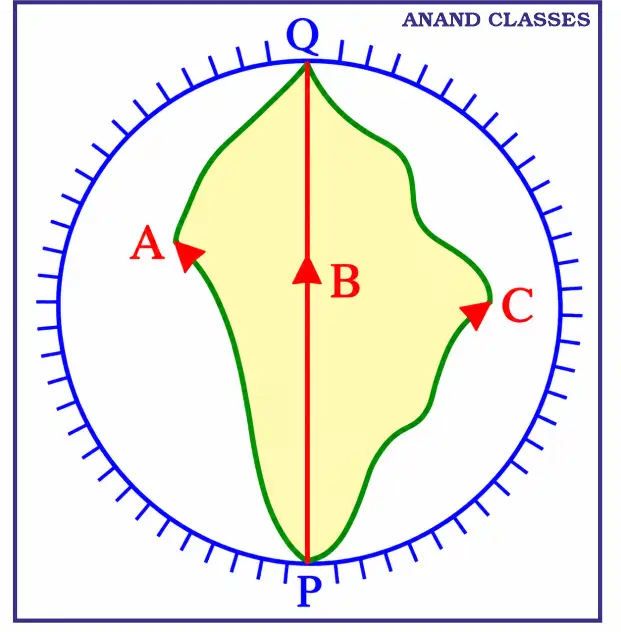
Path alignment: For Girl B, who skates in a straight line along the diameter, the displacement magnitude equals the actual path length skated.
NCERT Question
A cyclist starts from center O of a circular park of radius 1 km, reaches edge P, cycles along the quarter-circumference to Q, and returns to O via QO. If the round trip takes 10 minutes, calculate:
(a) Net displacement
(b) Average velocity
(c) Average speed
Answer :
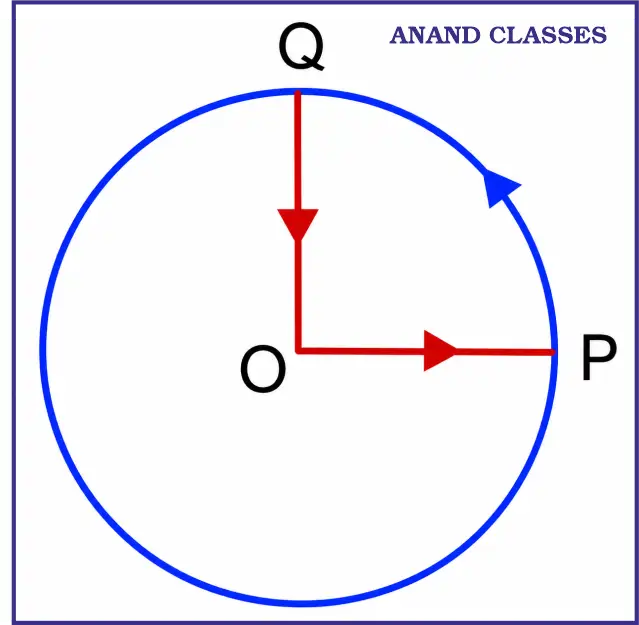
(a) Net displacement: 0 km (since the cyclist returns to the starting point O).
(b)
(c)
NCERT Question
On an open ground, a motorist follows a track that turns to his left by an angle of 60° after every 500 m. Starting from a given turn, specify the displacement of the motorist at the third, sixth and eighth turn. Compare the magnitude of the displacement with the total path length covered by the motorist in each case.
Solution. In this problem, the path is a regular hexagon ABCDEF of side length 500 m. Let the motorist start from A.
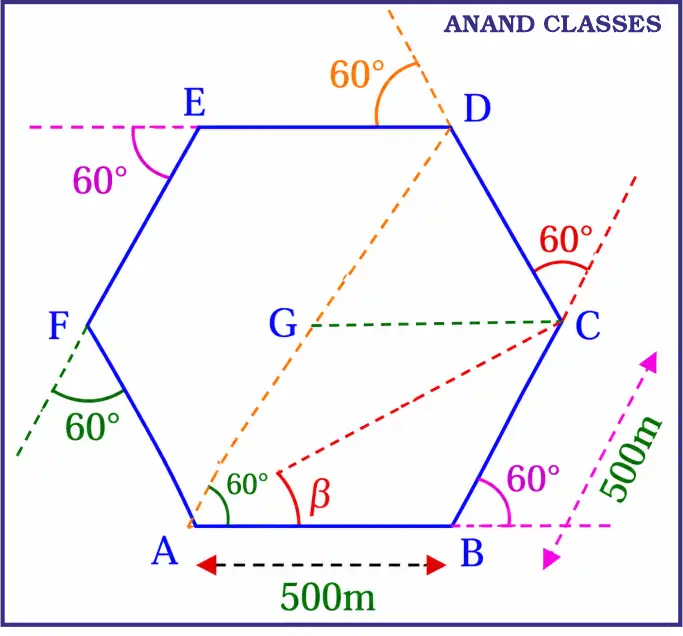
Third turn. The motor cyclist will take the third turn at D.
Displacement vector at D =
Magnitude of this displacement = 500 + 500 = 1000 m
Total path length from A to D = AB + BC + CD
Total path length from A to D = 500 + 500 + 500 = 1500 m
Sixth turn. The motor cyclist takes the sixth turn at A. So displacement vector is a null vector.
The total path length = AB + BC + CD + DE + EF + FA
The total path length = 6 × 500 = 3000 m
Eighth turn. The motor cyclist takes the eighth turn at C. The displacement vector , which is represented by the diagonal of the parallelogram ABCG.
It means makes an angle 30° with the initial direction.
Total path length = 8 × 500 = 4000 m
NCERT Question
A passenger arriving in a new town wishes to go from the station to a hotel located 10 km away on a straight road from the station. A dishonest cabman takes him along a circuitous path 23 km long and reaches the hotel in 28 minutes. What is (a) the average speed of the taxi, (b) the magnitude of average velocity? Are the two equal?
Solution. Here, actual path length travelled, S = 23 km; Displacement = 10 km; Time taken, t = 28 min = 28/60 h
(a)
(b)
The average speed is not equal to the magnitude of average velocity. The two are equal for the motion of taxi along a straight path in one direction.
NCERT Question
Rain is falling vertically with a speed of 30 m/s. A woman rides a bicycle with a speed of 10 m/s in the North to South direction. What is the direction in which she should hold her umbrella?
Solution. The rain is falling along OA with speed 30 m/s and the woman rider is moving along OS with speed 10 m/s i.e.,
, .
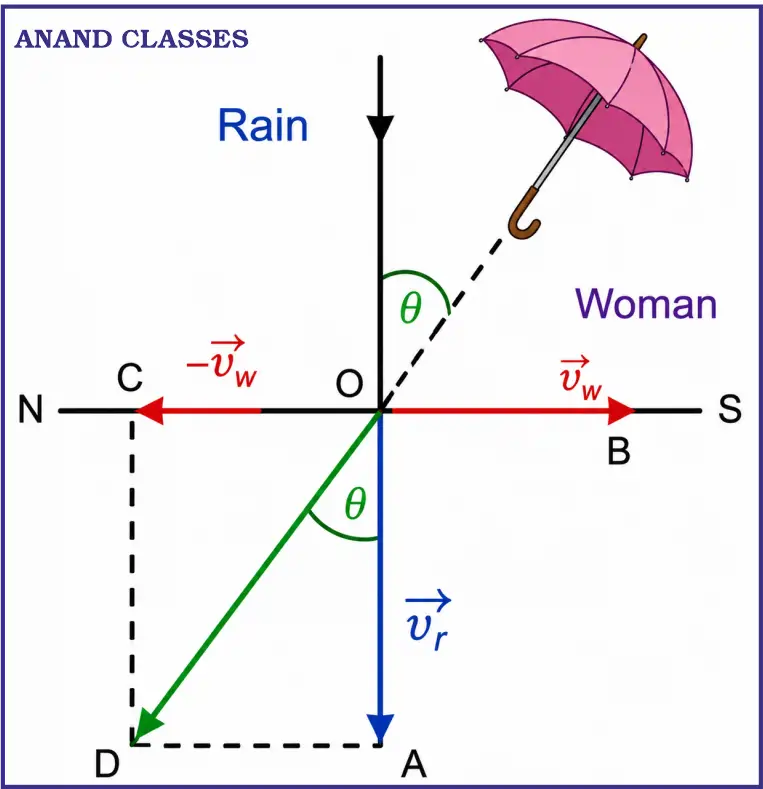
The woman rider can protect herself from the rain if she holds her umbrella in the direction of the relative velocity of rain w.r.t. woman.
To do so, apply an equal and opposite velocity of the woman on the rain i.e., impress the velocity due North on the rain, which is represented by .
Now the relative velocity of rain w.r.t. woman will be represented by the diagonal of the parallelogram OADC. If , then in :
NCERT Question
A man can swim with a speed of 4 km/h in still water. How long does he take to cross a river 1 km wide if the river flows steadily at 3 km/h and he makes his strokes normal to the river current? How far down the river does he go when he reaches the other bank?
Solution.
NCERT Question
In a harbour, wind is blowing at the speed of 72 km/h and the flag on the mast of a boat anchored in the harbour flutters along the N-E direction. If the boat starts moving at a speed of 51 km/h to the North, what is the direction of flag on the mast of the boat?
Solution. When the boat is anchored in the harbour, the flag flutters along the N-E direction. It shows that the velocity of wind is along the North-East direction. When the boat starts moving, the flag will flutter along the direction of the relative velocity of wind w.r.t. boat.
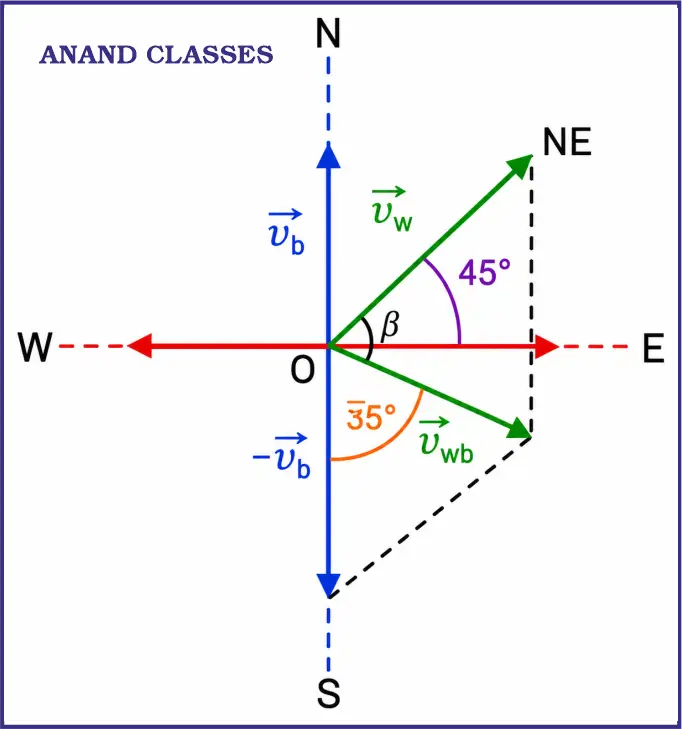
Let be the relative velocity of wind w.r.t. boat and be the angle between and . Now :
Here, , .
Angle between and is i.e., . Then :
It means the flag will flutter almost due East.
NCERT Question
The position of a particle is given by , where is in seconds and the coefficients have the proper units for to be in metres.
(a) Find the and of the particle?
(b) What is the magnitude and direction of velocity of the particle at t = 2 seconds?
Solutions.
(a) Velocity,
Acceleration,
(b) At time t = 2 seconds,
If θ is the angle which makes with the x-axis, then :
θ = 69.5° below the x-axis
NCERT Question
A particle starts from the origin at t = 0 with a velocity of 10.0 m/s and moves in the X-Y plane with a constant acceleration of .
(a) At what time is the x-coordinate of the particle 16 m? What is the y-coordinate of the particle at that time?
(b) What is the speed of the particle at that time?
Solution. Here, at t = 0.
Integrating it within the limits of motion (i.e., as time changes from 0 to t, velocity changes from to ) :
As , we get:
Integrating it within the conditions of motion (i.e., as time changes from to , displacement changes from to ):
Here, we have and .
(a) At x = 16 m :
(b) Velocity of the particle at time t is .
When t = 2 s :
NCERT Question
and are unit vectors along x- and y-axis respectively.
(a) What is the magnitude and direction of the vectors and ?
(b) What are the components of a vector along the directions of and ?
Solution : (a)
Magnitude of
Let the vector make an angle with the direction , then:
Magnitude of
Similarly, if is the angle which the vector makes with the direction , then:
(b) Here,
To find the component vector of along , we first find the unit vector along :
Magnitude of the component of along =
Component vector of along =
Let be the unit vector along the direction of :
Similarly, the component of along =
NCERT Question
For an arbitrary motion in space, which of the following relations are true:
(a)
(b)
(c)
(d)
(e)
(Note: The average stands for the average of the quantity over the time interval and )
Solution : The relations (b) and (e) are true; others are false because relations (a), (c) and (d) hold only for uniformly accelerated motion.
NCERT Question
Read each statement below carefully and state with reason and examples, if it is true or false. A scalar quantity is one that:
(a) is conserved in a process
(b) can never take negative values
(c) must be dimensionless
(d) does not vary from one point to another in space
(e) has the same value for observers with different orientations of axes.
Solution :
(a) False, because energy (being a scalar quantity) is not conserved during inelastic collisions.
(b) False, because the temperature (being a scalar quantity) can be negative.
(c) False, because the density (being a scalar quantity) has dimensions.
(d) False, because gravitational potential (being a scalar quantity) varies from point to point in space.
(e) True, because the value of a scalar does not change with the orientation of axes.
NCERT Question
An aircraft is flying at a height of 3400 m above the ground. If the angle subtended at a ground observation point by the aircraft positions 10 seconds apart is 30°, what is the speed of the aircraft?
Solution : O is the observation point on the ground. A and B are the positions of the aircraft for which ∠AOB = 30°. Draw a perpendicular OC on AB.
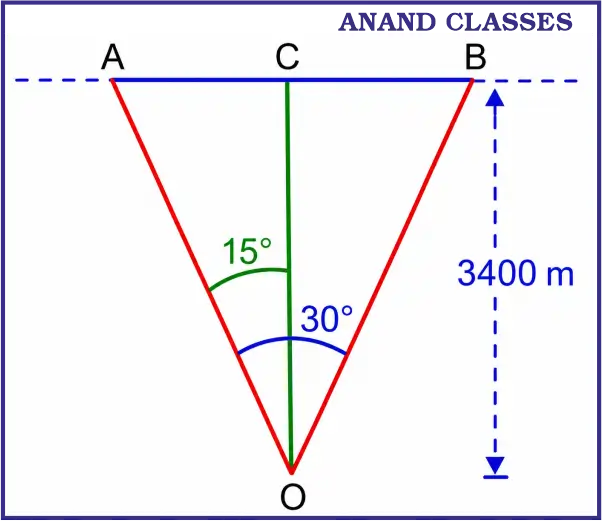
Here, OC = 3400 m and ∠AOC = ∠COB = 15°. Time taken by the aircraft from A to B is 10 seconds.
In △AOC :
AC = OC tan 15° = 3400 × 0.2679 = 910.86 m
AB = AC + CB = AC + AC = 2AC = 2 × 910.86 m
Speed of the aircraft:
NCERT Question
A vector has magnitude and direction. (i) Does it have a location in space? (ii) Can it vary with time? (iii) Will two equal vectors and at different locations in space necessarily have identical physical effects? Give examples in support of your answer.
Solution.
(i) A vector in general has no definite location in space because a vector remains unaffected whenever it is displaced anywhere in space, provided its magnitude and direction do not change. However, a position vector has a definite location in space.
(ii) Yes, a vector can vary with time. For example, the velocity vector of an accelerated particle varies with time.
(iii) No, two equal vectors at different locations in space do not necessarily have the same physical effects. For example, two equal forces acting at two different points on a body (which can cause the rotation of the body about an axis) will not produce the same turning effect (torque).
NCERT Question
A vector has both magnitude and direction. Does that mean anything that has magnitude and direction is necessarily a vector? The rotation of a body can be specified by the direction of the axis of rotation and the angle of rotation about the axis. Does that make any rotation a vector?
Solution. No. There are certain physical quantities which have both magnitude and direction, but they are not vectors as they do not follow the laws of vector addition, which is an essential condition for a quantity to be a vector.
A finite rotation of a body about an axis is not a vector because finite rotations do not obey the commutative law of vector addition, that is
()
However, an infinitesimally small rotation (i.e., a small angle of rotation) is a vector quantity because small rotations do obey the laws of vector addition.
NCERT Question
Can you associate vectors with:
(a) the length of a wire bent into a loop?
(b) a plane area?
(c) a sphere? Explain.
Solution.
(a) No, we cannot associate a vector with the length of a wire bent into a loop, as it does not have a unique, specific direction.
(b) Yes, we can associate a vector with a plane area. Such a vector is called an area vector, and its direction is represented by an outward-drawn normal perpendicular to the surface area.
(c) No, we cannot associate a vector with the volume of a sphere. However, an area vector can be associated with each small element of the surface area of the sphere.
Important Chapter Links
While studying Motion in a Plane in CBSE Class 11 Physics, it is important to have a clear understanding of the previous chapter Units and Measurements, as all physical quantities like displacement, velocity, and acceleration are expressed using fundamental units and derived units and significant figures as it forms the backbone of all numerical and conceptual understanding in kinematics. This section not only builds on those fundamental concepts but also includes practice through JEE Previous Year Questions (PYQs) and IMU CET PYQs, helping students connect basic measurement concepts with real problem-solving in motion. Topics such as physical quantities, systems of units, fundamental and derived units, significant figures, error analysis, dimensional analysis, and conversion of units are directly applied while solving motion problems. This section also connects with detailed practice resources including conceptual questions, numerical problems, and exam-oriented content like JEE Main PYQs (Set 1–4) and IMU CET (DNS & GME) PYQs and MCQs. By linking these topics, students can improve calculation accuracy, understand the correctness of physical equations using dimensional homogeneity, and strengthen their overall preparation for CBSE exams as well as competitive exams like JEE, NDA, IMUCET, and Merchant Navy entrance tests.