Dot product (scalar product) of two vectors is one of the most important operations in vector algebra and plays a vital role in physics and mathematics. Understanding the dot product, its formula, properties, and applications is essential for solving problems involving forces, motion, and geometry. This topic is highly important for students preparing for Class 11 Physics, JEE Main, JEE Advanced, NDA, IMU CET, CUET, NEET, and other competitive examinations, where vector operations are frequently tested through conceptual and numerical questions.
What is Scalar Product or Dot Product of Two Vectors ?
The dot product of two vectors and , represented by (read as dot ) is a scalar, which is equal to the product of the magnitudes of and and the cosine of the smaller angle between them.
If θ is the smaller angle between and , then :
Since A, B and cos θ are scalars, therefore, the dot product of and is a scalar quantity. That is why the dot product of two vectors is also called the scalar product. Each vector and has a direction, but their scalar product does not have a direction.
Similar concepts include Rectangular Components of Vector in Three Dimensions (Space), Direction Cosines and Vector Addition
What is the Geometrical Interpretation of Dot Product of Two Vectors ?
Let be represented by OP and be represented by OQ. Let ∠POQ = θ.
Draw QR ⊥ OP (Figure.(a)). Here, OR = B cos θ is the projection of onto . As = A(B cos θ), therefore is the product of the magnitude of and the magnitude of the component of along .
Alternatively, draw PS ⊥ OQ (Figure. (b)). Here, OS = A cos θ is the projection of onto . As = B(A cos θ), it is the product of the magnitude of and the magnitude of the component of along .
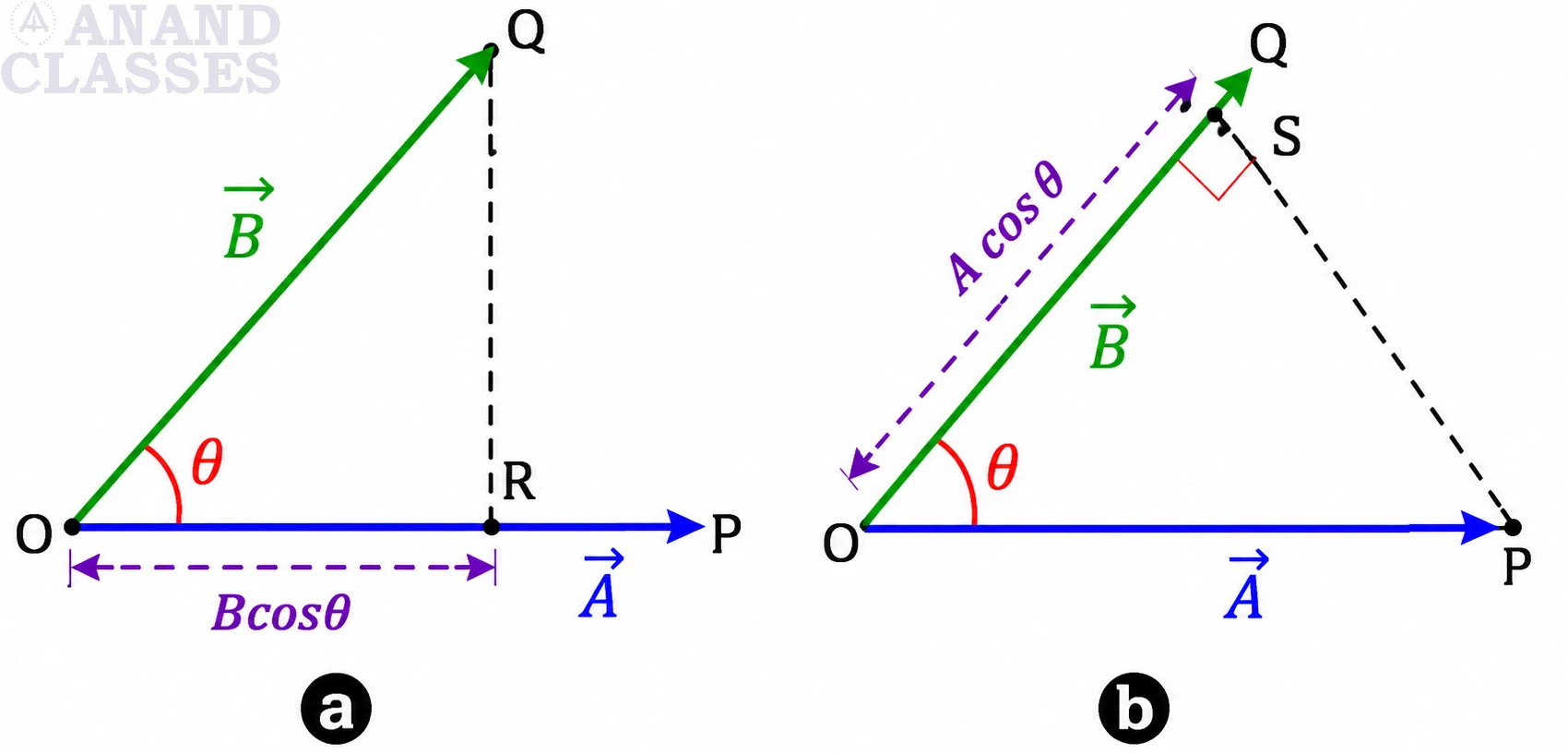
Thus, the dot product of two vectors is also defined as the product of the magnitude of one vector and the magnitude of the component of the other vector in the direction of the first vector.
Explore more concepts related to Resolution of a Vector and Rectangular Components of a Vector
Discuss the Special Cases of Dot Product of Vectors
What is the dot product of two parallel vectors?
(i) When two vectors are parallel, then θ = 0°, cos 0° = 1, therefore,
For unit vectors :
What is the dot product of two perpendicular vectors?
(ii) When two vectors are mutually perpendicular, then θ = 90°, cos 90° = 0, therefore:
It means the dot product of two perpendicular vectors is zero. For unit vectors :
What is the dot product of two vectors are in opposite directions ?
(iii) When two vectors are antiparallel, then then θ = 180°, cos 180° = -1.
Strengthen your fundamentals with Define Zero Vector or Null Vector: Properties, Significance, Applications, Solved Examples
How is the angle between two vectors calculated using the dot product?
The angle between two vectors and is found using :
Gain deeper understanding by studying Parallelogram Law of Vectors Addition and Subtraction of Vectors
What are the Properties of Dot Product of Two Vectors ?
(i) Dot product or scalar product of two vectors is commutative, i.e.,
.
By definition,
and
,
therefore .
(ii) Dot product or scalar product is distributive, i.e.,
.
(iii) Dot product of a vector with itself gives the square of its magnitude, i.e.,:
Further, where is a real number.
Frequently linked concepts include Polygon Law and Triangle Law of Vectors Addition, Lami’s Theorem Analytical Method
What are the Practical Examples of Scalar Product or Dot Product of two vectors ?
1. Work done (W) is defined as the dot product of the force vector and the displacement vector , i.e.,
2. The instantaneous power (P) is defined as the dot product of the force vector and the instantaneous velocity , i.e.,
3. Magnetic flux (Φ) linked with a surface is defined as the dot product of the magnetic field induction vector and the area vector , i.e.,
Note that since the dot product of two vectors is a scalar, hence, work done, power and magnetic flux are scalar quantities.
Master related concepts such as Multiplication of Vector by Real Number and Scalar
Explain Dot Product of Two Vectors in Cartesian Coordinates
Let two vectors :
and
Example.1
A constant force newton produces a displacement of metre. What is the work done?
Solution. Work done,
Example.2
If the magnitudes of two vectors are 2 and 3 and the magnitude of their scalar product is 3√2, then find the angle between the vectors.
Solution. Here, A = 2; B = 3,
.
As
,
so :
θ = 45°
Example.3
For what value of m, the vector is perpendicular to ?
Solution. Here given vectors are,
;
;
and angle between them is θ = 90°
Hence,
Example.4
Find the component of a vector along the direction of .
Solution. Here given vectors are,
.
Unit vector of :
Let θ be the angle between and .
The component vector of along the direction of is :
Since,
Example.5
If vectors and have magnitudes 5, 12 and 13 units and , find the angle between and .
Solution. As , then:
Example 6
If and . Find the magnitude of and and their scalar product .
Solution. Here given vectors are,
.
On solving, we get:
Example.7
If unit vectors and are inclined at an angle , then prove that .
Solution. We know that :
Example.8
Find the angle between force and displacement unit. Also, find the projection of on . (NCERT Solved Example)
Solution. Here, ; .
Unit vector along :
Projection of on = component vector of along . It is :
FAQs on Scalar Product (Dot Product) of Two Vectors
What is the scalar product or dot product of two vectors?
The scalar product (or dot product) of two vectors is a scalar quantity equal to the product of their magnitudes and the cosine of the smaller angle between them. It is represented as .
What is the formula for the dot product of two vectors?
The dot product is given by :
where (A) and (B) are the magnitudes of the vectors and (θ) is the angle between them.
Why is the dot product called a scalar product?
It is called a scalar product because its result is always a scalar quantity and has magnitude only, with no direction.
What is the geometrical interpretation of the dot product?
Geometrically, the dot product is the product of the magnitude of one vector and the projection (component) of the other vector along its direction.
What is the dot product of two parallel vectors?
For parallel vectors, the angle between them is (0°). Therefore
What is the dot product of two perpendicular vectors?
If two vectors are perpendicular, then :
This property is commonly used to test whether two vectors are perpendicular.
What is the dot product of two antiparallel vectors?
For antiparallel vectors, the angle between them is (180°). Hence:
8. Is the dot product commutative?
Yes. The dot product satisfies the commutative law:
Is the dot product distributive over vector addition?
Yes. It satisfies the distributive law:
What is the dot product of a vector with itself?
The dot product of a vector with itself equals the square of its magnitude:
How is the magnitude of a vector obtained using the dot product?
The magnitude is given by:
12. What is the dot product in Cartesian coordinates?
If
and
then :
What are the dot products of unit vectors?
The basic dot products are:
How is the angle between two vectors calculated using the dot product?
The angle is found using:
How can you determine if two vectors are perpendicular?
Two vectors are perpendicular if their dot product is zero:
What are the practical applications of the dot product?
The dot product is widely used in:
- Work done
- Instantaneous power
- Magnetic flux
- Vector projections
- Finding angles between vectors
- Computer graphics and engineering applications
How is work done related to the dot product?
Work done is defined as:
where () is force and () is displacement.
How is instantaneous power expressed using the dot product?
Instantaneous power is:
where () is the instantaneous velocity.
How is magnetic flux related to the dot product?
Magnetic flux is given by:
where () is the magnetic field and () is the area vector.
What is the projection of one vector on another?
The projection of vector () along vector () is obtained using the dot product and represents the component of () in the direction of ().
Can the dot product be negative?
Yes. The dot product is negative when the angle between the vectors is (obtuse) greater than (90°) and less than or equal to (180°).
What are the SI units of the dot product?
The SI units depend on the quantities involved. For example, the dot product of force (N) and displacement (m) gives work in joules (J).
Is the dot product defined only for vectors in the same dimension?
Yes. The vectors must belong to the same vector space (both in 2D or both in 3D) for the dot product to be defined.
Why is the dot product important in vector algebra?
The dot product helps determine angles between vectors, calculate projections, test perpendicularity, and solve numerous problems in physics, mathematics, engineering, and computer graphics.
Why is the scalar product important for Class 11 Physics, JEE, NDA, and IMU CET?
The scalar product is a fundamental concept in vector algebra and is extensively used in mechanics, work and energy, electromagnetism, and coordinate geometry. It is frequently tested in Class 11 Physics, JEE Main, JEE Advanced, NDA, IMU CET, CUET, NEET, and other competitive examinations.