
Vectors form the foundation of Motion in a Plane and are essential for understanding two-dimensional motion in Class 11 Physics. This chapter introduces the concepts of scalar and vector quantities, vector representation, addition and subtraction of vectors, resolution of vectors into components, unit vectors, and vector multiplication. The NCERT Exemplar Solutions for Vectors (Motion in a Plane) provide detailed, step-by-step explanations for all objective and subjective questions, helping students strengthen conceptual understanding and develop problem-solving skills required for CBSE Board, JEE Main, JEE Advanced, and NEET examinations.
NCERT Exemplar Question
The angle between and is
(a) 45°
(b) 90°
(c) -45°
(d) 180°
Ans. (b): Given
Hence, verifies the option (b).
Continue learning with JEE Main Vectors Chapterwise PYQs Solutions (Motion in a Plane)
NCERT Exemplar Question
Which one of the following statements is true?
(a) A scalar quantity is the one that is conserved in a process.
(b) A scalar quantity is the one that can never take negative values.
(c) A scalar quantity is the one that does not vary from one point to another in space.
(d) A scalar quantity has the same value for observers with different orientations of the axes.
Ans. (d): A scalar quantity does not depend on direction so it does not change after orientation of axis. So verifies the option (d).
This concept is linked with NCERT Solutions for Vectors Class 11 Physics Chapter Motion in a Plane
NCERT Exemplar Question
Figure shows the orientation of two vectors and in the X-Y plane.
If and , which of the following is correct?
(a) and are positive while and are negative.
(b) , and are positive while is negative.
(c) , and are positive while is negative.
(d) , , and are all positive.
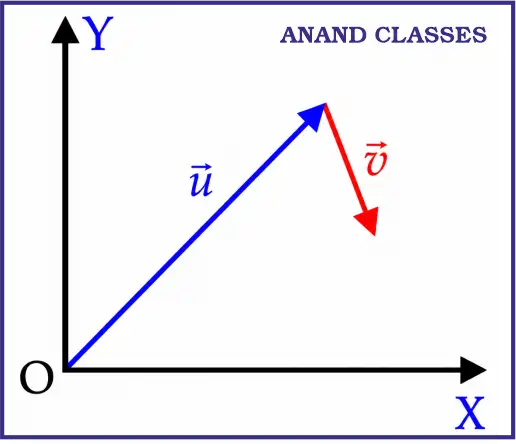
Ans. (b): Main concept used: Sign of a, b, p and q are sign of axis of their resolving components in the X-Y direction.
Components along X and Y axis of vector are both +X and +Y direction, so a, b are positive.
Now if we resolve , its X component is in +ve X direction but Y component will be in negative Y direction.
Hence, a, b and p are positive but q is negative. Verifies option (b).
Enhance your preparation with NEET PYQs Solutions for Vectors (Class 11 Physics Motion in a Plane)
NCERT Exemplar Question
The component of vector along X-axis will have maximum value if:
(a) is along positive Y-axis.
(b) is along positive X-axis.
(c) makes an angle of 45° with X-axis.
(d) is along negative Y-axis.
Ans. (b): Main concept used: On resolving the vector, values of cos θ or sin θ is always less than one, so components have smaller value.
As the vector has maximum value along positive X-axis. So its component along Y-axis is zero or any other value of its component will be $|vec{r}| > |vec{r}costheta|$.
Hence, given vector is along positive X-axis.
For complete preparation, also study JEE Main PYQs Solutions for Vectors (Class 11 Physics Motion in a Plane)
NCERT Exemplar Question
Consider the quantities, pressure, power, energy, impulse, gravitational potential, electric charge, temperature, area. Out of these, the only vector quantities are:
(a) Impulse, pressure and area
(b) Impulse and area
(c) Area and gravitational constant
(d) Impulse and pressure
Ans. (b): which is vector.
Sometimes area can also be treated as vector.. When current or a charge passing through a path its area of path is also vector, direction of which can be found out by Right hand thumb rule. Hence, verifies the option (b).
NCERT Exemplar Question
In a two dimensional motion, instantaneous speed v0 is positive, constant. Then which of the following are necessarily true?
(a) The average velocity is not zero at any time.
(b) Average acceleration must always vanish.
(c) Displacements in equal time intervals are equal.
(d) Equal path lengths are traversed in equal intervals.
Ans. (d): As speed is a scalar quantity and the options in (a), (b), and (c) are vectors, in (d) path length (which is a scalar) is the correct option.
As speed is a scalar quantity, hence it will be related with path length (scalar
quantity) only.
Hence, total distance travelled = Path length = (speed) × time taken
NCERT Exemplar Question
In two-dimensional motion, instantaneous speed v0 is positive and constant. Then which of the following are necessarily true?
(a) The acceleration of the particle is zero.
(b) The acceleration of the particle is bounded.
(c) The acceleration of the particle is necessarily in the plane of motion.
(d) The particle must be undergoing a uniform circular motion.
Ans. (c):
As we know, the change in acceleration and velocity is in the direction of Force () by:
Since the motion is restricted to two dimensions, the force causing the motion—and consequently the acceleration—must lie entirely within the same plane as that of the velocity. Thus, the acceleration of the particle is necessarily in the plane of motion.
NCERT Exemplar Question
Three vectors , , and add up to zero. Find which statement is false.
(a) is not zero unless and are parallel.
(b) is not zero unless and are parallel.
(c) If , , and define a plane, is in that plane.
(d)
Ans. (b, d)
Given that:
This implies that , , and lie in the same plane and can be represented by the sides of a triangle taken in order. Now consider the options one by one.
Verification of (a):Taking the cross product with :
Since .
Therefore:
This expression will be zero if and are parallel or anti-parallel (since or ). Thus, statement (a) is true.
Verification of (b) : From equation (i) :
Since is perpendicular to , their dot product is always zero, regardless of whether and are parallel. Thus, statement (b) is false.
Verification of (c) : Let . The direction of is perpendicular to the plane containing and . Now, let
.
The direction of is perpendicular to both and , which means it rotates back into the original plane containing , , and . Thus, statement (c) is true.
Verification of (d) : If , it means the angle between and is .
This statement is only true under specific constraints, making it incorrect in a general sense.
NCERT Exemplar Question
It is found that . This necessarily implies:
(a)
(b) and are anti-parallel
(c) and are perpendicular
(d)
Ans. (a):
Squaring both sides of the given condition:
From this, we get two possibilities :
1. If , then statement (a) is true, but it is not necessarily the only condition.
2. If :
(b) If and are antiparallel, then :
Or and are antiparallel only if , which does not verify option (b) for all conditions.
(c) If and are perpendicular, then :
Thus, and are perpendicular only if .
NCERT Exemplar Question
For two vectors and , is always true when:
(a)
(b)
(c) and and are parallel or anti-parallel
(d) When either or is zero
Ans. (b, d)
Given the condition:
Squaring both sides to eliminate the magnitude roots:
Expanding both sides using vector identities:
Subtracting from both sides:
Bringing all terms to one side:
Dividing by 4:
For this product to equal zero, at least one of the following individual conditions must be true:
- (Vector is a zero vector)
- (Vector is a zero vector)
When , it means the two vectors are perpendicular to each other ().
Therefore, the condition holds true either when the vectors are perpendicular (option b) or when at least one of the vectors is a zero vector (option d).
NCERT Exemplar Question
, , and are three non-collinear, non-coplanar vectors. What can you say about the direction of ?
Ans.
By the right-hand rule, the direction of the vector will be perpendicular to the plane containing vectors and .
Consequently, the vector triple product :
,
produces a vector that lies entirely within the plane formed by and , and it is strictly perpendicular to vector .
NCERT Exemplar Question
If and , match the relations in Column I with the corresponding angle between vectors and in Column II.
| Column I | Column II |
| (a) | (i) |
| (b) | (ii) |
| (c) | (iii) |
| (d) | (iv) |
Ans.
(a) (ii), (b) (i), (c) (iv), (d) (iii)
The general formula for the dot product of two vectors is:
Given that and , the expression simplifies to:
(a) Solution for
Conclusion: Option (a) matches with (ii).
(b) Solution for
Conclusion: Option (b) matches with (i).
(c) Solution for
Conclusion: Option (c) matches with (iv).
(d) Solution for
Conclusion: Option (d) matches with (iii).
NCERT Exemplar Question
If and , match the relations in Column I with the corresponding angle between vectors and in Column II.
| Column I | Column II |
| (a) | θ = 30° |
| (b) | θ = 45° |
| (c) | θ = 90° |
| (d) | θ = 0° |
Ans.
(a) (iv), (b) (iii), (c) (i), (d) (ii)
The general formula for the magnitude of the cross product of two vectors is:
Given that and , the expression simplifies to:
(a) Solution for
Conclusion: Option (a) matches with (iv).
(b) Solution for
Conclusion: Option (b) matches with (iii).
(c) Solution for
Conclusion: Option (c) matches with (i).
(d) Solution for
Conclusion: Option (d) matches with (ii).
NCERT Exemplar Question
A girl riding a bicycle with a speed of towards the north direction, observes rain falling vertically down. If she increases her speed to , rain appears to meet her at to the vertical. What is the speed of rain? In what direction does rain fall as observed by a ground-based observer?
Ans.
[Assume north to be direction and vertically downward to be . Let the rain velocity be . The velocity of rain as observed by the girl is always . Draw the vector diagram/s for the information given and find and . You may draw all vectors in the reference frame of a ground-based observer.]
Consider the northward direction as and the downward direction as .
Case I: When
The rain appears to fall vertically downward to her.
Let the velocity of the rain relative to the ground be:
The velocity of the rain relative to the girl () is:
Since the rain appears to fall vertically, the horizontal component of must be zero :
Case II: When the girl increases her speed to
The velocity of the rain relative to the ground is now .
The new velocity of the rain relative to the girl () becomes:
The rain now appears to fall at with the vertical ( axis):
Substituting and back into the ground velocity equation:
The magnitude (speed) of the rain is:
NCERT Exemplar Question
A river is flowing due east with a speed of 3 m/s. A swimmer can swim in still water at a speed of 4 m/s as shown in the figure.
(a) If the swimmer starts swimming due north, what will be his resultant velocity (magnitude and direction)?
(b) If he wants to start from point A on the south bank and reach the opposite point B on the north bank:
(i) In which direction should he swim?
(ii) What will be his resultant speed?
(c) From the two different cases as mentioned in (a) and (b) above, in which case will he reach the opposite bank in shorter time?
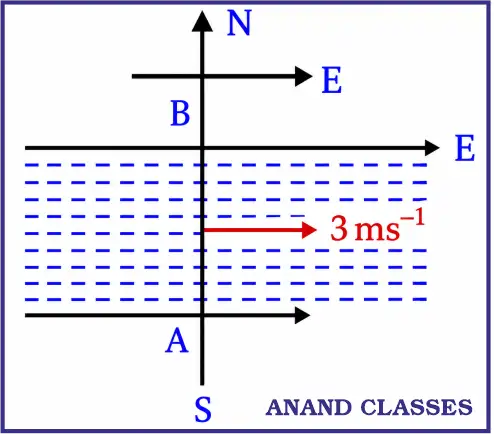
Ans.
Given parameters:
- Velocity of river () = 3 m/s due East
- Velocity of swimmer in still water () = 4 m/s
(a) Resultant velocity when swimming due North:
Since the swimmer heads north () and the river flows east (), their paths are perpendicular to each other.
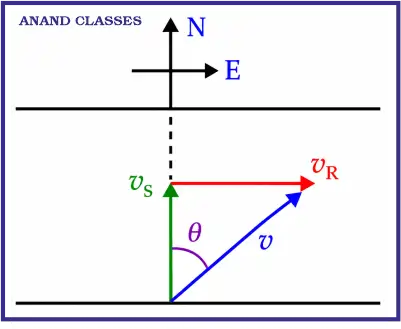
The magnitude of the resultant velocity (v) is:
The direction (θ) with respect to the North direction is:
(b) Reaching the exact opposite point B from point A:
To land directly across at point B, the swimmer must angle his direction towards the West to counteract the eastward river current.
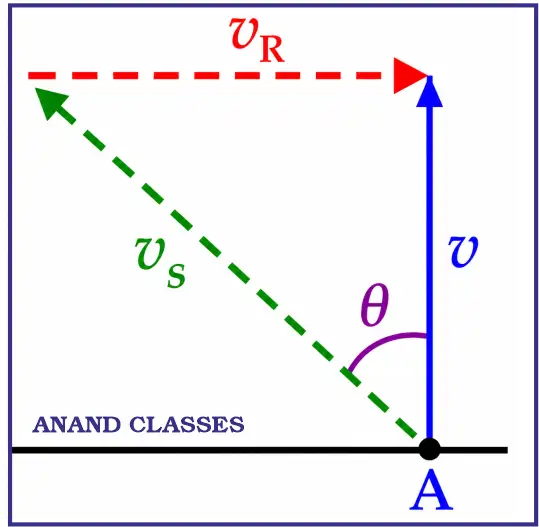
(ii) Resultant Speed:
From the right-angled triangle formed by the vector components:
(i) Direction:
(c) Comparison of crossing times:
Let the width of the river be .
Case (a): The velocity component strictly perpendicular to the river bank is
.
Case (b): The perpendicular velocity component pushing across the river is
.
Comparing the two time values:
Since $4 > sqrt{7}$, it holds true that $t_1 < t_2$. Therefore, the swimmer will reach the opposite bank in a shorter time in Case (a).
NCERT Exemplar Question
Motion in two dimensions, in a plane can be studied by expressing position, velocity and acceleration as vectors in Cartesian co-ordinates where are unit vectors along and directions, respectively and and are corresponding components of (figure)
Motion can also be studied by expressing vectors in circular polar co-ordinates as where and are unit vectors along directions in which and are increasing.
(a) Express and in terms of and .
(b) Show that both and are unit vectors and are perpendicular to each other.
(c) Show that where and .
(d) For a particle moving along a spiral given by where (unit), find the dimensions of ‘‘.
(e) Find velocity and acceleration in polar vector representation for a particle moving along the spiral described in (d) above.
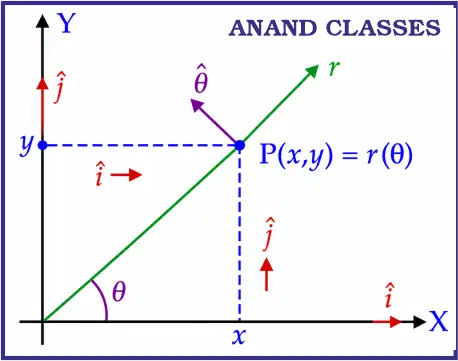
Solutions
(a) Expressing and in terms of and
Given the definitions:
To solve for , multiply equation (i) by and equation (ii) by :
Adding these two equations eliminates :
To solve for , multiply equation (i) by and equation (ii) by :
Subtracting the second from the first eliminates :
(b) Showing and are unit vectors and mutually perpendicular
First, check magnitudes:
Thus, both are unit vectors.
Taking their scalar (dot) product:
Since and , the dot product being zero proves they are perpendicular ().
(c) Proving the time derivatives
Given :
Given :
(d) Dimension of ‘‘
Given :
Since angles () and unit vectors () are dimensionless quantity ratios ():
The dimensions of constant equal that of length ().
(e) Velocity and Acceleration along the spiral
Given , the position vector is .
Velocity ():
Using the relationship : and :
Acceleration ():
Using product rule expansion across both terms:
Substitute and :
Grouping components along and yields the final result:
NCERT Exemplar Question
A man wants to reach from A to the opposite corner of the square C. The sides of the square are 100 m. A central square of 50 m × 50 m is filled with sand. Outside this square, he can walk at a speed of 1 m/s. In the central square, he can walk only at a speed of v m/s (v < 1). What is the smallest value of v for which he can reach faster via a straight path through the sand than any path in the square outside the sand?
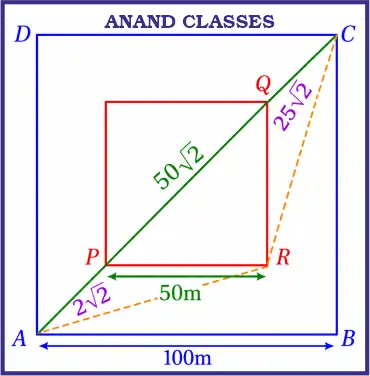
Solution.
1. Geometry of the Paths
The total diagonal of the large square ABCD is :
The diagonal of the central sandy square () is:
Since the central square is symmetric, the remaining portions of the straight diagonal path are split evenly:
.
2. Time Taken via the Straight Path :
Through Sand () The man walks at along sections and , and at speed along section :
3. Time Taken via the Shortest Path Outside Sand ()
The shortest clear path completely avoiding the sandy zone skirts along the perimeter edges to corner R, traveling via path ARC. Using Cartesian coordinates relative to corner A(0,0):
The position of point R is at (75, 25). The distance AR is given by :
Since the path is symmetric, .
As the travel speed outside sand is , the time taken is:
4. Calculating the Minimum Velocity v
For the path through the sand to be faster, we need :
Substituting our equations :
Divide both sides by :
Inverting the inequality to solve for v :
Rationalizing the denominator:
Approximating with numerical values ():