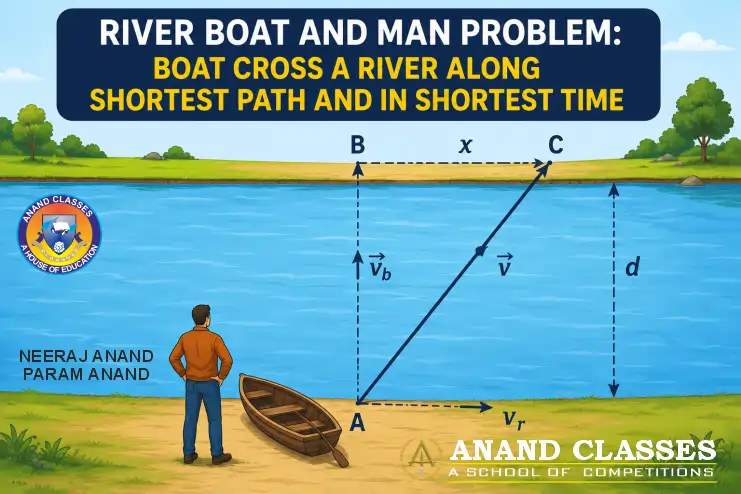
Boat and river problem is a classic application of relative velocity in two-dimensional motion, where a boat moves across a flowing river while the water current carries it downstream. Depending on the objective, the boat may be steered to cross the river along the shortest path by compensating for the river current or to cross in the shortest possible time by maximizing its velocity component perpendicular to the river bank. Understanding these two cases is essential for solving river crossing problems in class 11 physics, JEE, NEET and NDA. In this article, you’ll learn the concepts, derivations, vector diagrams, formulas, and solved examples for crossing a river along the shortest path and in the shortest time.
Under what condition does a boat cross a river along the shortest path?
A boat in a river always moves in the direction of resultant velocity of velocity of boat and velocity of river flow.
When a boat tends to cross a river along the shortest path, it should be rowed upstream making an angle θ with AB such that gives the direction of resultant velocity of velocity of boat () and velocity of flow of river (), as shown in Figure.
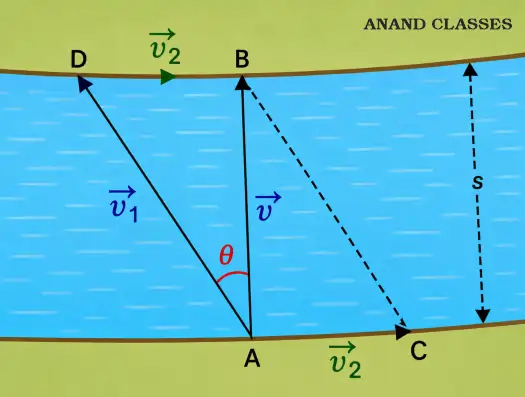
In a triangle △ABD :
and
Time of crossing the river by the boat:
Similar concepts include Relative Velocity in a Plane: Relative Velocity of Rain w.r.t. Moving Man Solved Examples
How does a boat cross a river in the shortest possible time?
When a boat tends to cross a river in the shortest time, the boat should go along AB, as shown in Figure. Now the boat will be going along AD which is the direction of resultant velocity of velocity of boat () and velocity of river ().
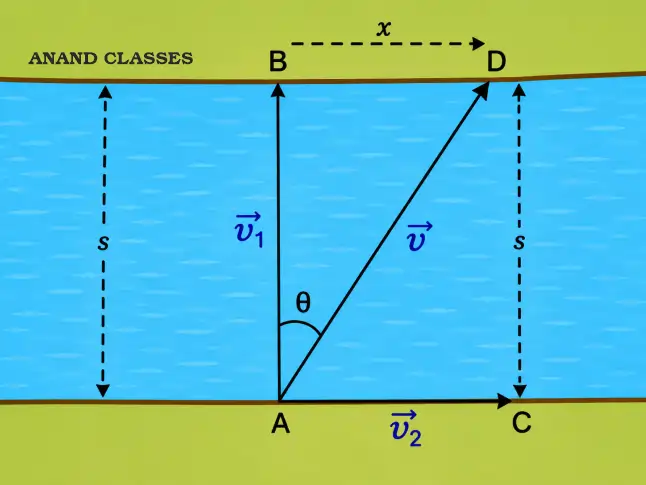
In a triangle △ABD :
and
Time of crossing the river by the boat:
The boat will be reaching the point instead of point . If , then:
or
Related topics include Relative Velocity Formula Explained With Solved Examples
Solved Examples Based on Boat and River Problem: Crossing a River Along the Shortest Path and in the Shortest Time
The following examples based on Boat and River Problem generally asked in Class 11 physics CBSE exam and competitive exams like JEE, NEET, NDA and IMUCET.
Example.1
A river 500 m wide flows at a rate of 4 km/h. A swimmer who can swim at 8 km/h in still water, wishes to cross the river straight. (i) Along what direction must he strike? (ii) What should be his resultant velocity? (iii) What is the time of crossing the river?
Solution.
(i) Refer to Figure.
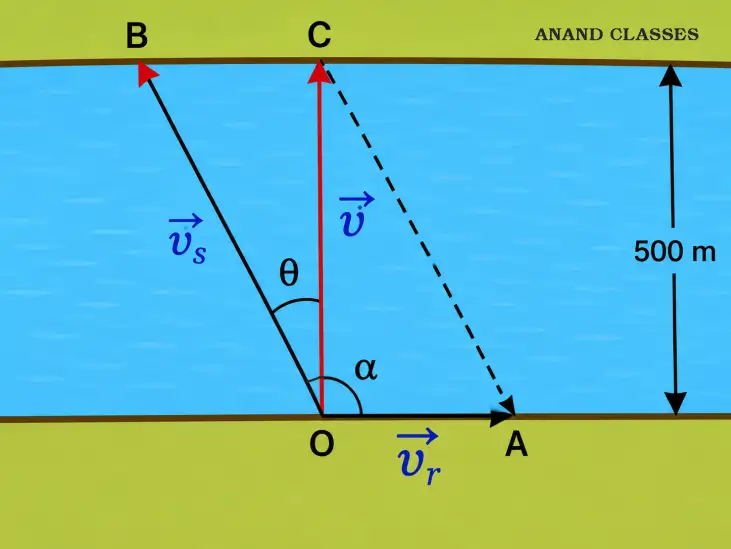
Velocity of river
Velocity of swimmer in still water
The swimmer will cross the river straight if the resultant velocity of and is perpendicular to the bank of the river, i.e., along .
This will be possible if the swimmer goes upstream of the river along OB, making an angle θ with OC. In right-angled triangle △OBC :
θ = 30°
The direction of stroke makes an angle α = 90° + 30° = 120° with the direction of river flow.
(ii) Resultant velocity of the swimmer:
(iii) Time taken to cross the river:
Build strong concepts by studying Scalars Vectors Types, Unit, Modulus or Magnitude, Negative, Equal, Orthogonal, Position, Collinear, Coplanar, Co-initial Vectors
Example.2
A person rows a boat in water with a speed of 4 m/s. Water in the river is flowing with a speed of 2 m/s. If the person rows the boat perpendicular to the direction of flow, find the resultant velocity of the boat and time taken by boat to cross the river if width of the river is 400 m.
Solution.
Here, velocity of boat, vb = 4 m/s along OB
velocity of water, vw = 2 m/s along OA,
width of river = 400 m,
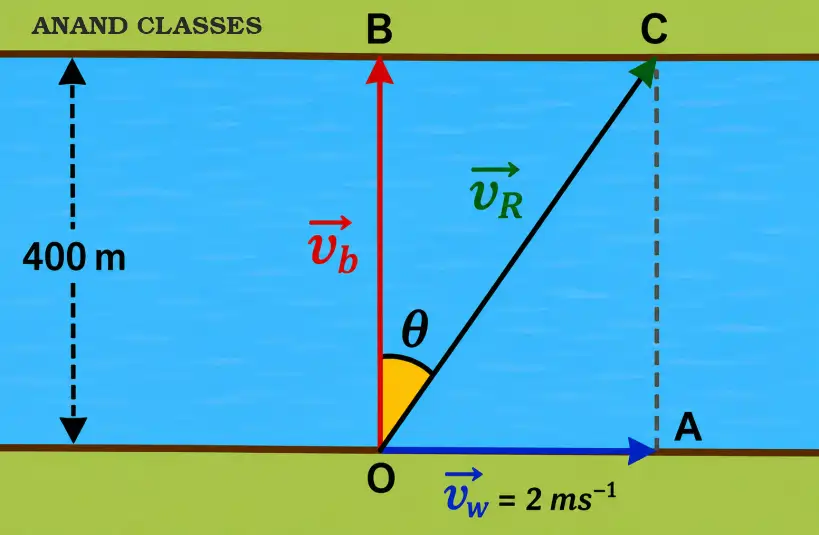
Resultant velocity of boat vR is along OC. Then:
If makes an angle θ with , then:
Time taken to cross the river:
Example.3
A man can swim at the rate of 5 km/h in still water. A river 1 km wide flows at the rate of 3 km/h. A swimmer wishes to cross the river straight.(a) Along what direction must he strike? (b) What should be his resultant velocity? (c) How much time he would take to cross?
Solution.
Given, width of river = 1 km}.
Velocity of swimmer, vs = 5 km/h; Velocity of water flowing in river, vr = 3 km/h along OA.
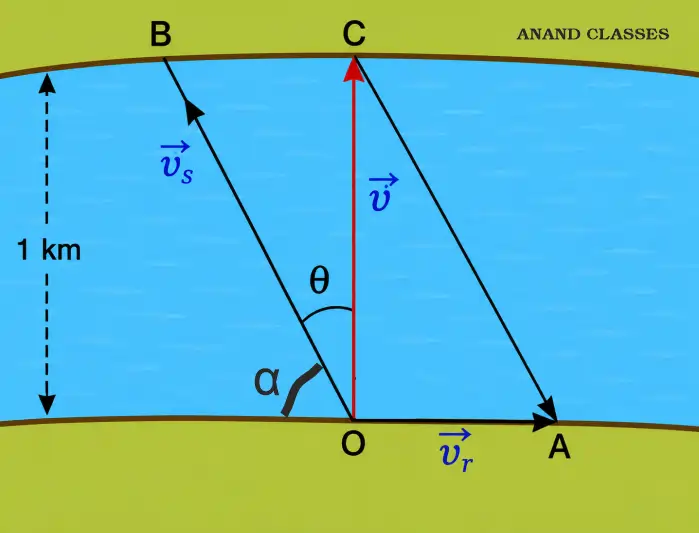
(a) The swimmer will cross straight if the resultant velocity of river flow and swimmer acts perpendicular to the direction of river flow i.e. along OC.
It will be so if swimmer moves making an angle with upstream i.e. goes along OB. Here, θ + α = 90° or θ = (90° – α).
In a triangle △OBC :
cos α = cos 53°8′
α = 53°8′ upstream
(b) Let v be the resultant velocity along OC :
(c) Time taken by swimmer to cross the river is :
FAQs on Boat and River Problem: Crossing a River Along the Shortest Path and in the Shortest Time
What is the boat and river problem in relative velocity?
The boat and river problem is a two-dimensional relative velocity problem in which a boat moves across a flowing river while the river current carries it downstream. The boat’s actual motion is determined by the vector sum of its velocity relative to the water and the velocity of the river current.
What is the difference between crossing a river along the shortest path and in the shortest time?
Shortest path: The boat is steered upstream so that the river current is exactly cancelled, allowing it to reach the point directly opposite its starting position.
Shortest time: The boat is steered perpendicular to the river bank, maximizing its velocity across the river. Although it reaches the opposite bank in the least time, it drifts downstream.
What is the formula for the relative velocity of a boat in a river?
The velocity of the boat relative to the ground is
where:
is the velocity of the boat relative to water.
is the velocity of the river current.
is the actual velocity of the boat relative to the ground.
Under what condition does a boat cross a river along the shortest path?
A boat crosses the river along the shortest path when its upstream component exactly balances the river current. This requires
where:
vb is the speed of the boat in still water,
vr is the speed of the river current,
θ is the angle made by the boat with the perpendicular to the river bank.
What is the angle required to cross a river along the shortest path?
The boat should be steered upstream at an angle satisfying
provided
What is the time taken to cross the river along the shortest path?
If the river has width d, the crossing time is
How does a boat cross a river in the shortest possible time?
To minimize the crossing time, the boat should be steered perpendicular to the river bank so that its entire speed contributes to crossing the river.
What is the time taken to cross the river in the shortest time?
If the boat moves perpendicular to the river bank, the crossing time is
where d is the width of the river.
How much downstream drift occurs during the shortest-time crossing?
The downstream drift is
Can a boat cross the river without drifting downstream?
Yes. A boat can cross without drift only if its speed in still water is greater than the speed of the river current:
In this case, the boat is steered upstream to cancel the current.
What happens if the river current is faster than the boat?
If , the boat cannot cancel the river current. Therefore, it cannot reach the point directly opposite its starting position and will always drift downstream.
Why is the shortest path not the shortest time?
When crossing along the shortest path, part of the boat’s speed is used to oppose the river current, reducing its effective speed across the river. Hence, the crossing takes longer than the shortest-time case.
Why does the shortest-time path produce downstream drift?
During the shortest-time crossing, the boat does not oppose the river current. As a result, the current continuously carries the boat downstream while it crosses the river.
Which type of river crossing takes less time?
The shortest-time crossing always requires less time than the shortest-path crossing, provided the boat speed remains constant.
What factors determine the boat’s actual path across the river?
The boat’s path depends on:
- the speed of the boat in still water,
- the speed of the river current,
- the direction in which the boat is steered, and
- the width of the river.
What are the practical applications of the boat and river problem?
The boat and river problem is used in:
- river navigation,
- ship steering,
- aircraft flying in wind,
- swimmer crossing river problems,
- rescue operations,
- relative velocity problems in competitive exams such as JEE Main, JEE Advanced, and NEET.
Which competitive exams commonly ask boat and river problems?
Boat and river problems are frequently asked in:
- JEE Main,
- JEE Advanced,
- NEET,
- NDA,
- CUET,
- engineering entrance examinations, and
- university-level physics courses.