JEE Main PYQs Solutions for Vectors (Class 11 Physics – Motion in a Plane) with detailed, step-by-step explanations designed to strengthen your conceptual understanding and problem-solving skills. This collection covers previous years’ JEE Main questions on vector algebra, vector addition and subtraction, scalar and vector products, unit vectors, and vector resolution, helping you understand the exam pattern, frequently asked concepts, and the most effective solving techniques. Practice these expertly explained PYQs to improve speed, accuracy, and confidence for your JEE Main preparation.
Why Practice JEE Main Previous Year Questions (PYQs) for topic Vectors of Chapter Motion in a Plane Class 11 Physics ?
Success in JEE Main comes from practicing the right questions with the right approach. Our JEE Main PYQs Solutions for Vectors are carefully explained to help students understand concepts, recognize question patterns, and build confidence before the exam. Prepared by Neeraj Anand and published by Anand Technical Publishers under the Anand Classes brand, this resource is designed to make revision faster, smarter, and more effective for every JEE aspirant.
Why should I choose Anand Classes JEE Main PYQs Solutions for Vectors?
Our solutions focus on clear explanations, exam-oriented preparation, and easy-to-follow methods. Authored by Neeraj Anand and published by Anand Technical Publishers under the Anand Classes brand, the content is created to help students practice with confidence and improve their performance in JEE Main.
Who are these JEE Main Vectors PYQs Solutions designed for?
These solutions are ideal for Class 11 students, JEE Main aspirants, and anyone revising the Motion in a Plane chapter. Whether you’re starting your preparation or doing final revision, this resource helps you practice authentic previous-year questions in a structured and student-friendly format.
JEE Main PYQ
Statement I: Two forces (P+Q) and (P-Q) where P ⊥ Q, when act at an angle θ1 to each other, the magnitude of their resultant is , and when they act at an angle θ2 the magnitude of their resultant becomes . This is possible only when θ1 < θ2.
Statement II: In the situation given above, θ1 = 60° and θ2 = 90°.
In the light of the above statements, choose the most appropriate answer from the options given below:
(a) Statement I is false but statement II is true.
(b) Both statement I and statement II are true.
(c) Statement I is true but statement II is false.
(d) Both statement I and statement II are false.
[2021, 31 Aug Shift-II]
Ans. (b)
Given force vectors P ⊥ Q i.e. θ = 90°
Let the resultant of (P+Q) = x and the resultant of (P-Q) = y. Assuming an initial base reference angle of 90° :
When θ1 is the angle between (P+Q) and (P-Q), then their resultant is given by :
Substituting the values of and , we get:
When θ2 is the angle between (P+Q) and (P-Q), then their resultant is given by :
Substituting the values of and , we get:
So, and , confirming θ1 < θ2. Hence, both statement I and statement II are true.
Practice more questions from JEE Main PYQs Previous Year Questions MCQs Topicwise Papers and Solutions Motion in a Straight Line
JEE Main PYQ
The resultant of these forces OP, OQ, OR, OS, and OT is approximately _______ N. [Take √3=1.7, √2 =1.4, and given and unit vectors along X, Y axis]
(a)
(b)
(c)
(d)
[2021, 27 Aug Shift-I]
![JEE Main PYQ [2021, 27 Aug Shift-I] The resultant of these forces OP, OQ, OR, OS, and OT is approximately](https://physicsanandclasses.co.in/wp-content/uploads/2026/07/JEE-Main-PYQ-2021-27-Aug-Shift-I-resolution-of-a-vector-topic.webp "JEE Main PYQs Solutions for Vectors (Class 11 Physics Motion in a Plane) 2")
Ans. (a)
![JEE Main PYQ [2021, 27 Aug Shift-I] resolution of a vector topic solution The resultant of these forces OP, OQ, OR, OS, and OT is approximately](https://physicsanandclasses.co.in/wp-content/uploads/2026/07/JEE-Main-PYQ-2021-27-Aug-Shift-I-resolution-of-a-vector-topic-solution.webp "JEE Main PYQs Solutions for Vectors (Class 11 Physics Motion in a Plane) 3")
From the given coordinate breakdown, we can write all the forces in vector notation as:
The resultant force vector is given by:
Build strong concepts by studying JEE Main Motion in a Straight Line MCQs PYQs Previous Year Questions and Solutions
JEE Main PYQ
The angle between vector and is:
(a)
(b)
(c)
(d)
[2021, 26 Aug Shift-II]
![The angle between vector A and (A −B) is [2021, 26 Aug Shift-II] JEE Main PYQ](https://physicsanandclasses.co.in/wp-content/uploads/2026/07/The-angle-between-vector-A-and-A-−B-is-2021-26-Aug-Shift-II-JEE-Main-PYQ.webp "JEE Main PYQs Solutions for Vectors (Class 11 Physics Motion in a Plane) 4")
Ans. (c)
The angle between and is θ = 180° – 120° = 60°
Let β be the angle between and . Using the dot product definition:
Expanding the left side:
Substitute cos 60° = 1/2 :
Dividing both sides by A:
Substituting this back into Equation 1:
To determine tan β, we set up a right-angled triangle where:
Adjacent = 2A – B
Using the Pythagorean theorem to find the opposite side ():
Now, we can write the expression for tan β:
Taking the inverse:
Similar topics for practice include JEE Main Units and Measurements PYQs Previous Year Questions and Solutions (Set-4)
JEE Main PYQ
The magnitude of vectors , , and in the given figure are equal. The direction of with the X-axis will be:
(a)
(b)
(c)
(d)
[2021, 26 Aug Shift-I]
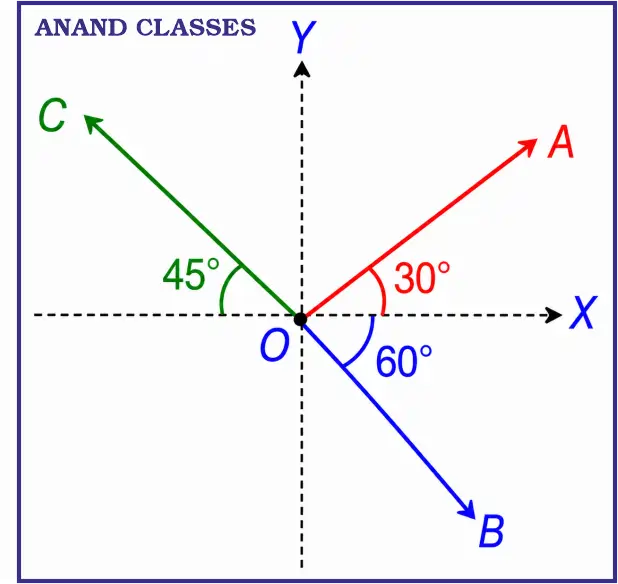
Ans. (a)
Let the equal magnitude of vectors , , and be m. Resolving into components from the vector orientations :
According to the question:
Enhance your preparation with JEE PYQs Units and Measurements Previous Year Solved Questions (Set-3)
JEE Main Question
Assertion (A):
If are four points on a semi-circular arc with centre at such that then
.
Reason (R): Polygon law of vector addition yields
.
In the light of the above statements, choose the most appropriate answer from the options given below.
(a) Both A and R are correct and R is the correct explanation of A.
(b) Both A and R are correct but R is not the correct explanation of A.
(c) A is correct but R is not correct.
(d) A is not correct but R is correct.
[2021, 27 July Shift-I]
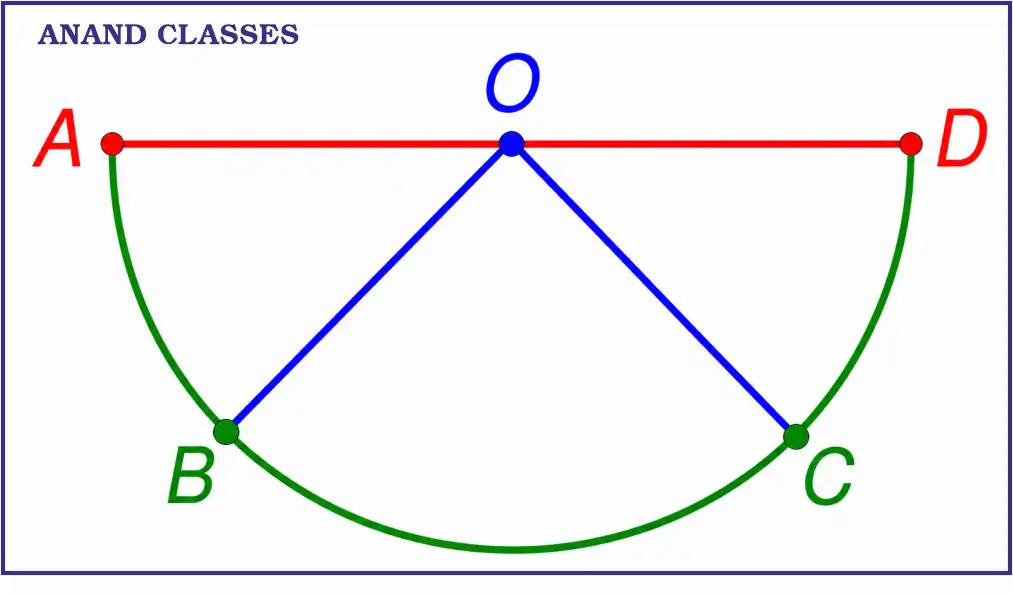
Ans. (c)
Applying the triangular law of vector addition, we can isolate expressions for each vector point:
Adding these vector definitions together:
Since (diametrically opposed bounds) , this simplifies directly to:
This satisfies Assertion (A).
According to polygon law of vector addition,
Hence, A is correct but R is not correct.
Important concepts connected to this topic are JEE Units and Measurements PYQs Previous Year Questions and Solutions (Set-2)
JEE Main Question
Two vectors and have equal magnitude. The magnitude of is times the magnitude of . The angle between and is:
(a)
(b)
(c)
(d)
[2021, 25 July Shift-II]
Ans. (b) Given
and
.
Squaring both sides and substituting :
JEE Main Question
Match List I with List II:
| List I (Vector Equations) | List II (Resultant Configurations) |
| (A) | (1) is the resultant vector () |
| (B) | (2) Cyclic vectors meeting closed boundary loops |
| (C) | (3) is the resultant vector () |
| (D) | (4) is the resultant vector () |
Choose the correct answer from the options given below.
(a) (A) → (iv), (B) → (i) , (C) → (iii), (D) → (ii)
(b) (A) → (iv), (B) → (iii) , (C) → (i), (D) → (ii)
(c) (A) → (iii), (B) → (ii) , (C) → (iv), (D) → (i)
(d) (A) → (i), (B) → (iv) , (C) → (ii), (D) → (iii)
[2021, 25 July Shift-1]
Ans: (a) (A) → (iv), (B) → (i) , (C) → (iii), (D) → (ii)
![JEE Main Question [2021, 25 July Shift-1] Match List I with List II:](https://physicsanandclasses.co.in/wp-content/uploads/2026/07/JEE-Main-Question-2021-25-July-Shift-1.webp "JEE Main PYQs Solutions for Vectors (Class 11 Physics Motion in a Plane) 7")
Using triangular law of vector addition for each case,
(A)
i.e is resultant vector.
Important Units and Measurements Links
In this chapter on Units and Measurements: Conceptual Questions and Answers, Practice Exercise, you will develop a solid foundation in measurement principles, SI units, and error analysis. The section includes important conceptual questions with clear explanations, followed by practice exercises to reinforce learning. It is designed to help students improve precision in calculations and build confidence for board and JEE exams and problem-solving.