Electric Charge is one of the most fundamental concepts in physics and forms the foundation of electrostatics, current electricity, and electromagnetism. This chapter explains the static electricity or frictional electricity, the nature of electric charge, its properties, conservation of charge, quantization of charge, origin of electric charge, Gold Leaf Electroscope and the forces acting between charged bodies. Along with complete theory, this chapter includes solved numerical problems, conceptual questions with answers and exam-oriented notes. Understanding Electric Charge is essential for Class 12 Physics, CBSE board examinations, JEE Main, JEE Advanced, NEET, CUET, NDA, IMU CET, and other engineering and medical entrance examinations.
Electrostatics or Static Electricity or Frictional Electricity
Many of us have the experience of seeing a spark or hearing a crackle, when we take off our synthetic shirts or nylon sweaters, particularly in dry weather. Sometimes, we feel the sensation of an electric shock while opening the door of our car or by holding the iron bar of a bus, after sliding from our seat. The reason for these experiences is discharge of electric charges through our body, which were accumulated due to rubbing of insulating surfaces. Another common example of electric discharge is the lightning that we see in the sky during thunderstorms.
We know that when a glass rod is rubbed with a piece of silk, the rod acquires the property of attracting light objects like bits of paper, straw, pith balls, dry leaves or even dust particles towards it. The glass rod is said to be electrified or charged. Similarly, a plastic comb gets electrified on passing through dry hair.
The metallic bodies of cars and trucks also get charged because of friction between them and the air rushing past them. This charge being large can produce even a spark. Such a spark can be dangerous in case of a petrol tanker. That is why petrol tankers often have a metal chain dragging along the ground. The charge produced leaks to the ground through this chain. Now a days, the tyres of cars and trucks are made by adding some carbon compound to the rubber. This facilitates the charge built up on the body of the vehicle to leak to the ground.
We learn from above that electric charges are produced due to friction between two insulating bodies, which are rubbed against each other. The charges on insulating bodies cannot move on their own. That is why they are called static charges.
What is frictional electricity? When is a body said to be electrified or charged ?
The property of rubbed substances due to which they attract light objects is called electricity. The rubbed substances which show this property of attraction are said to have become electrified or electrically charged. The electricity developed on objects, when they are rubbed with each other, is called frictional electricity. The electric charges so developed cannot move from one part of the object to the other part. For this reason, frictional electricity is also known as static electricity or electrostatics.
Define Frictional Electricity
The branch of Physics, which deals with the study of charges at rest (i.e., static charges), the forces between the static charges, fields and potentials due to these charges is called Electrostatics or Static Electricity or Frictional Electricity.
Give a historical view of frictional electricity. From where did the term electricity get its origin ?
Historically, this phenomenon was discovered around 600 BC by a Greek philosopher ‘Thales of Miletus‘. The name electricity was taken from Greek word ‘Elecktron‘.
Thales of Miletus, first noticed that if a piece of amber is rubbed with a woollen cloth, it then acquires the property of attracting light feathers, dust, lint, pieces of leaves, etc.
In 1600 AD., William Gillbert, the personal doctor to Queen Elizabeth-I of England, made a systematic study of the substances that behave like amber. In his book De Magnete (on the magnet), he introduced the name electrica for such substances. In fact, the Greek name for amber is elektron which is the origin of all such words : electricity, electric force, electric charge and electron.
| For Your Knowledge |
|---|
| Amber is a yellow resinous (gum like) substance found on the shores of the Baltic sea. It is a hardened sap of a tree – similar to a pine tree. |
| Most of the early experiments on electrostatics work best on a dry day, because excessive moisture provides a pathway for charge to leak off a charged object. |
| Both electric and magnetic phenomena can be derived from charged particles. Magnetism arises from charges in motion. The charged particles in motion exert both electric and magnetic forces on each other. Hence electricity and magnetism are studied together as electromagnetism. |
Electric Charge
All the substances are made of small particles called atoms, which are made of three elementary particles namely electrons, protons and neutrons. Because of their masses, these particles exert gravitational forces on each other. However, in addition to gravitational force, protons and electrons exert an extra force on each other, which is quite large as compared to gravitational force. This extra force is called electric force. Therefore, apart from their masses, protons and electrons must possess some additional intrinsic property.
The additional property of protons and electrons, which gives rise to electric
force between them, is called electric charge.
Electric charge is an intrinsic property of the elementary particles like electrons, protons, etc., of which all the objects are made up of. It is because of these electric charges that various objects exert strong electric forces of attraction or repulsion on each other.
According to William Gilbert, charge is something possessed by material objects that makes it possible for them to exert electrical force and to respond to electrical force.
Define Electric charge
Electric charge is an intrinsic property of elementary particles of matter which gives rise to electric force between various objects.
Electric charge is a scalar quantity.
Unit of Electric Charge
SI unit of electric charge is coulomb abbreviated as C. One coulomb of charge is equal to the charge of 625 × 1016 electrons.
1 coulomb = charge on 625 × 1016 electrons
Thus, when we say that a body has a positive charge of one coulomb (i.e., + 1C), it means that the body has a deficit of 625 × 1016 electrons from the normal due share.
The charge on one electron in coulomb is given by :
A proton has a positive charge (+e) and an electron has a negative charge (–e), where e = 1.6 × 10⁻¹⁹ coulomb.
Large-scale matter that consists of equal number of electrons and protons is electrically neutral. If there is an excess of electrons, the body has a negative charge and an excess of protons results in a positive charge
Two Kinds of Electric Charges
How will you show experimentally that (i) there are only two kinds of electric charges and (ii) like charges repel and unlike charges attract each other ?
About 100 years ago, Charles Du Fay of France showed that electric charges on various objects are of only two kinds. The following simple experiments prove this fact.
EXPERIMENT 1.
(i) Rub a glass rod with silk and suspend it from a rigid support by means of a silk thread. Bring another similarly charged rod near it. The two rods repel each other [Figure (a)].
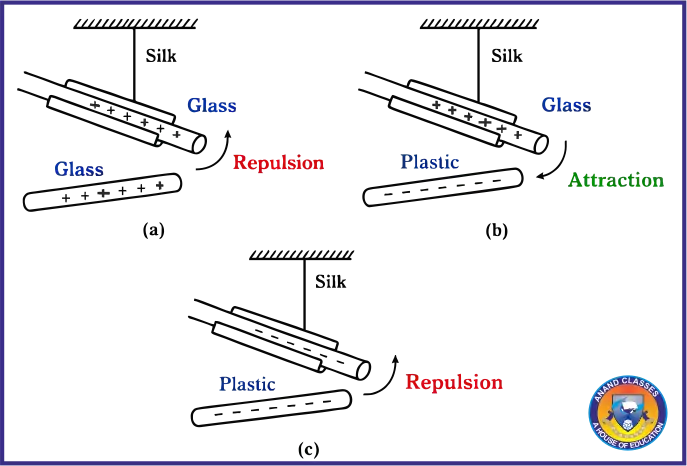
(ii) Bring a plastic rod rubbed with wool near the charged glass rod. The two rods attract each other [Figure.(b)].
(iii) Now rub a plastic rod with wool and suspend it from a rigid support. Bring another similarly charged plastic rod near it. There will be a repulsion between the two rods [Figure.(c)].
EXPERIMENT 2.
If a glass rod, rubbed with silk, is made to touch two small pith balls (or polystyrene balls) which are suspended by silk threads, then the two balls repel each other, as shown in Figure.(a). Similarly, two pith balls touched with a plastic rod rubbed with fur are found to repel each other [Figure.(b)]. But it is seen that a pith ball touched with glass rod attracts another pith ball touched with a plastic rod [Figure.(c)].

From the above experiments, we note that the charge produced on a glass rod is different from the charge produced on a plastic rod. Also the charge produced on a pith ball touched with a glass rod is different from the charge produced on pith ball touched with a plastic rod. We can conclude that:
1. There are only two kinds of electric charges-positive and negative.
2. Like charges repel and unlike charges attract each other.
The statement 2 is known as the fundamental law of electrostatics.
The above experiments also demonstrate that the charges are transferred from the rods to the pith balls on contact. We say that the pith balls have been electrified or charged by contact. This property which distinguishes the two kinds of charges is called the polarity of charge.
If a body possesses an electric charge, it is said to be charged or electrified. When it has no charge, it is said to be neutral.
Important Note :
Note that only rubbed area of non conducting body gets charged, and this charge does not move to other parts of the body. The charge is static on rubbed portion only.
What are vitreous and resinous charges ? What was wrong with this nomenclature?
Charles Du Fay used the terms vitreous and resinous for the two kinds of charges.
1. The charge developed on glass rod when rubbed with silk was called vitreous charge (Latin virtum = glass).
2. The charge developed on amber when rubbed with wool was called resinous charge (amber is a resin).
But later on, these terms were found to be misleading. For example, a ground glass rod develops resinous electricity while a highly polished ebonite rod develops vitreous electricity.
What are positive and negative charges? What is the nature of charge on an electron in this convention?
Benjamin Franklin (1706-1790), an American pioneer of electrostatics introduced the present-day convention by replacing the terms vitreous and resinous by positive and negative, respectively. According to this convention :
(i) The charge developed on a glass rod when rubbed with silk is called positive charge.
(ii) The charge developed on a plastic rod when rubbed with wool is called negative charge.
The above convention is consistent with the fact that when two opposite kinds of charges are brought in contact, they tend to cancel each other’s effect. According to this convention, the charge on an electron is negative.
Gold Leaf Electroscope (GLE)
A gold leaf electroscope (GLE) is an instrument which is used for detecting the presence of electric charge and its polarity (i.e., ± sign of charge). The instrument can also be used for measuring potential difference.
The essential parts of a gold leaf electroscope are shown in Figure. LL are two extremely thin gold foils attached to lower end of a metal rod R fitted in a glass jar G through an insulating stopper S of cork or rubber etc. D is a metal disc at the free end of the metal rod. The sensitivity of the instrument is increased by pasting two tin foils F, F on the inner side of glass jar opposite to the gold leaves.
As the gold leaves are extremely thin conducting foils which have low mass per unit area and are flexible, therefore, they respond very quickly to small electrostatic forces. Thin aluminium foils can also serve the same purpose. When a charged rod is touched with the metal disc D, the same charge is transferred to the gold leaves through the metal rod. The leaves repel eachother and diverge as shown in Figure. By measuring the divergence of leaves, the amount of charge on the body can be estimated.
Nature of electric charge on the body can be determined using a gold leaf electroscope, which is already charged.
When charge on the charged body is of opposite sign to that of the charge on GLE, then on touching the body with the disc of GLE, divergence of leaves would decrease.
When charge on the charged body is of same sign as that of charge on GLE, then on touching the charged body with the disc of GLE, the divergence of leaves would increase.
Origin of Electric Charge in Electrostatics
It is known that all matter is made up of atoms and/or molecules, the basic unit being an atom. We also know that every atom consists of a central core called the atomic nucleus, around which negatively charged electrons revolve in circular orbits. Every atom is electrically neutral, containing as many electrons as the number of protons in the nucleus. Thus, even though normally, the materials are electrically neutral, they do contain charges, but their charges are exactly balanced.
The vast amount of charge in an object is usually hidden as the object contains equal amounts of positive charge and negative charge. With such an equality or balance of charge, the object is said to be electrically neutral, i.e., it contains no net charge.
If the positive and negative charges are not in balance, then there is a net charge. Thus, an object is charged if it has a charge imbalance or some net charge. Hence, to electrify or charge a neutral body, we need to add or remove one kind of charge. When we say that a body is charged, we always refer to excess charge or deficit charge.
In solids, some of the electrons are less tightly bound in the atom. These are the charges, which are transferred from one body to the other.
When we rub two insulating substances against each other, we provide energy to overcome friction between them. This energy is used in removing electrons from one substance and transferring them to the other. The transfer takes place from the material in which electrons are held less tightly (with lower work function) to the material in which electrons are held more tightly (with higher work function), i.e., electrons are transferred from the material whose work function u lower to the material whose work function is higher. Consequently, the material which loses electrons acquires a positive charge and material which gains electrons acquires an equal negative charge. For example, when we rub a glass rod with silk, electrons are transferred from glass rod to silk. The glass rod becomes positively charged and silk acquires an equal negative charge. Thus, charging by rubbing is due to actual transfer of electrons.
The cause of charging is actual transfer of electrons from one material to the other. The insulating material with lower work function loses electrons and becomes positively charged and vice-versa.
Further, as an electron has a mass, howsoever small it may be, therefore there does occur some change in mass on charging. A positively charged body has lost some electrons and hence its mass reduces slightly. On the other hand, a negatively charged body has gained some electrons and hence its mass increases slightly.
Note that in rubbing two insulating bodies, the number of electrons that are transferred, is a very small fraction of the total number of electrons in the material bodies. Hence, the charge acquired by friction is a very small fraction (≈ 10-6 coulomb) of the total positive and negative charge content of the bodies.
Further, as only the less tightly bound electrons in a material body can be transferred from it to another by rubbing, only under suitable conditions, we have to stick to certain pairs of materials to observe charging on rubbing the bodies.
Table.1 gives a list of the pairs of objects which get charged on rubbing against each other. On rubbing, an object of column I will acquire positive charge while that of column II will acquire negative charge.
| Column I (Positive charge) | Column II (Negative charge) |
| Glass rod | Silk cloth |
| Flannel or cat skin | Ebonite rod |
| Woollen cloth | Amber rod |
| Woollen coat | Plastic seat |
| Woollen carpet | Rubber shoes |
Obviously, any two charged objects belonging to the same column will repel each other while those of two different columns will attract each other.
Further, different substances have been arranged in a series, called Triboelectric Series. When any two of the substances in series are rubbed together, the one occurring earlier in the series acquires positive charge and the other occurring later in series acquires negative charge. Some of the substances in triboelectric series are as follows :
- Fur
- Flannel
- Sealing wax
- Glass
- Cotton
- Paper
- Silk
- Human body
- Wood
- Metals
- Rubber
- Resin
- Amber
- Sulphur
- Ebonite
- Guta parcha
Thus glass acquires a positive charge when rubbed with silk but it acquires negative charge when rubbed with fur.
Are the Electric origin of frictional forces ?
The only way by which an electron can be pulled away from an atom is to exert a strong electric force on it. As electrons are actually transferred from one body to another during rubbing, so frictional forces must have an electric origin.
For Your Knowledge
- The cause of charging is the actual transfer of electrons from one material to another during rubbing. Protons are not transferred during rubbing.
- The material with lower work function loses electrons and becomes positively charged.
- As an electron has a finite mass, therefore, there always occurs some change in mass during charging. The mass of a positively charged body slightly decreases due to loss of some electrons. The mass of a negatively charged body slightly increases due to gain in some electrons.
Conductors, Insulators and Dielectrics
Most of the substances in nature are divided into two categories, namely, conductors and insulators.
A substance which can be used to conduct electric charge from one end to the other is called a conductor. Silver is one of the best conductors. Other examples of conductors are copper, iron, aluminium, mercury, coal etc. Earth is a good conductor. Human body is also a good conductor of electricity. The liquid conductors include, salt solutions, acids, alkalis etc.
In metallic conductors, there are very large number of free electrons which act as carriers of charge. Infact, in a metal, the outer (valence) electrons part away from their atoms and are free to roam about in the body of the metal, but they cannot leave the metal under normal circumstances due to metallic bonding. The free electrons form a kind of electron gas, they collide with one another; and also with the metal ions; and move randomly in different directions. In an external electric field, the free electrons drift against the direction of the field. The residual atoms made up of nuclei and the bound electrons remain held in their fixed positions. They constitute the bound charges in the conductor as they cannot move. In electrolytic conductors, the charge carriers are both, the positive and negative ions.
The insulators are the materials which cannot conduct electricity, i.e., they are poor conductors of electricity. Common examples of insulators are glass, rubber, plastic, ebonite, mica, wax, paper, wood etc. They are called insulators, because they prevent charge from going to places where it is not desired. Such substances possess almost no free electrons.
Infact, in an insulator, each electron is attached or bound to a particular atom and is not free to move in the body of the insulator. As each electron stays near its ‘parent’ nucleus or within its atom or molecule, and cannot move far away from it, therefore, an insulator does not possess freely movable charges. Hence it fails to conduct electricity.
Insulators are also called Dielectrics. Obviously, dielectrics cannot conduct electricity. However, when an external electric field is applied on them, induced charges appear on the surface of the dielectric. Hence we may define dielectrics as the insulating materials which transmit electric effects without conducting.
When some charge is transferred to a conductor, it gets distributed readily over the entire surface of the conductor. In contrast, if some charge is put on an insulator, it stays at the same place.
Do You Know ?
A nylon or plastic comb gets electrified on combing dry hair or on rubbing. But a metallic rod does not get electrified on rubbing. This is because the human body is a good conductor of electricity, so any charge developed on the metal rod is transferred to the earth through the human body. We can electrify the rod by providing it a plastic or a rubber handle and rubbing it without touching its metal part.
What is meant by earthing or grounding in household circuits ? What is its importance?
When a charged body is brought in contact with the earth (through a connecting conductor), its entire charge passes to the ground in the form of a momentary current. This process in which a body shares its charges with the earth is called grounding or earthing.

The electricity from the mains is supplied to our houses using a three-core wiring : live, neutral and earth wires. The live wire red in colour brings in the current. The black neutral wire is the return wire. The green earth wire is connected to a thick metal plate buried deep into the earth. The metallic bodies of the electric appliances such as electric iron, refrigerator, TV, etc. are connected to the earth wire. When any fault occurs or live wire touches the metallic body, the charge flows to the earth and the person who happens to touch the body of the appliance does not receive any shock
Charging by Induction
We know that a body can be charged by putting it in contact with another charged body either directly or by means of a conductor. For example, when a charged ebonite rod is in contact with a pith ball or connected to it by a copper wire, it transfers some of its negative charge to the pith ball. This is charging by conduction., i.e. charging by actual contact.
When a charged body A is brought near an uncharged metallic body B, then some charge of opposite sign appears on the near face of body B and an equal charge of same sign appears on the rear face of body B. The total charge on body B is zero. In this process, body A does not lose any charge as it is not in direct contact with body B. This phenomenon of charging body B without actual contact is called charging by induction.
Thus, phenomenon of charging an uncharged conducting body, by bringing a charged body near it, without making a direct contact between the two bodies is called charging by induction.
The steps involved in charging a metallic sphere by induction are shown in Figure below.
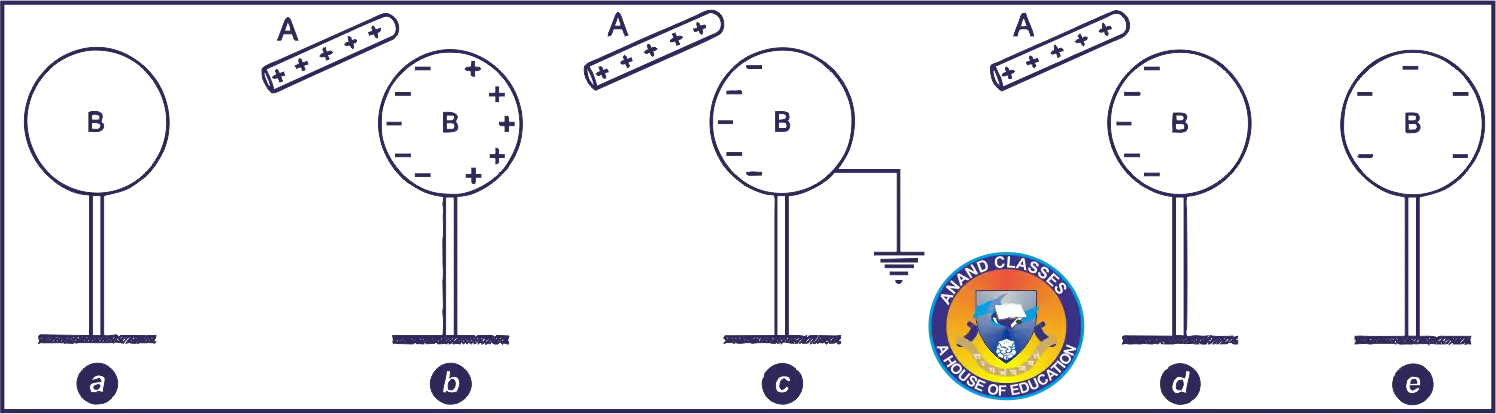
(a) To begin with, a metallic sphere B on an insulating stand is uncharged. Figure.(a).
{b) When a positively charged glass rod A is brought near the uncharged metallic sphere, free electrons of the sphere are attracted and start piling up at the near end. This end therefore, becomes negatively charged and the farther end of the sphere becomes positively charged to the same extent, due to deficit of electrons as the sphere on the whole remains neutral. Figure.(b). The redistribution of charge is almost instantaneous and stops as soon as net force on free electrons in the metallic sphere becomes zero.
(c) When the sphere is grounded, i.e., it is connected to earth by a conducting wire, electrons flow from the ground to the sphere and neutralise the positive charge on the farther end of the sphere. The negative charge at the near end of the sphere remains bound there due to attractive force of glass rod, Figure.(c).
(d) When the sphere is disconnected from the ground, the negative charge continues to be held on the near end, Figure.(d).
(e) When the glass rod is removed, the negative charge spreads uniformly over the sphere B, Figure.(c).
Similar steps are involved when a negatively charged rod is used for charging the sphere positively by induction.
Let us now understand how we charge two spheres by induction, Figure.(a) shows two metal spheres.
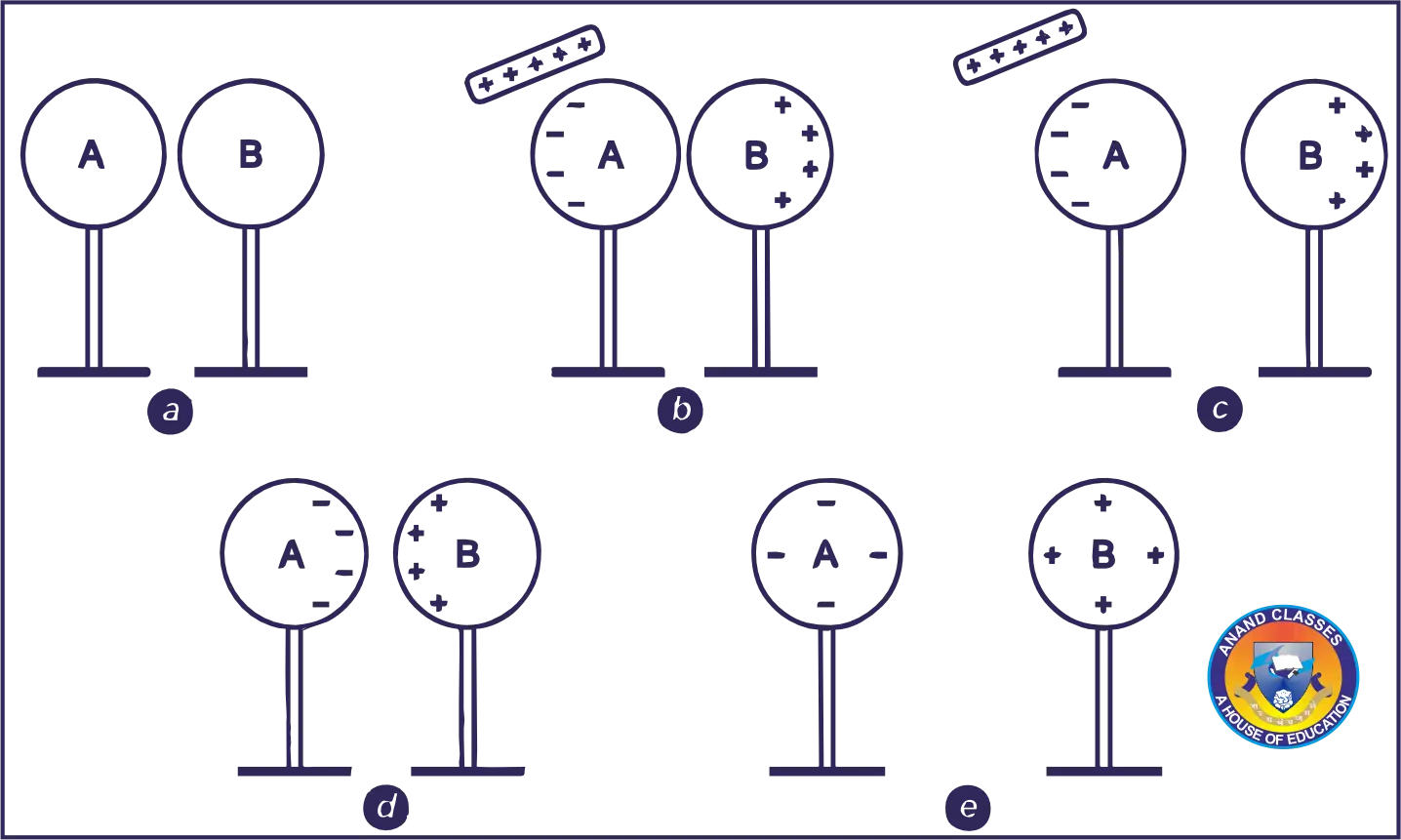
A and B supported on insulating stands, held in contact with each other. Let a positively charged glass rod be brought near the sphere A. Free electrons in both the spheres are attracted towards the rod. Therefore, left surface of left sphere A has an excess of negative charge and right surface of right sphere B has an excess of positive charge. Note that all the electrons in the spheres have not accumulated on the left surface of sphere A. This is because as negative charge starts building up at the left face of A, further electrons are repelled by these. An equilibrium is reached almost instantly under the action of force of attraction of the rod and the force of repulsion due to the accumulated negative charges. Figure.(b) shows this equilibrium situation.
Further, the accumulated charges Would remain on the surfaces as shown till the glass rod is held near the sphere A. If the rod were removed, the charges would return to their original neutral state in the absence of any outside force.
Separate the spheres A and B by a small distance, while the glass rod is still held near the sphere A. The two spheres carry opposite charges as shown in Figure(c). They attract each other. Remove the glass rod. The status of charges on the spheres is shown in Figure.(d).
When the spheres are now separated widely, the charges on them get uniformly distributed as shown in Figure.(e).
This is how two metal spheres get oppositely charged by induction. Note that in this process of electric induction, the positively charged glass rod does not lose any charge. This is contrary to charging by conduction, i.e., charging by actual contact where the charged glass rod loses some charge.
Quantization of Electric Charge
Quantization of electric charge is the property by virtue of which the charge on a body is an integral multiple of a basic unit of charge (e) carried by an electron or proton. Thus, charge q of a body is always given by
q = ne
Where, n is any positive or negative integer.
The basic unit of charge is the charge that an electron or proton carries. By convention, charge on an electron is taken to be negative. Therefore, charge on an electron is written as (-e) and charge on a proton is (+ e).
The value of the basic unit of charge or elementary charge is
e = 1.6 × 10⁻¹⁹ C
It is one of the important constants of nature.
If a body contains n1 electrons and n2 protons, the total amount of charge on the body is
q = n2(e) + n1(-e) = (n2 – n1) e
As n1 and n2 are integers, their difference must also be an integer. Thus, the charge on anybody is always an integral multiple of e, and can be increased or decreased also in steps of e.
Thus, any charged body or charged particle can possess charge equal to ±1e, ±2e, ±3e and so on, i.e., the possible values of charge are
q = ±1 e = ±1 × 1.6 × 10-19 C = ± 1.6 × 10⁻¹⁹ C
q = ±2 e = ±2 × 1.6 × 10-19 C = ± 3.2 × 10⁻¹⁹ C
q = ±3 e = ±3 × 1.6 × 10-19 C = ± 4.8 × 10⁻¹⁹ C
q = ±4 e = ±4 × 1.6 × 10-19 C = ± 6.4 × 10⁻¹⁹ C
and so on. The values of charge lying in between these values are not possible.
The cause of quantization is that only integral number of electrons can be transferred from one body to another. For example, when one electron is transferred, the charges acquired by the two bodies will be q=±1e = ± 1.6 × 10⁻¹⁹ C. Similarly, when n electrons are transferred, the charges acquired by the two bodies will be q =±ne = ± n × 1.6 × 10⁻¹⁹ C.
The quantization of charge was first suggested by the experimental laws of electrolysis discovered by Faraday. It was actually demonstrated experimentally by Millikan in 1912. Thus, quantization of charge is an experimentally verified law in all domains of nature. Like charge; energy and angular momentum are also quantized.
What are Quarks ?
Recent discoveries have shown that protons and neutrons are made up of quarks. These new particles have charges ±e/3 and ±2e/3. However, these particles are not known to exist in free state. That is why their charges are not taken as elementary charges. The basic unit of charge which has independent existence is ‘e’ only. Various quarks and antiquarks alongwith their charges are listed in Table.2.
| S. No. | QUARK | ANTI-QUARK |
| 1. | up (u) = +2e/3 | anti-up = -2e/3 |
| 2. | down (d) = -e/3 | anti-down = e/3$ |
| 3. | charm (c) = +2e/3 | anti charm = -2e/3 |
| 4. | strange (s) = -e/3 | anti strange = e/3 |
| 5. | top (t) = +2e/3 | anti-top = -2e/3 |
| 6. | bottom (b) = -e/3 | anti-bottom = e/3 |
Retain in Memory
Quantization of charge is meaningful only at the microscopic level, where the charges involved are of the order of a few tens or hundreds of e, i.e., they can be counted. Such charges appear in discrete lumps and quantization of charge cannot be ignored.
However, at the macroscopic level, we deal with charges of a few microcoulomb. A charge of magnitude 1 µC contains electrons whose number which is very large. At this scale, the fact that charge can increase or decrease only in units of e is not visible. The grainy nature of charge is lost and it appears to be continuous.
Solved Numerical Examples Based on Quantization of Electric Charge for Class 12 Physics, JEE, NEET, CUET and NDA Exams
Solved Numerical Examples Based on Quantization of Electric Charge with detailed step-by-step solutions for Class 12 Physics, JEE Main, JEE Advanced, NEET, CUET, NDA, and other competitive examinations are as follows.
Is a charge of 5.8 ×10⁻¹⁸ C possible ?
Solution. From formula
q = ne,
As n is not an integer, this value of charge is not possible.
What is the charge on a body from which one million electrons are removed?
Solution.
Here, n = 106 , e = 1.6 × 10⁻¹⁹ C
As electrons are removed from the body, charge acquired by body is positive.
q = ne = 106 × 1.6 × 10-19 C = 1.6 × 10⁻¹³ C
A copper sphere of mass 2g contains nearly 2 × 10²² atoms. The charge on the nucleus of each atom is 29e. What fraction of the electrons must be removed from the sphere to give it a charge of +2μC ?
Solution.
Total number of electrons in the sphere:
N = 29 × 2 × 1022 = 5.8 × 10²³
Number of electrons removed to acquire a charge q = +2μC = +2 × 10⁻⁶ C.
Fraction of electrons removed:
A person combs his hair on a dry day. The comb causes 1010 electrons to leave the person’s hair and stick to the comb. Calculate the charge the comb carries.
Solution:
Here, Number of electrons transferred, n = 1010,
Charge on an electron, e = 1.6 × 10⁻¹⁹ C
Using the quantization of charge formula q = ne
Due to the excess of electrons, the charge on the comb is -1.6 × 10⁻⁹ C or -1.6 nC).
Estimate the number of free electrons in 36g of water and the negative charge possessed by them. Given: Avogadro’s number = 6.023 × 10²³ and molecular weight of water = 18.
Solution:
Number of molecules in 36g of water:
A water (H2O) molecule is made up of two hydrogen atoms and one oxygen atom. Each hydrogen atom contains one electron and each oxygen atom contains 8 electrons. So, each molecule of water has 10 electrons.
Number of electrons (n) in 36g of water:
Negative charge possessed by them (q = ne):
What is the total charge on 75 0 kg of electrons ?
Total mass of electrons, M = 75.0 kg
Mass of a single electron, me = 9.1 × 10⁻³¹ kg
Charge on a single electron, e = -1.6 × 10⁻¹⁹ C
The total number of electrons (n):
The total charge (q): Using the quantization of charge formula q = ne :
The total charge on 75.0 kg of electrons is approximately -1.32 × 10¹³ C.
How many mega coulombs of positive (or negative) charge are in 1.00 mole of neutral molecular hydrogen gas (H2)?
Solution:
Number of hydrogen molecules in 1.00 mole : N = 6.023 × 10²³
Since each H2 molecule contains 2 protons and 2 electrons, the total number of positive or negative charges is:
n = 2 × 6.023 × 1023 = 12.046 × 10²³
Total charge (q = ne):
Since 1 MC = 106 C :
q = 0.1927 MC
The total positive (or negative) charge in 1.00 mole of H2 gas is 0.1927 MC.
Calculate the total positive or negative charge on a 3.11g copper penny. Given, Avogadro’s number = 6.023 × 10²³ per gram mole; for copper, atomic charge = 29 and atomic mass = 63.5.
Solution:
Number of atoms in the penny:
As each atom contains 29 protons and 29 electrons, the total number of positive or negative charges is n = n’ × 29.
Total positive/negative charge on the penny (q = ± ne):
q = ± 1.37 × 10⁵ C
The total positive or negative charge on the penny is ±1.37 × 10⁵ C.
Additivity of Charge
Additivity of charge is a property by virtue of which total charge of a system is obtained simply by adding algebraically all the charges present anywhere on the system.
It means charges are scalars like the mass of a body and are added by simple laws of Mathematics.
If a system contains n charges then the total charge of the system is
Charge has magnitude only, but no direction, similar to the mass. However, mass of a body is always positive, but charge can be either positive or negative. Therefore, proper signs have to be used while adding the charges in a system.
For example, if a system contains charge +q, -2q, +3q and +5q, then the total charge of the system is =+q – 2q + 3q + 5q =+7q
Conservation of Charge
Conservation of charge is the property by virtue of which total charge of an isolated system always remains constant or conserved.
An isolated system
An isolated system is that which is free from external influence i.e., no charged matter is allowed to enter or leave the volume of space occupied by the isolated system.
Within an isolated system consisting of many charged bodies, charges may get redistributed due to interactions among the bodies, but the total charge of the system shall remain the same.
For example, when we rub two insulating bodies, what one body gains in charge, the other body loses the same amount of charge. Thus, it is not possible to create or destroy net charge carried by any isolated system. However, charge carrying particles may be created or destroyed in a process.
For example, a neutron turns into a proton and an electron. The proton and electron thus created have equal and opposite charges. The total charge is zero before and after the creation. Thus, charges can be created or destroyed in equal and unlike pairs only.
Following examples illustrate the property of conservation of charge.
(i) In the phenomenon of pair production, a γ ray photon materialises into an electron and a positron having total charge -e + e = 0 which is the initial charge on a photon.
γ = e– + e+ (pair production)
(ii) In annihilation of matter, an electron and a positron annihilate eachother to produce two γ-ray photons with zero charge. Charge is thus conserved.
e– + e+ = γ + γ (annihilation)
(iii) In all radioactive decays, charge number is always conserved. For example, in radioactive decay of U-238, the nucleus is transformed into Th-234 with the emission of an alpha particle, which is a helium nucleus, i.e.,
(radioactive decay)
(iv) In all nuclear transformations, charge number is always conserved. For example:
IMPORTANT NOTE
Note that in applying the conservation of charge principle, we must add the charges algebraically, with regard to their signs.
Difference Between Charge and Mass
We are familiar with role of mass in gravitation, and we have just studied some features of electric charge. We can compare the two as shown in Table.3.
| CHARGE | MASS |
| 1. Electric charge on a body may be positive, negative or zero. | 1. Mass of a body is a positive quantity. |
| 2. Charge carried by a body does not depend upon velocity of the body. | 2. Mass of a body increases with its velocity as where c is velocity of light in vacuum, m is the mass of the body moving with velocity v and m0 is rest mass of the body. |
| 3. Charge is quantized. | 3. The quantization of mass is yet to be established. |
| 4. Electric charge is always conserved. | 4. Mass is not conserved as it can be changed into energy and vice-versa. |
| 5. Force between charges can be attractive or repulsive, according as charges are unlike or like charges. | 5. The gravitational force between two masses is always attractive. |
| 6. The force between two charges follows inverse square law. | 6. The force between two masses also follows inverse square law. |
| 7. Charge cannot exist without mass. | 7. Mass can exist without charge. |
| 8. Unit of charge is a derived unit 1C = 1 As (Ampere second) | 8. Unit of mass is a fundamental unit. |
| 9. An accelerated charge emits radiation. | 9. Accelerated mass emits no radiation. |
Conceptual Short Questions and Answers Based on Electric Charge for CBSE Board Class 12 Physics Exam
Conceptual Short Questions and Answers Based on Electric Charge for CBSE Board Class 12 Physics examination are as follows.
The electric charge of any body is actually a surplus or deficit of electrons. Why not protons ?
Electrons are loosely bound to atoms and can be readily exchanged during rubbing. Protons are firmly bound inside the nucleus. They cannot be easily detached. This is the reason why electric charge of any body is just a surplus or deficit of electrons.
A charge Q is kept in the inner cavity and a charge 2Q is given to the inner shell. A charge 3Q is given to the outermost shell, as shown in Figure. Find the charges at the surfaces A, B and C.
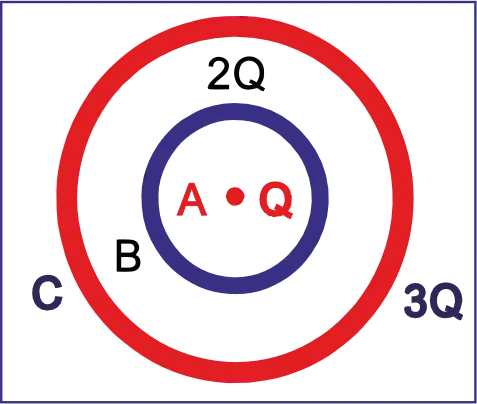
Due to induction, –Q charge is induced on the inner surface A of inner shell and +Q charge is induced on the outer surface B of inner shell. Thus, charge on surface A =-Q
Now charge on surface B = 2Q + Q = 3Q
Due to induction, -3Q charge is induced on the inner surface of outer shell C and +3Q charge is induced on the outer surface of outer shell C.
Thus, total charge on surface C = 3Q + 3Q = 6Q.
A glass rod rubbed with silk is brought close to two uncharged metallic spheres in contact with each other, inducing charges on them as shown in Figure.
Describe what happens when
(i) the spheres are slightly separated and
(ii) the glass rod is subsequently removed and finally
(iii) the spheres are separated far apart.

A glass rod rubbed with silk acquires positive charge. When this rod is brought close to two uncharged metallic spheres A and B in contact, negative charge is induced on the left side of sphere A and an equal positive charge is induced on the right side of sphere B, Figure(a).
(i) When the spheres are slightly separated, the induced charges are shown in Figure(b).
(ii) As the glass rod is removed subsequently and separation is too small, the distribution of charges on A and B remains the same as shown in Figure.(b).
(iii) When A and B are placed at a large distance, the positive and negative charges on each flow and neutralise, so that no charge is left on A or B.
A comb run through one’s hair attracts small bits of paper. Why? What happens if the hair are wet or if it is a rainy day? (NCERT Solved Example)
This is because the comb gets charged by friction. If the hair are wet, or if it is a rainy day, friction between the hair and the comb reduces. The comb does not get charged, and it will not attract small bits of paper.
Ordinary rubber is an insulator. But the special rubber tyres of aircrafts are made slightly conducting. Why is this necessary ? (NCERT Solved Example)
The special rubber tyres of air crafts are made slightly conducting so that electricity generated on account of friction between the tyres and the runway goes to earth.
Vehicles carrying inflammable materials usually have metallic ropes touching the ground during motion. Why? (NCERT Solved Example)
When a vehicle moves, its body gets charged on account of friction due to air. The tyres also accumulate the charge on account of friction between the tyres and the road. The metallic ropes from the vehicle touching the ground enable the accumulated charges to flow to earth. This would otherwise be hazardous to the inflammable materials.
A bird perches on a bare high power line, and nothing happens to the bird. A man standing on the ground touches the same line and gets a fatal shock. Why? (NCERT Solved Example)
When a bird perches on single bare high power line, nothing happens to him as no current flows through his body because the circuit is not complete. In case of a person standing on ground, the circuit is completed with the ground through his body. Current flows through his body resulting in a fatal shock.
An insulating rod carries some net charge, and a copper sphere is neutral. The rod and the sphere do not touch. Can there be force of attraction/repulsion between the two?
When the charged rod is brought near the neutral sphere, the sphere gets oppositely charged by induction. Therefore, the sphere and the rod will attract each other. However, force of repulsion between the two is not possible.
Neutral metal objects, especially in industry, are often coated with electrically charged paint or powder particles. How do these particles stick on the metal objects?
The electrically charged paint/powder particles charge the neutral metal surface oppositely by the process of induction. The particles stick on the metal objects on account of force of attraction between unlike charges.
What is the cause of charging?
The cause of charging is actual transfer of electrons from one body to the other.
An isolated conducting sphere is given a positive charge. Does its mass increase, decrease or remain the same ?
Its mass decreases slightly as it loses some electrons.
What is meant by quantization of charge ?
Charge on any body or particle can be integral multiple of charge on an electron (-e), i.e., q = ± ne, where n = 1,2,3,……
What do you mean by conservation of electric charge ?
Conservation of electric charge means that the total charge on an isolated system remains unchanged with time.
Is the total charge of the universe conserved?
Yes, charge conservation is a global phenomenon.
Name any two basic properties of electric charge.
(i) Quantization of charge (ii) Conservation of charge.
What is the value of charge on an electron ? Is a charge less than this value possible ?
e = -1.6 × 10⁻¹⁹ C. No, charge less than this value does not exist.
Give two points of distinction between charge and mass.
Charge can be positive, negative or zero. But mass is a positive quantity. Further, electric charge is always conserved. But mass is not conserved as it can be changed into energy and vice-versa.
Can ever photons have a charge? If not why ?
No, photons can never have a charge. This is because charge cannot exist without rest mass.
Which of the following quantities depends on state of rest or motion of a body: (a) mass (b) length (c) time (d) charge (e) charge density and (f) phase?
Mass, length, time and charge density depend on state of rest or motion of a body. However, charge and phase are invariant.
Is the force acting between two point charges q1 and q2 kept at some distance in air, attractive or repulsive when : (i) q1q2 > 0 (ii) q1q2 < 0
(i) When q1q2 > 0, the force is repulsive.
(ii) When q1q2 < 0, the force is attractive.
Four Properties of Electric Charges
(i) Like charges repel and unlike charges attract each other.
(ii) Charge is quantized.
(iii) Charge is conserved.
(iv) Charge on a body is not affected by its motion (it is invariant).
What role does electrostatics play in a xerox copying machine ?
A xerox copying machine is one of the many industrial applications of the forces of attraction and repulsion between charged bodies. Particles of black powder, called toner, stick to a tiny carrier bead of the machine on account of electrostatic forces. The negatively charged toner particles are attracted from carrier bead to a rotating drum, where a positively charged image of document being copied has formed. A charged sheet of paper then attracts the toner particles from the drum to itself. They are then heat fused in place to produce the photo copy.
What are some other applications of electrostatics?
(i) Electric capacitors or condensers, which have variety of applications are based on the principle of electrostatics.
(ii) High electric potential sources like van-de-graaf generator are based on principle of electrostatics.
(iii) Pollution is controlled by electrostatic precipitators of fly ash.
(iv) Spray paintings and powdered coatings are based on the principle of electrostatics.
(v) Power factor correctors, which reduce energy losses are based on the principle of electrostatics.
(vi) Electrostatic shielding protects sensitive instruments from external electric fields.
(vii) Natural phenomena like lightning and thunder storms are explained on the basis of electrostatics.
(viii) Electrostatics plays a great role in the reproduction of flowers.
When your friend chews a winter green life saver in a dark room, you see a faint flash of blue light from his mouth. How ?
This display of light is often called sparking. It occurs due to electric discharge of the electrostatic charges produced in chewing the winter green life saver.