
This article explains the torque and potential energy of an electric dipole in an electric field, including the behaviour of a dipole in uniform and non-uniform electric fields, solved numerical problems, and conceptual questions and answers useful for CBSE Class 12 Physics, JEE, and NEET preparation.
Torque on an Electric Dipole in a Uniform Electric Field
Consider an electric dipole consisting of two equal and opposite point charges –q at A and +q at B separated by a small distance AB = 2a, having dipole moment = q × 2a as shown in Figure.
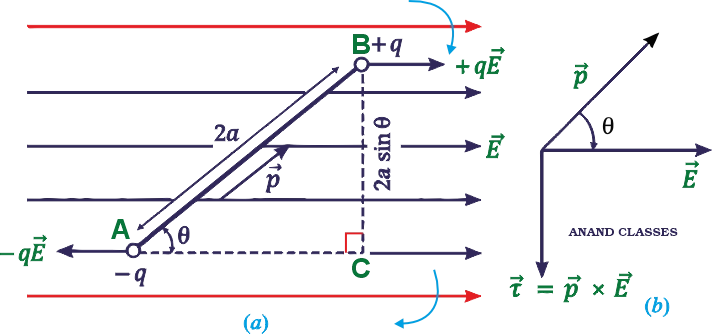
Let this dipole be held in a uniform external electric field at an angle θ with the direction of .
Force on charge +q at A = q, along the direction of electric field
Force on charge –q at B = q, in a direction opposite to electric field
Since electric field is uniform, therefore, net force on the dipole is (qE – qE) = 0 i.e.
Hence the net translating force on a dipole in a uniform electric field is zero. But the two equal and opposite forces act at different points of the dipole. They form a couple which rotates the dipole in the anticlockwise direction and exerts a torque.
However, as the forces are equal, unlike and parallel, acting at different points, therefore, they form a couple which rotates the dipole in the anticlockwise direction, as shown in Figure. Thus, the couple tends to align the dipole axis along the direction of electric field .
Draw AC⊥. Therefore perpendicular distance between the forces = arm of couple = AC
As torque = moment of the couple
τ = force × arm of couple
Torque (τ) = Either force × Perpendicular distance between the two forces
τ = F × AC
τ = F × AB sin θ
τ = F × 2a sin θ
τ = (qE) 2a sin θ
τ = (q × 2a) E sin θ
As q × 2a = p, therefore,
τ = pE sin θ
In vector form, we can rewrite the above equation.
The direction of is given by right hand screw rule and is perpendicular to and , i.e., perpendicular to the plane of the paper and outwards.
Special cases.
Stable equilibrium : As stated already, this torque tries to align the electric dipole in the direction of the field.
When dipole moment is along the direction of electric filed i.e. θ = 0°,
τ = pE sin 0° = 0
The dipole is in stable equilibrium.
Unstable equilibrium : However, when dipole is held in a direction opposite to the direction of electric field , the torque would turn the dipole through 180°. As such, the dipole will be in an unstable equilibrium.
Maximum Torque
The torque will be maximum, when θ = 90°
Maximum value of torque (τmax) = pE sin 90° = pE
Obviously, units of torque τ are N-m and its dimensional formula is [M1 L2 T-2].
Definition of Dipole Moment in terms of Torque
We know that the torque,
τ = pE sin θ
If E =1 unit, θ = 90°, then τ = p
Hence dipole moment may be defined as the torque acting on an electric dipole, placed perpendicular to a uniform electric field of unit strength.
| Noteworthy Points for CBSE Board, JEE and NEET |
|---|
| When dipole is placed in uniform electric field, it experiences only a torque. Net force on the dipole is zero. |
| Torque on the dipole becomes zero, when it aligns itself parallel to the electric field. |
| Torque on the dipole is maximum, when dipole is placed at right angles to the direction of the electric field. Maximum value of torque (τmax) = pE sin 90° = pE |
Master related concepts such as Electric Dipole Moment, Electric Field on Axial and Equatorial Line of Electric Dipole and on axis of Uniformly Charged Ring with Numericals
Electric Dipole in a Non Uniform Electric Field
In a non-uniform electric field (say E1 at +q and E2 at –q), the +q and –q charges of a dipole experience different forces in the non-uniform field and hence a net force acts on the dipole in a non-uniform field is not equal to zero.
Also, a net torque acts on the dipole which depends on the location of the dipole in the non-uniform field.
where is the position vector of the centre of the dipole.
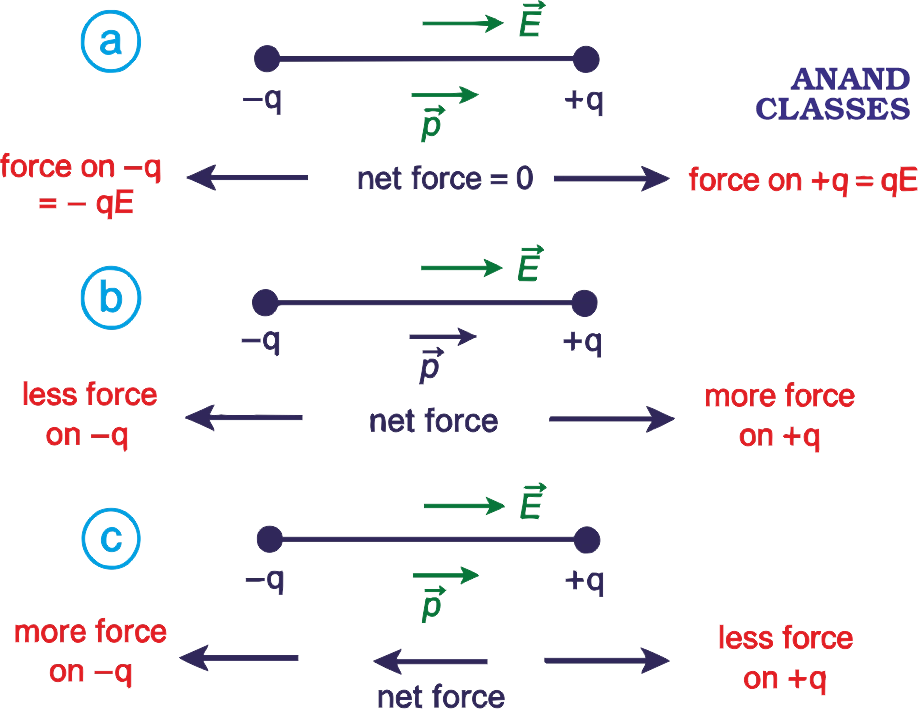
Note I. As shown in Figure.(a), When electric dipole is in a uniform electric field and is along the direction of dipole moment (i.e. along ).
Net torque = pE sin 0° = 0, as θ = 0°
Note II. When the dipole is parallel or antiparallel to . In a non-uniform field, if is parallel to or antiparallel to , the net torque on the dipole is zero (because the forces on charges ±q become linear). However, there is a net force on the dipole.
As shown in Figure.(b), when is parallel to , a net force acts on the dipole in the direction of increasing .
As shown in Figure.(c), when dipole moment is antiparallel to electric field , a net force acts on the dipole in the direction of decreasing electric filed .
This concept is linked with Electric Field Lines Properties, Electric Field due to Infinitely long thin wire, Charged Circular and Semicircular Ring
Numerical Problems Based on Torque on an Electric Dipole in a Uniform Electric Field for CBSE Class 12 Physics and JEE, NEET examinations
Practice these numerical problems to understand the calculation of Torque on an Electric Dipole in a Uniform Electric Field in different electrostatic situations. These problems are useful for CBSE Class 12 Physics preparation and JEE, NEET examinations.
An electric dipole, when held at 30° with respect to a uniform electric field of 104 NC-1 experiences a torque of 9 × 10-26 Nm. Calculate dipole moment of the dipole. [CBSE]
Solution. Here θ = 30°, E = 104 NC-1, τ = 9 × 10-26 Nm. As torque
τ = pE sin θ
Therefore, dipole moment,
An electric dipole consists of two opposite charges of magnitude 1/3 × 10-7 C, separated by 2 cm. The dipole is placed in an external field of 3 × 10⁷ NC-1. What maximum torque does the electric field exert on the dipole?
Solution. Here q = 1/3 × 10-7 C, 2a = 2 cm = 0.02 m,
E = 3 × 10⁷ NC-1
τmax = pE sin 90°
τmax = q × 2a × E ×1
τmax = 1/3 × 10-7 × 0.02 × 3 × 107 × 1
τmax = 0.02 Nm
Two charges of ±1000 μC are separated by 2 mm. The dipole so formed is held at an angle of 30° with a uniform electric field of 15 × 104 N/C. Calculate the torque acting on the dipole.
Solution. Here, q = ±1000 μC = ±1000 μC × 10-6 C = ± 10-3 C,
2a = 2 mm = 2 × 10⁻³ m, θ = 30°, E = 15 × 104 N/C, τ = ?
τ = pE sin θ
τ = q × 2a × E × sin 30°
τ = 10-3 × 2 × 10-3 × 15 × 104 × 1/2
τ = 0.15 N-m
In a certain region of space, electric field is along the Z-direction throughout. The magnitude of electric field is, however, not constant, but increases uniformly along the positive Z-direction, at the rate of 105 N/C per metre. What are the force and torque experienced by a system having a total dipole moment equal to 10-7 C-m in the negative Z-direction ?
Solution. Consider an electric dipole with –q charge at A and +q charge at B, placed along Z-axis, so that its dipole moment is in negative Z direction, i.e., pz = -10-7 C-m, as shown Figure.
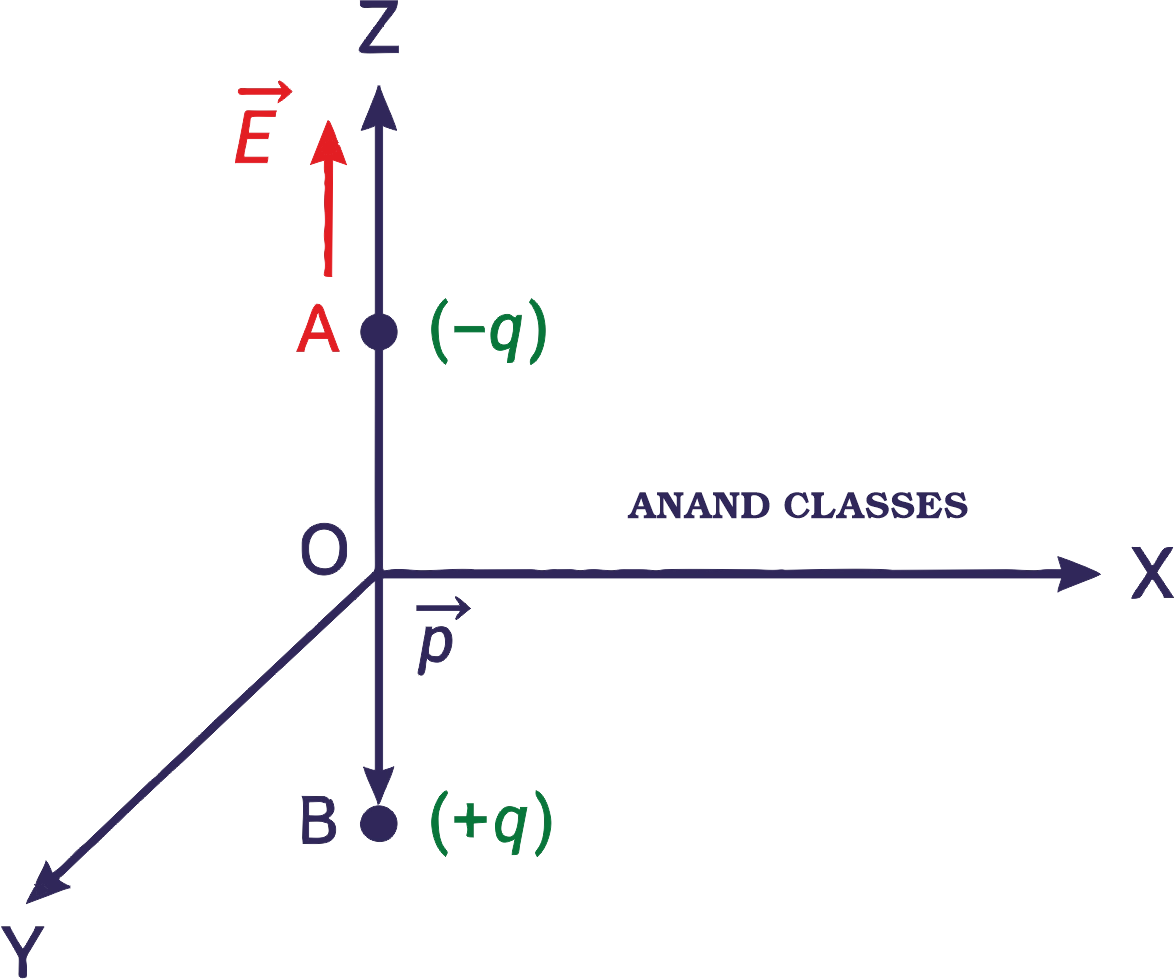
The electric field is along positive direction of +Z-axis, such that
= 105 N/C m-1
Therefore,
F = -10-7 × 105 = -10-2 N
The negative sign shows that force on the dipole is along negative Z-axis. Since the electric dipole moment is along negative Z-axis and the electric field is along positive Z-axis, θ = 180°.
Therefore torque on dipole,
τ = pE sin 180° = 0 N-m
A point particle of mass M is attached to one end of a massless rigid non-conducting rod of length L. Another point particle of the same mass is attached to the other end of the rod. The two particles carry charges +q and –q respectively. This arrangement is held in the region of uniform electric field E, such that the rod makes a small angle θ (say about 5°) with the field direction. Find an expression for the minimum time needed for the rod to become parallel to the field after it is set free. [IIT 1989]
Solution. The rod AB carrying two particles of charges +q and –q at the ends A and B and of mass M each has been placed in electric field, such that it makes a small angle θ with the direction of the field.
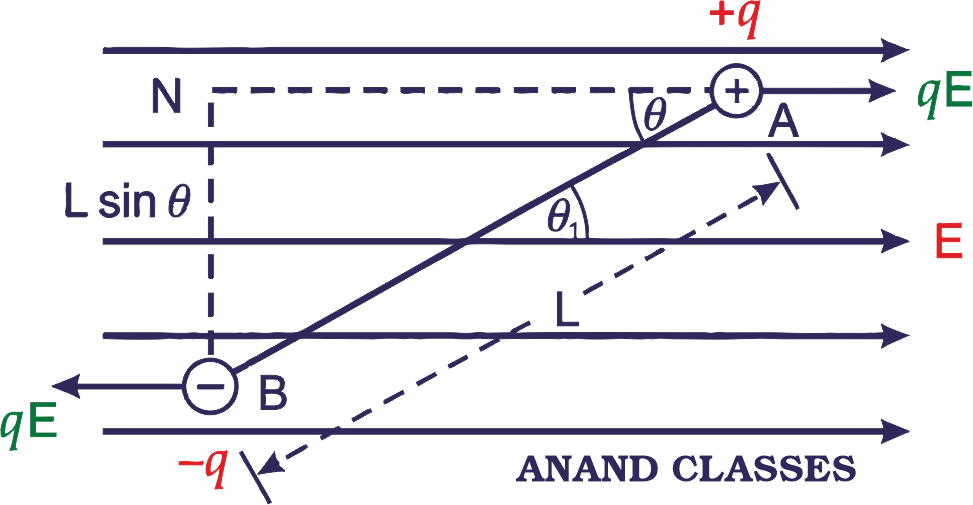
The force qE acts on the two particles at the points A and B along and opposite to the direction of the electric field. Since the two forces are equal in magnitude and opposite in direction, the two forces constitute a torque.
The magnitude of torque is given by
τ = qE × BN = qE × L sin θ
Since θ is small, sin θ ≈ θ, therefore
τ = qE × L θ
The torque acting on the system tends to rotate it in the electric field. If I is moment of inertia of the system and α, the angular acceleration produced, then
τ = Iα
In equilibrium,
Iα = qE × L θ
Therefore, the motion executed by the system is S.H.M. and its time period is given by
Moment of inertia of the system of two particles about an axis, which is right bisector of the rod AB is given by
Therefore time period of rod is,
The rod becomes parallel to the direction of electric field after executing one fourth of its one vibration i.e. in a time T/4.
Therefore, required time,
t = T/4
Enhance your preparation with Electric Field due to Point Charge, Group of Charges, Continuous Charge Distribution Numerical Problems
Potential Energy of an Electric Dipole in a Uniform Electric Field
Suppose an electric dipole of moment is oriented at an angle θ with the direction of uniform external electric field , as shown above Figure. We know, the torque acting on the dipole is
τ = pE sin θ
It tries to rotate the dipole to align it with electric filed .
Small amount of work done in rotating the dipole through a small angle dθ against the torque is
dW = τ dθ = pE sin θ dθ
Therefore total work done in rotating the dipole from orientation θ1 to θ2 is
W = –pE [cos θ2 – cos θ1]
W = pE [cos θ1 – cos θ2]
When the dipole is initially at right angle to the direction of electric field, , i.e., θ1 = 90°, and we have to set it at angle θ with electric field , i.e., θ2 = θ. Therefore,
W = pE [cos 90° – cos θ]
W = pE [0 – cos θ]
W = –pE cos θ
This work done is stored in the dipole in the form of potential energy (U).
U = –pE cos θ
U = –
Obviously, potential energy of an electric dipole is a scalar quantity. It is measured in joule.
Retain in Memory
To calculate potential energy of an electric dipole at any angle θ, we must start from the position of zero potential energy (i.e., θ1 = 90°). In given equation above, Potential Energy, U = W = pE [cos θ1 – cos θ2], we shall put θ1 = 90° and θ2 = θ. Never take θ1 = 0°, as it is not the position of zero potential energy. Therefore, Potential Energy, U = W = pE [cos 90° – cos θ] = –pE cos θ.
Special Cases
1. Position of stable equilibrium. When θ = 0°,
U = –pE cos θ
U = –pE cos 0°
U(min) =- pE
Thus the potential energy of a dipole is minimum when its dipole moment is parallel to the external field. This is the position of stable equilibrium.
2. Position of zero energy. When θ = 90°,
U = –pE cos θ
U = –pE cos 90°
U = 0
Thus the potential energy of a dipole is zero when it is held perpendicular to the external field. This can be explained as follows. If we hold the dipole perpendicular to the electric field and bring it from infinity into the field, then the work done on charge +q by the external agent is equal to the work done on charge –q. The net work done on the dipole will be zero and hence its potential energy is zero.
3. Position of unstable equilibrium. When θ = 180°,
U = –pE cos θ
U = –pE cos 180°
U = pE
Thus the potential energy of a dipole is maximum when its dipole moment is antiparallel to the external field. This is the position of unstable equilibrium.
Important concepts connected to this topic are Forces Between Multiple Charges: Principle of Superposition Solved Numerical Problems
Numerical Problems Based on Potential Energy of an Electric Dipole in a Uniform Electric Field for CBSE Class 12 Physics and JEE, NEET examinations
Practice these numerical problems to understand the calculation of Potential Energy of an Electric Dipole in a Uniform Electric Field in different electrostatic situations. These problems are useful for CBSE Class 12 Physics preparation and JEE, NEET examinations.
A dipole consists of an electron and a proton separated by a distance of 5 × 10⁻⁹ m. The dipole is aligned in a uniform electric field of 1.44 × 10⁴ N/C. Calculate potential energy of dipole to hold it at 60° with the direction of electric field.
Solution. Here q = 1.6 × 10⁻¹⁹ C ; 2a = 5 × 10⁻⁹ m
Dipole Moment,
p = q × 2a
p = 1.6 × 10-19 × 5 × 10-9
p = 8 × 10-28 C-m
θ1 = 0°, E = 1.44 × 10⁴ N/C, U = ?, θ2 = 60°
U = pE [cos θ1 – cos θ2]
U = 8 × 10-28 × 1.44 × 104 [cos 0° – cos 60°]
U = 8 × 10-28 × 1.44 × 104 [1 – 1/2]
U = 5.76 × 10⁻²⁴ J
A molecule of a substance has permanent electric dipole moment equal to 10-29 Cm. A mole of this substance is polarized (at low temperature) by applying a strong electrostatic field of magnitude 106 V/m. The direction of the field is suddenly changed by an angle of 60°. Estimate the heat released by the substance in aligning its dipoles along the new direction of the field. For simplicity assume 100% polarization of the sample. [NCERT]
Solution. Here p = 10-29 Cm, E = 106 V/m, θ = 60°,
Avogadro’s Number N = 6 × 10²³
Work required to bring one dipole from position θ1 = 0°, to position θ2 = θ, is
W = pE [cos θ1 – cos θ2]
W = pE [cos 0 – cos θ]
W = pE [1 – cos θ]
W = 10-29 × 106 [1 – cos 60°]
W = 10-29 × 106 [1 – 1/2]
W = 0.5 × 10⁻²³ J
Work required for one mole of dipoles
W × N = 0.5 × 10-23 × 6 × 1023 = 3.0 J
Heat released = Loss in P.E. = Work done = 3.0 J
For complete preparation, also study Coulomb’s Law of Electrostatics: Formula, Vector Form, Examples & Numericals
Conceptual Short Questions Answers Based on Torque and Potential Energy of an Electric Dipole in an Electric Field
These conceptual short questions and answers help students understand the Torque and Potential Energy of an Electric Dipole in an Electric Field for CBSE Class 12 Physics Board Exam.
Why a comb run through dry hair attracts small pieces of paper ?
As the comb runs through hair, it acquires charge due to friction. When the charged comb is brought closer to an uncharged piece of paper, it polarises the piece of paper i.e., induces a net dipole moment in the direction of the field. But the electric field due to the comb on the piece of paper is not uniform. It exerts a force in the direction of increasing field i.e., the piece of paper gets attracted towards the comb.
Give the physical significance of electric dipoles.
Physical significance of electric dipoles. Electric dipoles have a common occurrence in nature. A molecule consisting of positive and negative ions is an electric dipole. Moreover, a complicated array of charges can be described and analysed in terms of electric dipoles. The concept of electric dipole is used
(i) in the study of the effect of electric field on an insulator, and
(ii) in the study of radiation of energy from an antenna.
Will an electric dipole have translational motion when placed in a non-uniform electric field ? Give reason for your answer.
Yes, in a non-uniform electric field, an electric dipole experiences unequal forces at its ends. The two forces, add up to give a resultant force, which gives a translatory motion to the dipole.
In which orientation, a dipole placed in a uniform field is in (i) stable (ii) unstable equilibrium ?
If θ is angle between electric dipole moment (p) and electric filed (E), then θ = 0° for stable equilibrium, θ = 180° for unstable equilibrium.
How does a torque affect the dipole in an electric field ?
Torque tries to align the dipole along the field.
Which rule gives you the direction of torque ?
The direction of torque is given by right hand screw rule.
What happens when an electric dipole is held in a non uniform electric field ?
It experiences some net force and some net torque.
At what points, dipole field intensity is parallel to the line joining the charges ?
At any point on axial line or equatorial line of dipole.
When does an electric dipole placed in a non-uniform electric field experience a zero torque but non-zero force.
When the dipole is placed parallel to the non-uniform electric field.
An electric dipole is placed at rest in a uniform electric field, and released. How will it move ?
A torque will develop and align the electric dipole in the direction of the electric field, if the dipole is not aligned already. The dipole shall not move as net force on the dipole is zero.
Define the term electric dipole moment. Is it scalar or vector ?
Electric dipole moment (p) is the product of either charge (±q) and the distance (2a) between the charges, i.e., p = q (2a). It is a vector quantity, directed from –q to +q.
What is the direction of field intensity at a point (i) on axial line of dipole and (ii) on equatorial line of dipole ?
For a point on the axial line of dipole, the direction of electric field intensity is along a line parallel to the axis of dipole directed along the direction of dipole moment .
For a point on the equatorial line of dipole, the direction of electric field is along a line parallel to the axis of dipole directed opposite to the direction of dipole moment .
What is the nature of symmetry of the electric field due to (i) point charge and (ii) electric dipole ?
The electric field due to a point charge has spherical symmetry with point charge at the centre. It is so because, at equal distances from the point charge, field intensity is equal.
The electric field due to a dipole has a cylindrical symmetry. The axis of the cylinder passes through the dipole axis. It is so because, the electric field due to dipole will be same at every point on the surface of a right circular cylinder with electric dipole as the axis.
When an electric dipole is suspended in a uniform electric field, then under what conditions the dipole is in (i) stable equilibrium and (ii) unstable equilibrium.
The dipole in an electric field will be in stable equilibrium if the following conditions are satisfied:
(i) The resultant force on dipole is zero, i.e., there is no translatory motion of dipole.
(ii) The torque on dipole is zero, i.e., there is no rotatory motion of dipole.
(iii) The potential energy of dipole is minimum.
It will be so when dipole is aligned along the direction of electric field.
The dipole will be in unstable equilibrium if:
(i) the resultant force on dipole is zero.
(ii) the torque on the dipole is zero.
(iii) the potential energy of dipole is maximum.
It will be so when dipole is aligned opposite to the direction of electric field.
An electric dipole is held at an angle θ in a uniform electric field E. Will there be any (i) net translating force (ii) torque acting on it ? Explain.
(i) There will be no net translating force.
(ii) Torque on the dipole ; τ = pE sin θ. It will align the dipole along the field. Once the dipole is aligned, torque τ = 0.
Does an electric dipole always experience a torque, when placed in a uniform electric field ?
No. It does not experience a torque, when it is placed along the direction of electric field.
What is the net force on an electric dipole placed in a uniform electric field ?
An electric dipole does not experience any net force in a uniform electric field.
When is the torque acting on an electric dipole maximum, when placed in uniform electric field?
The torque is maximum, when the electric dipole is placed perpendicular to the direction of electric field.
Important exam-related topics include Electric Charge Quantization, Additivity, Charging by Induction, Solved Numericals
Electrostatics Complete Revision Notes PPTX Slideshow Download: Torque and Potential Energy of Electric Dipole in a Uniform Electric Field
Download the Electrostatics Complete Revision Notes PPTX Slideshow on Torque and Potential Energy of an Electric Dipole in a Uniform Electric Field for a concise visual revision of this important topic. The slideshow covers the torque acting on an electric dipole in a uniform electric field, its dependence on the angle between the dipole moment and electric field, conditions for stable and unstable equilibrium, and the potential energy of the dipole. It is useful for quick revision of key concepts, formulas, and important results for CBSE Class 12 Physics, JEE, and NEET.
Electrostatics: Torque and Potential Energy of Electric Dipole in a Uniform Electric Field Presentation Video
Watch the Electrostatics Video: Torque and Potential Energy of an Electric Dipole in a Uniform Electric Field Presentation Video for a clear visual revision of the important concepts related to an electric dipole in a uniform electric field. The presentation explains the torque acting on the dipole, its dependence on the orientation of the dipole, conditions of equilibrium, and the potential energy associated with different orientations. It is designed for quick and effective revision of CBSE Class 12 Physics, JEE, and NEET concepts.

Electrostatics Complete Revision Notes PDF Download : Torque and Potential Energy of Electric Dipole in a Uniform Electric Field
Download the Electrostatics Complete Revision Notes PDF on Torque and Potential Energy of an Electric Dipole in a Uniform Electric Field for a concise and systematic revision of this important topic. The PDF covers the torque experienced by an electric dipole in a uniform electric field, its dependence on the orientation of the dipole, conditions of stable and unstable equilibrium, and the potential energy associated with an electric dipole. It also includes important formulas, key results, and applications useful for understanding and solving problems in CBSE Class 12 Physics, JEE, and NEET. The PDF can be used for quick revision, exam preparation, and reference while studying the Electrostatics chapter.
To download the PDF notes of Torque and Potential Energy of Electric Dipole in a Uniform Electric Field, click the Download PDF button below :