Vectors JEE Main Previous Year Questions (PYQs) with Solutions are essential for mastering the Motion in a Plane chapter in Class 11 Physics. These carefully solved questions help students understand vector addition, subtraction, resolution of vectors, scalar and vector products, and their applications in problem-solving. The Class 11 Physics study material of Anand Classes, written by Neeraj Anand, provides detailed, step-by-step solutions to JEE Main PYQs, enabling students to strengthen concepts, improve accuracy, and boost confidence for JEE Main, JEE Advanced, NEET, and CBSE examinations.
Why Practice JEE Main Previous Year Questions (PYQs) for Vectors from the Motion in a Plane Chapter Class 11 Physics?
Practicing JEE Main Previous Year Questions (PYQs) is one of the most effective ways to master Vectors from the Motion in a Plane chapter of Class 11 Physics. Solving authentic exam questions helps students strengthen conceptual understanding, identify frequently asked topics, improve problem-solving speed, and gain confidence for the examination. Prepared by Neeraj Anand and published by Anand Technical Publishers under the Anand Classes brand, these detailed solutions are designed to make learning simple, systematic, and exam-oriented.
Why Choose Anand Classes JEE Main PYQs Solutions for Vectors?
Anand Classes JEE Main PYQs Solutions for Vectors provide step-by-step explanations, shortcut techniques where applicable, and concept-based approaches to every question. Written by Neeraj Anand and published by Anand Technical Publishers under the Anand Classes brand, this study resource helps students develop accuracy, avoid common mistakes, and prepare effectively for JEE Main, JEE Advanced, CBSE, and other engineering entrance examinations.
Who Can Benefit from These JEE Main Vectors PYQs Solutions?
These Vectors JEE Main PYQs with Solutions are specially designed for Class 11 students, JEE Main and JEE Advanced aspirants, and anyone revising the Motion in a Plane chapter. Whether you are building your concepts for the first time or revising before the exam, these solved previous-year questions provide structured practice and a deeper understanding of the topics most frequently tested in competitive examinations.
JEE Main Question
What will be the projection of vector on vector ?
(a)
(b)
(c)
(d)
[2021, 22 July Shift-II]
Ans. (d)
The vector projection of on is defined by the formula:
Practice more questions from JEE Main PYQs Solutions for Vectors (Class 11 Physics Motion in a Plane)
JEE Main Question
Two vectors and have equal magnitudes. If the magnitude of is times the magnitude of , then the angle between and is:
(a)
(b)
(c)
(d)
[2021, 20 July Shift-II]
Ans. (d) Given
and
.
Since , dividing across by yields:
Applying componendo and dividendo property, we get :
Practice more questions from JEE Main PYQs Previous Year Questions MCQs Topicwise Papers and Solutions Motion in a Straight Line
JEE Main Question
If and are two vectors satisfying the relation . Then, the value of will be:
(a)
(b)
(c)
(d)
[2021, 20 July Shift-I]
Ans. (d) We know that
and .
Given
Now, expanding the difference magnitude:
Build strong concepts by studying JEE Main Motion in a Straight Line MCQs PYQs Previous Year Questions and Solutions
JEE Main Question
If , the angle between and is ($0^circ < theta < 360^circ$). The value of will be …………….
[2021, 25 Feb Shift-II]
Ans. (180°)
Given,
Since cross product is anti-commutative :
The magnitude of a cross product is given by PQ sin θ = 0.
Assuming and , this is possible only when:
sin θ = 0
Given the condition 0° < θ < 360°, the only valid solution is : θ = 180°
Similar topics for practice include JEE Main Units and Measurements PYQs Previous Year Questions and Solutions (Set-4)
JEE Main Question
The sum of two forces and is such that . The angle (in degrees) that the resultant of and will make with is:
[2020, 7 Jan Shift-II]
Ans. (90°)
Given that the sum of and is . Let the angle between and be β. The magnitude of the resultant is given by :
Since (given) :
Since :
If the resultant of and makes an angle with , then the angle is given by:
Substituting the value of from Eq. (i) into the denominator:
⇒ θ = π/2 = 90°
Enhance your preparation with JEE PYQs Units and Measurements Previous Year Solved Questions (Set-3)
JEE Main Question
Let , , and .
The value of is :
(a) -106.5
(b) -112.5
(c) -99.5
(d) -118.5
[2019, 8 April Shift-II]
Ans. (d)
For the vector , we know :
Given , , and :
Now, expanding the required dot product :
Substituting the given values :
Important concepts connected to this topic are JEE Units and Measurements PYQs Previous Year Questions and Solutions (Set-2)
JEE Main Question
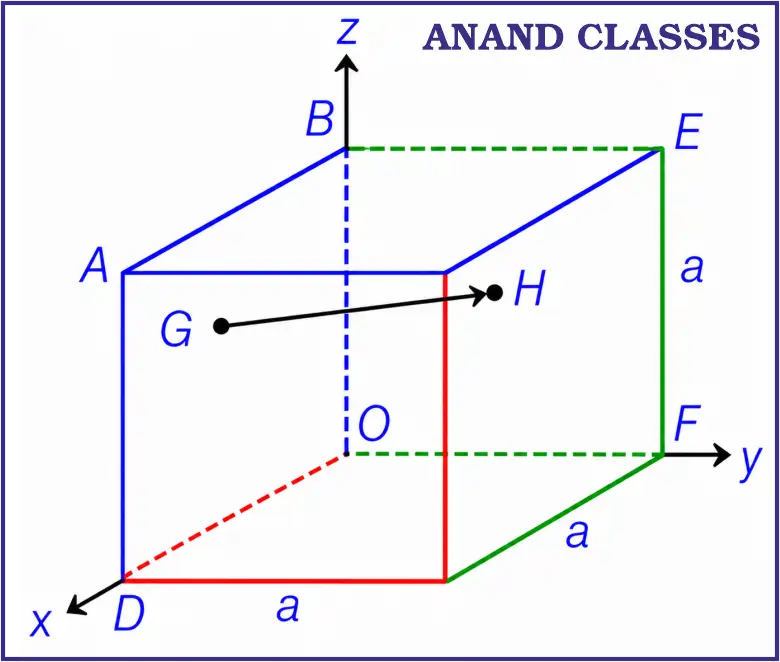
In the cube of side ‘a‘ shown in the figure, the vector from the central point of the face ABOD to the central point of the face BEFO will be :
(a)
(b)
(c)
(d)
[2019, 10 Jan Shift-I]
Ans. (b)
In the given cube of side a :
Point G is the center of the face ABOD lies in the xz-plane (y = 0). Its coordinates are:
Point H is the center of the face BEFO lies in the yz-plane (x = 0). Its coordinates are:
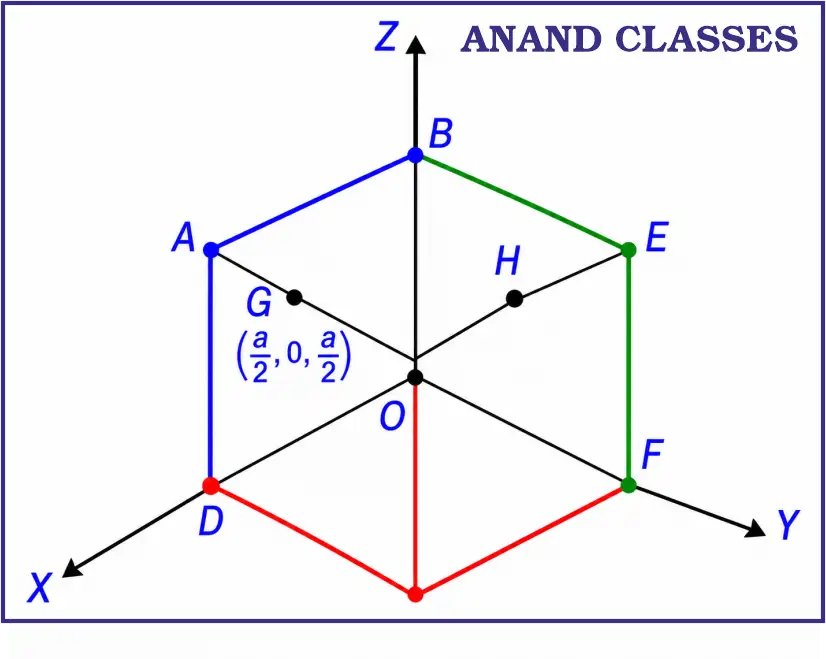
The position vector from point G to H is given by :
JEE Main Question
Two vectors and have equal magnitudes. The magnitude of is ‘‘ times the magnitude of . The angle between and is:
(a)
(b)
(c)
(d)
[2019, 10 Jan Shift-II]
Ans. (c)
Given, .
Let R be the magnitude of and R’ be the magnitude of .
For the sum:
For the difference :
Given condition:
Dividing Eq. (i) by Eq. (ii) :
Applying componendo and dividendo :
JEE Main Question
If , then the angle between and is :
(a) π
(b) π/3
(c) π/2
(d) π/4
[AIEEE 2004]
Ans. (a)
Given:
Since cross product is anti-commutative : :
2AB sin θ = 0
Since and :
sin θ = 0
θ = 0 or π
From the given options, π is the correct option.
JEE Main Question
The coordinates of a moving particle at any time are given by and . The speed of the particle at time is given by:
(a)
(b)
(c)
(d)
[AIEEE 2003]
Ans. (b)
The given coordinates are:
Then, the velocity components are:
Resultant velocity:
JEE Main Question
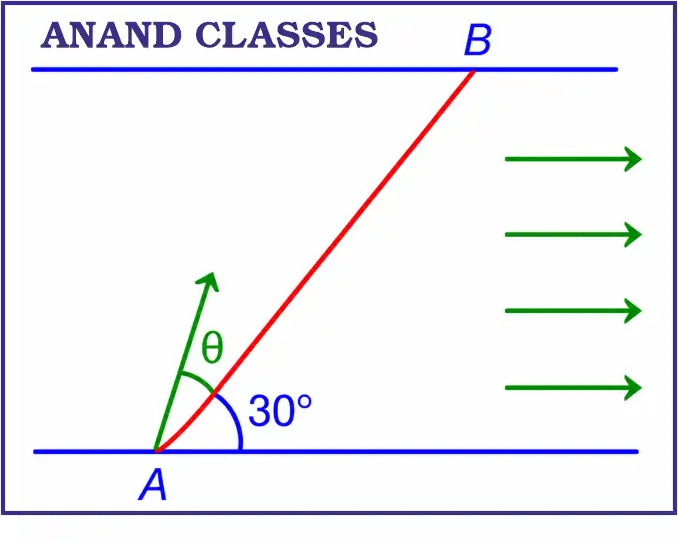
A swimmer wants to cross a river from point A to point B. Line AB makes an angle of 30° with the flow of river. Magnitude of velocity of the swimmer is same as that of the river. The angle with the line AB should be ……….°, so that the swimmer reaches point B.
[2021, 27 July Shift-II]
Ans. (30°)
Solution:
![JEE Main Question [2021, 27 July Shift-II] solution : A swimmer wants to cross a river from point A to point B. Line AB makes an angle of 30° with the flow of river. Magnitude of velocity of the swimmer is same as that of the river. The angle with the line AB should be ..........°, so that the swimmer reaches point B.](https://physicsanandclasses.co.in/wp-content/uploads/2026/07/JEE-Main-Question-2021-27-July-Shift-II-solution.webp "JEE Main Vectors Chapterwise PYQs Solutions (Motion in a Plane) 5")
Both velocity vectors are of same magnitude therefore resultant would pass exactly midway through them. That is θ = 30°
JEE Main Question
Three particles P, Q and R are moving along the vectors , and respectively. They strike on a point and start to move in different directions. Now, particle P is moving normal to the plane which contains vectors and . Similarly, particle Q is moving normal to the plane which contains vectors and . The angle between the direction of motion of P and Q is . Then, the value of x is :
[2021, 22 July Shift-II]
Ans. (3)
Given, particle P moves normal to the plane containing and .
Particle Q moves normal to the plane containing and .
Let the angle between and be θ. According to the given information :
Now,
Now,
Comparing with : x = 3
JEE Main Question
A butterfly is flying with a velocity 4√2 m/s in the North-East direction. Wind is slowly blowing at 1 m/s from North to South. The resultant displacement of the butterfly in 3 s is:
(a) 3 m
(b) 20 m
(c) 12√2 m
(d) 15 m
[2021, 20 July Shift-I]
Ans. (d)
Let be the velocity of the wind and be the velocity of the butterfly with respect to the wind.
![JEE Main Question [2021, 20 July Shift-I] : A butterfly is flying with a velocity 4√2 m/s in the North-East direction. Wind is slowly blowing at 1 m/s from North to South. The resultant displacement of the butterfly in 3 s is:](https://physicsanandclasses.co.in/wp-content/uploads/2026/07/JEE-Main-Question-2021-20-July-Shift-I.webp "JEE Main Vectors Chapterwise PYQs Solutions (Motion in a Plane) 6")
can be given as :
and can be given as:
Therefore, the velocity of the butterfly () relative to the ground is:
Displacement of the butterfly :
Magnitude of displacement:
JEE Main Question
A person is swimming with a speed of 10 m/s at an angle of 120° with the flow and reaches a point directly opposite on the other side of the river. The speed of the flow is x m/s. The value of x to the nearest integer is :
[2021, 18 March Shift-I]
Ans. (5)
Given, a person’s swimming speed with respect to the river, .
As shown in the figure, the resultant velocity is directed straight across the river. The angle with the vertical line is 120° – 90° = 30°.
![JEE Main Question [2021, 18 March Shift-I] : A person is swimming with a speed of 10 m/s at an angle of 120° with the flow and reaches a point directly opposite on the other side of the river. The speed of the flow is x m/s. The value of x to the nearest integer is](https://physicsanandclasses.co.in/wp-content/uploads/2026/07/JEE-Main-Question-2021-18-March-Shift-I.webp "JEE Main Vectors Chapterwise PYQs Solutions (Motion in a Plane) 7")
In the X-direction (along the horizontal flow of the river) :
Hence, the speed of the river flow is 5 m/s. So, the value of x to the nearest integer is 5.
JEE Main Question
A swimmer can swim with a velocity of 12 km/h in still water. Water flowing in a river has a velocity of 6 km/h. The direction with respect to the direction of flow of river water he should swim in order to reach the point on the other bank just opposite to his starting point is ……….° (Round off to the nearest integer).
[2021, 16 March Shift-II]
Ans. (120)
Where,
and .
To reach the directly opposite point, the components along the river flow must cancel out:
6 – 12 sin θ = 0
sin θ = 6/12 = 1/2
θ = 30°
The total angle α with the direction of river flow is :
α = 90° + θ = 90° + 30° = 120°
JEE Main Question
Trains A and B are running on parallel tracks in opposite directions with speeds of 36 km/h and 72 km/h respectively. A person is walking in train A in the opposite direction to its motion with a speed of 1.8 km/h. Speed in m/s of this person as observed from train B will be close to (Take the distance between the tracks as negligible):
(a) 28.5
(b) 30.5
(c) 29.5
(d) 31.5
[2020, 2 Sep Shift-I]
Ans. (c)
Speed of train A = 36 km/h
Speed of train B = 72 km/h (in opposite direction)
Condition given in question is as shown,
![JEE Main Question [2020, 2 Sep Shift-I] : Trains A and B are running on parallel tracks in opposite directions with speeds of 36 km/h and 72 km/h respectively. A person is walking in train A in the opposite direction to its motion with a speed of 1.8 km/h. Speed in m/s of this person as observed from train B will be close to (Take the distance between the tracks as negligible):](https://physicsanandclasses.co.in/wp-content/uploads/2026/07/JEE-Main-Question-2020-2-Sep-Shift-I.webp "JEE Main Vectors Chapterwise PYQs Solutions (Motion in a Plane) 8")
Speed of the person relative to train A = 1.8 km/h (opposite to train A’s motion)
Speed of the person with respect to the ground :
vp = 36 – 1.8 = 34.2 km/h (in the direction of train A)
So, the situation becomes as shown :
![JEE Main Solution [2020, 2 Sep Shift-I] " Trains A and B are running on parallel tracks in opposite directions with speeds of 36 km/h and 72 km/h respectively. A person is walking in train A in the opposite direction to its motion with a speed of 1.8 km/h. Speed in m/s of this person as observed from train B will be close to (Take the distance between the tracks as negligible):](https://physicsanandclasses.co.in/wp-content/uploads/2026/07/JEE-Main-Solution-2020-2-Sep-Shift-I.webp "JEE Main Vectors Chapterwise PYQs Solutions (Motion in a Plane) 9")
Hence, the speed of the person on train A as observed by an observer on train B moving in the opposite direction is :
vpB = 34.2 + 72 = 106.2 km/h
vpB = 106.2 × 5/18 m/s = 29.5 m/s
JEE Main Question
When a car is at rest, its driver sees raindrops falling on it vertically. When driving the car with speed v, he sees that raindrops are coming at an angle of 60° from the horizontal. On further increasing the speed of the car to (1+β)v, this angle changes to 45°. The value of β is close to :
(a) 0.50
(b) 0.41
(c) 0.37
(d) 0.73
Ans. (d)
Given, raindrops fall vertically downwards relative to the ground.
,
Velocity of rain w.r.t. man:
![JEE Main Question [2020, 6 Sep Shift-II] : When a car is at rest, its driver sees raindrops falling on it vertically. When driving the car with speed v, he sees that raindrops are coming at an angle of 60° from the horizontal. On further increasing the speed of the car to (1+β)v, this angle changes to 45°. The value of β is close to :](https://physicsanandclasses.co.in/wp-content/uploads/2026/07/JEE-Main-Question-2020-6-Sep-Shift-II.webp "JEE Main Vectors Chapterwise PYQs Solutions (Motion in a Plane) 10")
From diagram :
Now, when the man increases the velocity of the car to (1+β)v in the same direction :
Drawing velocity vectors :
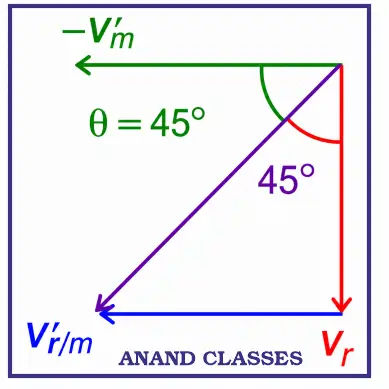
The new angle with the horizontal is 45°, meaning the angle with the vertical is also 45° :
JEE Main Question
A particle is moving along the x-axis with its coordinate with time t given by x(t) = 10 + 8t – 3t2. Another particle is moving along the y-axis with its coordinate as a function of time given by y(t) = 5 – 8t3. At t = 1 second, the speed of the second particle as measured in the frame of the first particle is given as √v. Then v (in m/s) is :
[2020, 8 Jan Shift-I]
Ans. (580)
Let particle A move along the X-axis :
x(t) = 10 + 8t – 3t2
Let particle B move along the Y-axis:
y(t) = 5 – 8t3
Velocities of particles A and B are:
At t = 1 second :
At t = 1 second :
Velocity of particle B w.r.t. particle A:
Magnitude of velocity:
Since :
v = 580
JEE Main Question
Ship A is sailing towards north-east with velocity , where points east and north. Ship B is at a distance of east and north of Ship A and is sailing towards west at . A will be at a minimum distance from B in:
(a) 4.2 h
(b) 2.6 h
(c) 3.2 h
(d) 2.2 h
[2019, 8 April Shift-I]
Ans. (b)
Considering the initial position of ship A as the origin (0, 0) :
For ship B :
Hence, the given situation can be represented graphically as :
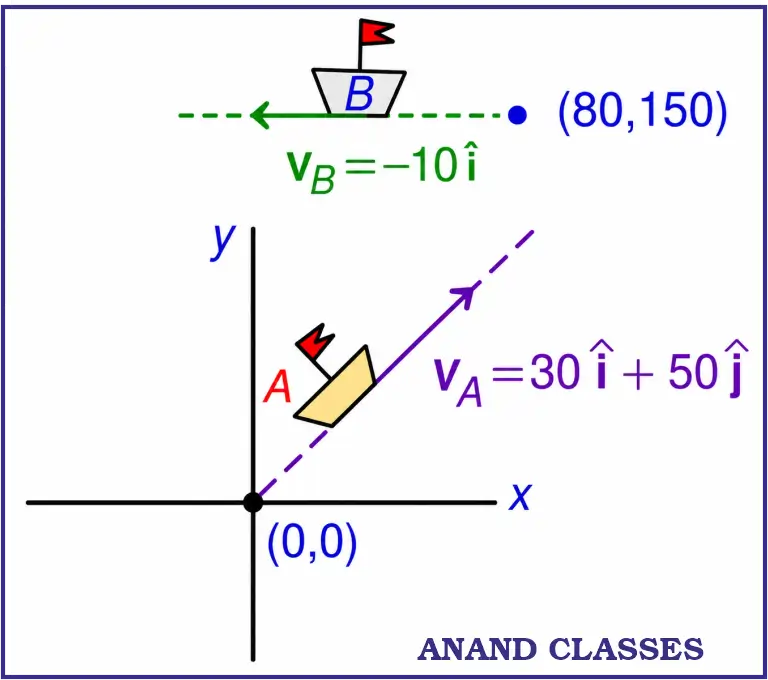
After time t, the coordinates of ships A and B are :
The distance squared d2 between them after time t is :
Distance is minimum when :
JEE Main Question
The stream of a river is flowing with a speed of 2 km/h. A swimmer can swim at a speed of 4 km/h. What should be the direction of the swimmer with respect to the flow of the river to cross the river straight?
(a) 60°
(b) 120°
(c) 90°
(d) 150°
[2019, 9 April Shift-I]
Ans. (b)
Let the velocity of the swimmer be and velocity of the river be .
Also, angle of swimmer with the flow of the river (down stream) is a as shown in the figure below :
![[2019, 9 April Shift-I] JEE Main PYQ Solution : The stream of a river is flowing with a speed of 2 km/h. A swimmer can swim at a speed of 4 km/h. What should be the direction of the swimmer with respect to the flow of the river to cross the river straight?](https://physicsanandclasses.co.in/wp-content/uploads/2026/07/2019-9-April-Shift-I-JEE-Main-PYQ-Solution.webp "JEE Main Vectors Chapterwise PYQs Solutions (Motion in a Plane) 13")
Let the angle of the swimmer with the vertical be .
Clearly, the total angle with the river flow is:
JEE Main Question
A passenger train of length 60 m travels at a speed of 80 km/hr. Another freight train of length 120 m travels at a speed of 30 km/hr. The ratio of times taken by the passenger train to completely cross the freight train when: (i) they are moving in the same direction and (ii) in the opposite direction is:
(a) 3/2
(b) 25/11
(c) 11/5
(d) 5/2
[2019, 12 Jan Shift-I]
Ans. (c)
When trains are moving in the same direction, relative speed .
In the opposite direction, relative speed .
The total distance to cross each other completely in both cases is the sum of lengths of the trains ().
JEE Main Question
A particle is moving Eastwards with a velocity of 5 m/s. In 10 seconds. the velocity changes to 5 m/s Northwards. The average acceleration in this time is:
(a) towards North-East
(b) towards North
(c) zero
(d) towards North-West
[AIEEE 2005]
Ans. (d)
Initial velocity (Eastward):
Final velocity (Northward):
Change in velocity :
![[AIEEE 2005] : A particle is moving Eastwards with a velocity of 5 m/s. In 10 seconds. the velocity changes to 5 m/s Northwards. The average acceleration in this time is:](https://physicsanandclasses.co.in/wp-content/uploads/2026/07/AIEEE-2005.webp "JEE Main Vectors Chapterwise PYQs Solutions (Motion in a Plane) 14")
Average acceleration :
For direction :
Average acceleration is towards North-West.
Strengthen your fundamentals with Derive Equations of Motion Using Calculus Method, Solved Numerical Examples
JEE Main Question
A ball is thrown from a point with a speed at an angle of projection . From the same point and at the same instant, a person starts running with a constant speed to catch the ball. Will the person be able to catch the ball? If yes, what should be the angle of projection?
(a) Yes, 60°
(b) Yes, 30°
(c) No
(d) Yes, 45°
[AIEEE 2004]
Ans. (a)
The man will catch the ball if his constant speed equals the horizontal component of the ball’s velocity, i.e.,
For complete preparation, also study Equations of Motion Under Gravity for free fall, upward and vertical downward motion
Important Units and Measurements Links
In this chapter on Units and Measurements: Conceptual Questions and Answers, Practice Exercise, you will develop a solid foundation in measurement principles, SI units, and error analysis. The section includes important conceptual questions with clear explanations, followed by practice exercises to reinforce learning. It is designed to help students improve precision in calculations and build confidence for board and JEE exams and problem-solving.