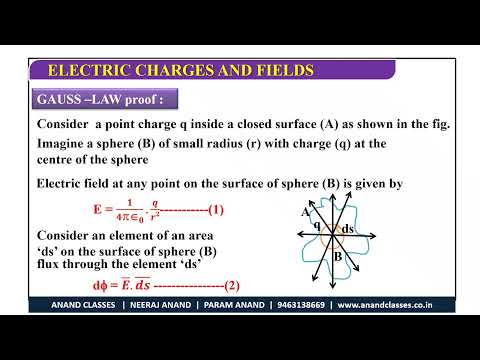
Electric flux and Gauss’s theorem are discussed through the area vector, electric flux through different surfaces, applications of Gauss’s theorem, and important solved numerical problems for CBSE Class 12 Physics and competitive examinations.
Area Vector
Area is a scalar quantity. But we come across many situations where we need to know not only the magnitude of a surface area but also its direction. The direction of a planar area vector is specified by the normal to the plane. In Figure(a), a planar area element dS has been represented by a normal vector . The length of vector represents the magnitude dS of the area element. If n̂ is a unit vector along the normal to the planar area, then
= dS n̂
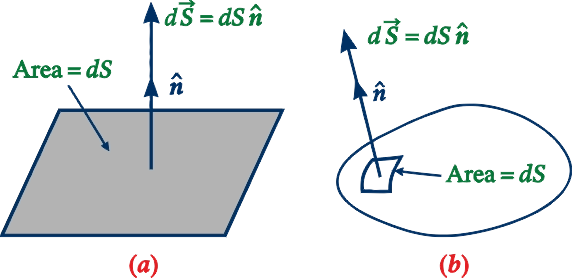
In case of a curved surface, we can imagine it to be divided into a large number of very small area elements. Each small area element of the curved surface can be treated as a planar area. By convention, the direction of the vector associated with every area element of a closed surface is along the outward drawn normal. As shown in Figure.(b), the area element at any point on the closed surface is equal to dS n̂, where dS is the magnitude of the area element and n̂ is a unit vector in the direction of outward normal.
Build strong concepts by studying Torque and Potential Energy of Electric Dipole in Uniform Electric Field With Numericals Questions Answers
Electric Flux
Electric flux over an area in an electric field is a measure of the number of electric field lines crossing this area.
The term flux implies some kind of flow. Flux is the property of any vector field. The electric flux is a property of electric field.
We know that the number of electric field lines crossing a unit area placed normal to the field at a point is a measure of strength of electric field at that point. If we place a small planar element of area ΔS normal to at this point, [see Figure (a)], the number of electric field lines crossing this area element is proportional to E (ΔS).
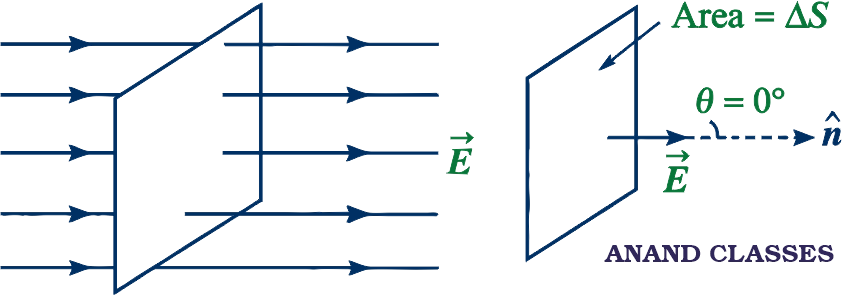
Thus the electric flux through a given area held inside an electric field is the measure of the total number of electric lines of force passing normally through that area.
As shown in Figure.(a), if an electric field passes normally through an area element ΔS, then the electric flux through this area is
ΔϕE = E ΔS
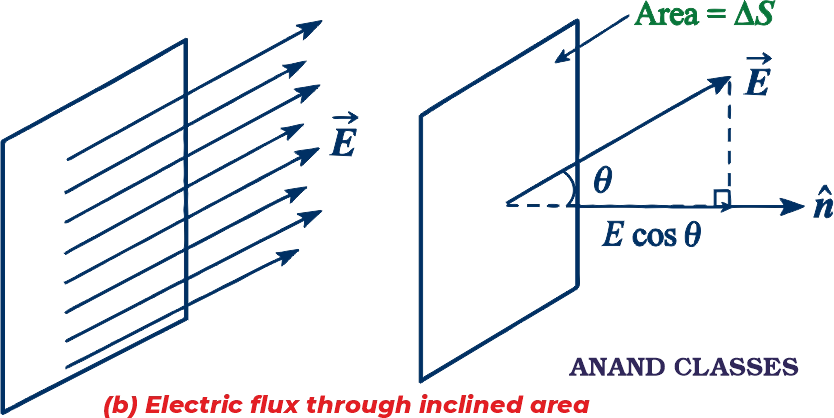
As shown in Figure.(b), if the normal drawn to the area element ΔS makes an angle θ with the uniform field , then the component of normal to ΔS will be E cos θ, so that the electric flux is
ΔϕE = Normal component of E × Surface area
ΔϕE = E cos θ × ΔS
ΔϕE = E ΔS cos θ
In case the field is non-uniform, we consider a closed surface S lying inside the field as shown in Figure.
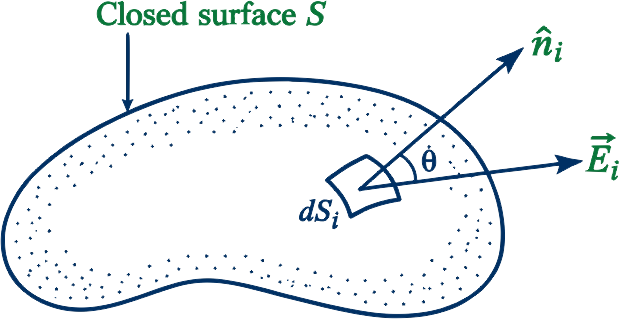
We can divide the surface S into small area elements : , , , …, . Let the corresponding electric fields at these elements be , , ……, . Now calculate the flux at each element and add them up with proper sign.
Then the electric flux through the surface S will be
When the number of area elements becomes infinitely large (N → ∞) and ΔS → 0, the above sum approaches a surface integral taken over the closed surface. Thus
The circle on the integral sign indicates that the surface of integration is a closed surface.
Note that electric flux over a closed surface S can be positive; negative or zero, according as θ < 90°; θ > 90° and θ = 90°.
When is normal to area element, θ = 0°, electric flux is maximum.
When is along the area element, θ = 90°, electric flux is zero.
When θ > 90°, cos θ is negative. Therefore, electric flux is negative.
Electric flux is a scalar quantity.
Units and Dimensions of Electric Flux
Units of electric flux ϕE = unit of E × unit of S = NC⁻¹ × m² = Nm² C⁻¹.
Equivalently, SI unit of electric flux = Vm⁻¹.m² = Vm.
Dimensional formula of electric flux ϕE = [MLT⁻²] [L²] [AT]⁻¹ = [M¹ L³ T⁻³ A⁻¹]
Base unit of electric flux = kg m³ s⁻³ A⁻¹
For complete preparation, also study Electric Dipole Moment, Electric Field on Axial and Equatorial Line of Electric Dipole and on axis of Uniformly Charged Ring with Numericals
Electric Flux Numerical Problems with Solutions
Strengthen your understanding of electric flux through a collection of solved numerical problems for CBSE Class 12, JEE, and NEET, covering different types of questions with clear and step-by-step solutions.
If = (6î + 3ĵ + 4k̂) N/C, calculate the electric flux through a surface of area 20 m² in Y-Z plane.
Solution. Electric field vector, = (6î + 3ĵ + 4k̂) N/C
As the area vector in the Y-Z plane points along outward drawn normal i.e., along positive X-direction, so
= 20î m²
Electric Flux,
ϕE =
ϕE = (6î + 3ĵ + 4k̂) · 20î
ϕE = 120 Nm² C⁻¹
A circular plane sheet of radius 10 cm is placed in a uniform electric field of 5 × 10⁵ N C⁻¹, making an angle of 60° with the field. Calculate electric flux through the sheet.
Solution. Here r = 10 cm = 0.1 m, E = 5 × 10⁵ N C⁻¹
As the angle between the plane sheet and the electric field is 60°, angle made by the normal to the plane sheet and the electric field is θ = 90° – 60° = 30°
Electric Flux,
ϕE = E S cos θ = E × π r² × cos θ
ϕE = 5 × 10⁵ × 3.14 × (0.1)² × cos 30°
ϕE = 1.36 × 10⁴ N m² C⁻¹
Consider a uniform electric field = 3 × 10³ î N C⁻¹. Calculate the electric flux of this field through a square surface of area 10 cm square
(i) when its plane is parallel to Y-Z plane.
(ii) when the normal to its plane makes an angle of 60° with X-axis.
Solution. Here, E = 3 × 10³ N C⁻¹; A = (0.1 m)² = 10⁻² m²
(i) When its plane is parallel to Y-Z plane, its normal is along X-axis and electric field is also along X-axis. As normal to area is in the direction of electric field, therefore, θ = 0°
ϕ = E A cos θ
ϕ = 3 × 10³ × 10⁻² cos 0°
ϕ = 30 N m² C⁻¹
(ii) In this case, θ = 60°
ϕ = E A cos θ
ϕ = 3 × 10³ × 10⁻² cos 60°
ϕ = 15 N m² C⁻¹
Gain deeper understanding by studying Electric Field Lines Properties, Electric Field due to Infinitely long thin wire, Charged Circular and Semicircular Ring
State and Prove Derivation of Gauss’s Theorem in Electrostatics (Gauss’s law)
According to this theorem,
The surface integral of electrostatic field produced by any sources over any closed surface S enclosing a volume V in vacuum i.e., total electric flux over the closed surface S in vacuum, is 1/ε₀ times the total charge (Q) contained inside S, i.e.,
The charges inside S may be point charges or even continuous charge distributions. There is no contribution to total electric flux from the charges outside S. Further, the location of Q inside S does not affect the value of surface integral.
The surface chosen to calculate the surface integral is called Gaussian surface. While selecting such a surface, we shall avoid charges on S itself.
Proof of Gauss’s theorem (for spherically symmetric surfaces only)
Suppose an isolated positive point charge q is situated at the centre O of a sphere of radius r, as shown in Figure.
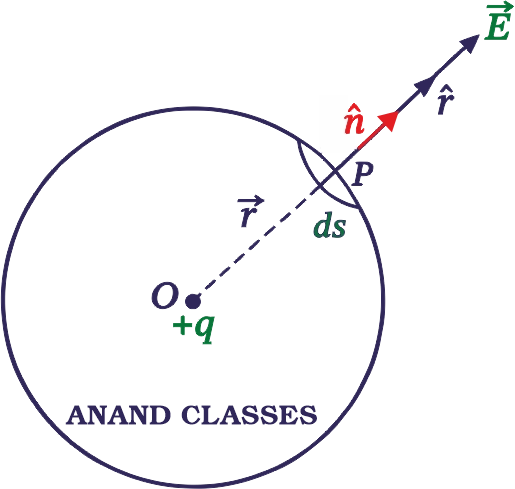
According to Coulomb’s law, electric field intensity at any point P on the surface of the sphere is
where r̂ is unit vector directed from O to P.
Consider a small area element ds of the sphere around P. Let it be represented by the vector , where n̂ is unit vector along outdrawn normal to the area element.
As the normal to a sphere at every point is along the radius vector at that point, therefore r̂ · n̂ = 1 :
Integrating over the closed surface area of the sphere, we get total normal electric flux over the entire spherical surface,
Hence,
, which proves Gauss’s theorem.
If there are point charges, q₁, q₂, q₃ …… qₙ lying inside the surface, each will contribute to the electric flux, independent of the others (superposition principle), then total electric flux over the entire surface :
where is the algebraic sum of all the charges inside the closed surface.
Hence, total electric flux over a closed surface in vacuum is 1/ε₀ time the total charge within the surface regardless of how the charges may be distributed.
If the medium surrounding the charge has a dielectric constant K, then
where K = εr = ε/ε₀ ∴
If there is no net charge within the closed surface i.e., when Q = 0, ∴ ϕE = 0
It means that the total electric flux through a closed surface is zero if no charge is enclosed by the surface or when algebraic sum of all the charges enclosed by the surface is zero.
It can be shown that charges situated outside the closed surface make no contribution to total electric flux over the surface.
To understand this topic better, learn about Electric Field due to Point Charge, Group of Charges, Continuous Charge Distribution Numerical Problems
Gaussian Surface
Any hypothetical closed surface enclosing a charge is called the Gaussian surface of that charge. It is chosen to evaluate the surface integral of the electric field produced by the charge enclosed by it, which, in turn, gives the total flux through the surface.
With a choice of Gaussian surface, we can easily calculate the electric fields produced by certain symmetric charge configurations which are otherwise quite difficult to evaluate by the direct application of Coulomb’s law and the principle of superposition.
Noteworthy Points For Competitive Exams
- Gauss’s theorem holds good for any closed surface, regardless of its shape or size.
- The surface that we choose for the application of Gauss’s law is called the Gaussian surface. However, we usually choose a spherical Gaussian surface, because this choice has three simplifying features :
(i) The dot product = E dS cos 0° = E (dS), because at all points on spherical Gaussian surface, θ = 0°.
(ii) Magnitude of || is constant at all points on the spherical Gaussian surface. Therefore, E can be brought out of the integral sign.
(iii) The remaining integral is merely the surface area of the sphere (= 4 π r²), which is obtained without actually doing the integration. - Take care to see that the Gaussian surface chosen does not pass through any discrete charge. This is because electric field is not well defined at the location of the charge.
- In the situation when the surface is so chosen that there are some charges inside and some outside the electric field (whose flux is calculated) is due to all the charges, both inside and outside the closed surface. However, for electric flux, the term (q) represents only the total charge inside the closed surface.
- Gauss’s theorem is used most commonly for symmetric charge configurations.
- Gauss’s theorem is based on inverse square dependence of on distance (i.e., E ∝ 1/r²).
- From Gauss’s theorem, we can calculate the number of electric lines of force that radiate outwards from one coulomb of positive charge in vacuum. As therefore, when q = 1 coulomb,
Verification of Gauss’s Theorem
To verify Gauss’s theorem, let us calculate electric flux through a closed cylindrical surface containing no charge. Let the cylinder be held in an external uniform electric field of intensity along the axis of the cylinder, as shown in Figure.
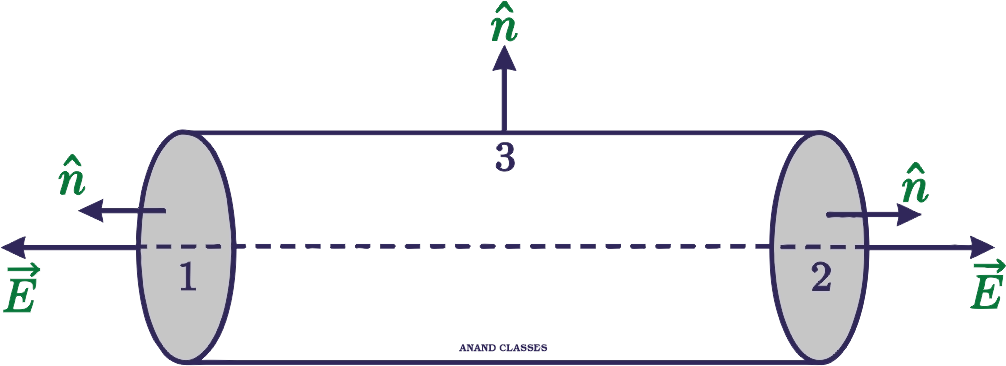
Suppose ϕ₁ and ϕ₂ represent the electric flux through the surfaces 1 and 2 of area s₁ and s₂ of the cylinder and ϕ₃ is the electric flux through the curved surface 3 of the cylinder.
Now, outward normal to surface 1 is opposite to and outward normal to surface 2 is along .
∴ ϕ₁ = − E s₁ and ϕ₂ = E s₂
As s₁ = s₂ = s = area of circular cross section of the cylinder, therefore,
ϕ₁ + ϕ₂ = − E s₁ + E s₂ = − E s + E s = 0.
Also, normal to surface 3 at every point is perpendicular to .
∴ ϕ₃ = E s₃ cos 90° = 0
Hence, ϕ₁ + ϕ₂ + ϕ₃ = 0, i.e., total electric flux over the closed cylindrical surface containing no charge is zero. This verifies Gauss’s theorem.
Explore more concepts related to Forces Between Multiple Charges: Principle of Superposition Solved Numerical Problems
Proof of Coulomb’s Law from Gauss’s Theorem
Consider an isolated positive point charge q at O. Imagine a sphere of radius r with centre O as shown in Figure. The magnitude of electric field intensity at every point on the surface of the sphere is the same and it is directed radially outwards. Further, the direction of vector representing a small area element ds on the surface of the sphere is along only, i.e., θ = 0°.
According to Gauss’s theorem,
This is the electric field intensity at any point P distant r from an isolated point charge q at the centre of the sphere. If another point charge q₀ were placed at P, then force on q₀ would be
F = E × q₀
This is Coulomb’s law.
Students should also study Coulomb’s Law of Electrostatics: Formula, Vector Form, Examples & Numericals
Gauss’s Theorem: Solved Numerical Problems
Build a strong command of Gauss’s theorem by practising a range of solved numerical problems designed for CBSE Class 12, JEE, and NEET, with step-by-step methods and explanations.
S₁ and S₂ are two hollow concentric spheres enclosing charges Q and 3Q respectively as shown in Figure. What is the ratio of electric flux through S₁ and S₂? What would be electric flux through S₁? If air inside S₁ is replaced by a medium of dielectric constant 3?
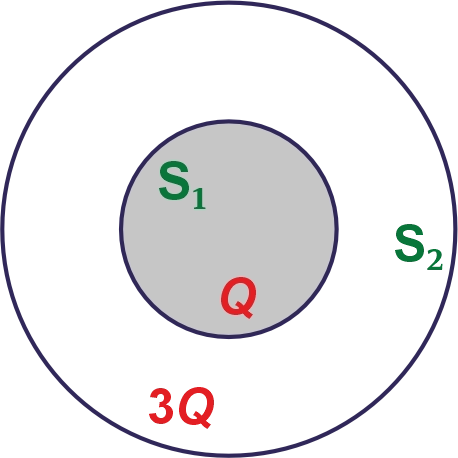
Solution. Electric flux through S₁,
Electric flux through S₂,
When air inside S₁ is replaced by a medium of εr = 3,
then electric flux through S₁ =
What will be the total electric flux through the faces of the cube with side of length a if a charge q is placed at
(a) A : a corner of the cube
(b) B : mid-point of an edge of the cube
(c) C : centre of a face of the cube
(d) D : mid-point of B and C.
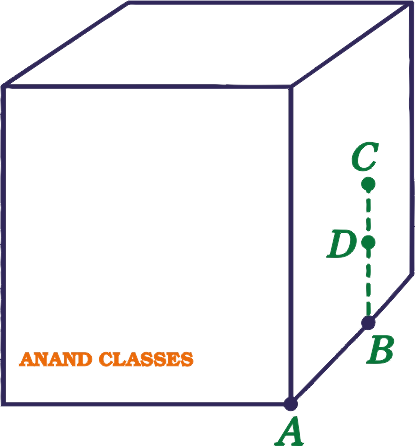
Solution.
(a) When a charge q is placed at corner A of the cube, it is being shared equally by 8 cubes. Therefore, total flux through the faces of the given cube = q / (8 ε₀).
(b) When the charge q is placed at B, the middle point of an edge of the cube, it is being shared equally by 4 cubes. Therefore, total flux through the faces of the given cube = q / (4 ε₀).
(c) When the charge q is placed at C, the centre of a face of the cube, it is being shared equally by 2 cubes. Therefore, total flux through the faces of the given cube = q / (2 ε₀).
(d) When the charge q is placed at D, the mid-point of B and C (which lies on the face of the cube), it is being shared equally by 2 cubes. Therefore, total flux through the faces of the given cube = q / (2 ε₀).
Calculate the number of electric lines of force originating from a charge of 1 C.
Solution. The number of lines of force originating from a charge of 1 C
= Electric flux through a closed surface enclosing a charge of 1 C
ϕE = q / ε₀
ϕE = 1 / (8.854 × 10⁻¹²) = 1.129 × 10¹¹
A positive charge of 17.7 μC is placed at the centre of a hollow sphere of radius 0.5 m. Calculate the flux density through the surface of the sphere.
Solution. From Gauss’s theorem, Electric Flux,
ϕE = q / ε₀
ϕE = (17.7 × 10⁻⁶) / (8.85 × 10⁻¹²)
ϕE = 2 × 10⁶ N m² C⁻¹
Flux density = Total flux / Area
Flux density = (2 × 10⁶) / [4 π (0.5)²]
Flux density = 6.4 × 10⁵ N C⁻¹
S₁ and S₂ are two concentric spheres enclosing charges Q and 3Q respectively as shown in Figure.
(i) What is the ratio of the electric flux through S₁ and S₂?
(ii) How will the electric flux through the sphere S₁ change, if a medium of dielectric constant K is introduced in the space inside S₁ in place of air?
(iii) How will the electric flux through sphere S₁ change, if a medium of dielectric constant K is introduced in the space inside S₂ in place of air?
Solution. (i) By Gauss’s Theorem,
Electric Flux through S₁ is ϕ₁ = Q / ε₀
Electric Flux through S₂ is ϕ₂ = (3Q + Q) / ε₀ = 4Q / ε₀
Ratio of electric flux through S₁ and S₂ is
ϕ₁ / ϕ₂ = (Q / ε₀) / (4Q / ε₀) = 1/4 = 1 : 4
(ii) If a medium of dielectric constant K is introduced in the space inside S₁, then electric flux through S₁ becomes
ϕ₁′ = Q / ε = Q / (K ε₀) = ϕ₁ / K
(iii) The electric flux through S₁ does not change with the introduction of dielectric medium inside the sphere S₂.
A uniformly charged conducting sphere of 2.4 m diameter has a surface charge density of 180.0 μC/m².
(i) Find the charge on the sphere.
(ii) What is the total flux leaving the surface of the sphere?
Solution. Here, radius R = 2.4 / 2 = 1.2 m,
Surface charge density, σ = 180.0 μC/m² = 180 × 10⁻⁶ C m⁻²
(i) Charge on the sphere,
q = 4 π R² σ
q = 4 × 3.14 × (1.2)² × 180 × 10⁻⁶
q = 3.26 × 10⁻³ C
(ii) Electric flux,
ϕE = q / ε₀
ϕE = (3.26 × 10⁻³) / (8.85 × 10⁻¹²)
ϕE = 3.68 × 10⁸ N m² C⁻¹
The electric field components as shown in Figure are Ex = α x1/2, Ey = Ez = 0 in which α = 800 N/C-m1/2. Consider the cube shown has side 0.1m. Calculate (a) the flux ϕE through the cube, and (b) the charge within the cube. Assume that a = 0.1 m
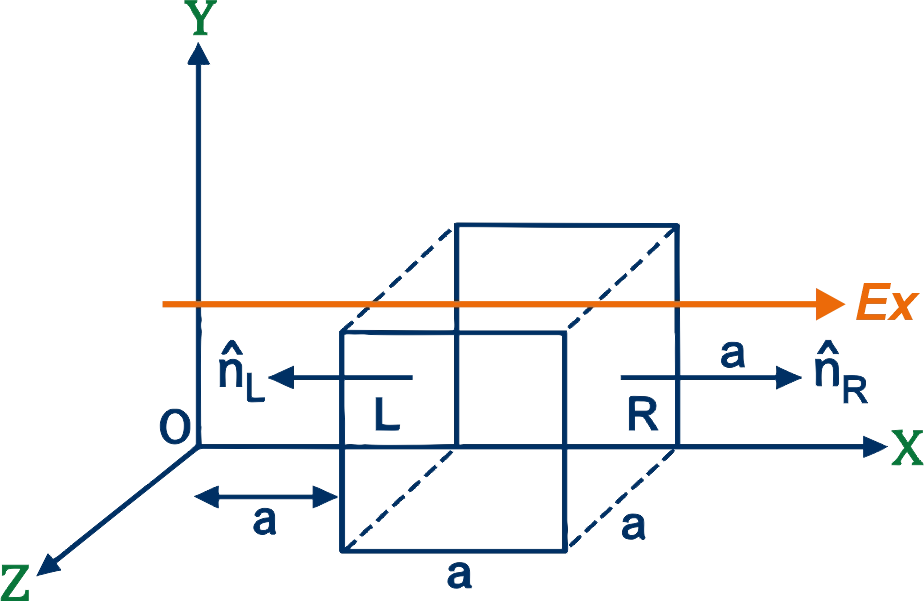
Solution. (a) Here, Ex = α x1/2, Ey = Ez = 0 in which α = 800 N/C-m1/2; a = 0.1 m. As the electric field has only x component, therefore, = ϕE = 0 for each of four faces of cube ⊥ to Y-axis and Z-axis. The area of each face of cube, S = a². Electric Flux is there only for left face L and right face R of the cube shown in Figure.
At the left face, x = a,
EL = α a1/2
ϕL =
ϕL = [α a1/2] (a²) cos 180°
ϕL = −α a5/2
At the right face, x = a + a = 2a,
ER = α (2a)1/2
ϕR =
ϕR = α (2a)1/2 (a²) cos 0°
ϕR = α a5/2 √2
Net flux through the cube =
ϕnet = ϕR + ϕL
ϕnet = α a5/2 √2 −α a5/2
ϕnet = α a5/2 (√2 − 1)
ϕnet = 800 (0·1)5/2 (√2 − 1)
ϕnet = 1.05 N m² C⁻¹
(b) By Gauss’s theorem, the charge within the cube is,
q = ε₀ ϕ
q = 8·85 × 10⁻¹² × 1.05
q = 9·27 × 10⁻¹² C
An electric field is uniform, and in the positive x-direction for positive x; and uniform with the same magnitude, but in the negative x-direction for negative x. It is given that = 200î N/C for x > 0 and = −200î N/C for x < 0. A right circular cylinder of length 20 cm and radius 5 cm has its centre at the origin and its axis along the x-axis so that one face is at x = +10 cm and the other is at x = −10 cm.
(a) What is the net outward flux through each flat face?
(b) What is the flux through the side of the cylinder?
(c) What is the net outward flux through the cylinder?
(d) What is the net charge inside the cylinder? (NCERT Solved Example)
Solution. (a) Here, l = 20 cm, r = 5 cm = 0·05 m As is clear from Figure, on the left face L, and are parallel.
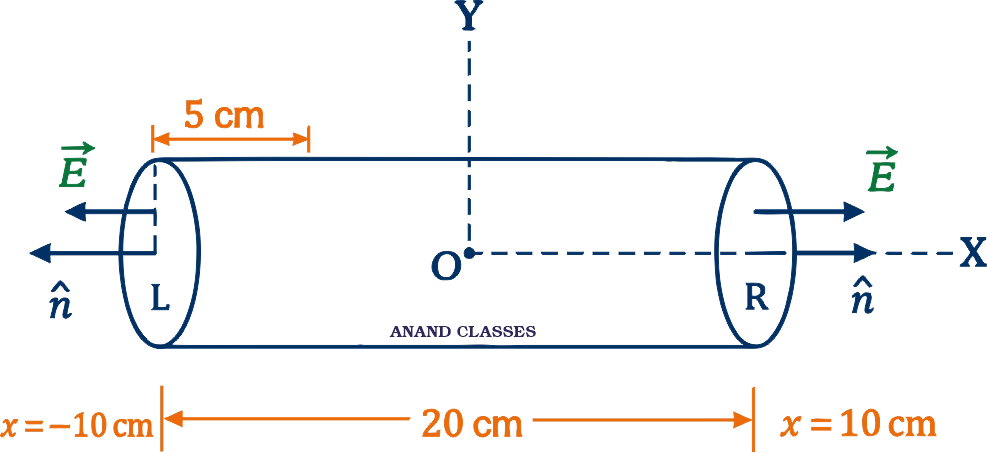
ϕL =
ϕL = −200î ·
ϕL = − 200 [π (0·05)²] cos 0°
ϕL = −1.57 N m² C⁻¹
Again, on right face, and are parallel.
ϕR =
ϕR = 200î ·
ϕR = 200 [π (0·05)²] cos 0°
ϕR = 1.57 N m² C⁻¹
(b) For any point on the curved surface of the cylinder,
⊥
ϕ = = 0
(c) Net outward flux through the cylinder,
ϕnet = 1.57 + 1.57 + 0 = 3.14 N m² C⁻¹
(d) By Gauss’s Theorem, the net charge inside the cylinder is :
q = ε₀ ϕ
q = 8·85 × 10⁻¹² × 3·14
q = 2·78 × 10⁻¹¹ C
An early model for an atom considered it to have a positively charged point nucleus of charge Ze, surrounded by a uniform density of negative charge upto a radius R. The atom as a whole is neutral. For this model, what is the electric field at a distance r from the nucleus? (NCERT Solved Example)
Solution. The charge distribution for this model of atom is shown in Figure. Charge on nucleus = +Ze
As atom is neutral, total negative charge = −Ze
∴ Negative charge density,
ρ = Charge / Volume
ρ = −Ze / (4/3 π R³)
ρ = −3Ze / (4π R³) …(i)
Imagine a Gaussian surface which is a spherical surface of radius r with centre at the nucleus (not shown). According to Gauss’s theorem in electrostatics,
ϕ = E(r) × 4π r² = q / ε₀ …(ii)
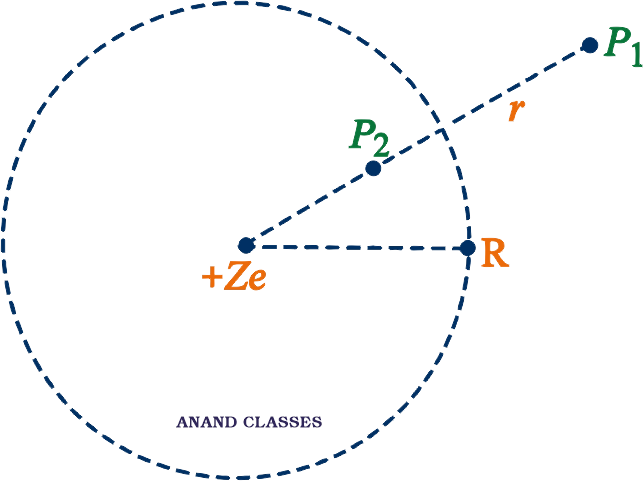
(i) When point P₁ is outside, i.e., r > R, q = Ze − Ze = 0
∴ E(r) = 0
(ii) When point P₂ is inside, i.e., r < R
Charge enclosed by Gaussian surface,
q′ = Ze + 4/3 π r³ ρ
q′ = Ze − Ze (r³ / R³) …using (i)
From (ii),
E′(r) = q′ / (4π ε₀ r²)
E′(r) = (Ze − Ze r³ / R³) / (4π ε₀ r²)
E′(r) = (Ze / 4π ε₀) (1 / r² − r / R³)
A hollow cylindrical box of length 1 m and area of cross section 25 cm² is placed in a three dimensional co-ordinate system as shown in Figure. The electric field in the region is given by = 50 x î, where E is in N C⁻¹, and x is in metre. Find
(i) Net flux through the cylinder
(ii) Charge enclosed by the cylinder.
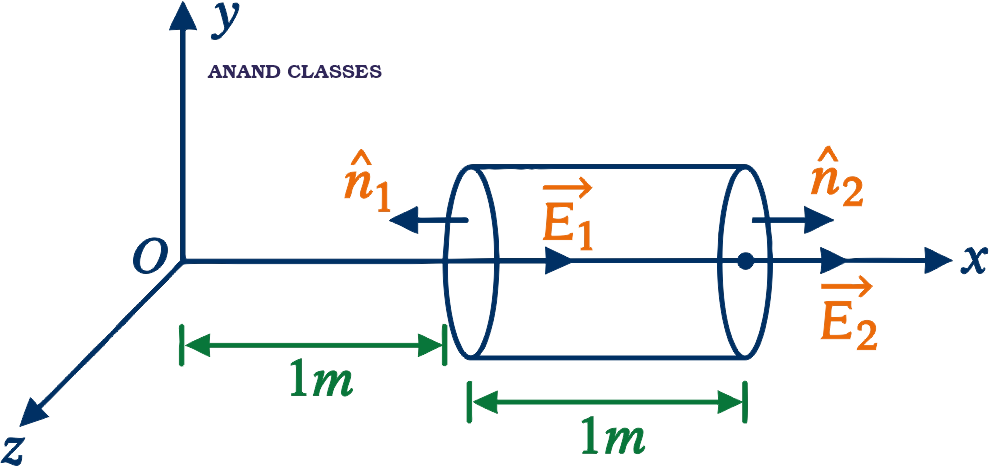
Solution. (i) Here, ds = 25 cm² = 25 × 10⁻⁴ m², along X-axis, = 50 x î
On the left end of the cylinder, E₁ = 50 × 1 N C⁻¹, along X-axis,
ϕ₁ = E₁ ds cos 180°
ϕ₁ = 50 × 25 × 10⁻⁴ (−1)
ϕ₁ = −0.125 N C⁻¹ m²
On the right end of the cylinder, E₂ = 50 × (1 + 1) = 100 N C⁻¹ along X-axis
ϕ₂ = E₂ ds cos 0°
ϕ₂ = 100 × 25 × 10⁻⁴ (1)
ϕ₂ = 0.250 N C⁻¹ m²
Net flux through the cylinder :
ϕnet = ϕ₁ + ϕ₂
ϕnet = −0·125 + 0·250
ϕnet = 0·125 N C⁻¹ m²
(II) Charge enclosed by the cylinder
q = ε₀ ϕ
q = 8·85 × 10⁻¹² × 0·125
q = 1·106 × 10⁻¹² C
Two charges of magnitude -2Q and +Q are located at points (a, 0) and (4a, 0) respectively. What is the electric flux due to charges through a sphere of radius ’3a’ with its centre at the origin.
Solution : By Gauss’s Theorem, the total electric flux through any closed surface is ϕ = q/ε₀
Charge -2Q is located at (a, 0), which is at a distance a from the origin (0,0). and charge +Q is located at (4a, 0), which is at a distance 4a from the origin (0,0).
The sphere is centered at the origin (0,0) with a radius R = 3a.
Since a < 3a, the point (a, 0) lies inside the sphere. Therefore, the charge -2Q is enclosed.
Since 4a > 3a, the point (4a, 0) lies outside the sphere. Therefore, the charge +Q is not enclosed.
Hence net charge enclosed within sphere is -2Q.
The electric flux through the sphere is :
ϕ = -2Q/ε₀
Charges of magnitudes 2Q and –Q are located at points (a, a, a) and (4a, a, a). Find the ratio of the electric flux of electric field, due to these charges, through concentric spheres of radii 2a and 8a centered at the origin.
Solution:
Distance of charge q₁ = +2Q at (a, a, a) from origin (0, 0, 0) :
r₁ = √(a² + a² + a²) = √(3a²) = a√3 ≈ 1.732a
Distance of charge q₂ = –Q at (4a, a, a) from origin (0, 0, 0) :
r₂ = √((4a)² + a² + a²) = √(16a² + a² + a²) = √(18a²) = 3a√2 ≈ 4.24a
Electric Flux through sphere of radius R₁ = 2a :
Since r₁ = 1.732a < 2a, charge q₁ = +2Q is inside the sphere.
Since r₂ = 4.24a > 2a, charge q₂ = –Q is outside the sphere.
Enclosed charge by sphere of radius = 2a is :
(qenclosed)₁ = +2Q
The electric flux :
ϕ₁ = 2Q / ε₀
Electric Flux through sphere of radius R₂ = 8a :
Since r₁ = 1.732a < 8a and r₂ = 4.24a < 8a, both charges lie inside the sphere.
Enclosed charge by sphere of radius = 8a is :
(qenclosed)₂ = (+2Q) + (-Q) = +Q
The electric flux :
ϕ₂ = Q / ε₀
Ratio of Electric Flux (ϕ₁ : ϕ₂) :
ϕ₁ / ϕ₂ = (2Q / ε₀) / (Q / ε₀) = 2 / 1
The ratio of the electric flux through the two spheres is 2 : 1.
Two charges of magnitudes -3Q and +2Q are located at points (a, 0) and (4a, 0) respectively. What is the electric flux due to these charges through a sphere of radius 5a with its centre at the origin ?
Solution:
Distance of charge q₁ = -3Q at (a, 0) from origin = a
Distance of charge q₂ = +2Q at (4a, 0) from origin = 4a
Radius of sphere, R = 5a, centered at origin.
Since both distances (a and 4a) are less than the radius 5a, both charges are enclosed within the sphere.
Total Enclosed Charge within the sphere :
qenclosed = (-3Q) + (+2Q) = –Q
Net Electric Flux by Gauss’s theorem :
ϕE = qenclosed / ε₀
ϕE = –Q / ε₀
Two concentric spherical shells of radii R and 2R are given charges Q₁ and Q₂ respectively. The surface charge densities of the outer surfaces are equal. Determine the ratio Q₁ : Q₂.
Solution.
Let the outer surface charge density of both spheres be σ.
For an isolated conducting spherical shell of radius r carrying charge q, the surface charge density is:
σ = q / (4π r²)
For the inner spherical shell (radius R, charge Q₁) :
σ₁ = Q₁ / (4π R²)
For the outer spherical shell (radius 2R, charge Q₂) : Due to electrostatic induction, the inner surface of the outer shell acquires a charge of −Q₁, and the outer surface of the outer shell retains a net charge of (Q₁ + Q₂).
Therefore, the surface charge density on the outer surface of the outer shell is:
σ₂ = (Q₁ + Q₂) / (4π (2R)²)
σ₂ = (Q₁ + Q₂) / (16π R²)
Given that the surface charge densities of the outer surfaces are equal (σ₁ = σ₂) :
Q₁ / (4π R²) = (Q₁ + Q₂) / (16π R²)
Q₁ = (Q₁ + Q₂) / 4
4Q₁ = Q₁ + Q₂
3Q₁ = Q₂
Q₁ / Q₂ = 1 / 3
(Note: If induction between the concentric shells is neglected, σ₁ = Q₁ / (4π R²) and σ₂ = Q₂ / (16π R²), which gives Q₁ / Q₂ = 1 / 4).
Careful measurement of the electric field at the surface of a black box indicates that the net outward flux through the surface of the box is 8·0 × 10³ N m²/C.
(a) What is the net charge inside the box ?
(b) If the net outward flux through the surface of the box were zero, could you conclude that there were no charges inside the box ? Why or why not ?
Solution.
(a) Given: ϕE = 8·0 × 10³ N m² C⁻¹, ε₀ = 8·85 × 10⁻¹² C² N⁻¹ m⁻², q = ?
By Gauss’s theorem:
ϕE = q / ε₀
The net charge inside the box is :
q = ε₀ ϕE
q = (8·85 × 10⁻¹²) × (8·0 × 10³)
q = 7·08 × 10⁻⁸ C
q = 0·07 × 10⁻⁶ C = 0·07 μC
(b) No, we cannot conclude that there are no charges inside the box.
When ϕE = 0, by Gauss’s theorem:
q = ε₀ ϕE = 0
This only means that the net charge (algebraic sum of all charges Σq) inside the box is zero. It is possible that the box contains equal amounts of positive and negative charges, or it may contain no charge at all.
A point charge of 2·0 μC is at the centre of a cubic Gaussian surface 9·0 cm on edge. What is the net electric flux through the surface ?
Solution. Here, q = 2·0 μC = 2 × 10⁻⁶ C, l = 9·0 cm.
By Gauss’s theorem:
ϕE = q / ε₀
ϕE = (2 × 10⁻⁶) / (8·85 × 10⁻¹²)
ϕE = 2·26 × 10⁵ N m² C⁻¹
A point charge causes an electric flux of −1·0 × 10³ N m²/C to pass through a spherical Gaussian surface of 10·0 cm radius centred on the charge.
(a) If the radius of the Gaussian surface were doubled, how much flux would pass through the surface ?
(b) What is the value of the point charge ?
Solution. Here, ϕE = −1·0 × 10³ N m² C⁻¹, r = 10·0 cm.
(a) If the radius of the Gaussian surface were doubled, flux passing through the surface would remain the same (i.e., −1·0 × 10³ N m²/C). This is because flux depends only on the charge q present inside the surface and not on its size or radius.
(b) As ϕE = q / ε₀
q = ε₀ ϕE
q = (8·85 × 10⁻¹²) × (−1·0 × 10³)
q = −8·85 × 10⁻⁹ C = −8·85 nC
A uniformly charged conducting sphere of 2·4 m diameter has a surface charge density of 80·0 μC/m².
(a) Find the charge on the sphere
(b) What is the total electric flux leaving the surface of the sphere ?
Solution. Here, D = 2r = 2·4 m ⇒ r = 1·2 m.
σ = 80·0 μC/m² = 80·0 × 10⁻⁶ C m⁻²
(a) Charge on the sphere,
q = σ × 4π r²
q = 80 × 10⁻⁶ × 4 × (22 / 7) × (1·2)²
q = 1·45 × 10⁻³ C
(b) Total electric flux leaving the surface of the sphere,
ϕE = q / ε₀
ϕE = (1·45 × 10⁻³) / (8·85 × 10⁻¹²)
ϕE = 1·63 × 10⁸ N m² C⁻¹
Gauss’s Theorem: Conceptual Short Questions With Answers
Test and strengthen your understanding of Gauss’s theorem with important short-answer conceptual questions for CBSE Class 12, JEE, and NEET, focused on key ideas, principles, and applications.
What is the total electric flux emanating from a closed surface enclosing an alpha particle (e = electronic charge).
Solution. Charge of α particle, q = 2e
According to Gauss’s theorem, electric flux emanating from closed surface surrounding the alpha particle is
A uniform electric field exists in space. Find the electric flux of the field through curved surface area of the cylinder with its axis parallel to the field.
Sol. As normal to curved surface area of the cylinder is at 90° to electric field, therefore
The dimensions of an atom are of the order of an Angstrom. Thus there must be large electric fields between the protons and electrons. Why, then is the electrostatic field inside a conductor zero ?
Solution : As is known, electrostatic field is caused by excess charges. On the inside of an isolated conductor, there is no excess charge. Therefore, electrostatic field inside a conductor is zero.
If the total charge enclosed by a surface is zero, does it imply that the electric field everywhere on the surface is zero ? Conversely, if the electric field everywhere on a surface is zero, does it imply that net charge inside is zero.
Solution.
No, when the total charge enclosed by a surface is zero, it does not imply that the electric field everywhere on the surface is zero. By Gauss’s law :
The net integral being zero only means that the total electric flux entering the surface equals the total electric flux leaving it, or that is everywhere perpendicular to .
For example, if an electric dipole or an external electric field is present, the enclosed charge is zero, but the electric field at points on the surface is non-zero.
Conversely, yes, if the electric field is zero everywhere on a surface, it implies that the net charge inside the surface must be zero.
Since = 0 everywhere on the surface, the total flux
According to Gauss’s theorem:
qenclosed = ε₀ ϕE = ε₀ (0) = 0
Thus, the net charge enclosed inside the surface is strictly zero.
Charge q₁ is inside the Gaussian surface; charge q₂ is just outside the surface. Does the electric flux through the surface depend on q₁ ? Does it depend on q₂ ? Explain.
Solution.
Electric flux through the surface depends on q₁ (as q₁ is inside the Gaussian surface).
It does not depend on q₂ because q₂ lies outside the Gaussian surface. Any electric field lines from q₂ that enter the Gaussian surface will also exit it, yielding a net contribution of zero to the electric flux.
A charge q is enclosed by a spherical surface of radius R. If the radius is reduced to half, how would the electric flux through the surface change ?
Solution.
When R is reduced to half, electric flux through the surface remains the same.
According to Gauss’s theorem (ϕE = qenclosed / ε₀), electric flux depends strictly on the total charge enclosed within the surface and is independent of the size or radius of the Gaussian surface.
Calculate the electric flux through each of the six faces of a closed cube of length l, if a charge q is placed (a) at its centre and (b) at one of its vertices.
Solution. (a) By symmetry, the electric flux through each of the six faces of the cube will be same when charge q is placed at its centre.
ϕE = 1/6 · (q / ε₀)
(b) When charge q is placed at one vertex, the flux through each of the three faces meeting at this vertex will be zero, as is parallel to these faces. As only one-eighth of the flux emerging from the charge q passes through the remaining three faces of the cube, so the electric flux through each such face is
ϕE′ = 1/3 · 1/8 · (q / ε₀)
ϕE′ = 1/24 · (q / ε₀)
A charge q is placed at the centre of a cube of side I what is the electric flux passing through two opposite faces of the cube ?
Solution : Electric flux through each face :
ϕE = 1/6 · (q / ε₀)
Therefore electric flux thorugh two opposite faces :
ϕ = 1/6 · (q / ε₀) + 1/6 · (q / ε₀)
ϕ = 1/3 · (q / ε₀)
An electric dipole of dipole moment 20 × 10⁻⁶ C m is enclosed by a closed surface. What is the net electric flux coming out of the surface?
Solution.
Net electric flux coming out of the closed surface is zero.
By Gauss’s theorem, the total electric flux through any closed surface is given by :
ϕ = qenclosed / ε₀
An electric dipole consists of two equal and opposite charges (+q and −q). The net charge enclosed inside the surface is:
qenclosed = (+q) + (−q) = 0
Hence the net electric flux coming out of the surface is :
ϕ = qenclosed / ε₀ = 0
What is the net flux of the uniform electric field through a cube of side 20 cm oriented so that its faces are parallel to the coordinate planes?
Solution.
Net flux over the cube is zero, because the number of field lines entering the cube is equal to the number of field lines leaving the cube.
By Gauss’s theorem:
ϕ = qenclosed / ε₀
Since the electric field is uniform, there is no net charge enclosed within the cube (qenclosed). Thus, the net electric flux through the cube is zero.
A metallic spherical shell has an inner radius R₁ and outer radius R₂. A charge Q is placed at the centre of the spherical cavity. What will be surface charge density on (i) the inner surface, and (ii) the outer surface ?
Solution.
When a charge +Q is placed at the centre of the spherical cavity:
Charge induced on the inner surface of the shell = −Q
Charge induced on the outer surface of the shell = +Q
(i) Surface charge density on the inner surface :
σinner = −Q / (4π R₁²)
(ii) Surface charge density on the outer surface :
σouter = +Q / (4π R₂²)
(a) Consider an arbitrary electrostatic field configuration. A small test charge is placed at a null point (i.e., where = 0) of the configuration. Show that the equilibrium of the test charge is necessarily unstable.
(b) Verify this result for the simple configuration of two charges of the same magnitude and sign placed a certain distance apart.
Solution.
(a) We can prove this by contradiction.
Suppose the test charge placed at the null point is in stable equilibrium. Stable equilibrium requires a restoring force in all directions. Thus, if the test charge is displaced slightly in any direction, it must experience a force directed back towards the null point.
This implies that all electric field lines near the null point must be directed inwards towards the null point. Consequently, there would be a net inward flux of the electric field through a small closed surface surrounding the null point.
However, according to Gauss’s law, the net electric flux through any closed surface enclosing no charge must be zero:
This contradicts our initial assumption of a net inward flux. Hence, the equilibrium of the test charge at a null point can never be stable; it is necessarily unstable.
(b) Verification for two equal like charges:
The null point for two equal positive charges lies at the midpoint of the line joining them.
- Along the line joining the charges : If a positive test charge is displaced slightly along the line towards either charge, it experiences a net repulsive restoring force pushing it back towards the midpoint.
- Perpendicular to the line joining the charges : If the positive test charge is displaced slightly perpendicular (normal) to this line, the net repulsive force from both charges has a component that pushes the test charge further away from the null point.
Since stable equilibrium requires a restoring force in all directions, and there is no restoring force for displacements perpendicular to the line, the test charge at the null point is not in stable equilibrium.
Continue learning with Electric Charge Quantization, Additivity, Charging by Induction, Solved Numericals
Gauss’s Theorem and Electric Flux : Practice Exercise
Practice a variety of conceptual short answer type questions based on Gauss’s theorem for CBSE Class 12, JEE, and NEET, designed to reinforce concepts and improve problem-solving skills.
- Define electric flux. Write its SI unit.
- Is electric flux a scalar or a vector ?
- State and prove Gauss’s law in electrostatics.
- Give the SI unit of surface integral of an electric field.
- State Gauss’s Theorem in electrostatics and deduce coulomb’s law from Gauss’s theorem.
- Using Gauss’s theorem, obtain an expression for the force between two point charges
- What is the direction of an area vector ?
- What is a Gaussian surface ?
- What is the use of Gaussian surface ?
- How much is the electric flux through a closed surface due to a charge lying outside the closed surface ?
- A charge QμC is placed at the centre of a cube. What is the flux corning out from anyone surface ?
Electrostatics Complete Revision Notes PDF Download : Electric Flux and Gauss’s Law
Download the Electrostatics Complete Revision Notes PDF covering Electric Flux and Gauss’s Law, including important concepts, formulas, key results, and exam-focused points for CBSE Class 12, JEE, and NEET preparation.
To download the PDF notes of Electric Flux and Gauss’s Law, click the Download PDF button below :
Electrostatics Complete Revision Notes PPTX Slideshow Presentation Download: Electric Flux and Gauss’s Law
Download the Electrostatics Complete Revision Notes PPTX Slideshow on Electric Flux and Gauss’s Law, featuring important concepts, formulas, key results, and exam-focused content for CBSE Class 12, JEE, and NEET preparation.
To download the PPTX Slideshow Presentation notes of Electric Flux and Gauss’s Law, click the Download Slideshow PPTX Presentation button below :
Electrostatics: Electric Flux & Gauss’s Law Presentation Video
Watch the video to understand Electric Flux and Gauss’s Law through important concepts, solved numericals, and short questions with answers, specially useful for CBSE Class 12, JEE, and NEET preparation.