Electric field intensity due to an infinite thin and thick plane sheet of charge and between two parallel thin sheets of charge using Gauss’s law and the principle of superposition covers, important formulas, special cases and solved numerical problems for effective preparation in Physics.
Electrostatics Complete Revision Notes PDF Download
Download the Electrostatics Complete Revision Notes PDF covering Electric Field Intensity Due to Infinite Plane Sheet of Charge Using Gauss’s Law, including important concepts, formulas, key results, and exam-focused points for CBSE Class 12, JEE, and NEET preparation.
To download the PDF notes, click the Download PDF button below :
Electric Field Intensity Due to a Thin Infinite Plane Sheet of Charge Derivation
Consider a thin, infinite plane sheet of charge. Let σ be the surface density of charge on the sheet (i.e. charge/area). We have to calculate electric field intensity at any point P, (at a perpendicular distance) r from the sheet.
From symmetry, we find that on either side of the sheet must be perpendicular to the plane of the sheet, having same magnitude at all points equidistant from the sheet.
Let us imagine a cylinder of cross-sectional area ds around P and length 2r, piercing through the sheet. At the two cylindrical edges P and Q, and outward normal n̂ are parallel to each other as shown in Figure.
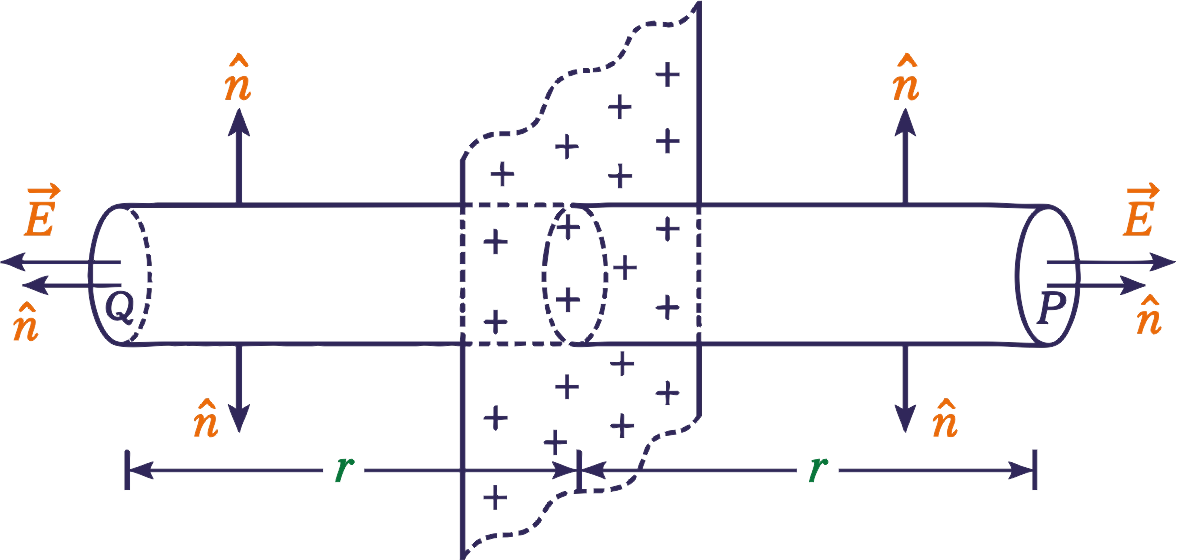
∴ Electric flux over these edges = 2 ds = 2 E ds
On the curved surface of the cylinder, and outward n̂ are ⊥ to each other. Therefore, no contribution to electric flux is made by the curved surface of the cylinder.
∴ Total electric flux over the entire surface of the cylinder, ϕE = 2 E ds
As area of the sheet intercepted by the cylinder is ds, therefore,
Total charge enclosed by the cylinder = σ ds
According to Gauss’s law in electrostatics,
We observe that E is independent of r, the distance of the point from the plane charged sheet.
If the sheet carries positive charge, σ > 0. The electric field is uniform, normal and outwards from the sheet. If the sheet carries negative charge, σ < 0. The field is uniform and along the inward normal to the plane sheet.
Note that for a planar sheet which is large, but not infinite, the above equation is only approximately true in the middle regions of sheet, away from the ends; and at distances not far away from the sheet.
Derivation of Electric Field Intensity Due to a Uniform Thick Infinite Plane Sheet of Charge
If the infinite plane sheet has uniform thickness, the surface density of charge σ is uniform and same on both the surfaces of the sheet.
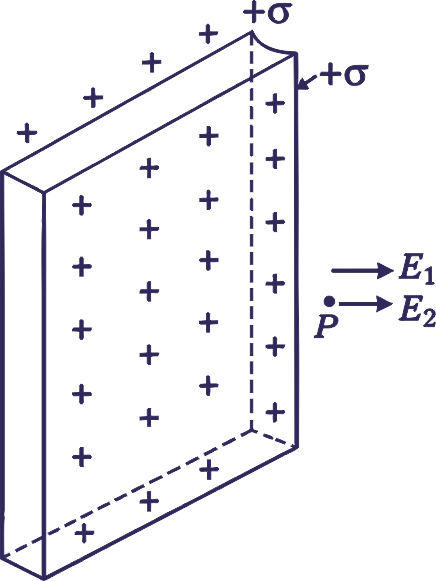
The electric field intensity at any point P due to each surface is
Both E₁ and E₂ are perpendicular to the plane of the sheet and directed away as shown in Figure. Therefore, according to superposition principle, net electric field intensity at P due to an infinite charged plane sheet of uniform thickness is
Note that the sheet is supposed to be of infinite size so that the ‘edge effect‘ due to distortion of electric field at the edges (of a finite sheet) can be ignored.
Solved Numerical Problems on Applications of Gauss’s Law – Electric Field Intensity Due to Infinite Plane Sheet of Charge
Solved numerical problems based on applications of Gauss’s Law – Electric Field Intensity Due to Infinite Plane Sheet of Charge help students apply Gauss’s law, electric field formulas, and electric flux for CBSE Class 12 Physics, JEE, and NEET-level questions.
A charge of 17.7 × 10⁻⁴ C is distributed over a large sheet of area 400 m². Calculate the electric field intensity at a distance of 10 cm from it.
Sol. Here, q = 17.7 × 10⁻⁴ C, A = 400 m², E = ?, r = 10 cm = 10⁻¹ m
In case of a large plane sheet, distance of the point (= r) does not matter.
E = σ/(2 ε₀) = (q/A)/(2 ε₀)
E = q/(2 ε₀ A)
E = (17.7 × 10⁻⁴)/[2 × (8.85 × 10⁻¹²) × 400]
E = 2.5 × 10⁵ N/C
Derivation of Electric Field Intensity Due to Two Thin Infinite Plane Sheets of Charge
Let A and B be two thin infinite plane charged sheets held parallel to each other as shown in Figure. Suppose
σ₁ = Uniform surface density of charge on A
σ₂ = Uniform surface density of charge on B
If E₁, E₂ are electric field intensities at a point due to charged sheets A and B respectively, then
The arrangement shows three regions I, II and III. We apply superposition principle to calculate the net field intensity in the three regions. As a matter of convention, a field pointing from left to right is taken as positive and the one pointing from right to left is taken as negative.
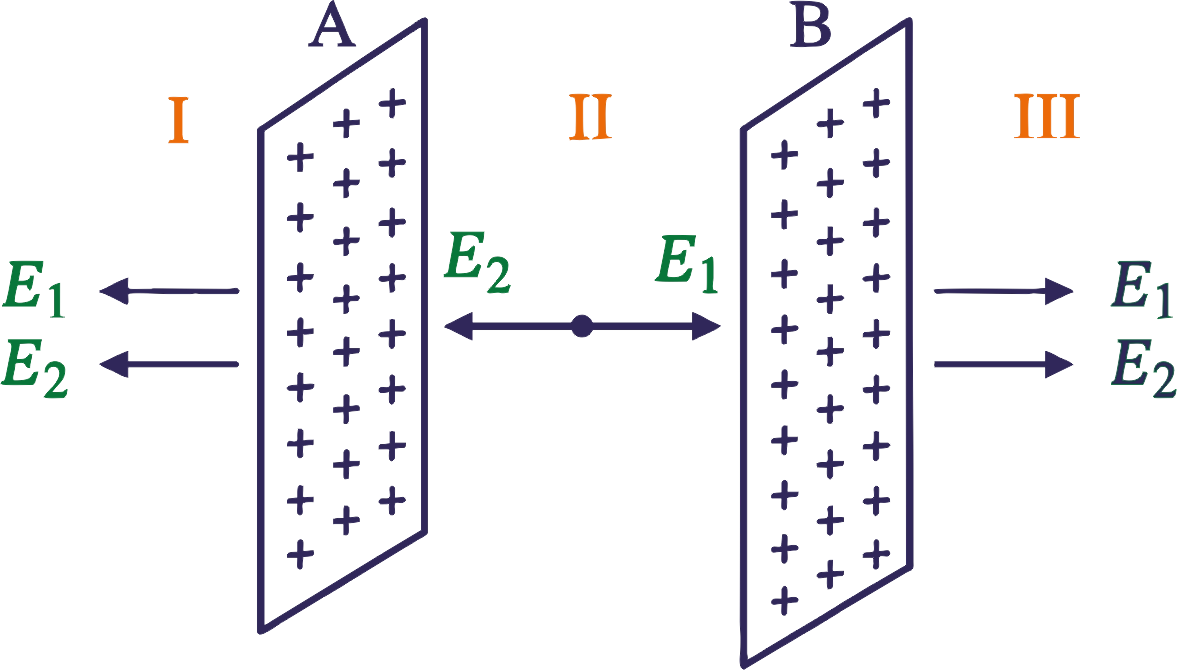
We assume that σ₁ > σ₂ > 0
In region I,
EI = – E₁ – E₂
Similarly, in region II,
EII = E₁ – E₂
and, in region III,
EIII = E₁ + E₂
Special cases: Suppose σ₁ = σ, and σ₂ = -σ i.e., two thin infinite plane sheets with equal and opposite uniform surface densities of charge are held parallel to each other.
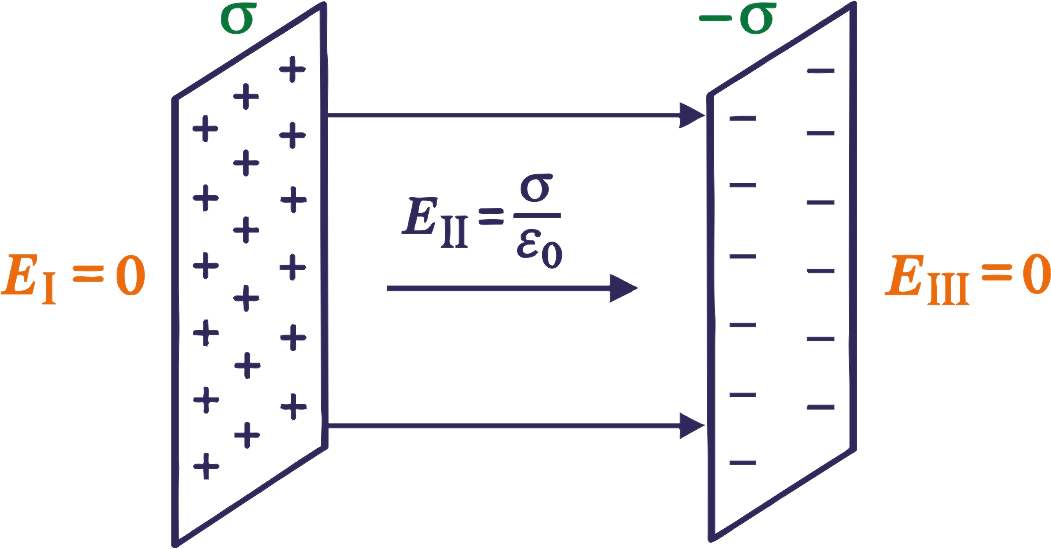
EI = EIII = 0,
Thus field intensity inbetween such sheets having equal and opposite uniform surface densities of charge becomes constant i.e., a uniform electric field is produced inbetween two such sheets as shown in Figure. Also, electric field intensity (E) does not depend upon the distance between the thin sheets.
Electrostatics Complete Revision Notes PPTX Slideshow Presentation Download
Download the Electrostatics Complete Revision Notes PPTX Slideshow featuring important concepts, formulas, key results, and exam-focused content for CBSE Class 12, JEE, and NEET preparation.
To download the PPTX Slideshow Presentation notes, click the Download button below :
Electrostatics Notes Presentation Video
Watch the video to understand Electric Field Intensity Due to an Infinite Plane Sheet and between two parallel thin sheets of Charge Using Gauss’s Law through important concepts, solved numericals, and short questions with answers.
