What is Uniform Motion, Non-Uniform Motion and Speed? Average Speed, Instantaneous Speed, Units and Examples

What is Uniform Motion, Non-Uniform Motion and Speed? Average Speed, Instantaneous Speed, Units and Examples

Motion is one of the most important concepts in physics and mechanics. In everyday life, we observe objects moving with different speeds and in different ways. Some objects move with constant speed and cover equal distances in equal intervals of time, while others change their speed continuously during motion. The study of uniform motion, non-uniform … Read more

Distance and Displacement, Solved Numericals, Conceptual Questions Answers

Distance and Displacement, Solved Numericals, Conceptual Questions Answers

Distance and displacement are fundamental concepts in kinematics that describe how an object moves from one position to another. While distance represents the total path traveled, displacement gives the shortest straight-line distance along with direction. Understanding these concepts is essential for solving numerical problems and answering conceptual questions accurately. This section includes solved numericals and conceptual questions with answers to strengthen problem-solving skills and clarify key differences between distance and displacement.

Motion in One, Two and Three Dimensions

Motion in One, Two and Three Dimensions Rest and Motion, Motion Types, Point Object and Its Position Vectorr

Motion in one, two, and three dimensions forms the foundation of kinematics of CBSE Class 11 Physics, helping us understand how objects move in space. From simple straight-line motion to complex three-dimensional trajectories, the study of rest and motion explains how position changes with time. By analyzing different types of motion and treating objects as point masses, we simplify real-world problems using position vectors, enabling precise mathematical descriptions of motion in physics. These concepts are frequently tested in JEE PYQs, NEET PYQs and IMUCET PYQs, making them crucial for exam preparation.

What is Mechanics, Statics, Dynamics, Kinematics, Kinetics

What is Mechanics, Statics, Dynamics, Kinematics, Kinetics

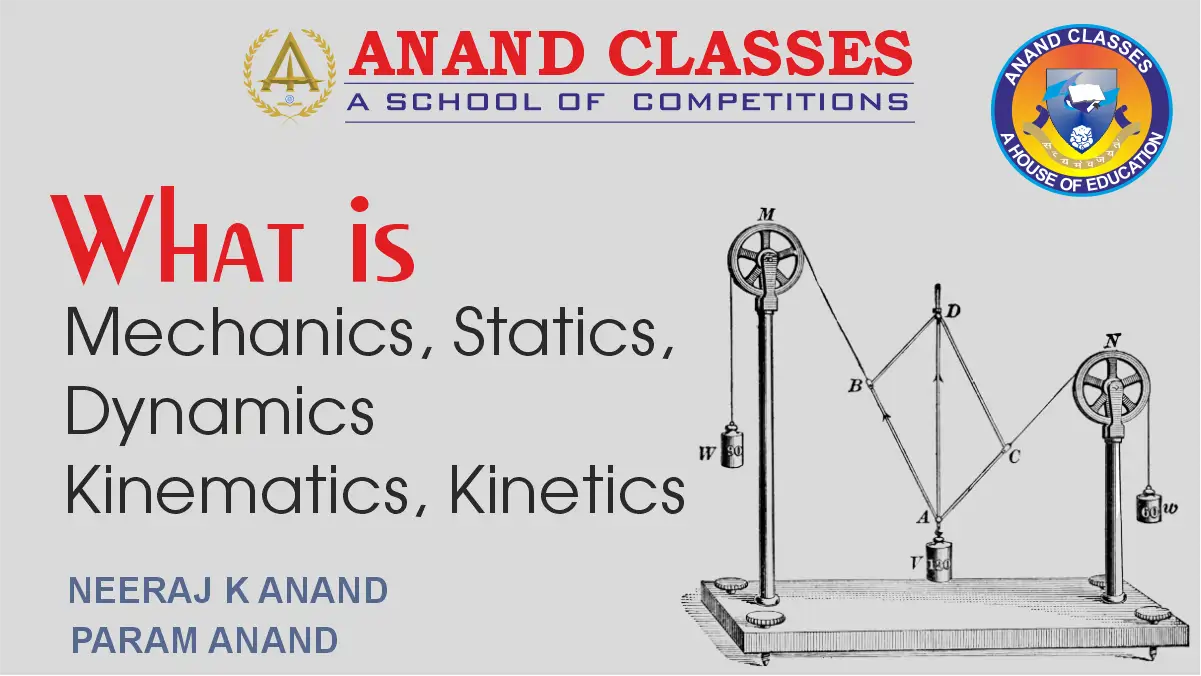
What is Mechanics, Statics, Dynamics, Kinematics, and Kinetics is a fundamental topic in physics that introduces the study of motion and forces. Mechanics is the branch of physics that deals with the behavior of objects under the influence of forces. It is divided into statics, which studies bodies at rest, and dynamics, which studies bodies in motion. Dynamics is further divided into kinematics, which describes motion without considering forces, and kinetics, which explains motion by considering the forces causing it. This topic forms the foundation for Class 11 Physics and is essential for exams like JEE, NDA, IMUCET, and Merchant Navy entrance tests.

Units and Measurements Conceptual Questions and Answers, Practice Exercise

Units and Measurements Conceptual Short Questions and Answers, Practice Exercise for CBSE Board Exam

Units and measurements are essential for expressing physical quantities in a clear and standardized form, forming the backbone of all scientific calculations. This chapter focuses on building strong conceptual understanding through carefully designed questions and answers, along with practice exercises. By mastering these concepts, students can improve their accuracy, understand measurement uncertainties, and confidently solve physics problems.

Dimensional Analysis, Units and Errors Numerical Problems and Solutions : Practice Questions and Answers

Dimensional Analysis, Units and Errors Numerical Problems and Solutions : Practice Questions and Answers

Dimensional analysis, units, measurements, and errors form the foundation of quantitative science, ensuring that physical quantities are expressed accurately and consistently. These concepts are essential for solving numerical problems in physics and engineering, as they help verify equations, convert units, and estimate uncertainties in measurements. Mastery of these topics not only improves problem-solving skills but also builds a deeper understanding of real-world scientific applications.

Convert One System of Units To Another by Dimensions of Physical Quantity

Conversion Of a Physical Quantity From One System of Units To Another by Dimensional Analysis

Conversion of one system of units to another using dimensions of physical quantities is an important application of dimensional analysis. This method helps in converting units accurately by using the dimensional formula of a quantity and applying proper conversion factors. Solving numerical problems step by step not only improves understanding but also enhances accuracy and speed, which is essential for competitive exams.

Derive Dimensional Formula of Physical Quantities, Principle of Dimensional Homogeneity

In deriving the relation between the various physical quantities, again the principle of homogeneity of dimensional equation is used. To derive a physical relation, we first of all explore the possible physical quantities upon which the given physical quantity may depend. By assuming the powers of the dependent physical quantities, the relation between the given physical quantity and the quantities on which it depends, is written. By making use of dimensional formulae of the physical quantities involved, the relation is expressed in terms of the fundamental units of mass, length and time. When the powers of M, L and T are equated on both sides of the dimensional equation, we get three equations from which the values of the three unknown powers can be calculated. Setting the values of the powers, the required relation is obtained.

Principle of Dimensional Homogeneity, Check Correctness of Physical Relations and Equations

The principle of dimensional homogeneity states that the dimensions of all terms in a physical equation must be the same. This principle is widely used to check the correctness of physical relations and equations in physics. By comparing the dimensions on both sides of an equation, we can verify whether a formula is dimensionally consistent, even without knowing its exact derivation. This concept is an important application of dimensional analysis and plays a key role in solving numerical problems in Class 11 Physics and JEE.

Dimensions and SI Units of Physical Quantities – Quantities Have Same Dimensions

Dimensional formulae and SI units play a crucial role in understanding the nature of physical quantities and their relationships. By expressing quantities in terms of fundamental dimensions such as mass, length, and time, dimensional analysis helps in identifying whether different physical quantities have the same dimensions. Quantities having the same dimensions can often be compared, related, or substituted in equations, making this concept essential for verifying formulas, solving numerical problems, and strengthening problem-solving skills in Class 11 Physics and JEE.