Laws of vectors addition is a fundamental operation in vector algebra used to determine the combined effect of two or more vector quantities acting simultaneously. Vectors cannot be added using ordinary algebraic methods. Instead, vector addition is performed using graphical and analytical techniques such as the Triangle Law of Vector Addition and Polygon Law of Vector Addition. This topic forms an important part of Class 11 Physics and provides a strong foundation for JEE Main, JEE Advanced, NEET, NDA, IMUCET, and other competitive examinations.
Laws of Vectors Addition – Triangle Law and Polygon Law With Extension Lami’s Theorem (Conditions for Zero Resultant Vector (Vector Equilibrium)
Master Laws of Vectors Addition with comprehensive notes, detailed explanations, solved examples, and practice questions designed for Class 11 Physics students. This study material helps build strong fundamentals and supports effective preparation for CBSE board exams, JEE Main, JEE Advanced, NEET, NDA, IMUCET, and other competitive examinations.
You may also like to study What happens when a vector is multiplied by a positive real number?
Who can benefit from these notes and study materials?
These notes are useful for Class 11 students, board exam aspirants, and candidates preparing for engineering, medical, defence, and other competitive entrance examinations.
Explore more concepts related to What are Rectangular Unit Vectors ?
How can organized study material help in exam preparation?
Well-structured study material makes learning easier, improves revision efficiency, enhances confidence, and helps students prepare systematically for all examinations.
Students should also study What are orthogonal vectors?
What is the general rule for Addition of Vectors ?
General rule of vectors addition states that the vectors to be added are arranged in such a way that the head of first vector coincides with the tail of second vector, whose head coincides with the tail of third vector and so on, then the single vector drawn from the tail of the first vector to the head of the last vector represents their resultant vector.
Continue learning with Scalars Vectors Types, Unit, Modulus or Magnitude, Negative, Equal, Orthogonal, Position, Collinear, Coplanar, Co-initial Vectors
What is the Triangle Law of Vectors Addition ?
Let the two vectors $\vec{A}$ and $\vec{B}$ be acting at some angle to each other as shown in Figure(a). To find their resultant vector $\vec{R}$, coincide the tail of $\vec{A}$ on the head of $\vec{B}$ as shown in Figure(b). Then, the single vector $\vec{R}$ drawn from the tail of $\vec{A}$ to the head of $\vec{B}$ gives the resultant vector.
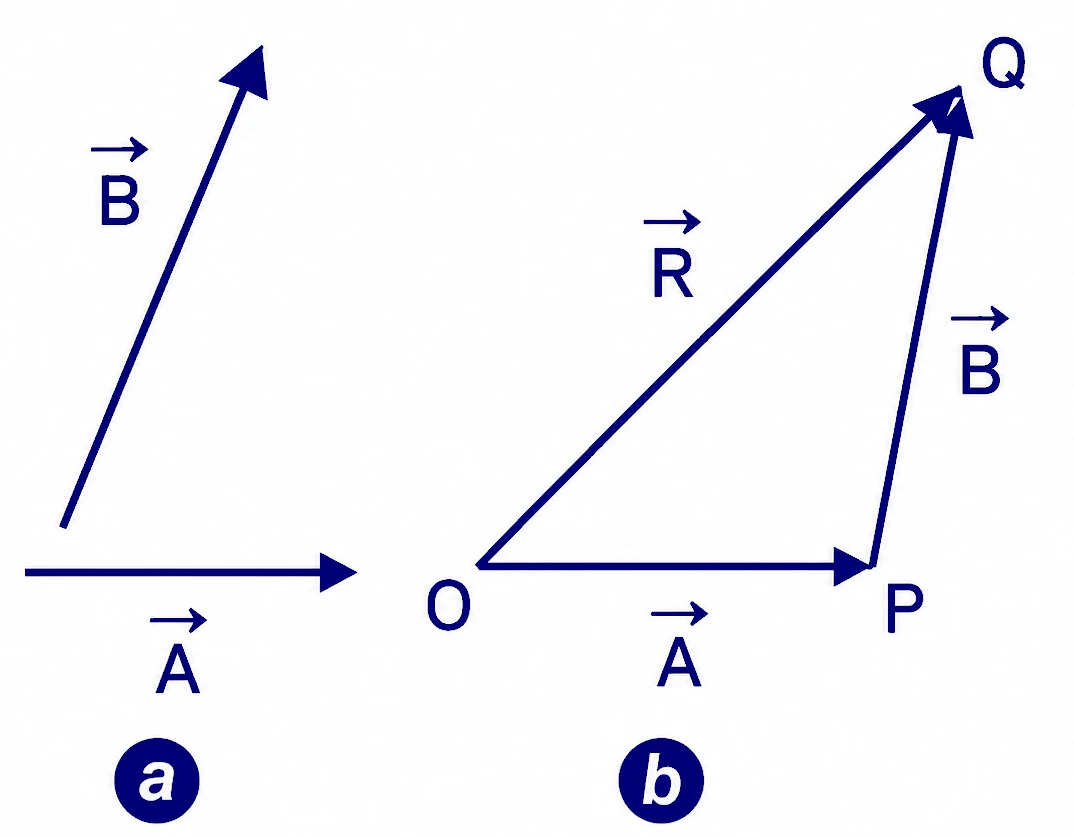
As shown in Figure(b), the two vectors $\vec{A}$ and $\vec{B}$ are represented by the sides $\vec{OP}$ and $\vec{PQ}$ of a triangle OPQ, taken in the same order. Their resultant $\vec{R}$ is represented by the third side $\vec{OQ}$ of the triangle taken in the opposite order. This method of finding the resultant of two vectors is called triangle law of vectors. Thus,
$\vec{OQ}$ = $\vec{OP}$ + $\vec{PQ}$
$\vec{R}$ = $\vec{A}$ + $\vec{B}$
What is Triangle Law of Vectors Addition – Analytical Method ?
Triangle law of vectors states that if two vectors acting on a particle at the same time are represented in magnitude and direction by the two sides of a triangle taken in one order, their resulant vector is represented in magnitude and direction by the third side of the triangle taken in opposite order.
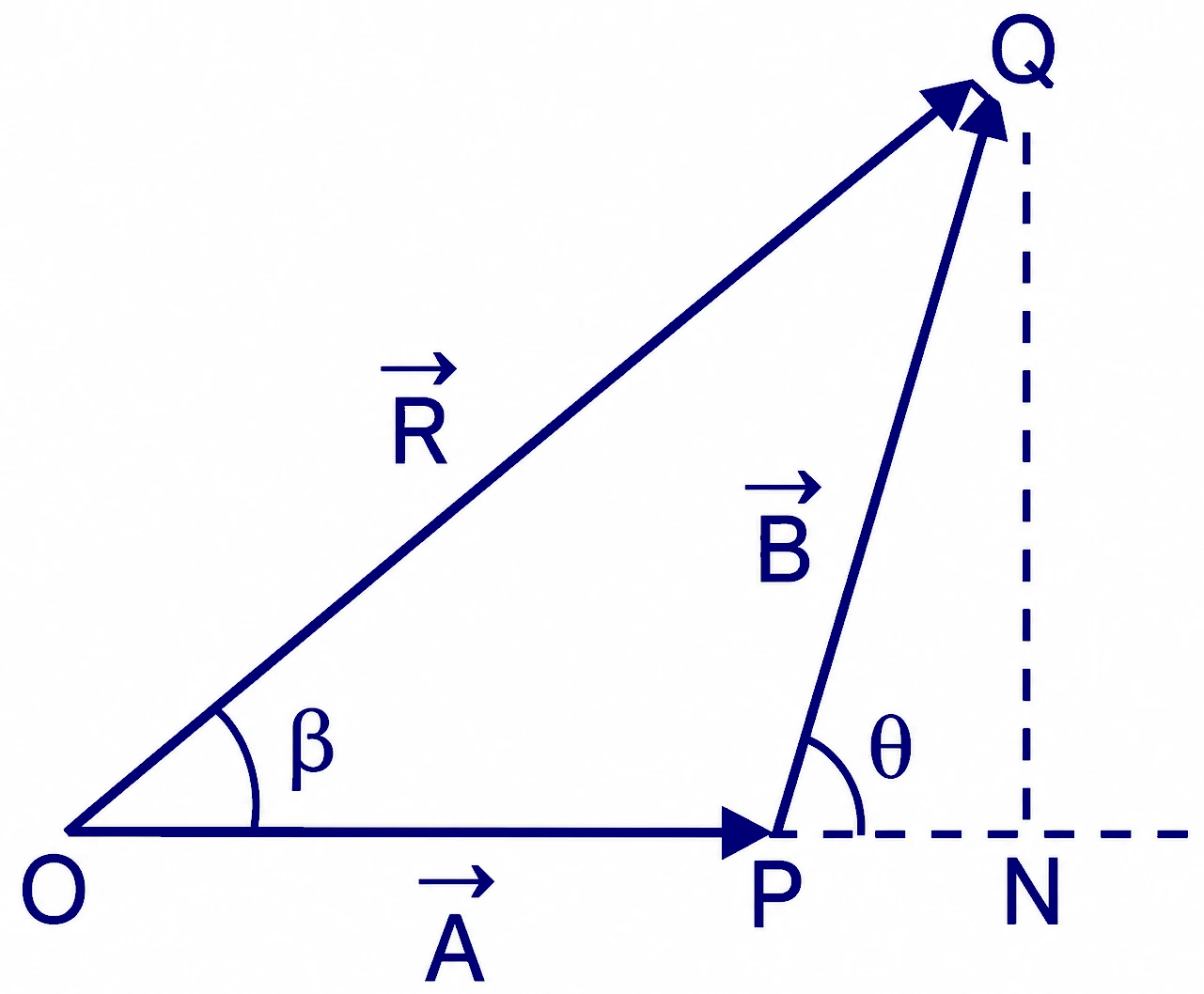
Let the two vectors $\vec{A}$ and $\vec{B}$ inclined at an angle θ be acting on a particle at the same time. The two vectors $\vec{A}$ and $\vec{B}$ are represented in magnitude and direction by two sides $\vec{OP}$ and $\vec{PQ}$ of a triangle OPQ, taken in the same order. Then, according to triangle law of vectors addition, the resultant vector $\vec{R}$ is represented in magnitude and direction by the third side $\vec{OQ}$ of the triangle taken in the opposite order.
Magnitude of R
Draw ON perpendicular to OP produced.
In Figure; OP = A ; PQ = B ; OQ = R and ∠NPQ = θ.
Using basic trigonometry in △QNP :
PN/PQ = cos θ or PN = PQ cos θ = B cos θ
QN/PQ = sin θ or QN = PQ sin θ = B sin θ
Since ON = OP + PN, we can substitute it into the equation below.
In right angled triangle △ONQ, we have
OQ2 = ON2 + QN2
Since ON = OP + PN, we can substitute it into the equation :
OQ2 = (OP + PN)2 + QN2
R2 = (A + B cos θ)2 + (B sin θ)2
R2 = A2 + 2AB cos θ + B2 (cos2θ + sin2θ)
R2 = A2 + 2AB cos θ + B2
R2 = A2 + B2 + 2AB cos θ
R = $ \sqrt{A^2 + B^2 + 2AB \cos\theta} $
Direction of $\vec{R}$
Let the resultant vector $\vec{R}$ make an angle β with the direction of vector $\vec{A}$. Then, from right angled triangle QNO,
$\tan\beta = \dfrac{QN}{ON} = \dfrac{QN}{OP + PN} = \dfrac{B \sin\theta}{A + B \cos\theta}$
t in the Same Direction (θ = 0o)
When two vectors $\vec{A}$ and $\vec{B}$ are parallel and point in the exact same direction, the angle between them is θ = 0o.
Magnitude of the Resultant
We know that cos 0o = 1. Substituting this into the magnitude formula :
$R = \sqrt{A^2 + B^2 + 2AB \cos 0^\circ}$
$R = \sqrt{A^2 + B^2 + 2AB(1)}$
$R = \sqrt{(A + B)^2}$
R = A + B
Rmax = A + B
When two vectors act in the same direction, the magnitude of the resultant vector is simply the algebraic sum of their individual magnitudes. This is the maximum possible value for the resultant of two vectors.
Direction of the Resultant (β)
We know that sin 0o = 0 and cos 0o = 1. Substituting these into the direction formula :
$\tan \beta = \dfrac{B \sin 0^\circ}{A + B \cos 0^\circ}$
$\tan \beta = \dfrac{B(0)}{A + B(1)} = \dfrac{0}{A + B} = 0$
β = 0o
The resultant vector acts along the exact same direction as vector $\vec{A}$ and vector $\vec{B}$.
Thus, for two vectors acting in the same direction, the magnitude of the resultant vector is equal to the sum of the magnitudes of two vectors and acts along the direction of vector $\vec{A}$ and vector $\vec{B}$.
Case 2 : When Two Vectors act in the Opposite Direction (θ = 180o)
When two vectors $\vec{A}$ and $\vec{B}$ are anti parallel and point in the exact opposite direction, the angle between them is θ = 180o.
Magnitude of the Resultant
We know that cos 180o = -1. Substituting this into the magnitude formula :
$R = \sqrt{A^2 + B^2 + 2AB \cos 180^\circ}$
$R = \sqrt{A^2 + B^2 + 2AB(-1)}$
$R = \sqrt{(A – B)^2}$
R = A – B or B – A
Rmin = | A – B |
When two vectors act in the opposite direction, the magnitude of the resultant vector is simply the difference of their individual magnitudes. This is the minimum possible value for the resultant of two vectors.
Direction of the Resultant (β)
We know that sin 180o = 0 and cos 180o = -1. Substituting these into the direction formula :
$\tan \beta = \dfrac{B \sin 180^\circ}{A + B \cos 180^\circ}$
$\tan \beta = \dfrac{B(0)}{A + B(-1)} = \dfrac{0}{A – B} = 0$
β = 0o or 180o
The resultant vector acts along the direction of vector whose magnitude is large.
Thus, for two vectors acting in opposite directions, the magnitude of the resultant vector is equal to the difference of the magnitudes of the two vectors and acts in the direction of bigger vector.
Case 3 : When Two Vectors act right angle to each other (θ = 90o)
When two vectors $\vec{A}$ and $\vec{B}$ are perpendicular to each other, the angle between them is θ = 90o.
Magnitude of the Resultant
We know that cos 90o = 0. Substituting this into the magnitude formula :
$R = \sqrt{A^2 + B^2 + 2AB \cos 90^\circ}$
$R = \sqrt{A^2 + B^2 + 2AB(0)}$
$R = \sqrt{(A^2 + B^2)}$
When two vectors act perpendicular to each other, the magnitude of the resultant vector is square root of sum of squares of their individual magnitudes.
Direction of the Resultant (β)
We know that sin 90o = 1 and cos 90o = 0. Substituting these into the direction formula :
$\tan \beta = \dfrac{B \sin 90^\circ}{A + B \cos 90^\circ}$
$\tan \beta = \dfrac{B(1)}{A + B(0)} = \dfrac{B}{A} $
β = $\tan^{-1}\left(\dfrac{B}{A}\right)$
Gain deeper understanding by studying JEE Main Motion in a Straight Line MCQs PYQs Previous Year Questions and Solutions
What is Polygon Law of Vector Addition ? – When Number of Vectors act in Different Directions
Let the number of vectors $\vec{A}$, $\vec{B}$, $\vec{C}$ and $\vec{D}$ etc. be acting in different directions as shown in Figure(a). To find their resultant vector, coincide the tail of $\vec{B}$ with the head of $\vec{A}$, tail of $\vec{C}$ with the head of $\vec{B}$ and tail of $\vec{D}$ with the head of $\vec{C}$. Then, the single vector drawn from the tail of $\vec{A}$ to head of $\vec{D}$ will represent their resultant vector in Figure(b).
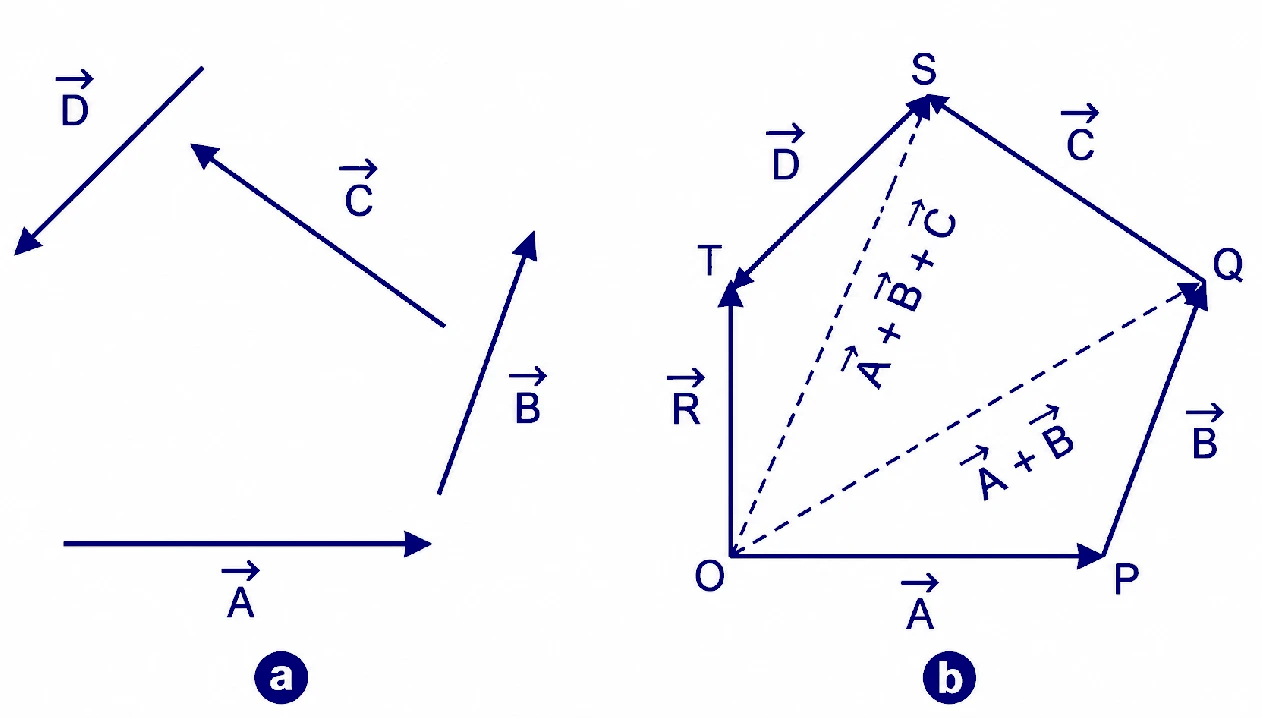
Thus, it is clear that if the vectors $\vec{A}$, $\vec{B}$, $\vec{C}$ and $\vec{D}$ are represented in magnitude and direction by the sides $\vec{OP}$, $\vec{PQ}$, $\vec{QS}$ and $\vec{ST}$ of an open polygon taken in the same order, then their resultant vector $\vec{R}$ will be represented in magnitude and direction by the closing side $\vec{OT}$ of the polygon taken in opposite order. This method of finding the resultant is called polygon law of vectors.
Polygon Law of Vectors Addition
Thus, polygon law of vectors states that if any number of vectors, acting on a particle at the same time are represented in magnitude and direction by various sides of an open polygon taken in the same order, their resultant is represented in magnitude and direction by the closing side of the polygon taken in opposite order.
According to polygon law of vectors :
$\vec{A}$ + $\vec{B}$ + $\vec{C}$ + $\vec{D}$ = $\vec{R}$, where $\vec{R}$ is the resultant vector of $\vec{A}$, $\vec{B}$, $\vec{C}$ and $\vec{D}$.
Proof :
In Figure(b), $\vec{A}$ = ($\vec{OP}$), $\vec{B}$ = ($\vec{PQ}$), $\vec{C}$ = ($\vec{QS}$), $\vec{D}$=($\vec{ST}$) and $\vec{R}$ =($\vec{OT}$). .Join O to Q and O to S, with straight lines.
From triangle law of vectors; In △OPQ,
$\vec{A}$ + $\vec{B}$ = ($\vec{OP}$) +($\vec{PQ}$)= ($\vec{OQ}$)
Apply triangle law in △OQS,
($\vec{A}$ + $\vec{B}$) + $\vec{C}$ = ($\vec{OQ}$) + ($\vec{OS}$) = ($\vec{OS}$)
Apply triangle law in △OST,
($\vec{A}$ + $\vec{B}$ + $\vec{C}$) + $\vec{D}$ = ($\vec{OS}$) + ($\vec{ST}$) = ($\vec{OT}$) = $\vec{R}$
Here, $\vec{R}$ is the resultant vectorof $\vec{A}$, $\vec{B}$, $\vec{C}$, and $\vec{D}$.
| Exam Tip |
|---|
| Polygon Law of Vector Addition : If any number of vectors are represented by the sides of a closed polygon taken in a single cyclic order, their net resultant is zero. |
| Homogeneity (Same Nature) : Two vectors can be added only if they represent the same physical quantity. For example, a displacement vector cannot be added to a force vector or a velocity vector; it can only be added to another displacement vector. |
“Students should also study Equations of Motion Under Gravity for free fall, upward and vertical downward motion“
Conditions for Zero Resultant Vector (Vector Equilibrium)
1. Triangle Law of Equilibrium (Three Vectors)
If three vectors acting on a point object at the same time can be represented in magnitude and direction by the three sides of a triangle taken in the same order (cyclic order), their resultant is zero. In this state, the object is said to be in equilibrium.
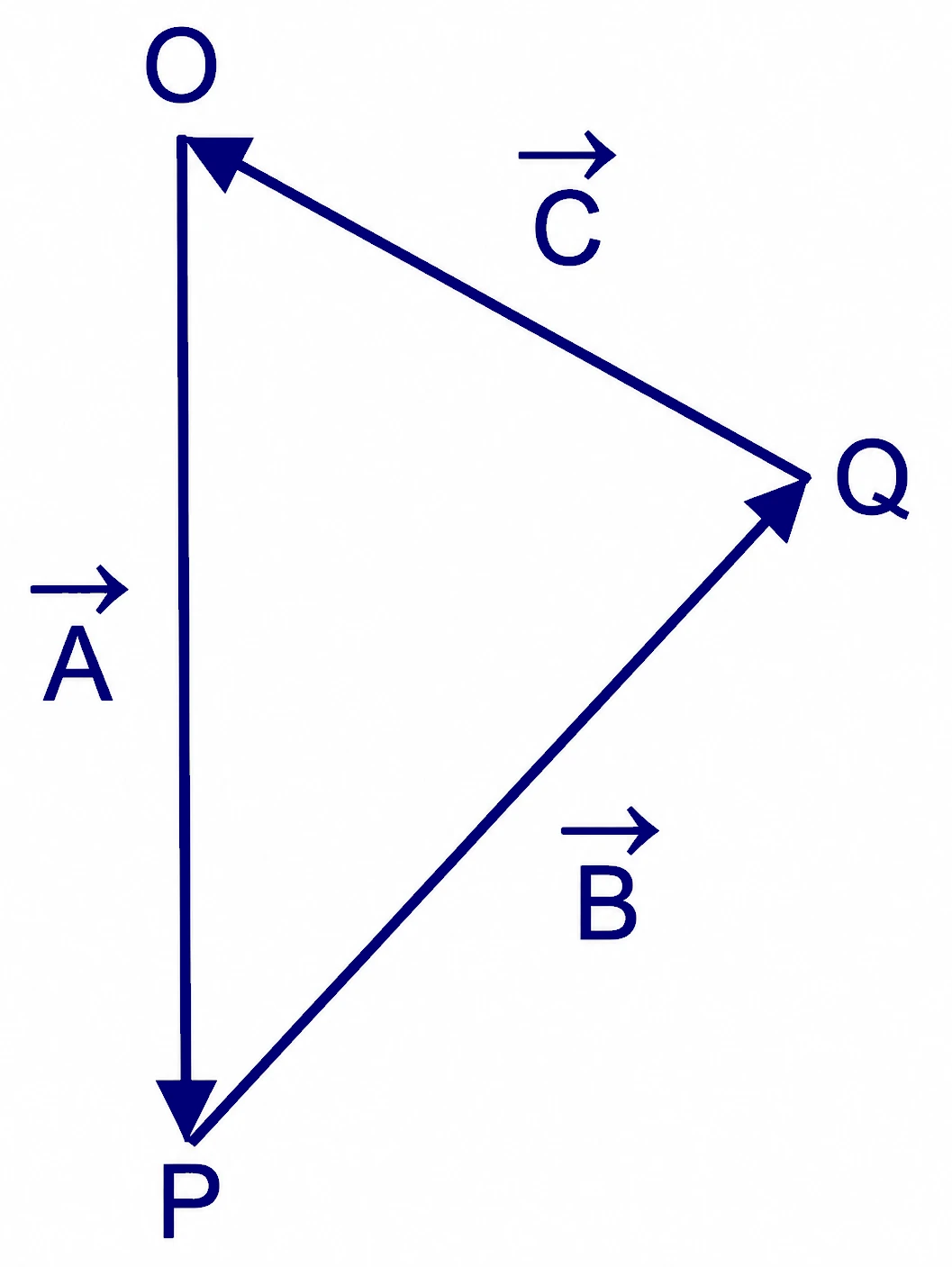
Consider three vectors $\vec{A}$, $\vec{B}$, and $\vec{C}$ acting on an object at the same time. Let them be represented by the sides $\vec{OP}$, $\vec{PQ}$, and $\vec{QO}$ of a triangle taken in one continuous (same) order. Since the starting point of the first vector coincides with the ending point of the last vector, the net vector sum is zero :
$\vec{A} + \vec{B} + \vec{C} = \vec{OP} + \vec{PQ} + \vec{QO} = 0$
2. Polygon Law of Equilibrium (Multiple Vectors)
Similarly, if any number of vectors acting on an object at the same time can be represented in magnitude and direction by the various sides of a closed polygon taken in the same order, their resultant vector is zero.
When this condition is met, all the forces or vector quantities perfectly cancel each other out, and the object remains in a state of translational equilibrium:
$\vec{A_1} + \vec{A_2} + \vec{A_3} + \dots + \vec{A_n} = 0$
Summary of Equilibrium Conditions
| Number of Vectors | Geometric Condition for Equilibrium | Resultant (R) |
| Two Vectors | Must be equal in magnitude and exactly opposite in direction (180o). | $\vec{R} = 0$ |
| Three Vectors | Must be coplanar and form a closed triangle in a continuous cyclic order. | $\vec{R} = 0$ |
| Multiple Vectors | Must form a closed polygon in a continuous cyclic order. | $\vec{R} = 0$ |
“Read more about Derive Equations of Motion Using Calculus Method, Solved Numerical Examples“
Explain Lami’s Theorem (Three Coplanar Forces Rule for Equilibrium)
Lami’s Theorem states that if three coplanar forces acting at a point are in equilibrium, then each force is directly proportional to the sine of the angle between the other two forces.
Let $\vec{A}$, $\vec{B}$, and $\vec{C}$ be three forces acting on a particle in equilibrium, and let α, β, and γ be the angles opposite to forces $\vec{A}$, $\vec{B}$, and $\vec{C}$ respectively. α is the angle between forces $\vec{B}$, and $\vec{C}$, β is the angle between forces $\vec{C}$, and $\vec{A}$, and γ is the angle between forces $\vec{A}$, and $\vec{B}$.
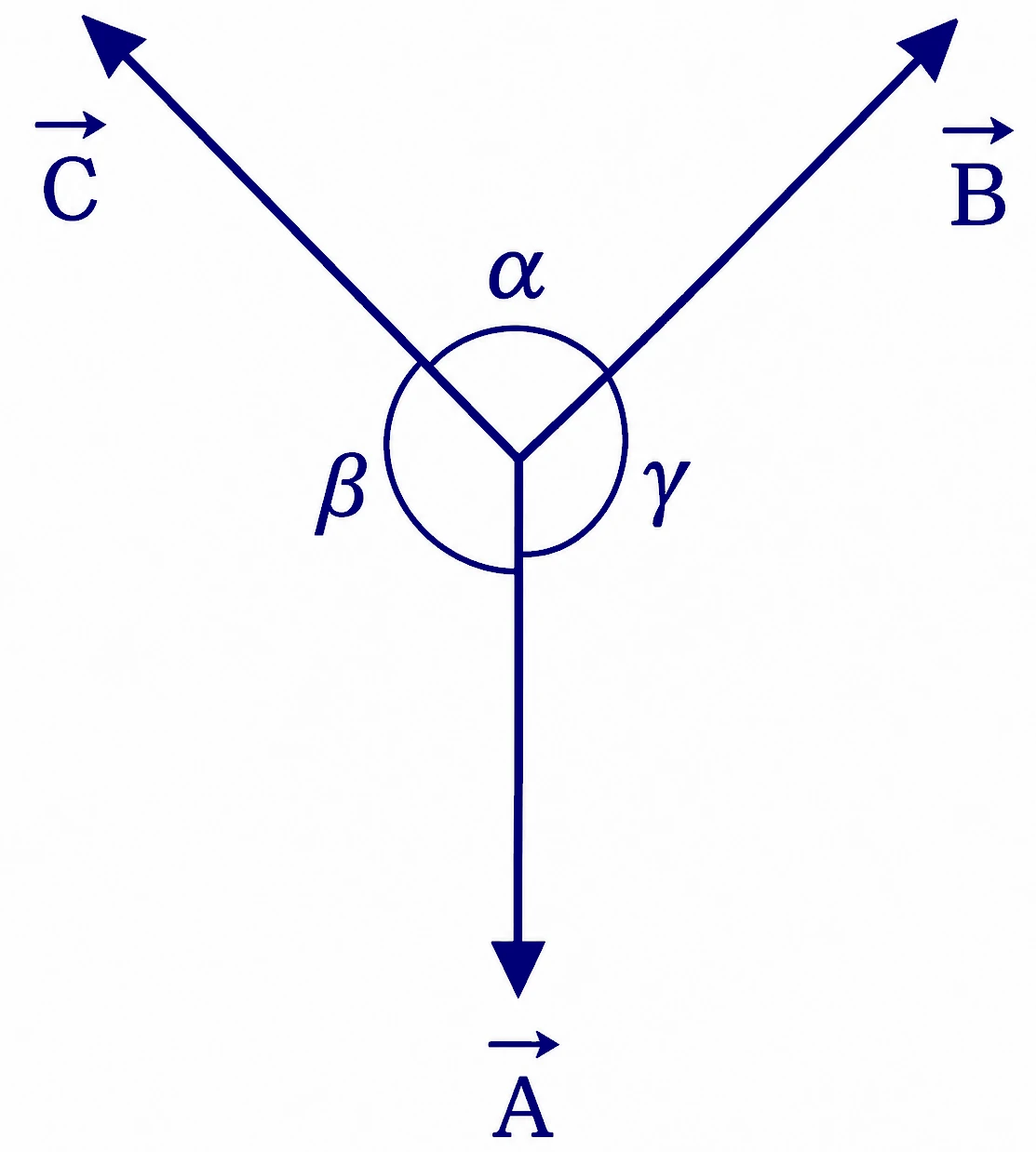
Mathematically, this is expressed as :
$$\frac{A}{\sin \alpha} = \frac{B}{\sin \beta} = \frac{C}{\sin \gamma}$$
Conditions for the Equilibrium of an Object
For a rigid body or object to be in complete mechanical equilibrium, it must satisfy the following three conditions :
1. Translational Equilibrium (No Linear Motion)
The net resultant force acting on the object must be equal to zero. This ensures the object does not accelerate linearly.
$\sum \vec{F} = 0 \quad \text{or} \quad \vec{F}_1 + \vec{F}_2 + \vec{F}_3 + \dots = 0$
2. Rotational Equilibrium (No Rotational Motion)
The net external torque (τ) acting on the object about any axis must be equal to zero. This ensures the object does not experience angular acceleration.
$\sum \vec{\tau} = 0$
3. Energy Condition (Stable Equilibrium)
For an object to be in a state of stable equilibrium, its potential energy (U) must be at a minimum.
Note: If the object is displaced slightly from a position of minimum potential energy, a restoring force will act on it to bring it back to its original equilibrium position.
“Build strong concepts by studying Derive Equations of Uniformly Accelerated Motion“
Prove that Vectors Addition is Commutative
The commutative law of vector addition states that the sum of two or more vectors remains the same regardless of the order in which they are added :
$\vec{A} + \vec{B} = \vec{B} + \vec{A}$
Proof using Parallelogram OPQS
Let two vectors $\vec{A}$ and $\vec{B}$ be represented by the adjacent sides OP and OS of a parallelogram OPQS. Join the O with Q.
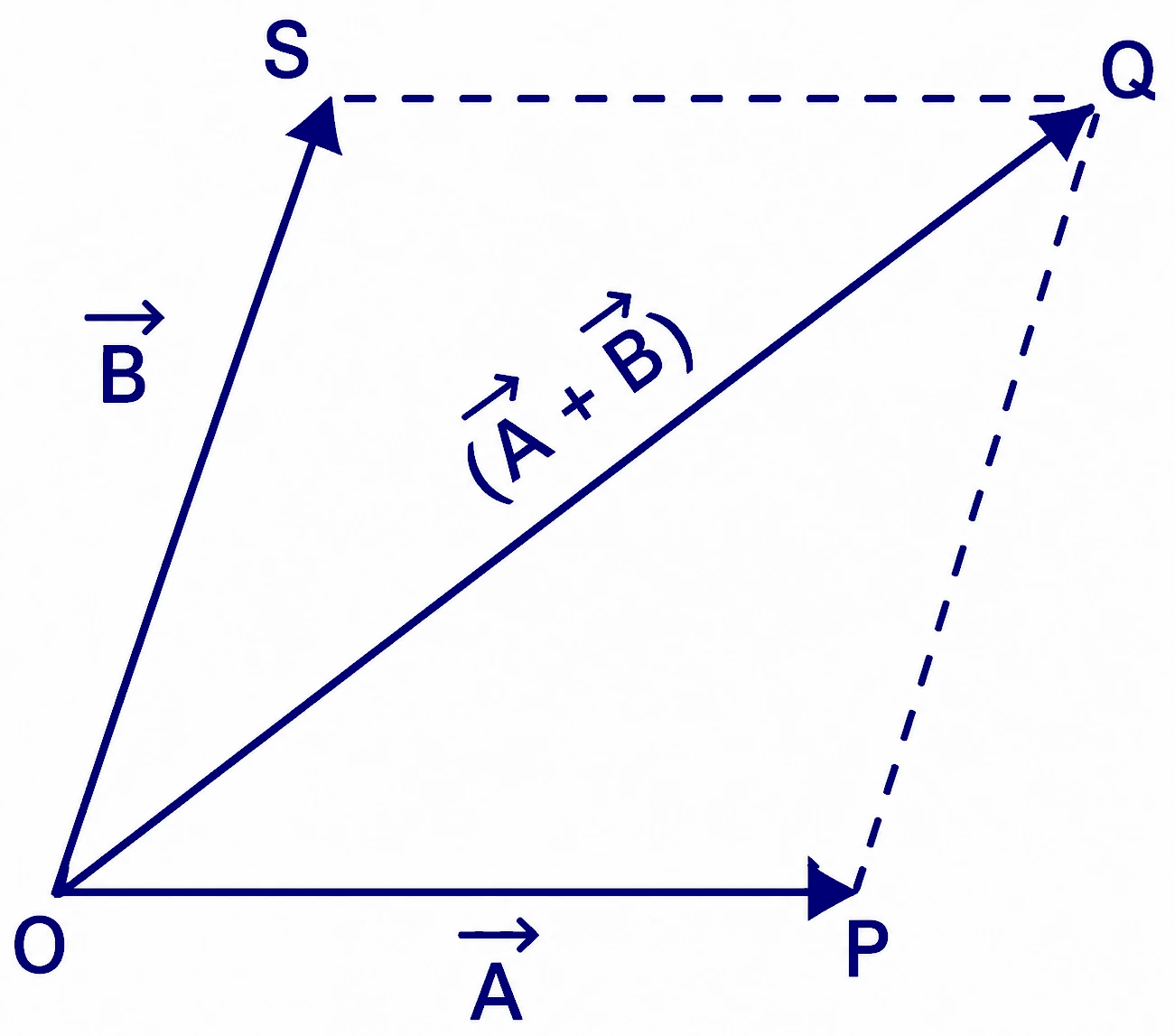
By the properties of a parallelogram, opposite sides are equal and parallel (OS ∥ PQ and OP ∥ SQ). As $\vec{OP} = \vec{SQ} = \vec{A}$ and $\vec{OS} = \vec{PQ} = \vec{B}$.
Step 1: Apply Triangle Law to △OPQ
Taking the lower path through the triangle △OPQ :
$\vec{OQ} = \vec{OP} + \vec{PQ}$
$\vec{OQ} = \vec{A} + \vec{B}$
Step 2: Apply Triangle Law to △OSQ
Taking the upper path through the triangle △OSQ :
$\vec{OQ} = \vec{OS} + \vec{SQ}$
$\vec{OQ} = \vec{B} + \vec{A}$
From above equations, the diagonal $\vec{OQ}$ represents the same resultant vector in both cases, hence,
$\vec{A} + \vec{B} = \vec{B} + \vec{A}$
This mathematically proves that vector addition is commutative.
Prove that Vectors Addition is Associative
The associative law of vector addition states that when adding three or more vectors, the sum remains the same regardless of how the vectors are grouped :
$(\vec{A} + \vec{B}) + \vec{C} = \vec{A} + (\vec{B} + \vec{C})$
Proof using Polygon OPQS
Let three vectors $\vec{A}$, $\vec{B}$, and $\vec{C}$ be represented by the sides OP, PQ, and QS of a polygon OPQS. According to the polygon law of vectors, the closing side OS represents the final resultant vector $\vec{R}$.
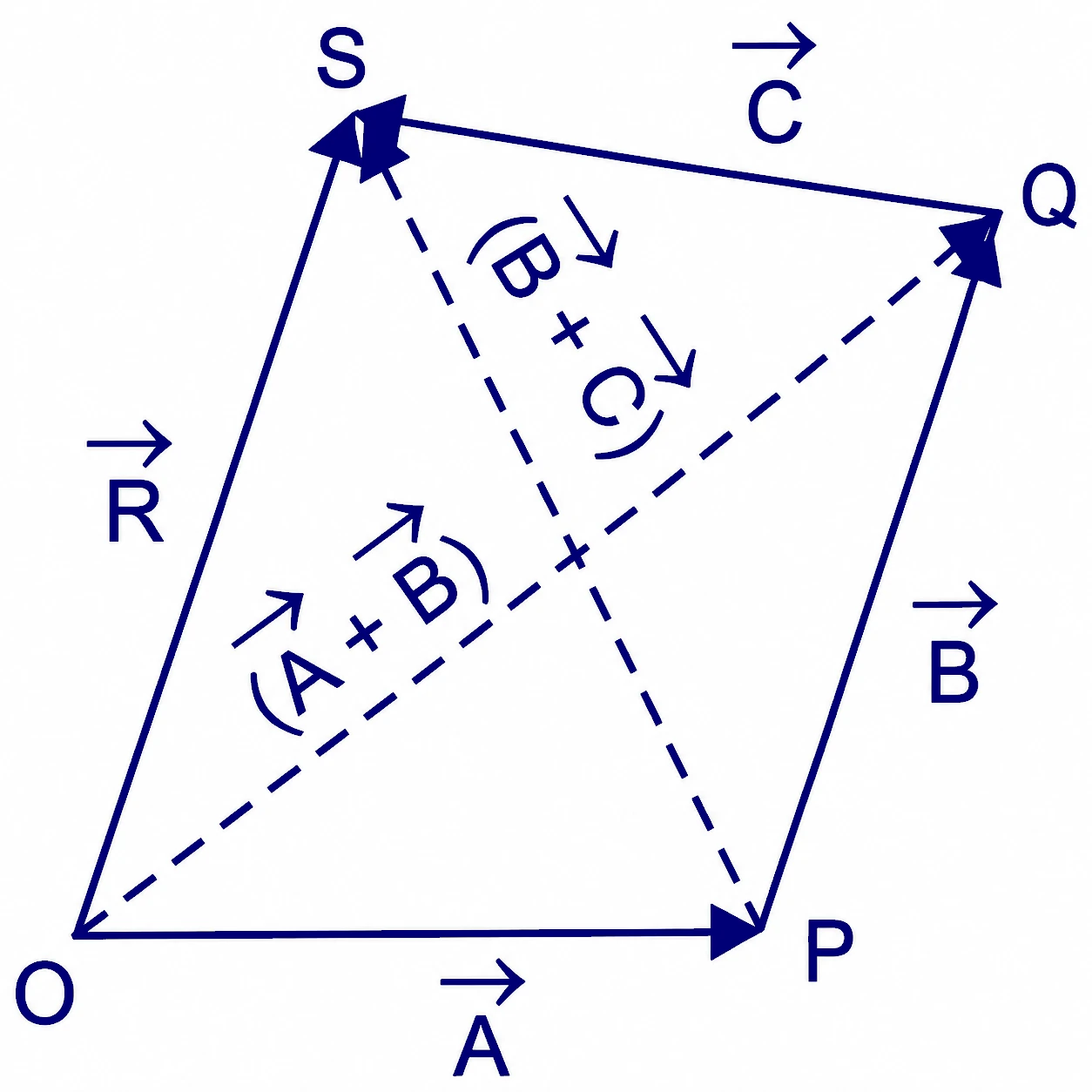
To prove associativity, we will find the value of OS using two different groupings by drawing the internal lines OQ and PS.
In triangle △OPQ. By the triangle law of vector addition :
$\vec{OQ} = \vec{OP} + \vec{PQ} = \vec{A} + \vec{B} $
Now, in triangle △OQS.
$\vec{OS} = \vec{OQ} + \vec{QS} = (\vec{A} + \vec{B}) + \vec{C} $
Next, look at the triangle △PQS. By the triangle law of vector addition :
$\vec{PS} = \vec{PQ} + \vec{QS} = \vec{B} + \vec{C}$
Now, look at the triangle △OPS
$\vec{OS} = \vec{OP} + \vec{PS} = \vec{A} + (\vec{B} + \vec{C}) $
From above equations, the vector $\vec{OS}$ represents the same resultant vector in both cases, hence,
$(\vec{A} + \vec{B}) + \vec{C} = \vec{A} + (\vec{B} + \vec{C})$
This mathematically proves that vector addition is associative.
Important Conceptual Notes About Laws of Vector Addition
1. Magnitude and Direction Alone Do Not Make a Vector
A physical quantity having both magnitude and direction is not automatically a vector.
Examples : Electric current, pressure, time, and surface tension all possess specific directions or orientations, yet they are scalar quantities.
2. The True Test of a Vector Quantity
A physical quantity is classified as a true vector only when it obeys the laws of vector addition, specifically the commutative law ($\vec{A} + \vec{B} = \vec{B} + \vec{A}$).
Example : Electric current does not follow vector addition. If two currents of 3A and 4A meet at a junction at a 90o angle, they add up algebraically to 7A via Kirchhoff’s Current Law, rather than combining vectorially to 5A using the Pythagorean theorem. Therefore, current is a scalar.
Short Conceptual Questions and Answers Based on Laws of Addition of Vectors
What is the general rule for the addition of vectors?
According to the general rule of vector addition, vectors are arranged such that the head of one vector coincides with the tail of the next vector. The resultant vector is then drawn from the tail of the first vector to the head of the last vector.
What is the Triangle Law of Vector Addition?
The Triangle Law states that if two vectors are represented in magnitude and direction by two sides of a triangle taken in the same order, their resultant is represented by the third side of the triangle taken in the opposite order.
Why is the Triangle Law of Vector Addition important?
It provides a graphical method for finding the resultant of two vectors acting at an angle to each other and helps in understanding vector addition geometrically.
What is the Polygon Law of Vector Addition?
The Polygon Law states that if several vectors are represented by the sides of an open polygon taken in the same order, their resultant is represented by the closing side of the polygon taken in the opposite order.
When is the Polygon Law of Vector Addition used?
It is used when more than two vectors act simultaneously in different directions and their resultant needs to be determined.
What happens when two vectors act in the same direction?
When two vectors act in the same direction, the magnitude of the resultant vector is equal to the sum of their magnitudes, and the resultant acts in the same direction.
What happens when two vectors act in opposite directions?
When two vectors act in opposite directions, the magnitude of the resultant vector is equal to the difference of their magnitudes and acts in the direction of the larger vector.
What happens when two vectors are perpendicular to each other?
When two vectors are at right angles, the magnitude of the resultant is obtained using the Pythagorean theorem, and its direction depends on the magnitudes of the two vectors.
What is meant by a zero resultant vector?
A zero resultant vector means that the vector sum of all vectors is zero. In such a case, the object is said to be in equilibrium.
What is the Triangle Law of Equilibrium?
If three vectors acting simultaneously on an object can be represented by the three sides of a triangle taken in the same order, their resultant is zero and the object remains in equilibrium.
What is the Polygon Law of Equilibrium?
If several vectors acting on an object can be represented by the sides of a closed polygon taken in the same order, their resultant vector is zero and the object remains in equilibrium.
What is Lami’s Theorem?
Lami’s Theorem states that if three coplanar forces acting at a point are in equilibrium, each force is proportional to the sine of the angle between the other two forces.
What is the commutative law of vector addition?
The commutative law states that the order of addition does not affect the resultant vector. In other words, adding vector A to vector B gives the same result as adding vector B to vector A.
What is the associative law of vector addition?
The associative law states that the grouping of vectors does not affect the final resultant. Vectors can be grouped and added in any order without changing the result.
Can vectors of different physical quantities be added together?
No. Only vectors representing the same physical quantity can be added. For example, displacement can be added to displacement, but displacement cannot be added to force or velocity.
How can we identify a true vector quantity?
A true vector quantity must obey the laws of vector addition. Possessing magnitude and direction alone is not sufficient for a physical quantity to be classified as a vector.
Important Units and Measurements Chapter Links
Strengthen your preparation with NEET Units and Measurements PYQs Previous Year Questions and Solutions along with full Class 11 Physics coverage, including important topics such as physical quantities, systems of units, dimensional analysis, significant figures, and errors in measurements. This section is closely connected with other Class 11 chapters like motion in one two and three dimensions, laws of motion, work energy and power, and gravitation, helping you build a strong conceptual foundation. Practicing these previous year questions not only improves accuracy and problem solving skills but also helps you understand exam patterns, making it an essential resource for complete NEET preparation and effective revision of the entire Class 11 syllabus.