Units and Error Analysis is one of the most fundamental topics in JEE Physics, forming the base for all numerical problem-solving and experimental accuracy. Questions from this chapter frequently appear in JEE Main and Advanced, testing concepts like significant figures, dimensional analysis, and error propagation. Practicing previous year questions (PYQs) helps students understand exam patterns, improve calculation precision, and avoid common mistakes in measurements. Get complete Class 11 Physics coverage including detailed theory, numerical problems, and board exam questions for thorough preparation. For Complete notes of Units and Measurements with clear concepts, solved examples, and practice questions to build a strong foundation for JEE Main Physics.

JEE Physics: Units and Error Analysis Previous Year Questions
TOPIC 1: Units
Problem : If E and H represent the intensity of electric field and magnetising field respectively, then the unit of E/H will be
(a) ohm
(b) mho
(c) joule
(d) newton
[2021, 27 Aug Shift-1]
Solution: Ans. (a)
Unit of intensity of electric field E is $vm^{-1},$
Unit of intensity of magnetising field H is $Am^{-1}$
Unit of E/H can be calculated as:
$$\frac{\text{Unit of E}}{\text{Unit of H}} = \frac{Vm^{-1}}{Am^{-1}} = \frac{V}{A} = \text{ohm.}$$
Thus, the unit of E/H will be ohm.
Start detailed theory of Measurements for thorough preparation by clicking the link.
Problem : Match List-I with List-II.
| List-I | List-II |
| A. R (Rydberg constant) | 1. $kg~m^{-1}s^{-1}$ |
| B. h (Planck’s constant) | 2. $kg~m^{2}s^{-1}$ |
| C. $\mu_{s}$ (Magnetic field energy density) | 3. $m^{-1}$ |
| D. $\eta$ (Coefficient of viscosity) | 4. $kg~m^{-1}s^{-2}$ |
Choose the most appropriate answer from the options given below:
(a) A-2, B-3, C-4, D-1
(b) A-3, B-2, C-4, D-1
(c) A-4, B-2, C-1, D-3
(d) A-3, B-2, C-1, D-4
[2021, 27 Aug Shift-II]
Solution: Ans. (b)
(a) $R_{H}$ (Rydberg constant) $= m^{-1}$
(b) $h$ (Planck’s constant) $= J-s = kg-m^{2}.s^{-2}.s = kg-m^{2}s^{-1}$
(c) Magnetic field energy density $(\mu_{B}) = \dfrac{\text{Energy}}{\text{Volume}} = \dfrac{kg-m^{2}s^{-2}}{m^{3}} = kg~m^{-1}s^{-2}$
(d) $\eta$ (coefficient of viscosity): $F = \eta A \dfrac{dv}{dx} \Rightarrow \eta = \dfrac{F dx}{A dv} = \dfrac{kg-ms^{-2}-m}{m^{2},ms^{-1}} = kg~m^{-1}s^{-1}$
So, the correct match is A-3, B-2, C-4 and D-1.
Problem : The density of a material in SI units is $128~kg~m^{-3}$. In certain units in which the unit of length is 25 cm and the unit of mass is 50 g, the numerical value of density of the material is
(a) 40
(b) 16
(c) 640
(d) 410
[2019, 10 Jan Shift-1]
Solution: Ans. (a)
To convert a measured value from one system to another system, we use $N_{1}u_{1} = N_{2}u_{2}$ where, N is numeric value and u is unit.
$$128 \cdot \frac{kg}{m^{3}} = N_{2} \frac{50g}{(25~cm)^{3}}$$
$[\because \text{density} = \dfrac{\text{mass}}{\text{volume}}]$
$$\Rightarrow \frac{128 \times 1000~g}{100 \times 100 \times 100~cm^{3}} = \frac{N_{2} \times 50~g}{25 \times 25 \times 25~cm^{3}}$$
$$\Rightarrow N_{2} = \frac{128 \times 1000 \times 25 \times 25 \times 25}{50 \times 100 \times 100 \times 100} = 40$$
Problem : The ‘rad’ is the correct unit used to report the measurement of
(a) the ability of a beam of gamma ray photons to produce ions in a target
(b) the energy delivered by radiation to a target
(c) the biological effect of radiation
(d) the rate of decay of a radioactive source
[AIEEE 2006]
Solution: Ans. (c)
‘Rad’ is used to measure biological effect of radiation.
TOPIC 2: Errors in Measurement and Significant Figures
Problem : Two resistors $R_{1}=(4\pm0.8)\Omega$ and $R_{2}=(4\pm0.4)\Omega$ are connected in parallel. The equivalent resistance of their parallel combination will be
(a) $(4\pm0.4)\Omega$
(b) $(2\pm0.4)\Omega$
(c) $(2\pm0.3)\Omega$
(d) $(4\pm0.3)\Omega$
[2021, 1 Sep Shift-II]
Solution: Ans. (c)
Given, $R_{1} = (4\pm0.8)\Omega$ and $R_{2}=(4\pm0.4)\Omega$.
Equivalent resistance when the resistors are connected in parallel is given by:
$$\frac{1}{R_{eq}} = \frac{1}{R_{1}} + \frac{1}{R_{2}} \Rightarrow \frac{1}{R_{eq}} = \frac{1}{4} + \frac{1}{4} \Rightarrow R_{eq} = 2~\Omega$$
Now, $\dfrac{\Delta R_{eq}}{R_{eq}^{2}} = \dfrac{\Delta R_{1}}{R_{1}^{2}} + \dfrac{\Delta R_{2}}{R_{2}^{2}}$
Substituting the values in the above equation, we get:
$$\frac{\Delta R_{eq}}{4} = \frac{0.8}{16} + \frac{0.4}{16} \Rightarrow \Delta R_{eq} = 0.3\Omega$$
The equivalent resistance in parallel combination is $R_{eq} = (2\pm0.3)\Omega$.
Problem : A student determined Young’s modulus of elasticity using the formula $Y=\dfrac{MgL^{3}}{4bd^{3}\delta}$. The value of g is taken to be $9.8~m/s^{2}$, without any significant error, his observations are as following:
| Physical quantity | Least count of the equipment | Observed value |
| Mass (M) | 1 g | 2 kg |
| Length of bar (L) | 1 mm | 1 m |
| Breadth of bar (b) | 0.1 mm | 4 cm |
| Thickness of bar (d) | 0.01 mm | 0.4 cm |
| Depression ($\delta$) | 0.01 mm | 5 mm |
Then, the fractional error in the measurement of Y is
(a) 0.0083
(b) 0.0155
(c) 0.155
(d) 0.083
[2021, 1 Sep Shift-II]
Solution: Ans. (b)
The given formula of Young’s modulus of elasticity, $Y=\dfrac{mgL^{3}}{4bd^{3}\delta}$
There is no error in the value of the g.
The fractional error in the measurement of Y:
$$\frac{\Delta Y}{Y} = \frac{\Delta M}{M} + 3\frac{\Delta L}{L} + \frac{\Delta b}{b} + 3\frac{\Delta d}{d} + \frac{\Delta\delta}{\delta}$$
Substituting the values in the above expression, we get:
$$\frac{\Delta Y}{Y} = \frac{10^{-3}}{2} + 3\frac{(1\times10^{-3})}{1} +\\\\ +\frac{0.1\times10^{-3}}{4\times10^{-2}} + 3\frac{(0.01\times10^{-3})}{0.4\times10^{-2}} + \frac{(0.01\times10^{-3})}{5\times10^{-3}}$$
$$\frac{\Delta Y}{Y} = 0.0155$$
The fractional error in the measurement of the Young’s modulus is 0.0155.
Problem : The diameter of a spherical bob is measured using a Vernier callipers. 9 divisions of the main scale, in the vernier calipers, are equal to 10 divisions of vernier scale. One main scale division is 1 mm. The main scale reading is 10 mm and 8th division of vernier scale was found to coincide exactly with one of the main scale division. If the given vernier callipers has positive zero error of 0.04 cm, then the radius of the bob is ……………..$\times 10^{-2}$ cm.
[2021, 31 Aug Shift-II]
Solution: Ans. (52)
Given, 9 divisions of main scale are equal to 10 divisions of Vernier scale.
i.e. $9~MSD = 10~VSD \Rightarrow VSD = \frac{9}{10}MSD$
Size of 1 main scale division, $1~MSD = 1~mm$
Now, least count, $LC = 1~MSD – 1~VSD = 1~MSD – \frac{9}{10}MSD = \frac{1}{10}MSD = 0.1~mm$
While measuring the diameter of bob:
Main Scale Reading, $MSR = 10~mm$
Vernier Scale Reading, $VSR = 8$
Zero error, $e = 0.04~cm$
Now, diameter, $d = [MSR + LC \times VSR] – e$
$$d = (10~mm + \frac{1}{10} \times 8~mm) – 0.4~mm $$
$$d= 10.8~mm – 0.4~mm = 10.4~mm = 1.04~cm$$
Radius, $r = \dfrac{d}{2} = \dfrac{1.04}{2}~cm = 0.52~cm = 52 \times 10^{-2}~cm$
Problem : If the length of the pendulum in pendulum clock increases by 0.1%, then the error in time per day is
(a) 86.4 s
(b) 4.32 s
(c) 43.2 s
(d) 8.64 s
[2021, 26 Aug Shift-II]
Solution: Ans. (c)
Increase in length of pendulum is 0.1%, i.e. $\dfrac{\Delta L}{L} \times 100 = 0.1$
Time period of pendulum is given by $T = 2\pi\sqrt{\dfrac{L}{g}}$
$$\frac{\Delta T}{T} \times 100 = \frac{1}{2} \frac{\Delta L}{L} \times 100 = \frac{1}{2} \times 0.1$$
$\Delta T = 0.05 \times \dfrac{T}{100}$
In one single day, the time in seconds is $T = 24 \times 60 \times 60 = 86400~s$
$$\Delta T = 0.05 \times \frac{86400}{100} = 43.2~s$$
Thus, the error in time per day is 43.2 s.
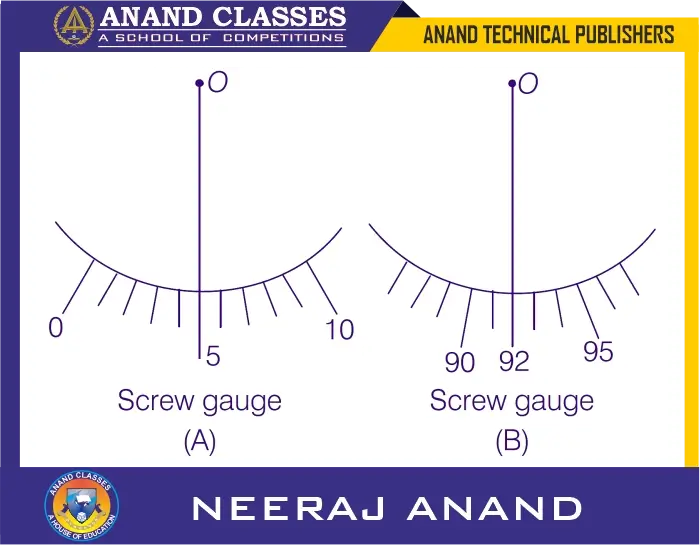
Problem : Student A and student B used two screw gauges of equal pitch and 100 equal circular divisions to measure the radius of a given wire. The actual value of the radius of the wire is 0.322 cm. The absolute value of the difference between the final circular scale readings observed by the students A and B is ……………….
[Figure shows position of reference O when jaws of screw gauge are closed] Given, $pitch=0.1~cm$.
[2021, 25 July Shift-1]
Solution: Ans. (13)
Given,
Number of circular scale division $=100$
True value of radius, $R = 0.322~cm$
Least count $(LC) = 0.1~cm/100 = 0.001~cm$
As we know that,
True value $(TV) = \text{Main scale reading (MSR)} + \text{Circular scale reading (CSR)} + \text{Error}$
where, $\text{Error} = n\text{th division} \times LC$
For student A:
$0.322 = 0.300 + CSR_{A} + 5 \times 0.001$
$CSR_{A} = 0.322 – 0.300 – 0.005 = 0.017$.
And for student B:
$0.322 = 0.2 + CSR_{B} + 92 \times 0.001$
$CSR_{B} = 0.322 – 0.2 – 0.092 = 0.030$
Difference $d = CSR_{B} – CSR_{A}$ $= 0.030 – 0.017 = 0.013~cm$
Now, division on circular scale $= \dfrac{0.013}{0.001} = 13$
Problem : Three students $S_{1}$, $S_{2}$ and $S_{3}$ perform an experiment for determining the acceleration due to gravity (g) using a simple pendulum. They use different lengths of pendulum and record time for different number of oscillations. The observations are as shown in the table.
| Student No. | Length of pendulum (cm) | No. of oscillations (n) | Total time for n oscillations (s) | Time period (s) |
| 1. | 64.0 | 8 | 128.0 | 16.0 |
| 2. | 64.0 | 4 | 64.0 | 16.0 |
| 3. | 20.0 | 4 | 36.0 | 9.0 |
(Least count of length = 0.1m, least count for $time=0.1s)$
If $E_{1}$, $E_{2}$ and $E_{3}$ are the percentage errors in g for students 1, 2 and 3 respectively, then the minimum percentage error is obtained by student number……………
[2021, 22 July Shift-II]
Solution: Ans. (1)
Given, observation of three students named $S_{1}$, $S_{2}$ and $S_{3}$.
Let $l_{1}, l_{2}, l_{3}$ and $T_{1}, T_{2}, T_{3}$ be the measured length and time period, and $E_{1}, E_{2}$ and $E_{3}$ be the errors in g.
$\Delta T=0.1~s, \Delta l=0.1~m$
As we know, $T=2\pi\sqrt{\dfrac{l}{g}} \Rightarrow T^{2}=4\pi^{2}\dfrac{l}{g}$
By using concept of relative error,
$\dfrac{\Delta g}{g} = \dfrac{\Delta l}{l} + \dfrac{2\Delta T}{T}$
$E_{1} = \dfrac{0.1}{64} + 2 \times \dfrac{0.1}{128} = 0.0141$
$E_{2} = \dfrac{0.1}{64} + 2 \times \dfrac{0.1}{64} = 0.0141$
$E_{3} = \dfrac{0.1}{20} + 2 \times \dfrac{0.1}{36} = 0.027$
From above calculations $E_{1} = E_{2}$, but since the number of oscillations in $S_{1}$ is more, it provides a more precise observation with less error. $\therefore$ Student number 1 will have the least error.
Problem : The vernier scale used for measurement has a positive zero error of 0.2 mm. If while taking a measurement, it was noted that ‘0’ on the vernier scale lies between 8.5 cm and 8.6 cm, vernier coincidence is 6, then the correct value of measurement is ……… cm.
[2021, 17 March Shift-1]
Solution: Ans. (b)
Given,
positive zero error $= 0.2~mm = 0.02~cm$
Least count $(LC) = 0.01~cm$
Main scale reading $(MSR) = 8.5~cm$
Vernier scale reading $(VSR) = \text{Vernier scale coincidence} \times \text{Least count} = 6 \times 0.01 = 0.06~cm$
Final reading $= MSR + VSR – \text{Zero error}$ $= 8.5 + 0.06 – 0.02 = 8.54~cm$
Problem : In order to determine the Young’s modulus of a wire of radius 0.2 cm (measured using a scale of least $count=0.001cm)$ and length 1m (measured using a scale of least $count=1~mm$, a weight of mass 1kg (measured using a scale of least $count=1g)$ was hanged to get the elongation of 0.5 cm (measured using a scale of least count 0.001 cm). What will be the fractional error in the value of Young’s modulus determined by this experiment?
(a) 0.14%
(b) 0.9%
(c) 9%
(d) 1.4%
[2021, 16 March Shift-II]
Solution: Ans. (d)
Young’s modulus, $Y = \dfrac{\text{Stress}}{\text{Strain}} = \dfrac{FL}{Al} \Rightarrow Y = \dfrac{mgL}{\pi R^{2}l}$
To determine fractional errors:
$\dfrac{\Delta Y}{Y} = \dfrac{\Delta m}{m} + \dfrac{\Delta L}{L} + 2\dfrac{\Delta R}{R} + \dfrac{\Delta l}{l}$
$\dfrac{\Delta Y}{Y} \times 100 = 100 \left[ \dfrac{1}{1000} + \dfrac{1}{1000} + 2(\dfrac{0.001}{0.2}) + \dfrac{0.001}{0.5} \right]$
$\dfrac{\Delta Y}{Y} \times 100 = \dfrac{1}{10} + \dfrac{1}{10} + 1 + \dfrac{1}{5} = \dfrac{14}{10} = 1.4\%$
Problem : One main scale division of a vernier callipers is $a \text{ cm}$ and $n^{th}$ division of the vernier scale coincide with $(n-1)^{th}$ division of the main scale. The least count of the callipers (in mm) is:
(a) $\dfrac{10na}{(n-1)}$
(b) $\dfrac{10a}{(n-1)}$
(c) $\left(\dfrac{n-1}{10n}\right)a$
(d) $\dfrac{10a}{n}$
[2021, 16 March Shift-I]
Solution: Ans. (d)
According to the question,
One division of main scale reading $(1 \text{ MSD}) = a \text{ cm}$
$n$ divisions of vernier scale ($n \text{ VSD}$) $= (n-1)$ divisions of main scale ($(n-1) \text{ MSD}$)
Therefore, $1 \text{ VSD} = \dfrac{(n-1)}{n} \text{ MSD} = \dfrac{(n-1)a}{n} \text{ cm}$
We know that Least Count ($LC$) is:
$LC = 1 \text{ MSD} – 1 \text{ VSD}$
$LC = a – \dfrac{(n-1)a}{n}$
$LC = \dfrac{an – (an – a)}{n} = \dfrac{a}{n} \text{ cm}$
To convert into mm:
$LC = \dfrac{a}{n} \times 10 \text{ mm} = \dfrac{10a}{n} \text{ mm}$
Problem : The resistance $R = \frac{V}{I}$, where $V = (50 \pm 2)V$ and $I = (20 \pm 0.2)A$. The percentage error in $R$ is $x\%$. The value of $x$ to the nearest integer is …………….
[2021, 16 March Shift-I]
Solution: Ans. (5)
Given, $V = (50 \pm 2)V$ and $I = (20 \pm 0.2)A$
where, $R = \dfrac{V}{I}$
$\dfrac{\Delta R}{R} \times 100 = \dfrac{\Delta V}{V} \times 100 + \dfrac{\Delta I}{I} \times 100$
$\% \text{ error in } R = \left[ \dfrac{2}{50} \times 100 + \dfrac{0.2}{20} \times 100 \right]\%$
$\% \text{ error in } R = [2 \times 2 + 0.2 \times 5]\% = 5\%$
Comparing with the given value in the question i.e., $x\%$, the value of $x = 5$.
Problem : A large number of water drops, each of radius $r$, combine to have a drop of radius $R$. If the surface tension is $T$ and mechanical equivalent of heat is $J$, the rise in heat energy per unit volume will be:
(a) $\dfrac{2T}{rJ}$
(b) $\dfrac{2T}{J}\left(\dfrac{1}{r} – \dfrac{1}{R}\right)$
(c) $\dfrac{3T}{rJ}$
(d) $\dfrac{3T}{J}\left(\dfrac{1}{r} – \dfrac{1}{R}\right)$
[2021, 26 Feb Shift-I]
Solution: Ans. (d)
Given, radius of small drop $= r$
Radius of big drop $= R$
Surface tension $= T$ and mechanical equivalent of heat $= J$
As small drops combine to form a big drop:
Volume of big drop $(V_B) = n \times \text{Volume of small drop } (V_S)$
$\frac{4}{3}\pi R^3 = n \times \frac{4}{3}\pi r^3 \Rightarrow nr^3 = R^3 \Rightarrow r = \dfrac{R}{n^{1/3}}$
Surface energy of small drops $(E_S) = n \times 4\pi r^2 T$
Surface energy of big drop $(E_B) = 4\pi R^2 T$
Change in energy, $\Delta E = E_S – E_B = 4\pi T(nr^2 – R^2)$
Heat energy per unit volume $= \dfrac{\Delta E}{V \cdot J} = \dfrac{4\pi T(nr^2 – R^2)}{J \times \dfrac{4}{3}\pi R^3}$
Heat energy per unit volume $ = \dfrac{3T}{J} \left( \dfrac{nr^2}{R^3} – \dfrac{1}{R} \right)$
Substituting $n = \dfrac{R^3}{r^3}$, we get:
Heat energy per unit volume $ = \dfrac{3T}{J} \left( \dfrac{R^3/r^3 \cdot r^2}{R^3} – \dfrac{1}{R} \right) = \dfrac{3T}{J} \left( \dfrac{1}{r} – \dfrac{1}{R} \right)$
Buy Complete Study Material
Get comprehensive study material for JEE, NEET, and CBSE Board Class 11 Exams, including detailed notes, MCQs, worksheets, and explanations at Anand Technical Publishers.
Published by: Anand Technical Publishers
Written by: Neeraj Anand
Proprietor: NIRMAL ANAND Educations
Contact: +91-9463138669, Physics Anand Classes