Systems of Units provide a standardized way to measure physical quantities in Physics. The SI system is the most widely used system, based on seven fundamental units such as metre, kilogram, and second, along with two supplementary units. Other systems like MKS, CGS, and FPS are also important for understanding unit conversions and historical developments. This topic explains different systems of units and the role of fundamental and supplementary units in scientific measurements.
- What Are Systems of Units ?
- What Are the Types of Systems of Units ?
- cgs System (Gaussian System)
- fps System
- mks System (Giorgi System)
- SI System (International System of Units)
- Define Seven Basic or Fundamental Units of SI (International System of Units)
- 1. metre (m)
- 2. kilogram (kg)
- 3. second (s)
- 4. ampere (A)
- 5. kelvin (K)
- 6. mole (mol)
- 7. candela (cd)
- Define Plane Angle and Solid Angle
- Plane Angle (dθ)
- Solid Angle (dΩ)
- Define Two Supplementary units of SI (International System of Units)
- 1. radian (rad)
- 2. steradian (sr)
- What are the advantages of SI (International System of Units) ?
- SI Units and Their Conventions
- What are S.I. Prefixes?
- List of S.I. Prefixes
- Very Short Frequently Asked Questions (FAQs) and Answers
- Multiple Choice Questions (MCQs) with Answers & Explanations
- Buy Complete Study Material
What Are Systems of Units ?
A system of units is a complete set of fundamental and derived units used to measure all physical quantities. Different systems have been developed based on fundamental quantities which are explained below.
What Are the Types of Systems of Units ?
Following are the common systems of units :
cgs System (Gaussian System)
This system of units was set up in France and it is based on centimetre, gram and second as the fundamental units of length, mass and time respectively. It is a metric system of units.
fps System
This system of units, also known as British system of units, is based on foot, pound and second as the fundamental units of length, mass and time. It is not a metric system. Its use in scientific work is declining more and more.
mks System (Giorgi System)
This system was also set up in France. It makes use of metre, kilogram and second as the fundamental units of mass, length and time. It is also a metric system of units and closely related to the cgs system of units. In contrast to the cgs and the fps systems of units, the mks system is a coherent system of units in
mechanics.
A system of units is said to be coherent, if all the derived units can be obtained by multiplying or dividing its fundamental units, such that no numerical factors are introduced.
SI System (International System of Units)
The units of mass, length and time can be used to obtain the units of physical quantities in mechanics only. These three fundamental units are not sufficient to obtain the units of the physical quantities which figure up in different branches of physics.
The General Conference of Weights and Measures held in 1960 introduced a new
and logical system of units known as Systeme Internationale d’ Unites. It is abbreviated as SI. It is based on the following seven basic or fundamental and two supplementary units:
| Fundamental Quantity | Name of Unit | Symbol |
|---|---|---|
| Length | Metre | m |
| Mass | Kilogram | kg |
| Time | Second | s |
| Electric Current | Ampere | A |
| Temperature | Kelvin | K |
| Amount of Substance | Mole | mol |
| Luminous Intensity | Candela | cd |
In addition to the seven fundamental units in physics, two more units are considered supplementary fundamental units. These are Radian (rad) and Steradian (sr), which measures plane angle and solid angle respectively and are defined as follows :
| Supplementary physical quantity | Name of Unit | Symbol |
|---|---|---|
| Plane angle | radian | rad |
| Solid angle | steradian | sr |
The above seven basic and two supplementary units are found to be sufficient to obtain the units of physical quantities from all branches of physics.
Define Seven Basic or Fundamental Units of SI (International System of Units)
The seven basic or Fundamental units of SI are defined as follows :
1. metre (m)
In 1960, the Eleventh General Conference of Weights and Measures decided to define metre by adopting atomic standards.
On atomic standards, one metre is defined as to be equal to 1,650,763·3 wavelengths in vacuum of the orange-red coloured radiation emitted by krypton having mass number 86.
Krypton-86 emits light of several different wavelengths. The orange-red coloured light emitted by krypton-86 has wavelength $6057.8021\ \text{\AA}$ or $6.0578021 \times 10^{-7}\ \text{m}$. The number of these wavelengths in $1\ \text{m}$ can be counted by using an optical interferometer, which comes out to be $16,50,763.3$.
In 1983, one metre was defined as the length of the path travelled by light in vacuum during a time interval of $\frac{1}{299,792,458}$ of a second.
2. kilogram (kg)
Originally, kilogram was defined as the mass of one cubic decimetre of water at 4°C (the temperature at which density of water is maximum).
The unit kilogram has not been defined on atomic standards.
Therefore, in SI, kilogram is the mass of a platinum-iridium cylinder kept in the International Bureau of Weights and Measures at Sevres, near Paris, France.
However, it is hoped that in the near future, kilogram may be defined in terms of the mass of some fundamental particle, like proton.
In atomic and nuclear physics, mass is measured in terms of atomic mass unit (a.m.u.)
One a.m.u. (atomic mass unit) is defined as $\dfrac{1}{12}$th of the mass of one $^{12}\text{C}$ atom.
It can be calculated that:
$$1\ \text{a.m.u.} = 1.66 \times 10^{-27}\ \text{kg}$$
3. second (s)
In 1964, the Twelfth General Conference of Weights and Measures held in Paris adopted atomic standard for measurement of time.
One second was defined as to be equal to the duration of 9, 192, 631, 770 vibrations corresponding to the transition between two hyperfine levels of cesium-133 atom in the ground state.
4. ampere (A)
It was adopted as the unit of current. One ampere is defined as the current generating a force of $2 \times 10^{-7}$ newton per metre between two straight parallel conductors of infinite length and negligible circular cross-section, when placed one metre apart in vacuum.
5. kelvin (K)
It was adopted as the unit of temperature. It is defined as the $\frac{1}{273.16}$th fraction of the thermodynamic temperature at the triple point of water.
6. mole (mol)
It was adopted as the unit of quantity of matter. It is the amount of substance containing same number of elementary units as there are atoms in $0.012$ kilogram of carbon-12.
7. candela (cd)
It was adopted as the unit of luminous intensity. One candela is the luminous intensity in perpendicular direction of a surface of $\frac{1}{6,00,000}$ square metre of a black body at a temperature of freezing platinum ($2046.65$ kelvin) and under a pressure of $1,01,325$ newton per square metre.
In 1979, candela was redefined as below:
It is the luminous intensity in a given direction due to a source, which emits monochromatic radiation of frequency $540 \times 10^{12}\ \text{Hz}$ and of which the radiant intensity in that direction is $1/683$ watt per steradian.
| 📍 Note : |
| SI system covers the units of physical quantities from all the branches of physics, whereas mks system is confined to mechanics only. |
Define Plane Angle and Solid Angle
Plane Angle (dθ)
It is defined as the ratio of the length of an arc of a circle to the radius of the circle.
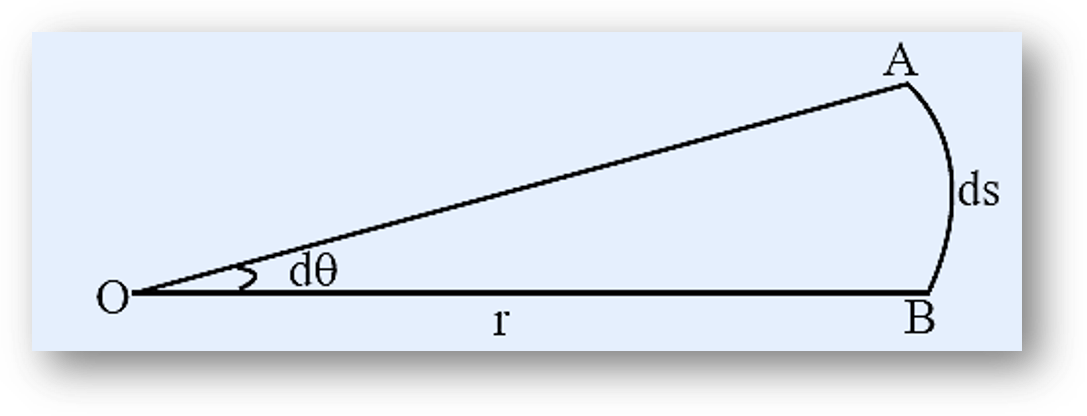
Mathematically, dθ = ds/r, where:
ds is the length of the arc
r is the radius of the circle
The SI unit of plane angle is the radian (rad).
Relation between radian and degree : π radians=180o
Solid Angle (dΩ)
It is the three-dimensional analogue of plane angle and is defined as the area of a portion of the surface of a sphere divided by the square of the radius of the sphere.
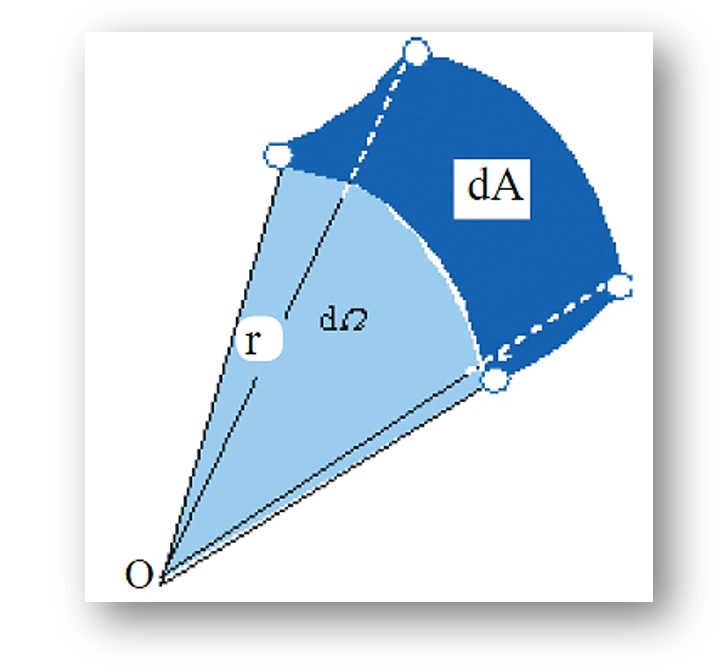
Mathematically, dΩ = dA/r2, where:
dA is the area of the portion of the sphere
r is the radius of the sphere
The SI unit of solid angle is the steradian (sr).
Define Two Supplementary units of SI (International System of Units)
The two supplementary units, radian (for plane angle) and steradian (for solid angle), are defined as below:
1. radian (rad)
It was adopted as the unit of plane angle. It is the plane angle between the two radii of a circle, which cut off from the circumference an arc equal to the length of the radius. In other words 1 radian is the angle subtended at the center of a circle by an arc whose length is equal to the radius of the circle.
$$\text{Plane angle (in radian)} = \frac{\text{length of arc}}{\text{radius}}$$
2. steradian (sr)
It was adopted as the unit of solid angle. It is the solid angle with its apex at the centre of a sphere that cuts out an area on the surface of the sphere equal to the area of the square, whose sides are equal to the radius of the sphere.
A sphere of radius r has a total surface area of 4πr2, so the solid angle subtended by the entire sphere at its center is: Ω=4πr2/r2 =4π sr
$$\text{Solid angle (in steradian)} = \frac{\text{area cut out from the surface of sphere}}{\text{radius}^2}$$
What are the advantages of SI (International System of Units) ?
The SI (International System of Units) has the following key advantages over other systems of units:
1. It is a rational system of units.
SI makes use of only one unit for one physical quantity. For example, for all types of energies (mechanical, heat, electrical, etc.), the joule is used as the universal unit.
- In CGS and MKS systems, different units are used for different types of energies. In the MKS system, mechanical energy is measured in joules, heat energy in calories, and electrical energy in watt-hours.
- Furthermore, in CGS and MKS, both absolute and gravitational units are often used (e.g., in MKS, force is measured in both newtons and kilogram-force). In SI, no such distinction is made; only the newton is used as the unit of force.
2. SI is a coherent system of units.
In SI, all derived units can be obtained simply by dividing or multiplying the basic and supplementary units without involving any numerical factors. In CGS and MKS systems, obtaining derived units sometimes requires the introduction of numerical constants.
3. SI is closely related to the CGS system.
It is very easy to convert from the SI system to the CGS system and vice-versa, as they are based on similar decimal logic.
4. SI is a metric system.
Like the CGS and MKS systems, SI is a metric system, meaning it uses powers of 10 for multiples and sub-multiples, making calculations much simpler.
SI Units and Their Conventions
SI (Système International d’Unités) is the internationally accepted system of measurement. Proper use of SI units ensures clarity, accuracy, and consistency in scientific and technical communication. Below are the fundamental conventions for using SI units:
- Representation of Units: The unit of every physical quantity should be represented by its symbol. Example : Length is measured in meters (m), time in seconds (s).
- Capitalization Rules:
- The full name of a unit always starts with a lowercase letter, even if named after a scientist. Example: newton, joule.
- However, the symbol for such units is capitalized. Example: Newton (N), Joule (J).
- Plural Form: Symbols for units do not take a plural form. Example: Force is 20 N, not 20 newtons or 20 Ns.
- Punctuation: Symbols for units should not contain any full stops. Example: 25 kg, not 25 kg..
- Writing Units in Numerator and Denominator:
- The SI unit of acceleration is written as m/s² or m s⁻², but not m/s/s.
- Combination of Units:
- Avoid mixing full unit names with symbols. Example: The correct notation for specific heat capacity is J/kg K, not joule/kg K.
- Prefix Symbols:
- Prefixes are used before unit symbols to denote powers of 10. Example:
- 1 ms = 1 millisecond = 10⁻³ s
- 1 μs = 1 microsecond = 10⁻⁶ s
- 1 ns = 1 nanosecond = 10⁻⁹ s
- Double prefixes should be avoided when a single one is available. Example:
- 10⁻⁶ s = 1 μs (not 1mms).
- 10⁻⁹ s = 1 ns (not 1 mμs).
- Prefixes are used before unit symbols to denote powers of 10. Example:
- Spacing Rules:
- A space or hyphen should be used when indicating multiplication of two units. Example:
- Correct: m s⁻¹ or m-s⁻¹.
- Incorrect: ms⁻¹ (ms can be misinterpreted as milliseconds).
- A space or hyphen should be used when indicating multiplication of two units. Example:
What are S.I. Prefixes?
In physics, we deal with extremely small (micro) and extremely large (macro) magnitudes, such as the mass of an electron (9.1 × 10⁻³¹ kg) and the mass of the Sun (2 × 10³⁰ kg). To conveniently express such values, S.I. prefixes are used.
List of S.I. Prefixes
| Power of 10 | Prefix | Symbol |
|---|---|---|
| 10ⁱ⁸ | exa | E |
| 10ⁱ⁵ | peta | P |
| 10ⁱ² | tera | T |
| 10⁹ | giga | G |
| 10⁶ | mega | M |
| 10³ | kilo | k |
| 10² | hecto | h |
| 10¹ | deca | da |
| 10⁻¹ | deci | d |
| 10⁻² | centi | c |
| 10⁻³ | milli | m |
| 10⁻⁶ | micro | μ |
| 10⁻⁹ | nano | n |
| 10⁻¹² | pico | p |
| 10⁻¹⁵ | femto | f |
| 10⁻¹⁸ | atto | a |
Very Short Frequently Asked Questions (FAQs) and Answers
What is a System of Units?
A system of units is a complete set of fundamental and derived units used to measure all physical quantities. Different systems have been developed based on fundamental quantities.
What are Types of Systems of Units ?
1. CGS System (Gaussian System)
- Fundamental Quantities: Length, Mass, Time
- Fundamental Units: Centimetre (cm), Gram (g), Second (s)
2. MKS System (Giorgi System)
- Fundamental Quantities: Length, Mass, Time
- Fundamental Units: Metre (m), Kilogram (kg), Second (s)
3. FPS System
- Fundamental Quantities: Length, Mass, Time
- Fundamental Units: Foot (ft), Pound (lb), Second (s)
- In this system, force is a derived quantity with the unit poundal.
What are Practical Units in Measurement ? Give Examples
Practical units are frequently used fundamental or derived units that may not always belong to a standard system but can be converted into standard units.
Examples:
Light year (practical fundamental unit) → Distance measurement
Horsepower (practical derived unit) → Power measurement
1 mile = 1.6 km = 1.6 × 10³ m
Why is the SI system preferred over other systems?
The SI system is internationally recognized, standardized, and universally accepted across all scientific disciplines.
What is the unit of solid angle in the SI system?
The unit of solid angle is Steradian (sr).
Can practical units be converted into SI units?
Yes, practical units can be expressed in terms of SI units. Example: 1 horsepower = 746 watts.
Why are supplementary units like Radian and Steradian used?
They are necessary for measuring angles in physics, which cannot be directly defined using fundamental quantities.
What is a plane angle?
A plane angle is the angle subtended at the center of a circle by an arc of the circle. It is measured in radians.
What is a solid angle?
A solid angle is the three-dimensional analogue of a plane angle and is subtended by a surface at the center of a sphere. It is measured in steradians.
How many steradians are there in a complete sphere?
A complete sphere subtends a solid angle of 4π steradians at its center.
What is the solid angle subtended by the moon at any point on Earth, given that the diameter of the moon is 3474 km and its distance from Earth is 3.84 × 10⁸ m?
Solid angle (Ω) = Area of the disc of the moon/(moon – earth distance)2
Ω = π(1 .737×103)2/(3.84×105)2 = 2.045 x10⁻⁵ sr
Why should unit symbols not have a full stop at the end?
A full stop might be misinterpreted as a decimal point, leading to confusion in scientific calculations.
Why is “ms⁻¹” incorrect notation for meters per second?
“ms” is already the symbol for milliseconds, so “ms⁻¹” could be misinterpreted as milliseconds inverse. The correct notation is “m s⁻¹”.
Multiple Choice Questions (MCQs) with Answers & Explanations
Q1: Which system of units uses centimetre, gram, and second as fundamental units?
A) MKS
B) SI
C) CGS
D) FPS
Answer: C) CGS
Explanation: The CGS system is also called the Gaussian system and uses cm, g, and s as fundamental units.
Q2: The SI unit of luminous intensity is:
A) Radian
B) Steradian
C) Candela
D) Mole
Answer: C) Candela
Explanation: Candela (cd) is the SI unit of luminous intensity.
Q3: Which system of units is also called the Giorgi system?
A) SI
B) CGS
C) FPS
D) MKS
Answer: D) MKS
Explanation: The MKS system, also known as the Giorgi system, uses metre, kilogram, and second as fundamental units.
Q4: How many fundamental quantities are there in the SI system?
A) 5
B) 6
C) 7
D) 8
Answer: C) 7
Explanation: The SI system defines seven fundamental quantities.
Q5: The practical unit of power is:
A) Newton
B) Joule
C) Horsepower
D) Watt
Answer: C) Horsepower
Explanation: Horsepower is a practical derived unit of power, commonly used for engine performance.
Strengthen your understanding with Class 11 Physics Notes for complete theory and concepts.
Revise the Units and Measurements chapter to build a clear foundation in systems of units.
Practice JEE Units and Measurements PYQs to improve accuracy and understand exam-level questions.
Buy Complete Study Material
Get comprehensive study material for JEE, NEET, and CBSE Board Class 11 Exams, including detailed notes, MCQs, worksheets, and explanations at Anand Technical Publishers.
Published by: Anand Technical Publishers
Anand Classes Jalandhar
Author: Neeraj Anand
Proprietor: NIRMAL ANAND Educations
Contact: +91-9463138669, Physics Anand Classes
Academic Building : Physics Anand Classes